
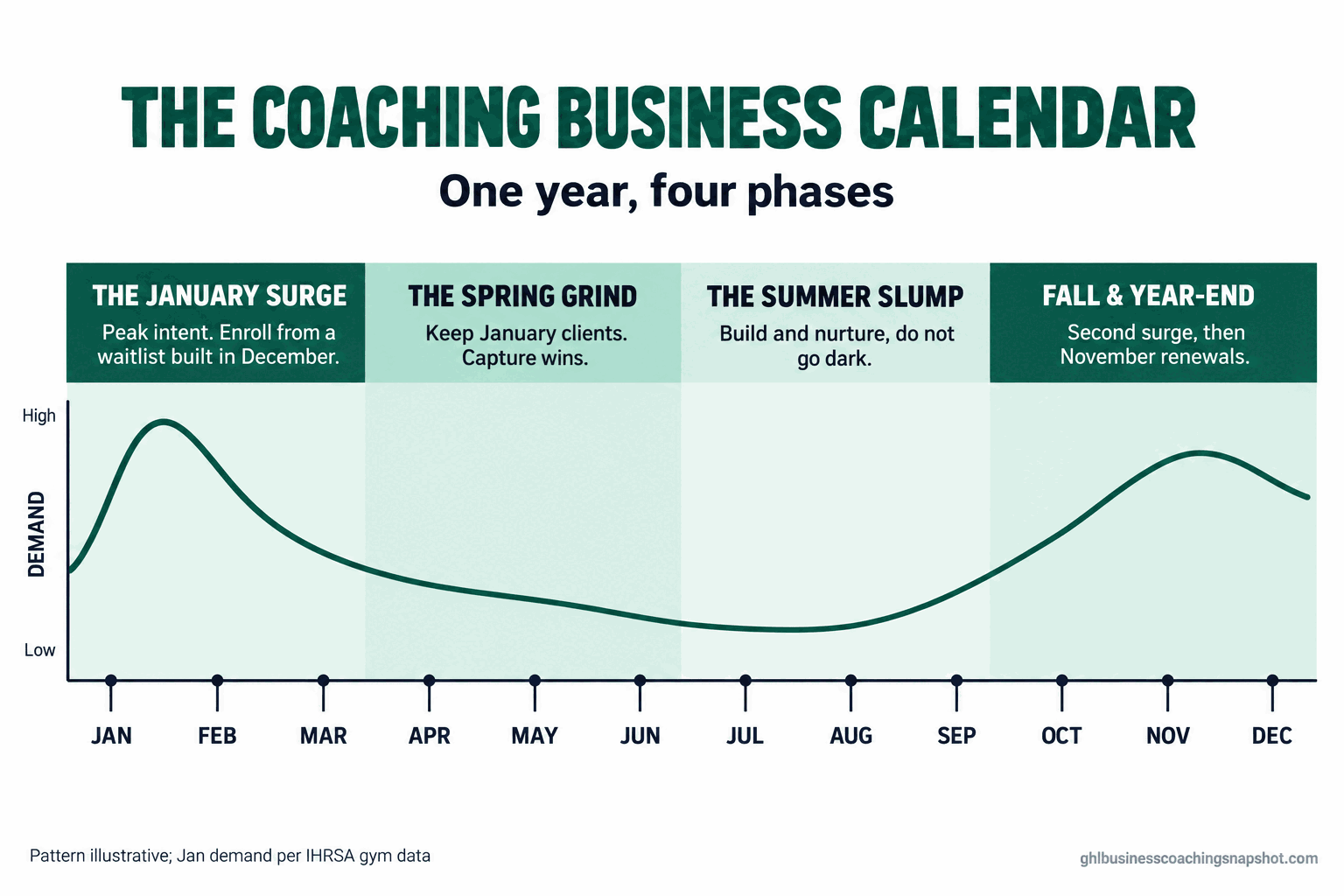
Short answer: coaching is a seasonal business whether you plan for it or not. Demand climbs with New Year resolutions in January, settles through spring, drops through summer when your buyers are on vacation, and comes back in September before a year-end window where renewals and tax planning collide. The coaches who feel feast-or-famine are usually just living inside this cycle with no plan for it. The fix is not to fight the seasons. It is to run a different play in each one: build pipeline before the surge, enroll hard when demand peaks, keep selling through the slow months instead of going dark, and start the renewal conversation in November, not December. Below is the month-by-month version, with the exact messages to send and the mistakes that quietly cost a quarter.
Does a coaching business really have seasons?
It is the third week of January and your calendar is finally full. Discovery calls back to back, two cohort spots left, a waitlist you did not expect. You think, this is it, I have cracked it. Then March comes, the calls thin out, and by late June you are refreshing your inbox at 9pm wondering where everyone went. You did not do anything wrong. You ran into the shape of the year.
Coaching demand tracks the same rhythms as the rest of the self-improvement economy, and that rhythm is loud in January. The fitness industry, the closest public proxy for New Year behavior, sells about 12% of its entire year of memberships in that one month, against a monthly average closer to 8% for the rest of the year (Newsweek, citing IHRSA). People decide in January that this is the year they fix the thing. Some of them are your clients.
But the same research documents the collapse. Forbes Health found the average New Year resolution lasts just 3.74 months before it is abandoned (Forbes Health), and Strava’s activity data gave us “Quitter’s Day,” the mid-January point when fitness activity falls back below baseline (Strava, via Triathlete). The motivation that fills your pipeline in January is the same motivation that empties it by spring. Your job is to turn a January impulse into a signed agreement before it fades, and to have something to sell when nobody is feeling impulsive.
This matters more every year, because the market is crowded. The 2025 ICF Global Coaching Study counted a record 122,974 coach practitioners worldwide, up 15% since 2023, pulling an estimated $5.34 billion in annual revenue (International Coaching Federation). More coaches chasing the same January window means the planning gap is where you win or lose.
Sources: ICF 2025 Global Coaching Study; Newsweek, citing IHRSA; Forbes Health. Gym data is a proxy for New-Year demand, not coaching-specific.
The coaching year at a glance
The year has one loud spike and one quiet trough, with two transition stretches between. Everything in this playbook hangs off those four phases.
Share of annual gym memberships sold, January versus a typical month, used here as a public proxy for New-Year self-improvement demand. Coaching has no equivalent open dataset, but the pattern rhymes. Source: Newsweek, citing IHRSA, 2016.
- The January surge (December into February). Peak intent. You enroll, but only if the offer and the waitlist were ready before the ball dropped.
- The spring grind (March to May). Pipeline normalizes. The real work is keeping the January signups from churning at month two or three, and turning wins into referrals.
- The summer slump (June to August). Buyers are on vacation. This is build-and-nurture season, not go-dark season.
- Fall re-engagement and year-end (September to December). A second, calmer surge, then a renewal-and-planning window where tax timing works in your favor.
Phase 1: The January surge
The biggest mistake coaches make with January is treating it as a January job. By the time the new year arrives, the coaches who win it have already built the thing you are about to start thinking about. The surge is captured in December.
What to set up, in order:
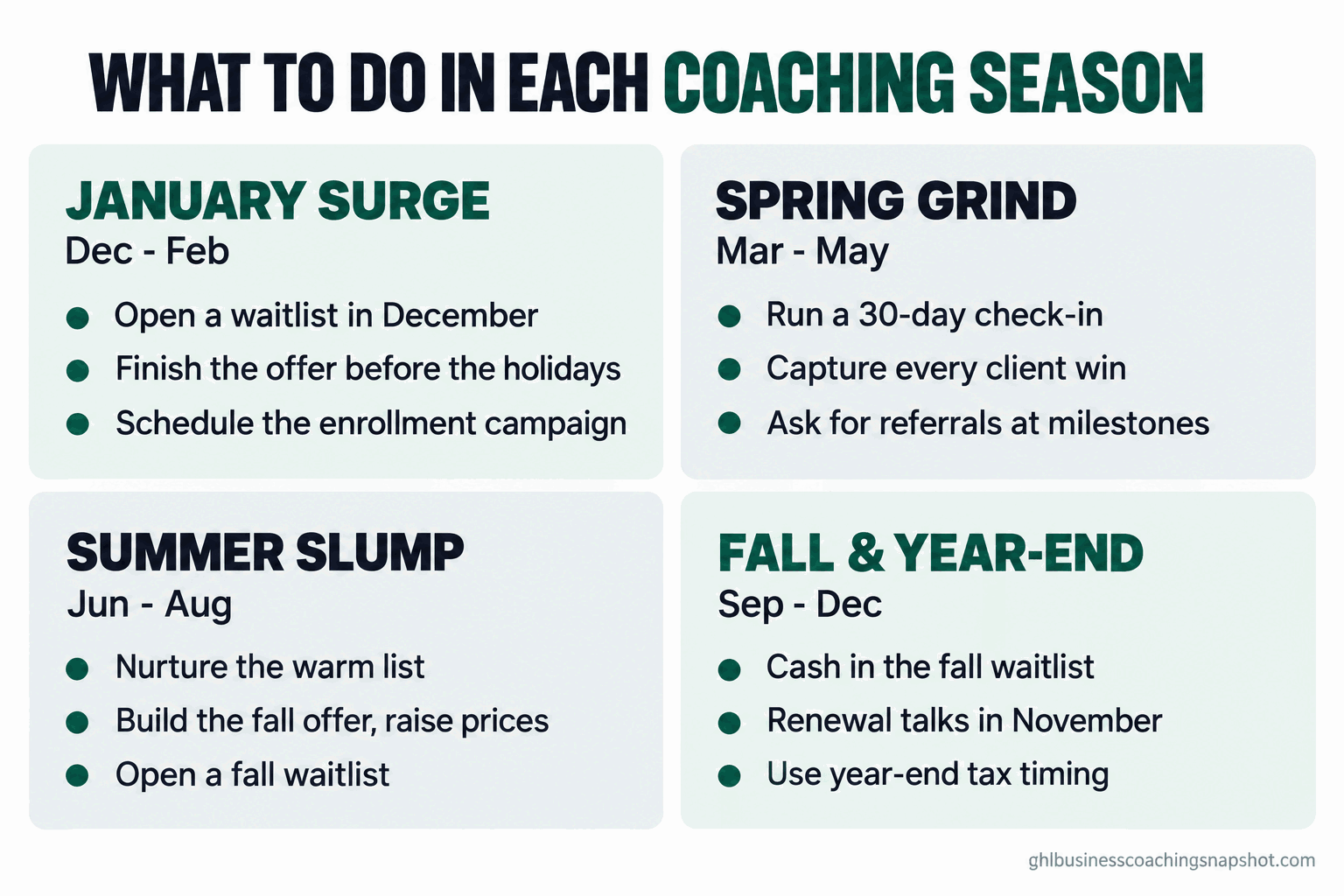
- Open a waitlist in early December. A simple form, a clear promise (“doors open January 6, waitlist gets first access and a founding price”), and an automation that tags every signup. You move the decision earlier so you are not starting from zero on January 2.
- Finalize the offer before the holidays. Price, inclusions, start date, number of spots. If packaging is where you stall, settle how to price and package a coaching offer now, not on January 3.
- Write the January campaign in December. Three to five messages, scheduled, not improvised. Nobody writes their best enrollment email on four hours of post-holiday sleep.
- Point your booking flow at a real calendar with reminders. January no-shows are brutal because people book on impulse and cool off by the appointment. Confirmations, reminders, and a one-tap reschedule are the difference between a full calendar and a calendar full of ghosts.
Here is the kind of copy to have loaded and ready.
How this breaks, and what to do:
- You launch cold. No waitlist, just a January 2 post into the void. The surge rewards the person with an audience already leaning in. If you have no list, December is for borrowing one: a partner’s audience, a webinar, a free workshop.
- You overbuild for the spike. The surge feels like the new normal, so you raise delivery commitments, then March arrives and the math breaks. Enroll into a capped cohort, not an open-ended promise you cannot afford in June.
- Impulse buyers ghost the call. Reminders are not optional in January. Our reduce discovery-call no-shows breakdown has the full cadence.
Phase 2: The spring grind
Spring is where the January money either compounds or leaks away. Lead flow is still decent but no longer frantic, and the center of gravity shifts from selling to keeping. Your January signups are now at the exact point where coaching relationships quietly die: month two and month three, when the honeymoon fades and the client has not yet seen enough results to feel the value.
What to run in spring:
- A structured check-in cadence. Not “how’s it going,” which gets a “good, thanks” and tells you nothing. A real rhythm: a scheduled progress review, a between-session nudge, a flag when someone goes quiet. Silence is the first symptom of a cancellation. Our reduce client churn playbook has the cadence that catches month-two risk.
- A results-capture habit. Every spring win is a testimonial, a case study, and a referral ask waiting to happen, but only if you log it in the moment. It feeds everything you sell in fall. See tracking client progress.
- A referral ask with a trigger. Ask right after a client hits a milestone, not in a quarterly blast. Tie the ask to the win.
The month-two check-in, two ways
A monthly 'how are you doing?' text. The client says 'good!' You both move on. Three weeks later they cancel and you never saw it coming, because 'good' was the sound of someone who had already checked out.
A scheduled 30-day review: what we set out to change, what has actually moved, what is stuck, one commitment for the next 30 days. A struggling client says so here, while you can still fix it, instead of in a cancellation email.
How this breaks, and what to do:
- You coast on the January glow. Revenue looks fine, so you stop selling and pour everything into delivery. Then the January cohort finishes and you have nothing behind it. Keep a small, steady amount of pipeline work going even when the calendar feels full.
- You treat all clients the same. The quiet client and the engaged client need different touches. Segment by engagement, not just by start date.
- You wait until renewal time to prove value. The spring check-in cadence is what makes the fall renewal conversation easy. Skip it and renewal becomes a cold pitch.
Phase 3: The summer slump
Summer is the phase coaches handle worst, because the instinct is exactly wrong. Demand softens, so coaches go quiet, which turns a normal seasonal dip into a self-inflicted drought. A Sagefrog survey found that about two-thirds of business-to-business companies see a summer sales slowdown, with July and August the hardest-hit months (Sagefrog). Your buyers are on vacation, their decision-makers are unreachable, and sales cycles stretch out. Disappearing is not the answer.
Summer is build season. The work you cannot do in January, because January is for selling, gets done now.
What to actually do in summer:
- Nurture the warm list instead of chasing cold leads. The person who did not buy in January is still on your list. Stay useful to them so you are the obvious choice in September. Summer is also when you finally have time to reactivate a dormant database properly.
- Build the fall offer and raise your prices. Rebuild the program, record evergreen content, set fall pricing. A price rise is far easier to decide in August calm than September rush.
- Open a fall waitlist now. Same move as December. Capture the “ask me in September” intent while it exists so your fall surge does not start cold.
- Fix the systems you resent all year. The clunky onboarding, the manual invoicing, the follow-up you keep forgetting. Summer is the only season with slack to fix them.
How this breaks, and what to do:
- You go fully dark from June to September, then reappear to a list that forgot you exist. Even one useful touch a month keeps you warm.
- You panic-discount. A fire sale in your slowest season trains your best leads to wait for a deal and devalues the fall launch. Hold price. Build value instead.
- You waste the slack on rest alone, then enter fall with the same broken systems. Rest, and also fix one thing that saves you hours every month for the rest of the year.
If running a January campaign, a spring cadence, a summer nurture, and a fall waitlist sounds like four jobs you do not have time for, that is the honest problem. It is also exactly what a done-for-you system is for.
Phase 4: Fall re-engagement and year-end renewals
Fall gives you two distinct jobs, and coaches usually do the first and forget the second.
The first is the back-to-business surge. After Labor Day, people stop coasting and get serious again. It is a quieter, more deliberate version of January: fewer impulse buyers, more qualified ones who have been thinking since summer. If you opened a fall waitlist in August, this is when you cash it in. September to October is your second-best enrollment season of the year, and it rewards the same preparation January does.
The second job is the one that quietly makes or breaks next year: renewals. And renewals are a November job, not a December one.
Why November: December disappears. Between the holidays, travel, and year-end chaos, the renewal conversation you keep meaning to have gets pushed into January, which means a revenue gap and a client who has mentally moved on. Have it in November, while everyone is still at their desk.
Why year-end timing helps you: many of your clients run their own businesses, and the end of the calendar year is a real financial moment for them. Expenses booked before December 31 land in this tax year. Quarterly estimated taxes are due January 15 for the fourth quarter, with later payments on April 15, June 15, and September 15 (IRS). A client deciding whether to commit to next year’s coaching has a genuine reason to do it before the year closes, and it is fair to name that. You are not inventing urgency. You are pointing at a real calendar.
How this breaks, and what to do:
- You let December eat the renewal. The number-one fall mistake. Move the conversation to November on purpose, by calendar, not by vibes.
- You lead with the ask, not the proof. A renewal is a results conversation. If you captured wins since spring, it is easy. If not, it is a cold pitch to someone unsure what they got.
- You skip the year-end logic because it feels pushy. Naming a real tax-timing reason is useful information for a business owner, as long as you are honest and send them to their accountant for specifics.
Run the calendar for your stage
The four phases are the same for everyone. How hard you lean into each depends on where your business is.
The solo coach in the first stretch. Your constraint is time, and the calendar is brutal by hand. Do not try to run four polished campaigns. Pick the two highest-value moves: the December-into-January enrollment push and the November renewal conversation. Automate those two completely and keep spring and summer to a light, consistent touch. Borrow an audience for your first January surge if you have no list yet. One well-run surge beats four half-run ones.
The two-to-eight-person boutique with retainers. Your constraint is coordination, not time. The risk is that each associate runs their own ad-hoc version and nothing is consistent. Standardize the four phases across the team: one enrollment campaign, one check-in cadence, one renewal sequence, so a client gets the same experience whoever they work with. Fractional-retainer clients especially expect the November renewal to feel proactive, because they are managing their own year-end budgets.
The coach scaling past solo into cohorts and a course. Your constraint is that the calendar now runs several products at once: a January cohort, an evergreen course, ongoing one-to-one. The seasons stack and sometimes conflict. Here the calendar has to live in one system that can run multiple enrollment windows, segment by product, and keep the renewal logic straight across all of them. This is the point where a stitched-together stack of separate tools stops being annoying and starts costing real revenue, which we break down in the true cost of running a coaching business.
The compliance line on seasonal promos
Seasonal selling bumps into two rules worth knowing, because the January “founding price, last chance” energy is exactly where coaches get sloppy.
First, urgency has to be true. If you say “price goes up tonight,” the price has to actually go up tonight. Fake countdown timers that reset and “only 2 spots left” that is never true are the kind of deceptive urgency the FTC polices, and they burn trust with the sophisticated buyer this market is full of.
Second, testimonials and results claims. Fall renewal season runs on client wins, so you will be publishing results, and the FTC’s 2023 Endorsement Guides require that a testimonial showing an atypical result carry a clear disclosure of what a normal client should expect, or be backed by substantiation. If you run recurring or auto-renewing billing, there are also state auto-renewal laws to get right, even though the federal click-to-cancel rule was struck down in 2025. We cover all of it, with paste-ready disclosure copy, in the FTC rules for coaches. None of this is legal advice, and a quick review with a lawyer who knows your state is cheap insurance.
Common objections
“My coaching isn’t seasonal. My clients come in all year.” They do, and the average still has a shape. You are not claiming nobody buys in July. You are noticing that more buy in January and fewer in July, and running a plan for both instead of being surprised by both.
“I can barely keep up with clients. I don’t have time for four campaigns.” That is the real objection, and it is the whole argument for automating the calendar instead of performing it live. A solo coach cannot hand-write a January sequence, a spring cadence, a summer nurture, and a November renewal push on top of delivering the coaching. A system can.
“Won’t the automated January campaign feel impersonal when everyone knows it’s a launch?” Only if it reads like a template. The copy above is specific, gives people an easy out, and is honest about the deadline. Automation sets the timing. The voice stays yours.
“I already do a January push. Isn’t that enough?” A January push with nothing behind it is why spring feels like a cliff. The point of the calendar is that each phase sets up the next: spring check-ins make the fall renewal easy, the summer nurture makes the fall surge warm. One push is a spike. The calendar is a flywheel.
FAQ
When is the best time to launch a coaching program?
The two strongest windows are early January, when New Year motivation peaks, and September, when people return from summer and get serious again. January is loudest but most crowded, so open a waitlist in December and enroll in the first two weeks. September is quieter but the buyers are more qualified. Both reward preparation in the month before, not a cold start.
Why does my coaching business slow down in summer?
Your buyers are on vacation, decision-makers are harder to reach, and sales cycles stretch out. A Sagefrog survey found about two-thirds of business-to-business firms see a summer sales dip, with July and August worst. It is a normal pattern, not a sign something is broken. The mistake is going dark in response, which turns a normal dip into a drought.
How do I keep coaching revenue steady through the slow months?
Run a phase plan instead of treating each month as independent. Build pipeline before the January and September surges with waitlists, keep a light, consistent nurture going through spring and summer, and move renewal conversations to November. Steady revenue comes from each phase setting up the next, not from any single campaign.
When should I ask coaching clients to renew?
In November, not December. Holidays and year-end chaos push December conversations into January, creating a revenue gap and giving clients time to drift. A mid-November conversation led by their results, and tied to a genuine year-end tax-timing reason for business-owner clients, closes renewals before the calendar works against you.
Is January really the best month for coaching sales?
It has the highest intent, but highest intent is not the same as easiest sales, because every coach competes for the same attention. January rewards the coach who prepared in December with a waitlist, a finished offer, and a booking flow that survives impulse no-shows. A coach starting cold on January 2 often does worse than a prepared coach does in September.
How do I avoid the feast-or-famine coaching cycle?
Feast or famine is usually the seasonal cycle experienced without a plan. Always build pipeline at a low level even when you are full, so the end of a cohort does not leave you at zero, and use slow seasons to build rather than panic. Automating the four-phase calendar is what lets a solo coach keep that steady pipeline work going without stealing time from delivery.
Related reading
- How to escape the feast-or-famine coaching pipeline
- Fill a group coaching cohort: the enrollment playbook
- Reduce coaching client churn at month two and three
- Database reactivation: win back dormant leads and past clients
- The true monthly cost of running a coaching business
The calendar is not something you beat. It is something you ride. Go back to that coach in late January with the full calendar and the sinking feeling that spring is coming. The difference between them and the coach who stays full all year is not talent or luck. It is that one of them wrote the spring plan in February, the summer plan in May, and the renewal plan in October, and let a system run it while they coached. That is the whole game.