
It is Thursday afternoon and you are finally away. First real break in months. Phone in a drawer, out of habit more than discipline. You last twenty minutes before you check it. Two new leads came in through the website this morning and both are still sitting there unanswered. A client’s card declined on her retainer and the billing email bounced to a folder you never open. Someone booked a discovery call for Monday at a time you are not back yet. And a client you have not heard from in three weeks just sent a one-line “hey, are we still doing this?” that you know means she is halfway out the door.
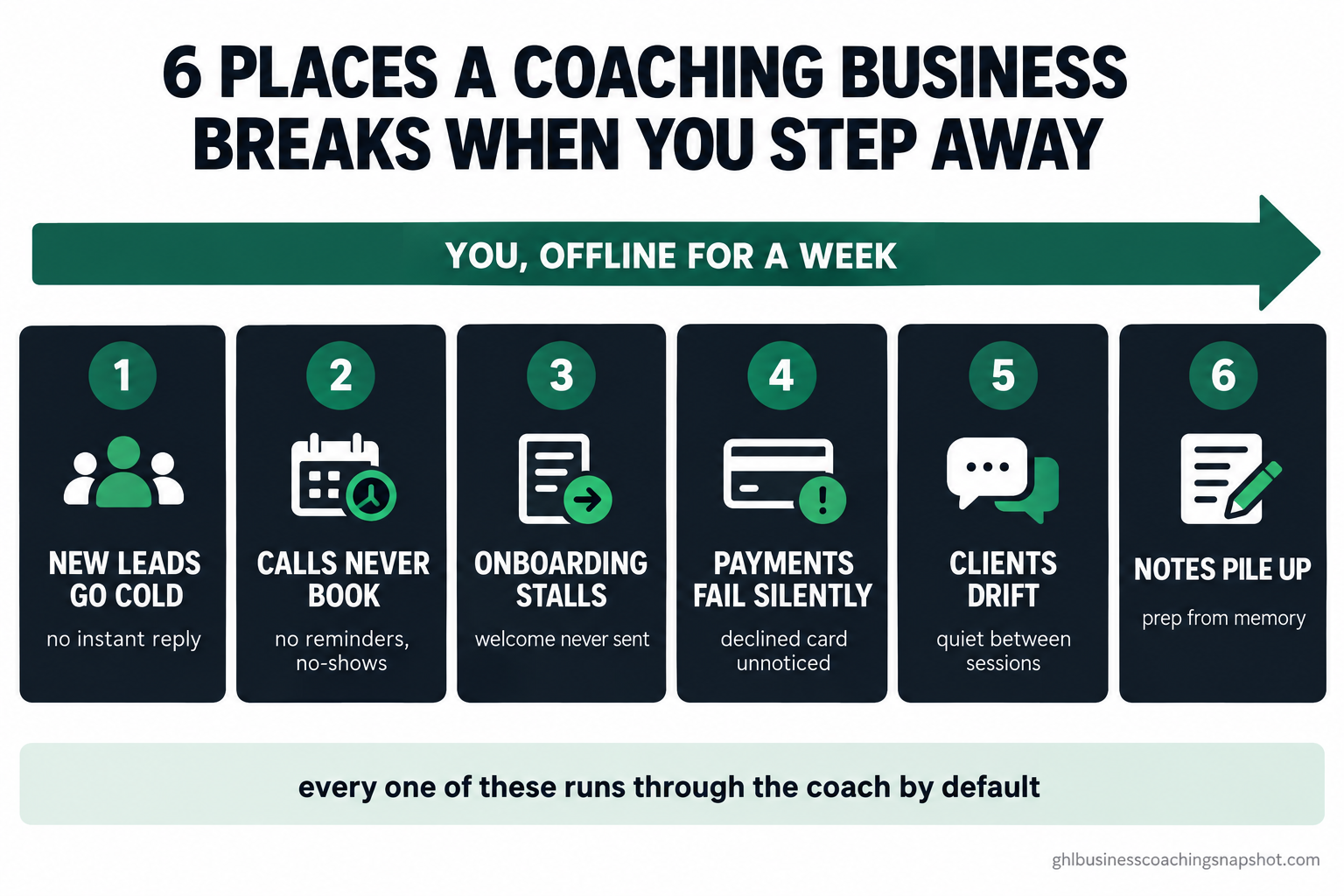
None of that is a crisis on its own. Together they are the reason you cannot actually leave. The honest answer to “why can’t I take a week off?” is almost never that you are lazy or disorganized. It is that every moving part of the business routes through you by default. You are the lead response, the booking desk, the onboarding, the billing clerk, and the accountability nudge, all at once. This post is about the six specific places a coaching practice stalls the moment the coach steps away, and the systems that keep each one running when you are not there to run it.
Sources: FreshBooks Holiday Break Report (500 North American self-employed, 2022); Lead Response Management Study; ICF 2025 Global Coaching Study. Small-business and sales-lead data are proxies for owner behavior, not coaching-specific.
What owner dependency actually costs you
Most coaches treat “I can’t step away” as a scheduling problem. Block the calendar better, batch the week, warn clients in advance. That treats the symptom. The real issue is structural: the business only works while you are personally operating it, which means it has one single point of failure, and that point of failure needs to sleep, get sick, and occasionally go to a wedding.
You are not unusual for being stuck here. In a FreshBooks survey of 500 North American self-employed people and small business owners, nearly 40% said they had not taken a consecutive week off from work in a year or more, and only 15% said they fully disengage from work when they do take time off (FreshBooks Holiday Break Report). A separate Gallup microbusiness survey found 1 in 5 owners took no vacation at all in the prior twelve months (Gallup). This is the water you are swimming in, and it is why “just plan better” has never worked.
The cost is not the vacation you skip. It is the money that leaks while you are heads-down in delivery, which is most weeks, not just the ones you travel. A website lead you answer in 30 minutes instead of 5 is roughly 21 times less likely to qualify, and after 30 minutes the odds fall off a cliff (Lead Response Management Study). A retainer that fails and nobody chases becomes an involuntary cancellation. A client who drifts and does not renew costs 5 to 25 times more to replace than to keep (Harvard Business Review). And demand is not slowing down: the 2025 ICF Global Coaching Study counted a record 122,974 coach practitioners worldwide, up 15% since 2023, pulling an estimated $5.34 billion in revenue, with 57% of coaches also offering consulting (International Coaching Federation). More coaches chasing the same prospects means every lead you drop is one a competitor answers in five minutes.
Relative odds of qualifying an inbound lead by response time. A 30-minute wait is roughly 21x worse than a 5-minute reply. Source: Lead Response Management Study. Figures are from sales-lead research and are directional for coaching inquiries.
The real test: what breaks when you go offline for a week
Here is a useful exercise. Imagine you go completely dark for seven days. No email, no phone, no checking. Now walk the business forward and ask, at each step, “does this still happen without me?” For almost every solo and small coaching practice, the answer is no at six specific points. Those six are the whole map. Fix them and you have a business that runs; fix none and you have a job that pays you only while you are at the desk.
One week offline, two different businesses
Leads sit unanswered until you're back. Discovery calls either don't book or no-show with no reminder. New clients wait on a welcome email you'll send 'when things calm down.' A failed card goes unnoticed for weeks. Quiet clients get quieter. You come back to a backlog and a smaller pipeline than you left.
Leads get an instant reply and a booking link. Calls book against your real availability and get three reminders. New clients get the contract, intake, and welcome automatically. A failed card triggers a four-touch recovery sequence. Check-ins keep going out. You come back to a tidy inbox and the same pipeline you left.
The rest of this post walks each failure point in order: how it breaks, the fix, the actual message copy you can steal, and the ways the fix itself goes wrong if you are careless.
Failure point 1: new leads go cold
This is the one that costs the most and hurts the least in the moment, because you never see the lead you lost. Someone fills in your contact form or replies to an ad at 9pm. If the first human response is you, tomorrow, after your morning sessions, you are already outside the window where speed matters. The research is blunt about that window, and the honest read is that most of your “the leads were low quality” story is actually a response-time story.
The fix. An inbound lead should get an automated reply within seconds, by text and email, that does two things: acknowledges them like a person and hands them a booking link. The automation is not the relationship. It is the thing that holds the door open until you can have the relationship. Build it once as a workflow triggered by any form submission, and it runs at 9pm, on a Sunday, and while you are on a plane.
How it breaks. The classic mistake is an auto-reply that reads like a robot wrote it (“Your inquiry is important to us”). That is worse than silence because it tells the lead a machine has them. Keep it short and human. The second failure is sending the instant reply and then never following up, because the booking link got ignored. Attach a two-step nudge: a text the next morning and one two days later, then stop. If you want the full treatment on this, the speed-to-lead playbook for coaches goes deeper on timing and channel.
Failure point 2: discovery calls never book or no-show
Manual booking is a tax you pay in email threads. “Does Tuesday work? No? How about Thursday at 2? That’s gone now, sorry.” Every round trip is a chance for the lead to cool off or ghost. And the calls that do book then no-show, because nothing reminded them and the commitment was soft to begin with. When you are away, booking stops entirely, because you are the one trading messages.
The fix. A calendar that shows your real availability, books against it without you touching anything, and fires its own reminder sequence. The reminders are where no-shows actually die. A booked-but-unreminded call is a coin flip. Three well-timed reminders turn it into a near-sure thing, and none of them need you awake.
How it breaks. Over-reminding reads as desperate, so cap it at three and make the one-hour text short. The bigger failure is a reminder that gives no easy reschedule path, which turns a “I can’t make it” into a silent no-show instead of a kept-in-the-pipeline reschedule. Always include the reschedule link. If no-shows are your specific leak, the deep dive on reducing discovery-call no-shows breaks down the full cadence.
Failure point 3: new clients onboard late
A client says yes. That is the highest-energy moment of the whole relationship, and it is usually where the machine stalls, because onboarding is a pile of manual steps only you know how to do: send the agreement, collect the deposit, send the intake form, book the first session, send the welcome. If you are mid-week in delivery, or away, the new client sits in limbo for days with buyer’s remorse creeping in, and you have spent trust you will not get back.
The fix. One trigger (deal marked won, or contract signed) kicks off the whole sequence automatically: contract out, payment link, intake form, first-session booking link, and a warm welcome that tells them exactly what happens next. The client experiences a fast, confident handoff. You do nothing but show up to the first session prepared.
How it breaks. Automated onboarding that fires all five messages in the same minute feels like a mailmerge and overwhelms a brand-new client. Space them over a day or two. The other failure is automating the welcome but routing the intake answers nowhere, so you still arrive to the first session cold. Pipe the intake into the client record so the prep is done for you. The full build is in the coaching client onboarding sequence, and the proposal-to-contract-to-invoice system covers the money side.
Failure point 4: retainer payments fail silently
This is the quiet one that costs real cash. Cards expire. Banks decline charges for no reason. On a monthly retainer, a failed payment is not a lost month, it is often a lost client, because the failure goes unnoticed, the client never finds out, and two months later you realize you have been coaching someone for free who now feels awkward about the back-pay. When you are away, nobody is watching the billing dashboard, and silent failures are the default.
The fix. A failed-payment recovery sequence that triggers the moment a charge fails: it retries on a schedule and sends the client a friendly, low-shame heads-up with a one-click update link. This is pure margin. The money is already owed and the client already wants to pay; they just do not know anything broke.
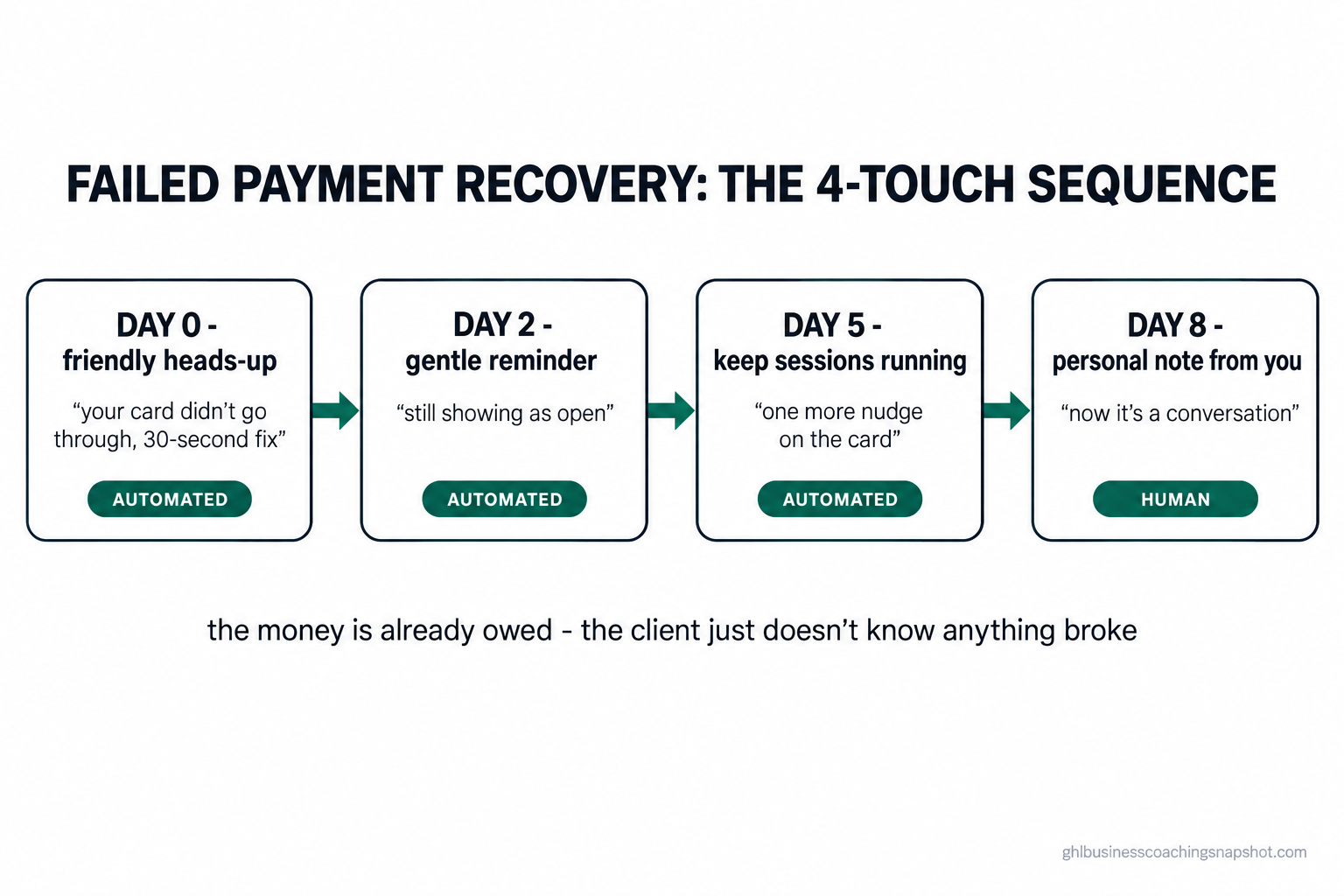
How it breaks. Dunning that sounds like a collections agency damages the relationship you are trying to protect, so keep the tone “your card, not your character.” The other failure is retrying forever with no human handoff, which lets a genuinely churning client linger as a half-paying ghost. Cap the automated touches and route the stubborn ones to you. The complete version, retries, timing, and tags, is in the retainer billing recovery guide.
Failure point 5: clients drift between sessions
Coaching happens in the session. The results happen between sessions, and that is exactly the stretch you cannot personally supervise across a full roster. A client who goes quiet in week six is not usually unhappy; they are stuck, a little embarrassed they did not do the work, and drifting toward a non-renewal they have not told you about. Self-directed effort with nobody waiting on it collapses: across roughly a million registrants in 16 free University of Pennsylvania online courses, only about 4% finished (University of Pennsylvania via Higher Ed Dive). Your presence is the thing that keeps people moving, and your presence does not scale by hand.
The fix. A light accountability cadence that goes out on a schedule between sessions: a check-in that asks one real question, celebrates the small win, and gives the client an easy way to flag they are stuck. It runs whether or not you are at your desk, and it surfaces the quiet ones so you can reach out on week six instead of finding out at the renewal they skip.
How it breaks. A “just checking in!” with no real question is noise, and clients learn to ignore it. Ask something specific and answerable in one line. The deeper danger is automating the check-in but ignoring the replies, which trains clients that you are not really listening. The reply has to go somewhere that prompts action. The accountability check-in system covers the full cadence, and why clients go quiet covers reading the silence.
Failure point 6: delivery prep and notes pile up
The last one is less about automation and more about the paper trail. Session prep, notes, action items, and the “what did we agree last time” that you rebuild from memory before every call. When this lives in your head and a dozen scattered docs, it works right up until you are tired, sick, or away, at which point the quality of your coaching quietly drops because you are winging the prep. It also means you can never hand any of it off.
The fix. A single client record that holds the intake, the session notes, the action items, and the engagement history, with session prep assembled from the last check-in and last session automatically. You are not automating the coaching. You are automating the remembering, so that you, or a VA, or future-you after a week off, can walk into any session already oriented.
How it breaks. The failure here is building an elaborate system you never actually fill in, so it rots and you go back to memory. Keep the per-session capture to three fields: what we covered, what they committed to, what to raise next time. If even that is more admin than you want to own, hiring a GHL-trained VA to keep the records clean is often the better move than doing it yourself at 10pm.
How rarely owners actually step away. Sources: FreshBooks Holiday Break Report (40%, 15%) and Gallup Microbusiness survey (20%). Different surveys and samples; shown together as directional context.
What this looks like at every stage of practice
The six failure points are the same at every size. What changes is which ones hurt first and who should own the fix.
The solo coach taking first clients. You have maybe five to ten clients and you are the entire operation. Do not try to build all six systems at once; you will stall. Fix lead response and booking first, because that is where growth comes from, then billing recovery, because that is where cash leaks. Onboarding, check-ins, and delivery records can stay lightly manual until the roster grows. The goal at this stage is not a hands-off business, it is removing the two failures that cost money in your sleep so you stop losing leads to a competitor who replied faster.
The 2 to 8 person boutique layering fractional retainers. Now the problem is not just you, it is that everyone on the team runs their own version of each step, so nothing is consistent and clients get a different experience depending on who picked up. Here the six systems become a shared operating standard: one onboarding flow everyone triggers, one billing recovery sequence, one check-in cadence. The payoff is that a client’s experience no longer depends on which human is having a good week, and you can actually hand work off without re-explaining it every time.
The coach scaling past solo. You are deliberately trying to make the business not depend on you, whether to add associate coaches, sell, or just to take a real sabbatical. Every one of the six points has to run without the founder, and the delivery-records piece becomes non-negotiable, because associate coaches cannot coach from your memory. At this stage the question for each function is not “is it automated” but “could a competent stranger run it from the documentation tomorrow.” If the answer is no anywhere, that is your single point of failure and your next project.
Objections I hear from coaches
“Won’t automated messages make my coaching feel impersonal?” Only if you write them like a machine. Everything above is saved copy you wrote in your own voice, sent at the right moment. The alternative is not “personal,” it is “late, or never.” A client does not feel more cared-for because you forgot to reply for two days. The automation handles the predictable touches so your actual attention goes to the conversations that need a human.
“I already pay for Kajabi (or Kartra, or Calendly plus a half-dozen tools). Isn’t this redundant?” Usually the opposite. Most coaches run a course platform, a scheduler, email, and payments as separate tools with no shared client record underneath, which is exactly why nothing runs without you, you are the integration. Consolidating the six functions onto one system with one record is what makes them run on their own. If you are weighing that trade-off, we broke down the true monthly cost of a coaching stack and what disconnected tools quietly cost you.
“Do I need to be technical to run this?” No, but someone has to build it once. The flows above are standard scheduling, email, SMS, and payment automations. You can build them yourself if you enjoy that, hire it out, or install a prebuilt system. The skill is not technical; it is deciding the exact copy and timing, which is the part only you can do well.
“What if I set this up and it runs wrong while I’m away?” Fair, and it is why every section above has a “how it breaks” note. Build it, then test it on yourself before you leave: run a fake lead through, let a test payment fail, watch what fires. A system you have watched work once is one you can trust offline. A system you built and never tested is just a new thing to worry about.
A compliance note before you automate
Automating client contact means you are now sending programmatic texts and emails, and a few rules apply. For SMS specifically, US carriers require registration and real consent before you send automated texts; our walkthrough on A2P 10DLC for coaches covers what that means in practice. Get explicit opt-in at the form, keep the records, and honor opt-outs automatically.
Two more, briefly. If your marketing uses client results or testimonials, the FTC’s Endorsement Guides require that testimonials reflect typical results or carry a clear disclosure, and that any material connection is disclosed (FTC). And on the billing side, the federal “click to cancel” rule was vacated by the Eighth Circuit in July 2025 and is not in force, but many states have their own auto-renewal laws, some stricter, so your retainer terms and cancellation path still need to be clean. None of this is legal advice; when your copy edges into a regulated claim or a specific state’s rules, get a quick review. The automation does not change your obligations, it just does them at scale, which is exactly why they matter.
FAQ
Building a coaching business that runs without you
Which of the six systems should I build first?
Lead response and failed-payment recovery. Those are the two that cost real money while you are not looking: a dropped lead goes to a competitor, and a silent failed charge becomes a lost client. Booking, onboarding, check-ins, and delivery records matter, but they rarely cost cash on day one the way those two do.
How long does it take to set all six up?
Building from scratch in a tool like GoHighLevel, expect a serious weekend per system if you are comfortable with automations, and considerably more if you are learning as you go, which is where the '200 hours' figure comes from. Installing a prebuilt system that is already wired up takes closer to a day, with your time going into customizing the copy and timing rather than the build.
Will clients be able to tell it is automated?
If it is written in your voice and timed sensibly, no, and it would not matter much if they could. Clients care that they got a fast, warm, useful message, not whether a workflow sent it. The tells are robotic copy, bad timing, and ignoring replies. Avoid those three and automation reads as attentiveness, not absence.
I only have a handful of clients. Is this overkill?
Not for lead response and billing, which pay off immediately. The rest you can keep lightly manual until the roster grows. The point is not to automate everything at five clients; it is to stop losing the leads and payments you cannot afford to lose at any size.
Do I still need to show up if the systems run themselves?
Yes, and that is the point. The systems handle the predictable, repeatable touches so your actual attention goes to the coaching and the conversations that need a human. A business that runs without you is one where your presence is a choice on the parts that matter, not a requirement on the parts that do not.
Can I do this inside the tools I already use?
Sometimes, if they share a client record and can trigger cross-tool automations. More often the reason nothing runs without you is that your tools do not talk to each other, so you are the integration. Consolidating onto one system with one record is usually what makes the six functions actually run on their own.
You started the week unable to leave. The fix was never a better-blocked calendar; it was moving the six functions that route through you (leads, booking, onboarding, billing, check-ins, and records) out of your head and onto a system that runs on its own. Build them one at a time, test each on yourself, and the next time you put the phone in a drawer, it can actually stay there. The leads still get answered, the payments still get recovered, and the business keeps its shape while you are gone. That is the difference between owning a coaching practice and being owned by one.