

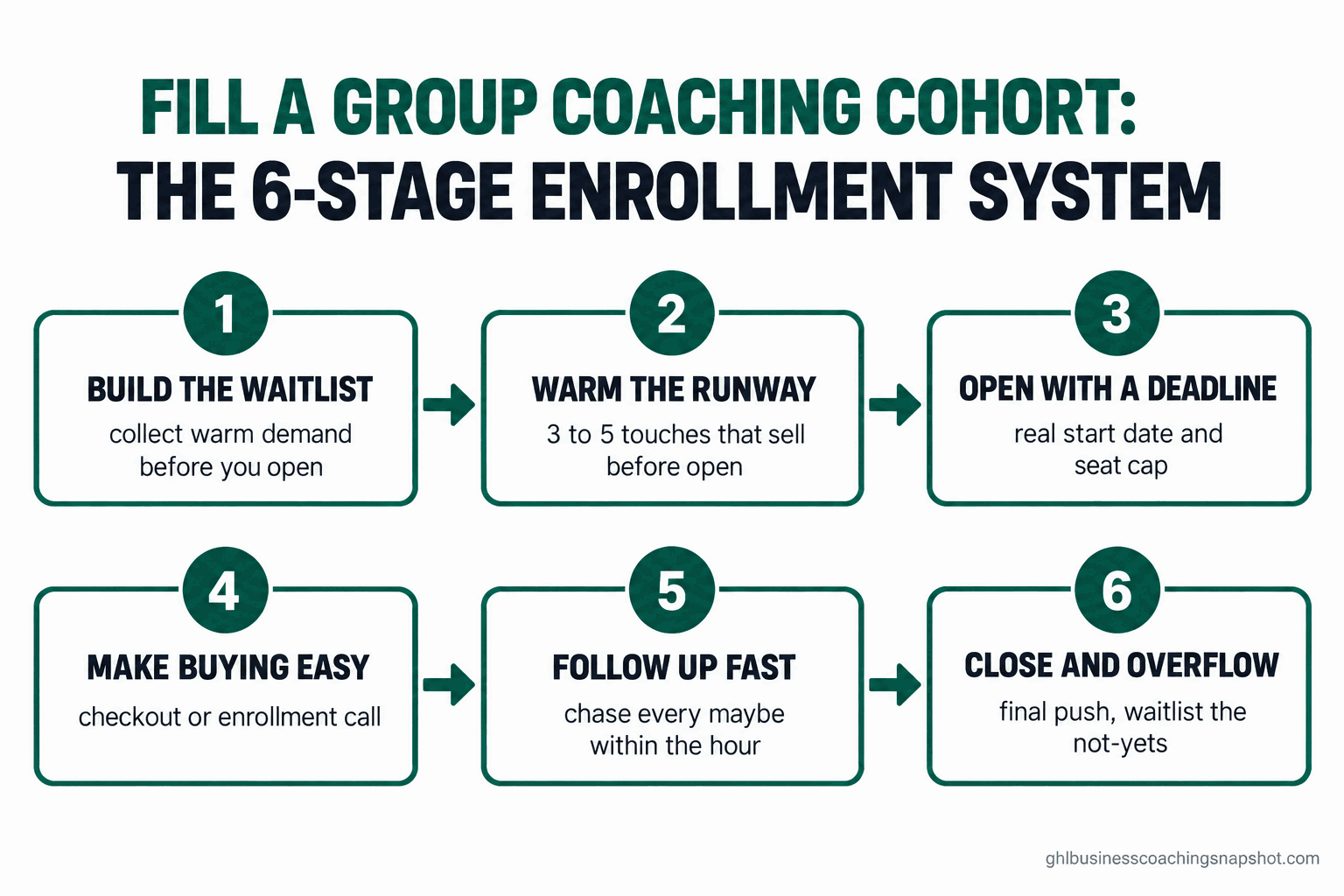
Short answer: you fill a group coaching cohort by building demand before you ever open the cart, then running a real enrollment push with a hard deadline and follow-up that does not wait for you to be at your desk. The coaches who end up with half-empty cohorts treat enrollment as a single announcement email. The coaches who sell out treat it as a six-stage system: a warm waitlist, a short open window with a real deadline, a frictionless way to buy, fast follow-up on every maybe, and an overflow plan for the people who were not ready this time. Below is that system, stage by stage, with the message copy you can steal and the exact point each stage leaks seats.
What an empty seat actually costs you
A group program is priced on a full room. You set the seat price, pick a cohort size, and the math only works if most of those seats sell. So an empty seat is not a neutral event. It is revenue you planned for and did not collect, and it quietly changes the economics of the whole cohort.
Say you planned a 12-seat cohort at $2,500 a seat. A full room is $30,000. Fill eight, and you are at $20,000 for the same number of live calls, the same curriculum, the same hours out of your week. The cost per delivery hour just dropped by a third, and the gap is the money the launch left on the table. Run that cohort twice a year and under-fill both, and you have given up a five-figure chunk of your annual income to a launch process you never actually built.
There is a second cost that is easy to miss. A thin cohort is harder to deliver well. Group coaching works partly because of peer energy, the sense that other people like you are doing the work alongside you. A room of four feels quiet, accountability drops, and the clients who did buy get a weaker experience, which hurts your renewals and testimonials for the next one. Under-filling is not just a revenue miss this quarter. It makes the next launch harder too.
Sources: completion rates from a 1.3M-enrollment analysis in the Ruzuku course-completion study (platform data, September 2026 snapshot); lead-response figure from HBR; revenue from the ICF 2025 revenue release.
Demand is not the thing that is broken. Global coaching revenue grew to roughly $5.34B in 2025, up from prior years (ICF), and more than half of coaches already run a blended model that includes group work (ICF). People are buying coaching. The reason seats sit empty is almost always the enrollment machine, not the market. If you are still deciding whether a group tier belongs in your practice at all, start with the broader move from 1:1 to group coaching guide, then come back here for the fill.
The 6-stage enrollment system
Treat filling a cohort like running a machine you built once, not a heroic sprint you reinvent every launch. Six stages, and skipping any one is a predictable place seats go missing.
| Stage | What it does | The failure if you skip it |
|---|---|---|
| 1. Build the waitlist | Collects warm demand before you open | Launching to a cold list and shouting into a quiet room |
| 2. Warm the runway | Primes the list so the open lands on ready buyers | An open week that surprises people who forgot you existed |
| 3. Open with a deadline | Turns interest into urgency to act now | An always-open cart nobody feels a reason to buy today |
| 4. Make buying easy | Removes friction between yes and paid | Interested people stalling at a confusing, slow checkout |
| 5. Follow up fast | Chases every maybe before the moment cools | Hand-raisers going cold while you were offline |
| 6. Close and overflow | Captures the final rush and the not-yets | A dead cart at midnight and leads you never hear from again |
Stage 1: Build the waitlist before you open
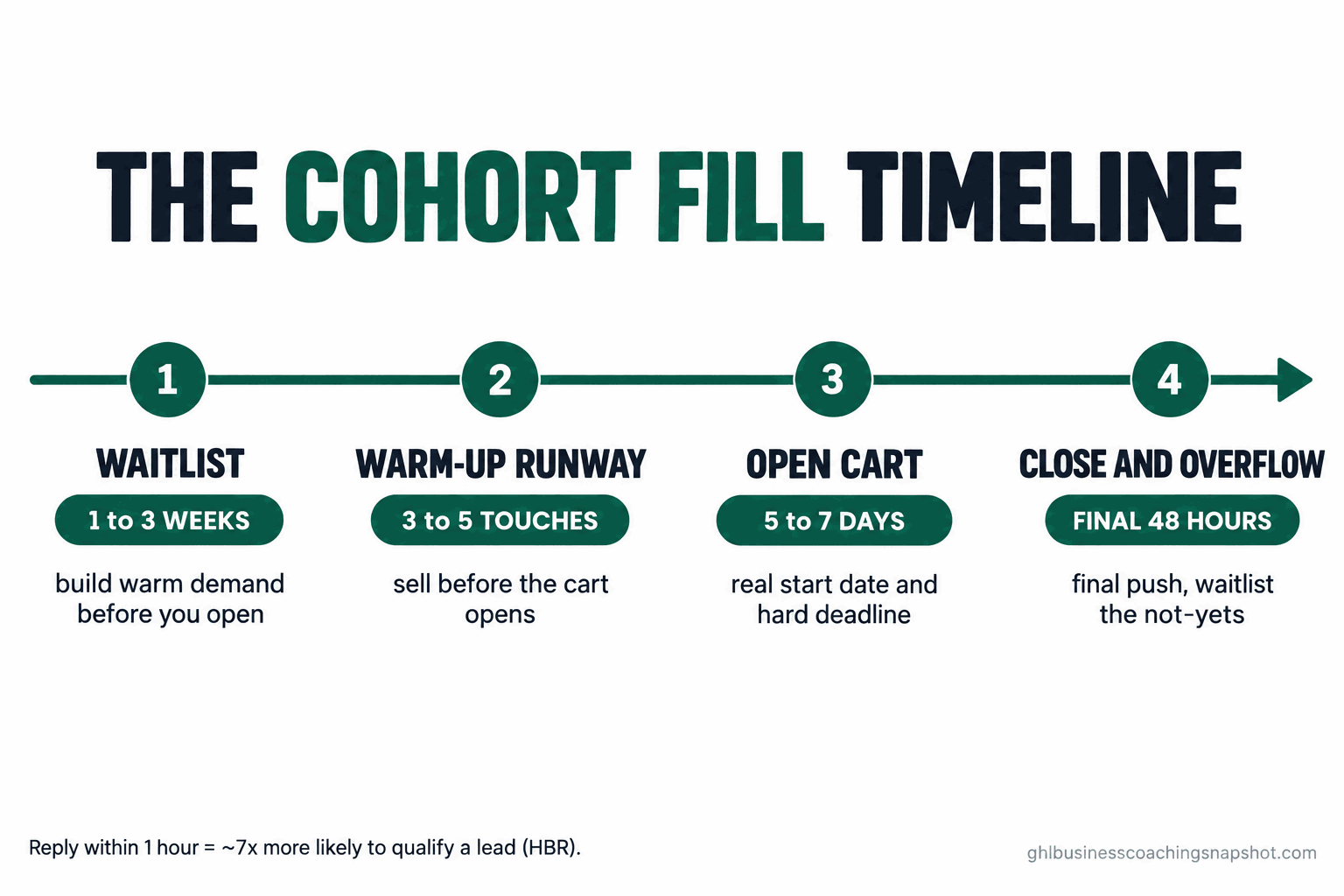
The single biggest reason a cohort under-fills is launching to a cold list. If the first time your audience hears about the program is the day you want their money, you are asking strangers to decide fast, and most will not. The fix is to separate interest from enrollment. You collect interest for one to three weeks, then you open only to the people who already raised a hand.
A waitlist does three jobs. It gives you a real count of demand before you commit to a date and a cohort size, so you are not guessing. It creates a group of people who feel early and chosen, which is worth more than any discount. And it gives your follow-up system a warm, permissioned list to work during the open window instead of a cold blast.
Seed it from where attention already lives. Your current and past 1:1 clients. Anyone who downloaded a lead magnet or attended a past workshop. Old leads who went quiet, which is exactly where a database reactivation pass earns its keep. A simple landing page with one promise and one email field is enough to start.
How it breaks: treating the waitlist as a formality you build the day before you open. A list you gathered in 24 hours is a cold list wearing a waitlist label. Give it one to three weeks to fill, and watch the sign-up rate. If the waitlist is thin, that is your early warning that the offer or the audience needs work before you spend a launch week on it, not after.
Stage 2: Warm the list with a short runway
A waitlist is warm, not sold. Between sign-up and open, you run a short runway of content that does one thing: moves people from “sounds interesting” to “I need this now.” This is where most of the actual selling happens, quietly, before the cart is even open.
Keep it simple. Three to five touches over the week or two before you open. Each one earns its place by teaching something real and connecting it to the transformation the cohort delivers. A short lesson that solves one piece of the problem. A story of a client who got the result. A straight answer to the objection you hear most. You are not pitching yet. You are making the eventual yes feel obvious.
A live or recorded masterclass is the strongest version of this runway, because it lets people experience your coaching before they buy it. If that fits your style, the coaching webinar funnel breaks down the registration page, reminders, and the on-webinar transition into enrollment. If it does not, a simple email sequence does the same job at lower production cost, and the email marketing for coaches playbook has the structure.
How it breaks: going dark after sign-up, then blasting a hard pitch on open day. People forget they joined a waitlist in a week. If the first thing they hear after signing up is “buy now,” you have wasted the warm list you worked to build. Stay in contact through the runway, lightly and usefully, so the open lands on people who remember you and want in.
Stage 3: Open with a real deadline
Now you open, and the open has to have a real deadline. This is the whole point of the cohort format. A group starts on a date, so there is a genuine reason to decide now instead of someday. An always-open program has no such pressure, and “I’ll think about it” is where most coaching sales quietly die.
Your deadline needs two kinds of scarcity, and both have to be true. A date: the cohort starts on [day], and enrollment closes on [day]. A cap: there are [N] seats, because the room has to stay small enough for real attention. Never invent either one. Fake urgency, a countdown that resets or seats that never actually run out, trains your best buyers to ignore every deadline you ever set. Honest scarcity is a tool. Fake scarcity is a tax on your credibility.
The open itself is a sequence, not a single email. Announce to the waitlist first, a day before you go public, so they get the early access you promised. Then open publicly. Then run a steady cadence through the window: the announcement, a proof or FAQ email mid-window, and a clear ramp as the deadline nears.
How it breaks: an open window with no teeth. If there is no date and no cap, or if everyone can tell the deadline is soft, nobody feels a reason to act. The flip side also breaks you: a deadline so aggressive it feels manipulative. The sweet spot is a true date, a true cap, and a tone that respects the reader. More on where urgency crosses legal lines in the compliance section below.
Stage 4: Make buying the obvious next step
You have interest and a deadline. Now the path from “yes” to “paid” has to be short and clear, because every extra step is a place someone talks themselves out of it. There are two main buying paths, and the right one depends on your price.
For lower seat prices, roughly under a few thousand dollars, let people buy directly. One page, the offer, the price, a payment plan option, and a checkout button. Interested person clicks, pays, gets an instant confirmation, and lands in onboarding. No call required, no friction.
For higher-ticket cohorts, an enrollment call often converts better, because a bigger decision wants a conversation. The call is short, it confirms fit, it handles the real objection, and it ends with a clear next step. The risk here is no-shows and scheduling drag, so the booking has to be instant and the reminders automatic. Our discovery and enrollment call no-show playbook covers the reminder cadence that keeps those calls from evaporating.
Either way, offer a payment plan. A three-pay or four-pay option removes the single most common price objection without lowering your price, and it often lifts fill rate more than any discount would. Make sure the plan is clear, the terms are written down, and the recurring charges are set up to retry and recover a failed card automatically, or you will spend the cohort chasing payments by hand.
How it breaks: a buying path with too many steps or too much doubt. A checkout that asks for information you do not need, an enrollment call booked three days out so the momentum dies, a payment plan hidden until the last screen. Every one of those is a leak. Map your own path from “clicks the open email” to “paid” and count the clicks. If it is more than three or four, you have friction to cut.
Stage 5: Follow up fast on every maybe
Most people who end up buying do not buy the first time they see the open. They click and get interrupted. They reply with a question at 9pm. They start the checkout and abandon it. The follow-up system is what turns those maybes into seats, and it lives or dies on speed.
The numbers are blunt. Reaching an interested lead within an hour makes you roughly 7x more likely to qualify them than waiting even a few hours (HBR), and it takes about 8 touchpoints on average to land a first meeting (RAIN Group). During a launch week, when you are also delivering your current clients and running the rest of your life, you physically cannot reply to every hand-raiser within the hour by hand. This is the stage that has to be automated, because the moment you miss is a seat you lose.
Three follow-up tracks run in parallel during the open window. A track for people who clicked but did not book or buy. A track for people who started a checkout or enrollment call and did not finish. And a track for people who asked a question, which should trigger a fast, human reply, not an autoresponder that reads like a robot wrote it.
How it breaks: manual follow-up, or none. If chasing maybes is a to-do list you work by hand, you will do it for the first few and drop the rest by Thursday of launch week, which is exactly when the deadline is doing its work. Build the tracks once so they fire on the trigger, and keep the questions routed to you so your attention goes to real conversations, not data entry.
Stage 6: Close day and the overflow plan
The last 48 hours of an open window do a disproportionate share of the work, because the deadline finally bites. Decision-delayers who have been sitting on the fence all week act when “someday” turns into “today or not at all.” So the close has to be run deliberately, not trailed off.
Ramp the contact as the deadline nears. A reminder two days out, one the morning of close day, and a final one a few hours before the cart closes, each one short, clear, and honest about what happens when the window shuts. The tone is not panic. It is a straight statement of fact: the cohort starts [date], seats are limited, enrollment closes at [time], here is the link.
Then plan for the people who did not buy, because most of your audience will not buy this time and that is normal. The overflow plan is what makes the next launch easier. Everyone who showed interest and did not enroll goes onto the waitlist for the next cohort, with a short note that tells them when it opens. A full cohort can even run a real waitlist for itself: “we’re full, here’s how to get first access next round.” Nothing is wasted. This launch feeds the next one.
Announcement launch vs enrollment system
One email to a cold list on open day. A handful of replies you answer when you get to them. Seats sit empty, the deadline is soft, and the people who did not buy disappear. You quietly lower the cohort size to save face.
A warm waitlist, a runway that sells before you open, a hard deadline, fast automatic follow-up on every maybe, a deliberate close, and an overflow list for the not-yets. The room fills, and the leftovers seed the next launch.
Once the room is full, the job shifts from enrollment to onboarding, the window between “bought a seat” and “showed up to week one” where groups quietly leak. The group program cohort kickoff playbook picks up exactly there.
Run the numbers: first cohort, boutique, scaling
Same six stages, different emphasis depending on where you are.
The solo coach filling a first cohort
You have an audience, maybe a list of a few hundred and some past clients, and you want to fill your first group without a big ad budget. Your whole launch runs on the warm list. Spend real time on the waitlist and the runway, because that is your entire pipeline, and set a conservative cap, six to eight seats, so a “sold out” is realistic and a thin room is not a public miss. Lean hard on automation for the follow-up, because you have no team to catch the maybes while you deliver your current clients. The win is proving the machine once and getting a repeatable process you can run again.
The 2-to-8 person boutique layering a cohort onto retainers
You run fractional or 1:1 retainers and the cohort is a lower tier that warms future retainer clients or serves the ones who cannot afford the top offer. Here the enrollment system has to connect to the rest of your pipeline, so a cohort member who raises a hand for more gets routed to a retainer conversation fast. The operational focus is handoffs and a shared view of who is where, which is why a real CRM and sales pipeline matters more for you than for a solo coach. The cohort is the front of a ladder, not a standalone product.
The coach scaling into repeatable cohorts
You have filled a group once or twice and want it on a calendar, several cohorts a year, maybe with a facilitator. Now the enrollment system is the product. Every stage has to be documented and automated enough that a launch is a checklist, not a scramble, and the waitlist runs year-round so you open to a full list every time. This is where the tooling choice stops being optional. The best platform for mastermind and group coaching breakdown covers how the pieces fit at this scale.
The chart below shows the shape of the revenue at stake across those fill rates. It is illustrative example math, not a promise.
Illustrative example math only, not a guarantee of results: cohort revenue at an example $2,500 seat price filled to 4, 8, and 12 of 12 seats. Your numbers depend on your offer, price, and fill rate.
The compliance bit you cannot skip
A cohort launch puts urgency, testimonials, and recurring payments in front of a lot of people at once, which raises the stakes on a few U.S. rules. None of this is legal advice, and a program that leans hard on results or income should get a real review, but here is the shape of it.
Testimonials and results. If you fill the cohort with client wins, the FTC’s 2023 Endorsement Guides apply. A testimonial showing an atypical result needs a clear disclosure of what people can generally expect, or substantiation, and any material connection, a discount or an affiliate tie, must be clear and conspicuous (FTC). A “results not typical” line buried in grey eight-point text does not clear that bar.
Income claims. If your cohort teaches people to make money, a sales group or a “grow your practice” program, be careful with earnings claims. A program that is really coaching other coaches to build a business can fall under the FTC Business Opportunity Rule, which requires an Earnings Claim Statement (FTC). When in doubt, describe the process, not a promised number.
Payment plans and auto-renewal. If your plan bills on a recurring schedule, know the rules on cancellation. The FTC’s federal “click to cancel” Negative Option Rule was vacated by the 8th Circuit in July 2025, so the federal rule most content still warns about is not in force (Cooley). The contrarian catch: more than 25 states have their own auto-renewal laws, some stricter, so clear terms and an easy cancel still matter. And if your reminders go out by SMS, keep them compliant, which is what the A2P 10DLC for coaches guide is for. The full breakdown lives in FTC rules for coaches.
Objections, answered
“I don’t have a big enough list to fill a cohort.” You probably need less than you think. A six to eight seat cohort can fill from a list of a few hundred warm people, plus past clients and old leads. The waitlist and runway stages exist precisely so a small list converts well. Start the cohort small, fill it from the people who already know you, and let the results build the list for the next one.
“Won’t a hard deadline feel pushy or manipulative?” Only if it is fake. A real start date and a real seat cap are not manipulation, they are facts about how a group works, and most buyers appreciate a clear reason to decide. The manipulation is the countdown that resets and the “last chance” that comes around every month. Keep your scarcity true and your tone respectful, and the deadline helps your reader instead of pressuring them.
“I already pay for a course platform. Do I need something else?” You need five jobs covered: waitlist capture, the warm-up sequence, enrollment booking or checkout, fast follow-up, and reminders. Some course platforms do a couple of those; almost none do all five well, which is how coaches end up stitching a platform plus a scheduler plus email plus a payment tool into the roughly $340-a-month stack that still leaks between the tools. The jobs matter, not the brand names.
“Do I need to be technical to set this up?” No, but you do need the pieces wired together once. The work is in the plumbing: the trigger that fires the abandoned-enrollment nudge, the reminder that keeps the enrollment call, the payment plan that retries a failed card. You can build that yourself over a weekend or two, or install it pre-built. Either way, you build it once and run it every launch.
FAQ
How far in advance should I open enrollment for a cohort?
Build the waitlist for one to three weeks, run a short warm-up runway of three to five touches, then open a cart window of about five to seven days with a hard deadline. The demand is built before you open; the open window itself is short on purpose so the deadline has teeth.
How big should my first group coaching cohort be?
Start with six to eight committed seats. It is small enough that a sold-out room is realistic from a modest list, big enough to create the peer energy that makes group coaching work, and it lets you prove the enrollment system before you scale the cohort size.
Should I use an enrollment call or let people buy directly?
It depends on price. For seats under a few thousand dollars, direct checkout with a payment plan usually converts fine and removes friction. For higher-ticket cohorts, a short enrollment call tends to convert better because a bigger decision wants a conversation. Either way, make the booking or checkout instant and the reminders automatic.
What's the biggest reason a cohort launch under-fills?
Launching to a cold list. If the first time your audience hears about the program is the day you want their money, most will not decide fast enough. Building a warm waitlist and a short runway before you open is the single biggest fix.
How do I fill the seats that don't sell by the deadline?
You don't force them. Everyone who showed interest and did not enroll goes onto the waitlist for the next cohort with a note on when it opens. A launch that captures its not-yets makes the next launch easier, because you open to a warmer, larger list every time.
Do I need GoHighLevel to run a cohort launch?
You need five jobs covered: waitlist capture, a warm-up sequence, enrollment booking or checkout, fast follow-up, and reminders. You can stitch those from separate tools or run them from one system like GoHighLevel. The Coaching Snapshot ships them as pre-built workflows so you don't assemble the launch machine by hand each time.
It is the week before your launch, and you can already feel which way it is going to go, because you built the demand before you opened the doors. The waitlist is warm, the runway did the selling, the deadline is real, and the follow-up runs whether you are at your desk or coaching a client. That is the difference between a launch you dread and a cohort that opens on a calendar. Build the machine once, write the copy once, and the next room fills itself while you do the work you actually started this practice to do.