

Short answer: most coaches do not have a pricing problem, they have a packaging problem. When you sell your time by the hour, the client is buying a commodity and shopping you against every other hour on their calendar. When you sell a packaged outcome with a start, a finish, and a scope, you are the only person who offers that specific thing, and the price stops being a comparison. The system below has six stages: price the outcome instead of the hour, build a three-tier ladder, set an anchor and a real number, scope the delivery so it cannot leak, present the price without apologizing, and raise your rates on a schedule. Each stage has the exact copy you can steal and the way it quietly breaks if you skip it.
Why pricing feels impossible for coaches
Here is the scene. A good-fit prospect is on the discovery call, the conversation has gone well, and then they ask the question: “So what do you charge?” You hear yourself say a number, and in the half second after it leaves your mouth you watch your own face for a flinch. You add a softener. “But we can be flexible.” You just discounted before they said a word.
That flinch is not a confidence problem you fix with affirmations. It is structural. You are quoting a rate for a thing with no edges. An hour of coaching is hard to value because an hour is an hour, and the client already knows what their own hour is worth, so they anchor your price against their time and against the cheapest coach on Instagram. Priced that way, the number really is arbitrary.
The coaches who never flinch did one thing differently. They stopped selling hours and started selling a packaged result with a name, a timeline, and a clear in and out. That one move changes the whole conversation, and everything in this guide is downstream of it.
What underpricing is costing you right now
Coaching is not a small or struggling field. The global profession generated an estimated $5.34 billion in annual revenue in 2025, up 17% since 2023, across a record 122,974 coach practitioners (ICF 2025 Global Coaching Study). Demand is clearly there.
So why is the average coach not rich? Because the average coach earns about $52,800 a year from coaching, and more than one in two, 53%, report less than $30,000 (ICF 2023 Global Coaching Study). That gap between a multi-billion-dollar field and a sub-$53,000 average income is not a demand problem. It is a pricing and packaging problem, repeated across tens of thousands of practices.
The tell is in how coaches plan to grow. In 2025, 59% expected revenue to rise in the year ahead, but they expected it to come from more clients (60%) and more sessions (51%), not from charging more per client (ICF 2025 Global Coaching Study). That is the hourly trap in one line. The plan is always “add more hours,” never “make each hour worth more,” which is exactly the plan that crowds coaching out with admin and ends in burnout.
Session fees vary enormously by region, which tells you the “right” price is far more about positioning and packaging than about any market rate. In 2022 the average one-hour session ran $277 in Western Europe against $114 in Latin America and the Caribbean, with a global average of $244 (ICF 2023 Global Coaching Study).
Average fee per one-hour coaching session, 2022, USD. Source: ICF 2023 Global Coaching Study, Executive Summary.
The pricing system: six stages
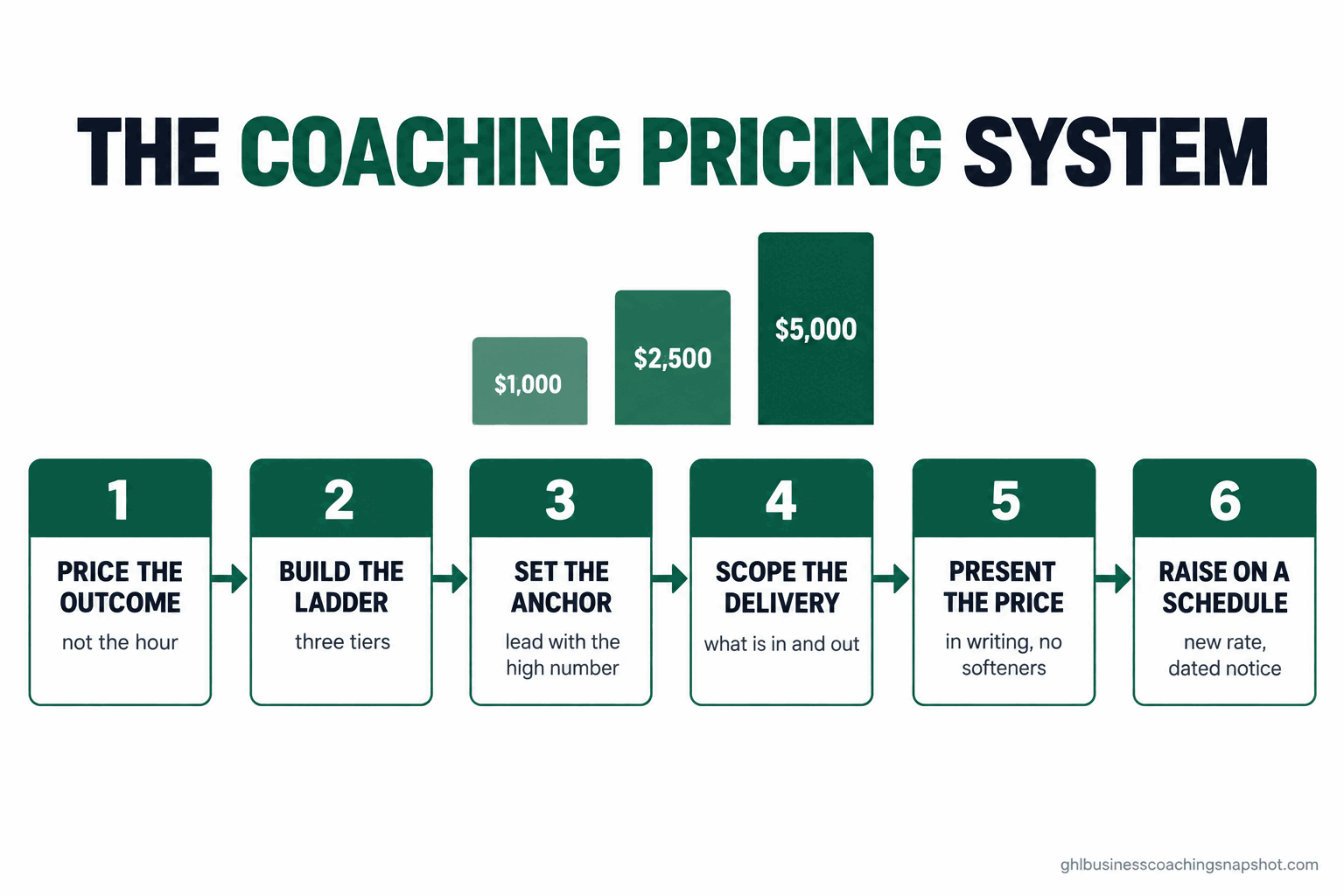
Pricing is not a single decision you agonize over once. It is a repeatable system you run every time you build or revisit an offer. The six stages:
- Price the outcome, not the hour. Decide what transformation you sell and attach the price to that, not to time.
- Build the three-tier ladder. Give the buyer a choice among three packages so the decision becomes which, not whether.
- Set the anchor and the real number. Use a high anchor so your core package reads as the reasonable one.
- Scope the delivery so it cannot leak. Define what is in, what is out, and how overages are handled before anyone signs.
- Present the price without flinching. Deliver it in a proposal with a script, in writing, with no softeners.
- Raise your rates on a schedule. New rate for new clients, a dated notice for current ones, no drama.
Work them in order. Skipping stage one makes every later stage harder, and skipping stage four is how a profitable package quietly turns into unpaid work by month two.
Stage 1: Price the outcome, not the hour
The first move is the whole game: stop pricing your time and start pricing the result. Nobody hires a sales coach because they want eight hours of conversation. They hire a sales coach because they want to close a bigger percentage of their pipeline. Price the close rate, not the conversation.
Practically, that means naming the destination and the window. “A twelve-week container to rebuild your sales process and your first thirty days of execution on it” is a thing with edges. “$250 an hour” is a meter running. The container can be priced at $4,500 or $9,000 depending on who you serve and the stakes, and the client evaluates it against the value of a better sales process, not against the going rate for an hour of anyone’s time.
The copy to steal. When a prospect asks what you charge, do not answer with a number first. Answer with the shape:
“I work in twelve-week engagements, because that is how long it realistically takes to get from where you are now to a rebuilt, repeatable sales process you can run without me. The investment for the full engagement is $6,000. I can walk you through exactly what the twelve weeks look like, if that is useful.”
Stage 2: Build the three-tier package ladder
A single price forces a yes-or-no decision, and “no” is always the safer answer for a nervous buyer. Three tiers change the question from “should I buy this?” to “which one is right for me?” That is a completely different, and much easier, decision for the client to say yes to.
The structure that works for most coaching practices is a simple good, better, best ladder, where the middle tier is the one you actually want most people to choose:
A three-tier coaching package ladder (illustrative structure)
| Plan | Foundation | Core Program recommended | Private Retainer |
|---|---|---|---|
| Price | $2,500 | $6,000 | $2,500/mo |
| Feature 1 | 6-week focused engagement | 12-week transformation container | Ongoing monthly engagement |
| Feature 2 | Biweekly 1:1 sessions | Weekly 1:1 sessions | Weekly sessions + priority access |
| Feature 3 | Email support between sessions | Async messaging access (scoped) | Quarterly strategy intensives |
| Feature 4 | Core workbook and templates | Full toolkit + accountability tracking | Done-with-you implementation |
| Feature 5 | Good for a single, specific fix | The package most clients should pick | For established clients who want you on call |
| Entry tier | Most popular | Top tier |
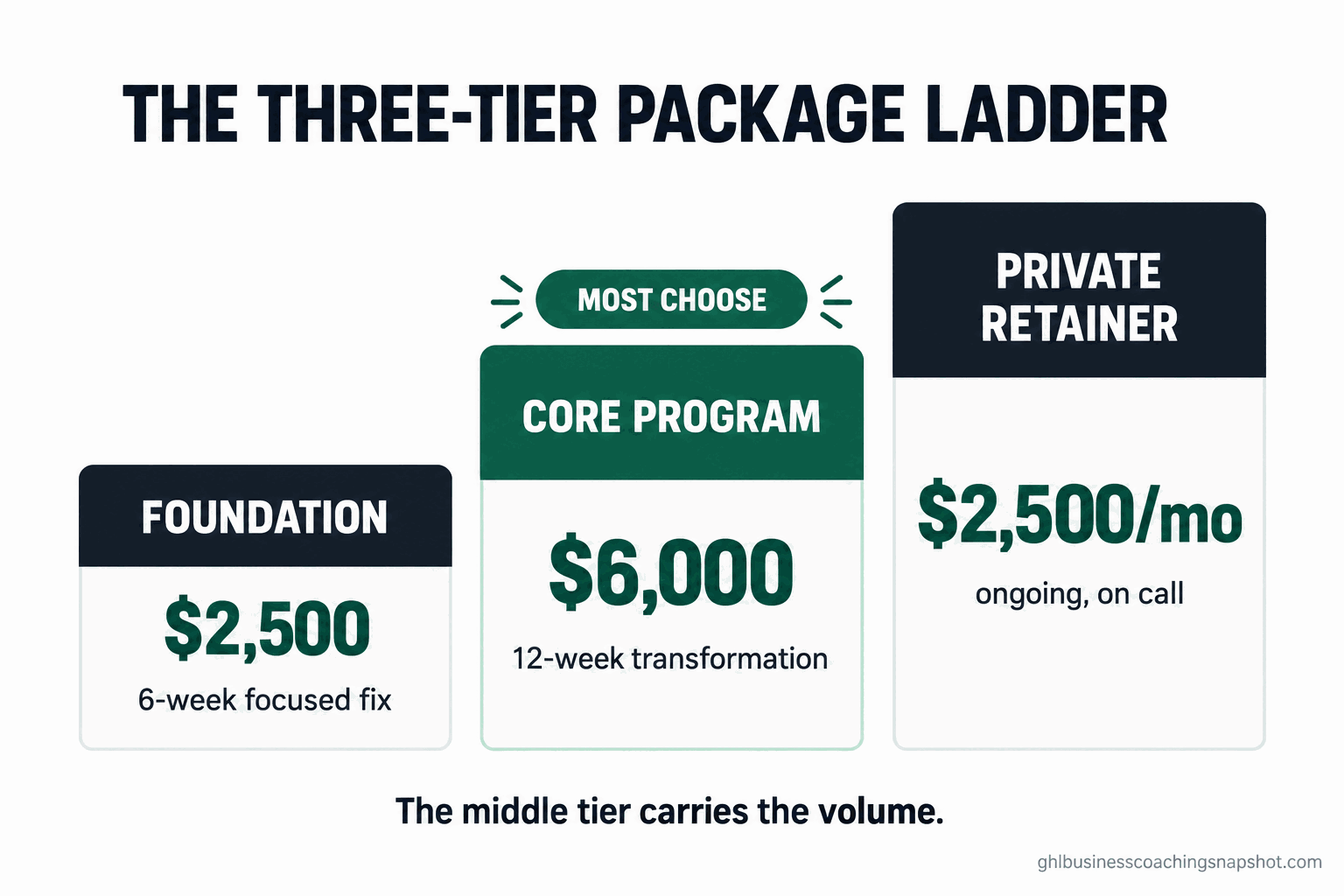
The top tier does a specific job even when almost nobody buys it. It makes the Core Program look like the sensible, grounded choice rather than the expensive one. Without a tier above it, your Core Program is the ceiling, and ceilings feel expensive. With a tier above it, your Core Program is the middle, and middles feel safe.
The copy to steal. On the proposal, label the tiers by who they are for, not by features: “Foundation, for a single specific fix. Core Program, for a full rebuild, this is what most clients choose. Private Retainer, for when you want me on call ongoing.” You are doing the sorting for them.
Stage 3: Set the anchor and the real number
People do not judge prices in absolute terms. They judge them relative to the first number they see. That is why the Private Retainer tier matters even when it rarely sells, and it is why the order you present prices in changes what the client feels.
Lead with the highest number. If you are talking a client through the ladder, start at the retainer and work down, so each subsequent price lands as a relief rather than a shock. If you open with the cheapest tier and climb, every step up feels like being upsold.
Then pick your real number, the price of the Core Program, with a method instead of a vibe. Three inputs: the floor (your costs plus the income you need per delivered hour), the value (a fraction of the outcome the client can expect), and the market (where packaged coaches sit, not hourly ones). Your price lives in the overlap, and for most coaches the honest finding is that there is room to move up without touching the value ceiling at all.
The copy to steal. When you set the number internally, write the one-line justification you would be comfortable saying out loud: “Six thousand for twelve weeks is five hundred a week to rebuild the single system that runs your revenue.” If you cannot say the justification without wincing, the problem is usually that the package is vague, not that the number is high.
Stage 4: Scope the delivery so it cannot leak
A package priced beautifully still loses money if the delivery has no edges. Scope creep is the silent killer of coaching margins: the “quick question” texts at 10pm, the extra session “just this once,” the review of a document that was never part of the deal. Each one is small. Together they turn a $6,000 package into a $9,000 delivery you only got paid $6,000 for.
Define three things in writing before anyone signs: what is included (exact number of sessions, exact support channels, exact response window), what is explicitly not included (extra sessions, document review, work for the client’s team), and how overages are handled (additional sessions billed at a stated rate, async support capped at a stated volume). You are not being rigid. You are protecting the relationship from the resentment that builds when you quietly do unpaid work.
Scoping the between-session support
Open-ended: the client texts whenever, you reply whenever, and 'support between sessions' means whatever they decide it means. By month two you are on call, unpaid, and starting to resent it.
Defined: async messaging Monday to Thursday, one reply per business day, voice notes welcome, nothing over the weekend. The client knows exactly what they have, and you know exactly what you owe.
The copy to steal. A single line in the agreement does most of the work:
“Between-session support is available by message Monday through Thursday, with one reply per business day. Additional live sessions beyond the package are available at $300 each. This keeps your dedicated session time protected and makes sure everyone who works with me gets my full attention.”
That framing, “so everyone gets my full attention,” turns a limit into a feature.
Stage 5: Present the price without flinching
Everything so far fails if the price gets delivered badly. The most expensive moment in your whole practice is the thirty seconds when you say the number, because that is when discounts are born.
Three rules. First, present the price in writing, in a proposal, not live on a call where your nerves can edit it. A written number is just a fact. A spoken number invites negotiation. Second, state it once and stop talking. The silence after a price feels unbearable to the person who said it and completely normal to the person hearing it. Whoever speaks first in that silence loses, and it should not be you. Third, no softeners. Never attach “but,” “only,” or “we can work something out” to a price. Those words tell the client the number is negotiable and that you do not believe it yourself.
The copy to steal. The whole price delivery, in a proposal and then confirmed on the call:
“The Core Program is $6,000 for the twelve weeks. You can pay in full, or in three monthly payments of $2,100. Which works better for you?”
Notice the question at the end is not “is that okay?” It is “which payment option?” You have moved the client past the decision to buy and into the logistics of buying, and you have done it without flinching.
Stage 6: Raise your rates without losing clients
The coaches who build real income raise their prices on a schedule, not when they finally snap from resentment. A rate increase done well is almost never the thing that loses a good client. A rate increase done in a panic, with an apology, usually is.
The mechanics are simple and they protect everyone. New rate applies to all new clients starting today, no announcement needed, you just quote the new number. Current clients get a dated notice, usually thirty to sixty days out, with the new rate and the date it takes effect. Clients mid-engagement finish their current package at the price they signed, always. And your best long-term clients can be grandfathered at their current rate as an explicit loyalty reward, which turns the increase into a reason to feel valued rather than squeezed.
The copy to steal. The rate-increase notice to current clients:
“A quick heads-up on pricing. Starting [date], my coaching rates are increasing to reflect the depth of the work and the results we have been getting. Because you have been with me since [earlier date], your current rate is locked in through [date], so nothing changes for you right now. I wanted you to hear it from me directly rather than see a different number later. Thank you for the trust, it means a lot.”
Three versions: first ten clients, scaling solo, boutique
The six stages do not change. What changes is how you apply them at your stage. Run the same framework three ways.
First ten clients (just starting). Your job is not to maximize price, it is to validate that people will pay for a packaged outcome at all. Build one package, not three, and price it at a real number you can say without wincing, often somewhere around the $2,000 to $3,500 range for a focused engagement. Skip the retainer tier for now. Your anchor is simply “this versus doing nothing.” Collect outcomes obsessively, because those outcomes are what let you raise the price for clients eleven through twenty.
Scaling past solo (established, time-capped). You are out of hours, which means the hourly trap is now actively costing you money. This is where the full three-tier ladder earns its keep, and where you deliberately push volume toward group and packaged formats so your income stops being chained to your calendar. If you are feeling the ceiling, our guide on moving from 1:1 to group coaching covers the one-to-many math in detail. Raise your 1:1 rate high enough that it steers the price-sensitive toward the group, on purpose.
Boutique with fractional-CxO retainers (2 to 8 people). Now pricing has to account for who delivers, not just what. Your retainer tier becomes the core of the business, priced on the seniority of the person on the account, and packages get scoped per deliverable because multiple people touch the work. The failure mode is a founder-priced retainer delivered by a junior coach, which quietly destroys margin. Price the account to the role, protect the scope ruthlessly, and optimize the recurring retainers rather than one-off packages.
The directional difference across models is large. The same delivered hours produce very different annual revenue depending on whether they are sold as loose hours, fixed-price packages, or recurring retainers.
Illustrative annual revenue (USD, thousands) from ten active client slots under three pricing models, holding delivered hours roughly constant. Illustrative structure, not a projection of your results. Loose hours churn and skip; packages and retainers hold.
The compliance line on price and income claims
Pricing conversations drift into dangerous territory the moment you justify the number with someone else’s results. “This pays for itself, my clients usually add $50,000 in revenue” is not a pricing argument, it is an earnings claim, and the FTC regulates it.
The 2023 FTC Endorsement Guides require that any testimonial describing an atypical result either carry substantiation or a clear, conspicuous disclosure of the results people can generally expect (FTC Endorsement Guides). If you quote a client outcome to justify a price, that outcome is now a claim you have to be able to back up and qualify.
It can go further. The FTC has proposed expanding its Business Opportunity Rule, and a related earnings-claims rulemaking, to cover programs that teach people how to make or increase money, which squarely includes a lot of business and “coach the coaches” offers. As of early 2025 that was a proposal out for public comment, not a final rule, and it drew two dissenting votes (FTC Business Opportunity Rule rulemaking). Treat the direction as the warning: if your pricing leans on income promises, you are the kind of seller these rules target. For the full breakdown, see our guide to FTC rules for coaches.
The safe pricing posture is to sell the process and the access, not the dollar outcome. “Twelve weeks to rebuild your sales process” is a defensible claim about what you deliver. “Twelve weeks to add six figures” is a claim about what the client will earn, and you almost never control that.
Common objections
“My market will not pay package prices, they expect hourly.” Your market expects hourly because that is what it has been offered. The regional fee data shows the same hour of coaching priced from $114 to $277 depending purely on positioning (ICF 2023). Buyers are not resisting packages, they are resisting vague packages. Give the outcome edges and the hourly expectation fades.
“Won’t three tiers confuse people or look like I am upselling?” Three is a guided choice, not confusion. One price is a dare, five is a spreadsheet, and three labeled by who each is for is the amount of choice that helps a buyer decide. The upsell worry disappears when the tiers are genuinely different things rather than the same thing at escalating prices.
“If I raise rates, I will lose the clients I have.” You will lose almost none of your current clients, because you grandfather them and finish every engagement at the signed price. The new rate applies to new clients, who have no old number to compare against. The only people who leave over a well-handled increase are people who were leaving anyway.
“I already pay for a dozen tools, I do not want pricing to add more software.” It should remove tools, not add them. The scoping, the proposal, the payment plans, and the rate-increase notices all belong in one system rather than in a scheduler plus a contract app plus a payment processor plus your memory. We ran the numbers on the stitched-together stack in our true cost of running a coaching business teardown, and the duct tape is usually the more expensive option.
“What about the clients whose payments fail on a package or retainer?” That is a delivery problem, not a pricing one, and it is bigger than most coaches think because failed charges are silent. The fix is automated dunning on the recurring and installment payments, which we cover in retainer billing recovery for coaches.
FAQ
How much should I charge for a coaching package?
Set the Core Program price from three inputs: your floor (costs plus the income you need per delivered hour), the value (a fraction of the financial or strategic outcome the client can expect), and the market for packaged, not hourly, coaches. For most newer coaches a focused engagement lands around $2,000 to $3,500, while a full twelve-week transformation commonly runs $5,000 to $10,000 depending on the stakes and who you serve. The right number is one you can justify out loud in a single sentence without wincing.
Should I show my prices on my website?
Show a starting price or a range if your packages are relatively standard, because it filters out poor-fit buyers before they take a discovery call slot. Hold exact pricing for the proposal if your engagements are heavily customized or high-ticket, where the number only makes sense after you have scoped the work on the call. Either way, never make a good-fit prospect email you to find out whether they can afford you.
How do I move existing hourly clients onto packages?
Do it at a natural boundary, not mid-stream. When an hourly client finishes a block of work or hits a new goal, present the next phase as a packaged engagement: 'For this next stage I work in twelve-week containers, here is what that looks like.' Most will move over because the package gives them a clearer path, and the ones who insist on staying hourly can be quoted a higher hourly rate that makes the package the obvious better deal.
How often should I raise my coaching rates?
Review your rates at least once a year, and raise them whenever you are consistently booked, have added proof of outcomes, or have improved your delivery. Apply the new rate to new clients immediately, give current clients 30 to 60 days' notice, let anyone mid-engagement finish at their signed price, and grandfather your longest-standing clients as a loyalty reward. On that cadence, an increase rarely costs you anyone worth keeping.
Is it better to charge monthly retainers or fixed-price packages?
Fixed-price packages suit a defined transformation with a clear finish, which makes them easy for a new client to say yes to. Monthly retainers suit ongoing, open-ended relationships and give you more predictable recurring revenue, which is why established practices lean on them. Most mature coaching businesses use both: packages to win and transform new clients, retainers to keep the ones who want you on call after the package ends.
Can I use client income results to justify my prices?
Be very careful. The moment you justify a price with what clients earn, you have made an earnings claim the FTC can regulate, and atypical results need substantiation or a clear disclosure of typical outcomes. The safe posture is to price on the process and access you deliver, which you control, rather than on a dollar outcome, which you do not. See our FTC rules guide for the specifics and sample disclosure language.
Pricing is not a personality trait you either have or lack. It is a system: name the outcome, build the ladder, set the anchor, scope the delivery, present without flinching, and raise on a schedule. Run those six stages and the discovery call changes. The prospect asks what you charge, you tell them in writing, and the half-second flinch never arrives, because for the first time the number is attached to something with real edges. That is the whole difference between a coach who trades hours for a $52,800 average and one who gets paid for the transformation they actually deliver.