
It is a Tuesday and your “Free Coaching Clarity Guide” just crossed 600 downloads. Six hundred people handed over an email address to get it. You felt good about that for about a week. Then you looked at your calendar and realized not one of those 600 had booked a discovery call. The guide works. The opt-in works. The pipeline does not.
Short answer: a coaching lead magnet that only collects email addresses is a list-building tool, not a client-getting system. The downloads are the easy 10% of the job. The other 90% is the funnel that sits behind the magnet: a delivery that asks for the call while excitement is high, a short nurture sequence that warms the people who did not book on day one, and a speed-to-lead safety net that catches the ones who finally raise their hand. Build that funnel in GoHighLevel and the same 600 downloads start producing booked, qualified discovery calls instead of a bigger list you never email.
Why downloads without calls is worse than no lead magnet
A lead magnet feels like progress because the number goes up. Six hundred downloads, then 800, then a thousand. But a list you do not convert is not an asset, it is a monthly bill: the email tool, the landing-page tool, the storage, and the quiet guilt every time you see the subscriber count and remember you have not emailed them since the welcome message.
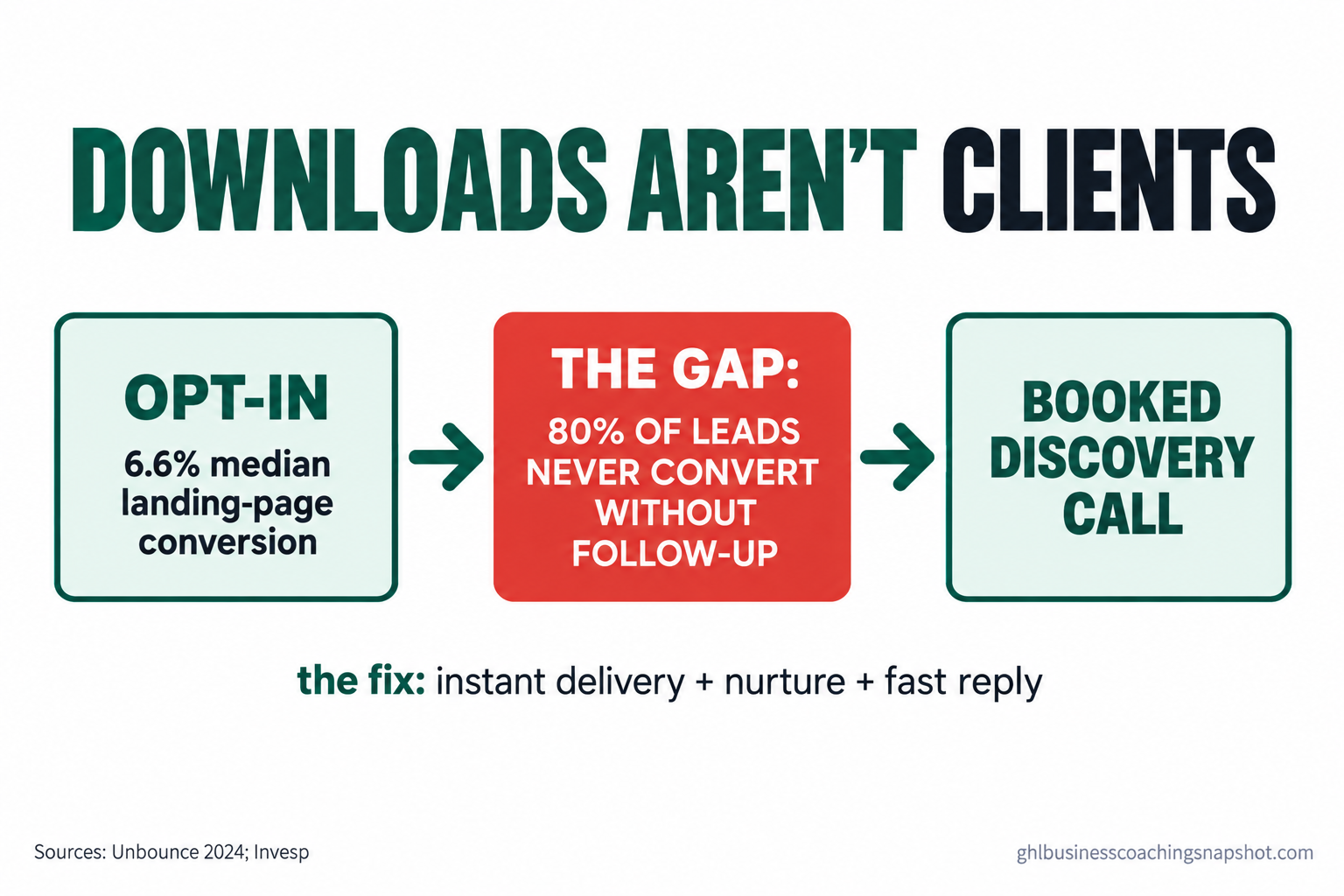
Here is the uncomfortable math. Getting the opt-in is the easy part. The median landing page converts about 6.6% of visitors across all industries, based on Unbounce’s analysis of 41,000 landing pages (Unbounce). Plenty of coaches clear that bar. The problem is what happens next: the download fires, the welcome email sends, and then nothing. The lead cools. By the time you remember they exist, the certainty that made them download is gone.
That is not a small leak. Roughly 80% of new leads never translate into sales, and the firms that do nurture systematically pull 50% more sales-ready leads at a 33% lower cost than the ones that do not (Invesp). The gap between a dead list and a pipeline is not a better magnet. It is the system that runs after the download.
Share of new leads that never become sales without nurturing. Source: Invesp, lead nurturing statistics.
And the market is too crowded to waste the ones you get. The 2025 ICF Global Coaching Study counted a record 122,974 coach practitioners worldwide, up 15% since 2023, generating $5.34 billion in revenue (International Coaching Federation). Your prospect downloaded three other guides the same week they downloaded yours. The coach who turns the download into a conversation wins the client. The one who adds them to a list and hopes does not.
What a lead magnet funnel actually is
A lead magnet funnel is the complete path from a stranger’s first click to a confirmed discovery call. The magnet is one piece of it, the first piece, and the one coaches over-invest in. The parts that actually produce calls come after.
There are six stages, and each one has a single job:
- The magnet pre-sells the call instead of just answering a question.
- The opt-in page turns a visitor into a known contact with the fewest fields possible.
- The delivery hands over the resource and asks for the call while excitement is at its peak.
- The nurture sequence warms the 80% who did not book on day one.
- The booking ask gives them a clear, low-friction reason to pick a time.
- The speed-to-lead safety net catches every “book now” click in seconds, not the next morning.
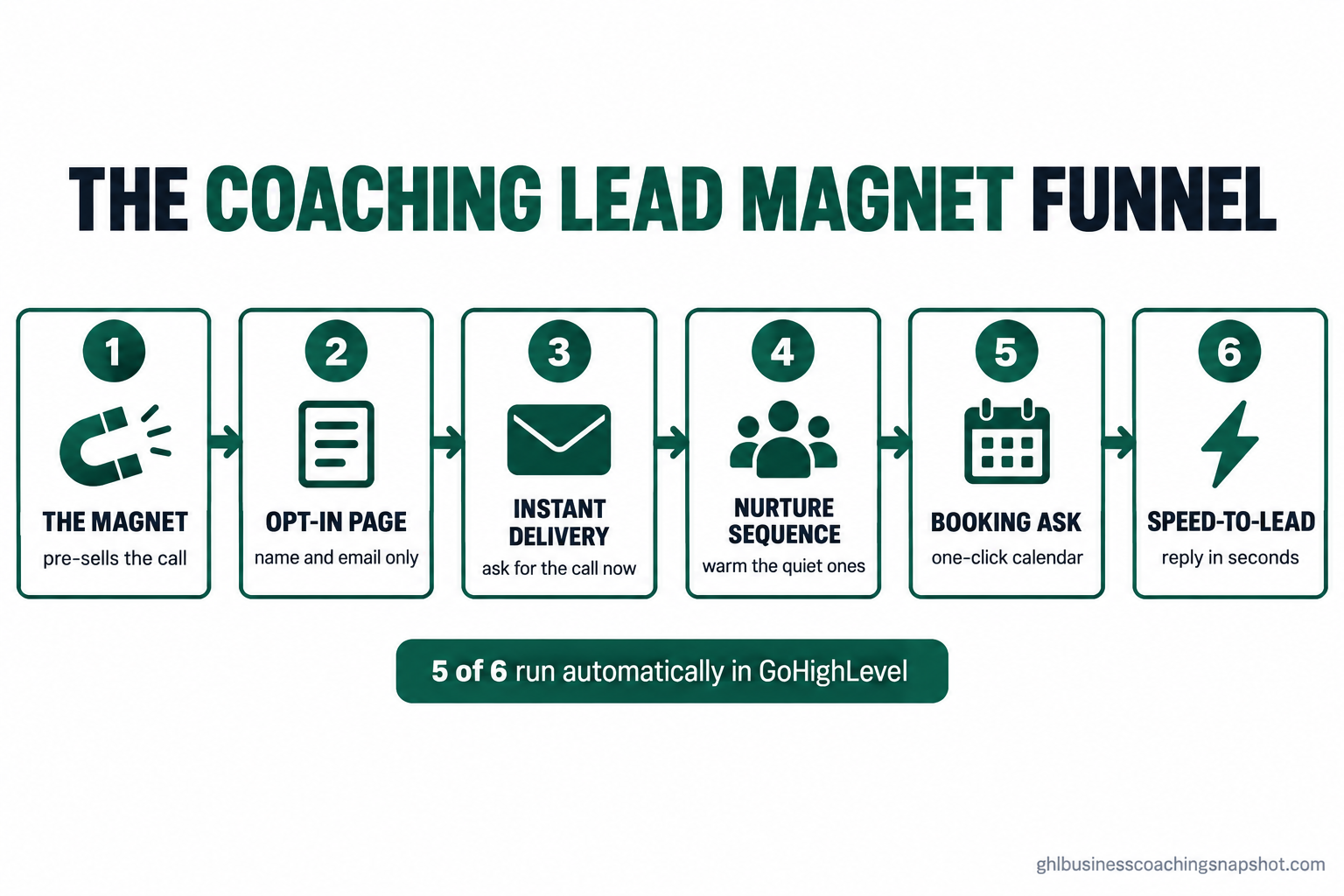
Miss any one and the funnel leaks at that exact seam. Most coaching funnels have a great stage one and nothing behind it. We are going to build all six, and every stage below includes the way it breaks and the copy you can lift straight into your account.
Stage 1: Pick a magnet that pre-sells the call
Most coaching lead magnets fail at the concept stage. A 42-page “ultimate guide” is a terrible magnet because it does two things wrong: it takes effort to consume (so most people never do), and if it somehow delivers the full transformation, it removes the reason to book you. The best magnet solves one specific, painful, narrow problem completely, and in solving it, reveals the bigger problem that needs you.
Think of it as a demonstration, not a textbook. A scorecard that tells an executive their leadership team is a 4 out of 10 on delegation creates a question they cannot answer alone. A one-page pricing calculator that shows a consultant they are leaving $40K on the table creates urgency. Those pull the call. A generic PDF does not.
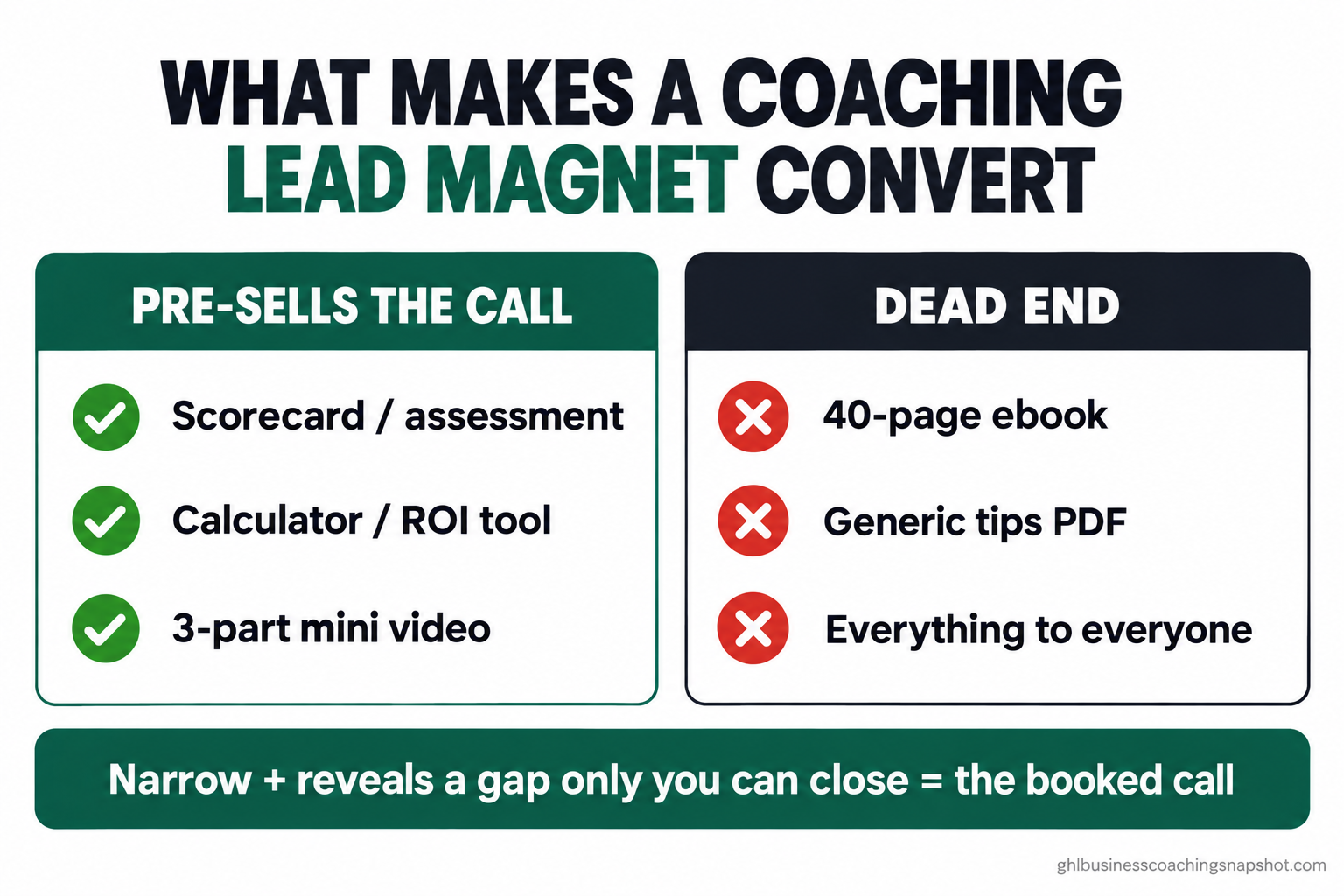
Here is how the common formats stack up for a coaching practice:
| Magnet type | Consumes in | Pre-sells the call? | Best for |
|---|---|---|---|
| Scorecard / assessment | 3–5 min | Strong (names a gap only you can close) | Executive, leadership, sales coaches |
| Calculator / ROI tool | 2 min | Strong (quantifies the cost of inaction) | Consultants, business coaches |
| Short checklist / template | 5 min | Medium (useful, but easy to self-serve) | Early-stage, broad audiences |
| Mini video training (3 parts) | 15–20 min | Strong (builds trust and authority) | High-ticket, group programs |
| 40-page ebook | “later” (never) | Weak (effort high, reason to book low) | Almost nobody |
How it breaks: the magnet is too broad (“Grow Your Coaching Business”), so it attracts everyone and qualifies no one. Fix it by narrowing to one avatar and one problem. “The 10-Minute Delegation Scorecard for Overloaded Founders” beats “Leadership Tips” every time, because the specific person reading it feels seen.
Stage 2: The opt-in page and form
The opt-in page has exactly one job: trade the resource for a contact. Everything on it either serves that trade or hurts it. The headline names the specific outcome (“Find the one delegation gap costing you 10 hours a week”), three bullets say what they get, and the form asks for as little as you can get away with.
On fields: for a top-of-funnel magnet, ask for first name and email, and stop. Every extra field drops your conversion. You will qualify them later, in the nurture and on the call, where it does not cost you the opt-in. The exception is a phone number, and only if you plan to text them, with consent, because an SMS nurture outperforms email on speed (more on that in Stage 6).
How it breaks: the page asks for seven fields “to qualify better,” and conversion craters. Or the page is beautiful but buries the actual value below a 600-word story. Put the offer and the form above the fold. A visitor decides in seconds.
Stage 3: Delivery that books the call on the spot
This is the stage coaches skip, and it is the single biggest win in the whole funnel. The moment someone opts in is the peak of their interest. They will never be warmer than in the 60 seconds after they hit submit. Most funnels waste that moment by dropping the person on a plain “check your inbox” page. Instead, your thank-you page should deliver the resource and immediately offer the next step.
Steal this thank-you page copy:
Your scorecard is on its way to your inbox (check spam if it is shy).
While you are here: the coaches who get the most out of this scorecard do not stop at the score. They spend 20 minutes with me walking through the one gap that is costing them the most, and leave with a plan to close it. No pitch, no pressure. If your score was under 7, that conversation is worth more than the guide.
[Grab a 20-minute strategy call → ]
And the delivery email that follows, in seconds:
Subject: Here is your Delegation Scorecard, {{first_name}}
Hi {{first_name}}, your scorecard is attached. Two things: first, be honest on the self-scores, the value is in the gaps you would rather not admit. Second, if your total came in under 7, you are in the range where a 20-minute call saves you the most time. Here is my calendar: [book a slot]. Talk soon, Dana.
That is the whole trick. You are not waiting for them to come back. You are asking for the call at the exact moment they care most, on the thank-you page and in the first email. A meaningful share of your calls will come from this step alone, which is why skipping it is so expensive.
How it breaks: the thank-you page says “thanks, check your email” and stops. Or the delivery email arrives three hours later because it is not truly automated. Both kill the peak-interest window. The delivery has to be instant and it has to ask.
Stage 4: The nurture sequence that warms the quiet ones
Most people will not book on day one, and that is normal, not a failure. They are busy, they are skeptical, or the timing is wrong. The nurture sequence exists for them. Its job is to stay useful and present for the two to three weeks while they decide you are worth 20 minutes.
The mistake is treating nurture as a newsletter. A newsletter informs. A nurture sequence moves someone toward a decision. Each message does one of three things: proves you understand their problem, proves your approach works, or removes a reason not to book. Here is a five-touch sequence that does all three, mixing email and (with consent) SMS:
- Day 1 (email): the “did you use it” nudge. Reference the magnet, point them to the one thing most people miss, re-offer the call.
- Day 3 (email): the proof. A short, specific client story (or a before/after) that shows the gap closing. End with the call link.
- Day 5 (SMS, if opted in): the pattern-interrupt. One line, human, no pitch: “Quick one, {{first_name}} - did your scorecard surprise you? Happy to walk through it. Reply YES and I will send times.”
- Day 8 (email): the objection remover. Name the quiet fear (“you think you should fix this yourself first”) and reframe it. End with the call link.
- Day 12 (email): the soft close. “I am holding a couple of slots this week for scorecard folks. After that I am back to client work for the month.” Then the link.
Steal this Day 3 proof email:
Subject: She scored a 3 on delegation. Here is what changed in 6 weeks.
{{first_name}}, one of the founders I work with scored a 3 the first time she ran this. She was doing $1.2M but still approving every invoice herself. We did not add tools, we moved four recurring decisions off her plate and built a simple rule for the rest. Six weeks later she took her first unplugged week in two years. Your number does not have to be a 3 for this to work. If you want to find your four decisions, here is my calendar: [book a slot].
The copy references their magnet and their stated problem because the form and the scorecard fed those details into the CRM. That is what makes an automated sequence read as hand-sent instead of like a marketing autoresponder. We go deeper on the full email engine in email marketing for business coaches.
How it breaks: the sequence is all “value, value, value” and never asks for the call, so warm people drift off. Or it is five hard pitches in a row, so they unsubscribe. The ratio that works is useful-but-always-with-a-door-open.
Stage 5: The booking ask
Every stage so far has been building toward one action: picking a time. If the booking step has friction, all the warming you did leaks out at the final seam. The booking ask is both the call-to-action copy and the mechanics of the calendar itself.
On the copy: name the length, name the value, and remove the fear. “Grab a 20-minute strategy call” tells them the cost (20 minutes) and the payoff (strategy). “Book a sales call” tells them they are about to be sold to. Reframe the call as a continuation of the magnet, not a pitch. They already got value for free. The call is more of the same, specific to them.
On the mechanics: the calendar link goes straight to a real booking page with your actual availability, reminders built in, and no login required. Every extra step between “I want to talk” and “it is on both our calendars” costs you bookings. If they have to email you to find a time, you have reintroduced the exact phone tag this whole system was meant to kill. This is the handoff into your discovery-call follow-up sequence, which takes over once the slot is booked.
How it breaks: the call-to-action is vague (“let’s chat sometime”), or the link points at a contact form instead of a live calendar. Give them a specific length, a specific benefit, and a one-click path to a confirmed time.
Stage 6: The speed-to-lead safety net
Here is the stage that quietly decides whether the whole funnel works: what happens in the first five minutes after someone finally raises their hand. Because the research on this is brutal and it has not changed in a decade. Respond to a new web lead within five minutes rather than thirty and you are about 21x more likely to qualify them, from the MIT and InsideSales Lead Response Management study of roughly 15,000 leads (Lead Response Management study).
Relative likelihood of qualifying a web lead by response speed. Source: MIT / InsideSales Lead Response Management study.
Almost nobody actually does it. In a live audit of 433 B2B companies, only 7% responded within five minutes and 55% did not respond within five business days (Drift). Slow is the norm, which is exactly the opening for a coach whose system is fast.
No solo coach can hit five minutes by hand while mid-session or asleep, and you should not try. The safety net is automation: the instant the booking click comes in, an SMS or email fires confirming the slot, reminders go out before the call to kill no-shows, and if the lead started booking but stalled, a nudge catches them. This is the same instant-response engine covered in speed to lead for coaches and the reason a no-show reminder cadence belongs in the build from day one.
Run it for your stage: solo, boutique, scaling
The six stages are the same for everyone. What changes is how much you lean on each one, based on where your practice is.
The solo coach chasing the first 10 clients. Your constraint is traffic, not scale. Build one magnet, one opt-in page, one five-touch nurture. Do not build three funnels, you do not have the audience to feed them. Lean hardest on Stage 3 (delivery that books the call) and Stage 6 (speed), because when you only get a handful of opt-ins a week, you cannot afford to lose one to a slow reply. Keep the SMS touch, it converts your tiny volume harder.
The 2-to-8-person boutique layering retainers. You have traffic and you have a team, so your risk is inconsistency: one coach replies in two minutes, another in two days. Your win is in Stage 6 and in branching. Route every opt-in through one automated workflow so the lead’s experience does not depend on which human happened to see the notification. Add a second magnet tuned to your highest-value service (a fractional-CxO scorecard, say) and keep the nurtures separate.
The practice scaling past solo. You are moving from “I do the follow-up” to “the system does the follow-up and I do the calls.” Your focus is measurement and segmentation: tag opt-ins by which magnet they came through, score engagement, and route the hottest ones to a human faster while the colder ones stay in a longer nurture. This is also where a dormant-lead reactivation layer starts paying off, because you now have enough past opt-ins to win back.
The compliance bit nobody reads (but should)
Two rules matter for a lead magnet funnel, and getting them wrong is expensive.
First, email. Every nurture email needs a working unsubscribe link and a real physical mailing address, and you must honor opt-outs promptly. That is CAN-SPAM, and it is not optional even for a one-person practice. A compliant unsubscribe is also just good hygiene: people who do not want to hear from you drag down your deliverability.
Second, SMS. If you text leads, you need their consent to do it, a clear STOP opt-out, and you should respect quiet hours. The consent has to be specific, not buried. If you collect a phone number on the opt-in, the form should make clear they may receive texts, and the first text should honor STOP instantly. We cover the texting side in depth in the A2P 10DLC registration guide for coaches.
None of this is a reason to avoid building the funnel. It is a reason to build it in a system that handles unsubscribes, STOP, and consent for you, rather than stitching it together across tools where one of them quietly drops the ball.
Objections, answered
“Won’t a free magnet just attract freebie-seekers who never pay?” Some, yes. That is what the funnel is for. The nurture and the booking ask filter the tire-kickers from the ready buyers without you spending a minute on either. A freebie-seeker ignores the call offer and costs you nothing but an email send. A real prospect books. You are not trying to make everyone buy, you are trying to find the 20% who will and start a conversation with them cheaply.
“Do I need a huge list for this to work?” No. This system is about conversion rate, not list size. A coach with 300 engaged opt-ins and a real funnel books more calls than one with 5,000 subscribers and a dead list. If anything, a small list is easier, because you can keep the nurture personal and even reply by hand. Start with the audience you have.
“Isn’t email dead? Nobody opens anything.” Email is not dead, untargeted email is. Done right it remains the highest-ROI channel in marketing, returning roughly $36 for every $1 spent (Litmus). The reason your past emails flopped is almost always that they were newsletters to a cold list, not a sequence to people who just asked you for something specific. This funnel fixes both.
“I already have an opt-in on my Kajabi or Kartra page. Isn’t that enough?” The opt-in is stage two of six. If all it does is add the person to a list, you have the easy part and none of the parts that produce calls. You do not necessarily need to leave your course platform, but the funnel behind the opt-in (the instant booking offer, the branching nurture, the speed-to-lead reply) has to exist somewhere, and most course platforms do not do CRM-grade automation well. That is the gap this fills.
Metrics worth watching
Four numbers tell you whether the funnel is working, and none of them is “downloads.”
- Opt-in rate. Visitors who become contacts. The 6.6% median (Unbounce) is your floor for warm-ish traffic. Below it, fix the page before anything else.
- Opt-in-to-booked-call rate. The number that matters. What share of new contacts book a discovery call within 30 days? This is the one downloads hide.
- Speed to first contact. How fast your system responds to a booking click. Aim for seconds, measure it, because almost nobody hits five minutes and that is your edge.
- Nurture-attributed bookings. Of your booked calls, how many came from the sequence versus the thank-you page? This tells you whether your nurture is earning its place.
Build it yourself vs. have it installed for you
Everything above is buildable in a blank GoHighLevel account. It is also a real project: a native opt-in form wired to custom fields, a thank-you page with a live calendar, an instant delivery workflow, a branching five-touch nurture across email and SMS, consent and STOP handling, reminder logic, and tagging so you can measure it. Each piece is simple. Wiring them together so they fire in the right order, react to behavior, and never double-send is the part that eats weekends.
Three honest paths:
| Path | What it costs you |
|---|---|
| Build it yourself in GHL | 40–80 hours across forms, pages, workflows, and nurture copy; full control, slow to launch |
| Hire a GHL agency | $3K–$5K/mo retainer to build and maintain the automation |
| Coaching Snapshot | One-time install, the full funnel (opt-in, delivery, nurture, speed-to-lead) pre-built into your GHL in about 24 hours |
The Coaching Snapshot ships this lead-magnet funnel as one part of a complete coaching system, so a stranger flows from a cold click to an opt-in to a booked, reminded discovery call without you touching the admin. If you do not have GoHighLevel yet, you can grab it with our bonuses here, or if you would rather see it running first, book a walkthrough. For the bigger picture of steadying an up-and-down pipeline, start with the feast-or-famine coaching pipeline, and for filling a group program specifically, see how to fill a group coaching cohort.
It is now a different Tuesday. The guide still crosses a few downloads a day, but you have stopped watching that number. You watch the calendar instead, where three discovery calls landed this week from people you have never spoken to, each one having already read the thing, scored themselves, and decided a conversation was worth 20 minutes. The magnet did not change. The 90% behind it finally exists.
Frequently asked questions
What is a lead magnet funnel for coaches?
A lead magnet funnel is the complete path from a stranger's first click to a booked discovery call. It has six stages: the magnet itself, the opt-in page, an instant delivery that asks for the call, a nurture sequence that warms people who did not book right away, a low-friction booking ask, and a speed-to-lead safety net that responds in seconds. The magnet collects the contact; the funnel behind it produces the call.
Why does my lead magnet get downloads but no clients?
Because downloads are stage two of six, and most coaches build nothing after it. The opt-in adds someone to a list, then the lead cools because there is no instant booking offer, no nurture sequence, and no fast response when they finally raise their hand. Around 80% of new leads never convert without follow-up, so a magnet that only collects emails is a list-building tool, not a client-getting system.
What makes a good coaching lead magnet?
One that solves a single narrow problem completely and, in doing so, reveals a bigger problem that needs you. Scorecards, assessments, and calculators work well because they quantify a gap the person cannot close alone, which pre-sells the call. Long ebooks work poorly because they take effort to consume and, if they deliver everything, remove the reason to book you. Narrow beats comprehensive.
How many emails should a lead magnet nurture sequence have?
A five-touch sequence over about two weeks works well for most coaching practices: a day-1 nudge, a day-3 proof story, a day-5 SMS (with consent), a day-8 objection remover, and a day-12 soft close. Each message should be useful and end with a door open to the call. The sequence should stop the moment someone books, and branch based on whether they clicked the calendar link.
Can I build a lead magnet funnel in GoHighLevel?
Yes, this is exactly what GoHighLevel is built for. A native form captures the opt-in to your CRM, a workflow fires instant delivery with a booking link, a branching nurture sequence runs across email and SMS with consent and STOP handling, and the booking click triggers an immediate confirmation plus reminders. Because the contact lands in your CRM the instant they submit, the automation can respond in seconds rather than hours.
Do I need a big email list for a lead magnet funnel to work?
No. The system is about conversion rate, not list size. A coach with 300 engaged opt-ins running a real funnel books more calls than one with 5,000 subscribers and a dead list. A smaller list is actually easier to convert because you can keep the nurture personal. Start with the audience you have and build the funnel before you spend on more traffic.
Related reading
- Speed to Lead for Coaches: Book More Calls Before the Lead Goes Cold
- Email Marketing for Business Coaches: The Client-Getting System
- The Coaching Application Form That Actually Qualifies
- How to Reduce Discovery-Call No-Shows
- The Feast-or-Famine Coaching Pipeline
Statistics reflect publicly available sources as of November 2026 and are linked inline; figures from third parties are set by those publishers and may change, so confirm them on the source pages. Examples, copy, and targets on this page are illustrative and not a guarantee of revenue, client count, booking rate, or income.