
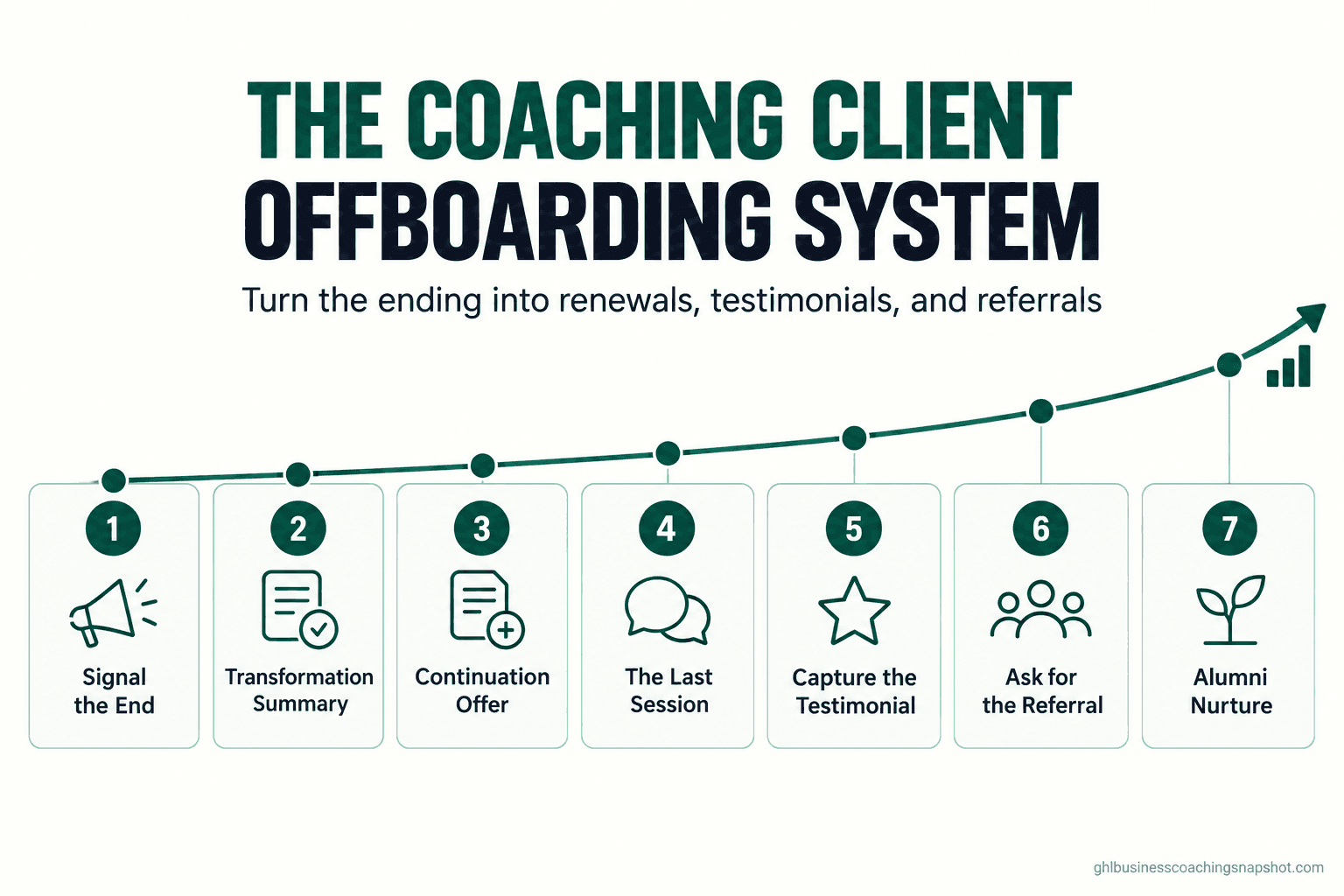
Short answer: most coaches build a beautiful onboarding and then let the engagement end by drifting. The last session happens, nobody says it was the last session, the invoice stops, and a client who got real results just evaporates. That quiet exit is the single most expensive habit in a coaching practice, because the end of an engagement is when a renewal is easiest to win, a testimonial is most honest, and a referral is warmest. Offboarding is the system that turns the ending into a deliberate, repeatable moment: you signal the end, you show the client how far they came, you make the continuation offer, you run a real last session, and then you capture the testimonial, ask for the referral, and move them into an alumni list that brings some of them back. Below is the whole thing, stage by stage, with the real copy and the ways each step breaks.
What a silent ending actually costs you
Start with the market, because the problem is not a shortage of coaching. The 2025 ICF Global Coaching Study counts 122,974 coach practitioners worldwide, up about 15% since 2023, generating roughly $5.34 billion in annual revenue, with 90% of coaches actively serving clients (ICF). The field is crowded and growing. What separates a practice that compounds from one that treads water is not the number of leads coming in the front door. It is what happens at the back door when an engagement ends.
Market figures: ICF 2025 Global Coaching Study. Retention-to-profit range: Harvard Business Review, “Zero Defections: Quality Comes to Services.”
A silent ending costs you three ways, and all three are expensive. First, you lose the renewal you never asked for. A client who just finished a strong engagement is the easiest sale you will make all quarter, because they trust you, they have momentum, and the alternative is losing it. If you never present the next step, they default to stopping, not because they chose to leave but because nobody offered them a reason to stay. The retention math is not soft either. The Harvard Business Review study on service businesses found that cutting customer defections by five percentage points lifted profits by 25% to 85% (HBR).
Second, you lose the testimonial. The most honest, specific, usable testimonial a client will ever give you is the one they give in the week they finish, when the before-and-after is vivid in their head. Wait three months and you get “it was great,” which sells nothing.
Third, you lose the referral, and this is the one that compounds. In the Wharton referral study, referred customers carried a lifetime value roughly 16% to 25% higher than customers acquired other ways, and they churned about 18% more slowly (Wharton). Referred clients are not just cheaper to get. They stay longer and are worth more. And the warmest referral you will ever get is from a client at the moment they are most grateful, which is the moment the engagement ends.
Relative customer lifetime value, indexed to 100 for non-referred clients. The Wharton study found referred customers were worth 16% to 25% more; 120 is the midpoint. Source: Wharton (Schmitt, Skiera, Van den Bulte), German bank data.
The ending most coaches run vs. a designed offboarding
Last session happens, nobody names it as the last. Invoice stops. Client drifts off. No renewal offered, no testimonial captured, no referral asked for. Three months later you cannot even remember what result they got.
The end is scheduled weeks out. The client gets a written before-and-after. You make the continuation offer, run a proper final session, collect a dated testimonial with proof, ask for one specific referral, and add them to an alumni list that reactivates a third of them within a year.
The offboarding system: seven stages
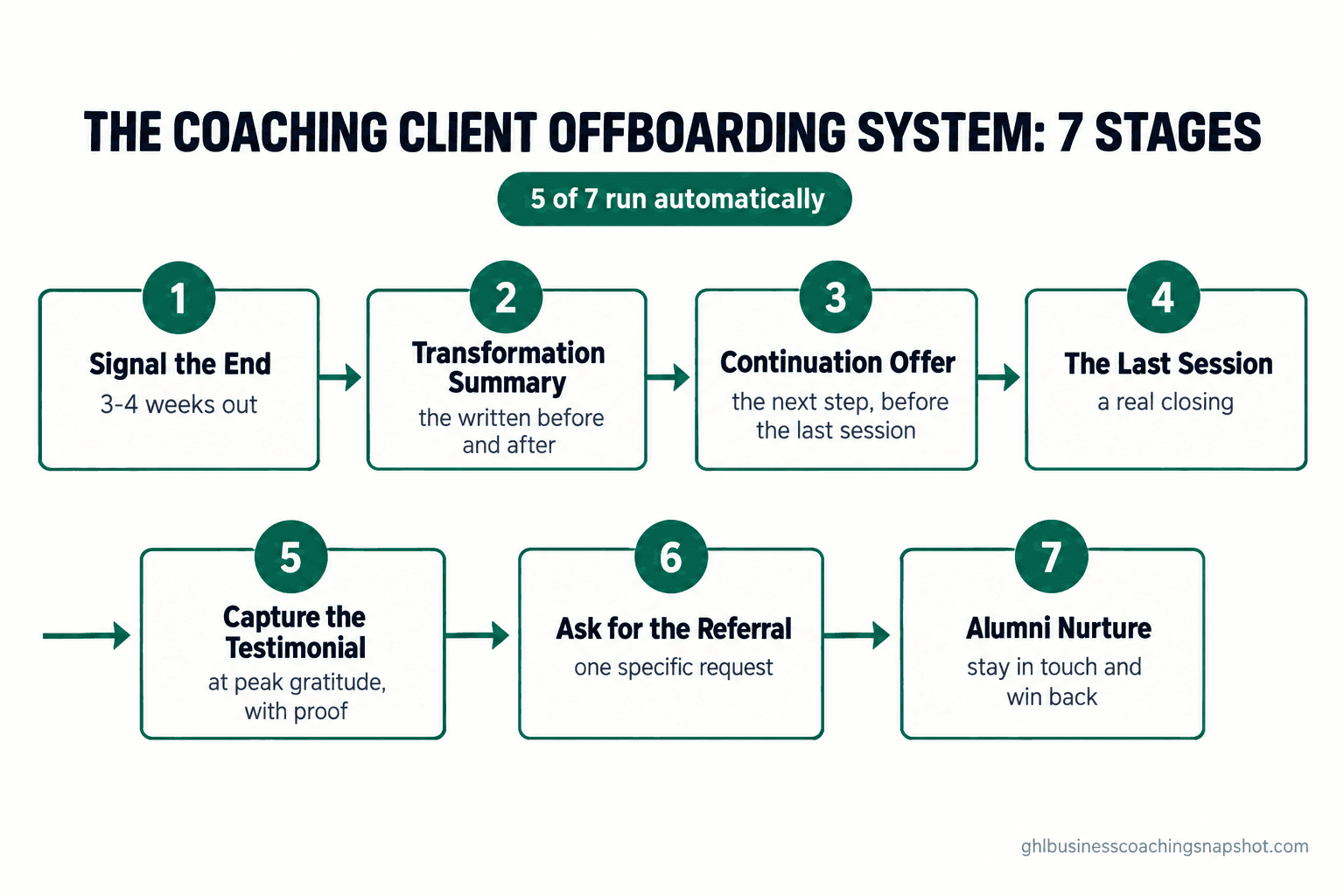
Offboarding is not a goodbye email. It is seven small steps that run across the final few weeks of an engagement, most of them automatable with the kind of CRM workflows that fire on a date instead of on your memory, that together turn an ending into renewals, proof, and introductions. Here they are in order, then each in detail with the setup, the real copy, the timing, and how it breaks.
- Signal the end so the ending is expected, not a surprise that catches everyone flat.
- Transformation summary shows the client, in writing, how far they came.
- Continuation offer puts the natural next step in front of them before the last session.
- The last session is run as a real closing, not just another call that happens to be the final one.
- Capture the testimonial at peak gratitude, with the proof the FTC expects.
- Ask for the referral with one specific, easy request, not a vague “send people my way.”
- Alumni nurture keeps the door open so past clients come back and keep referring.
Stage 1: Signal the end before it arrives
What it does: tells the client the engagement is ending three to four weeks out, so the ending is a planned event you both walk toward, not a thing that quietly happens when the sessions run out. Everything that follows depends on the client knowing the end is coming, because a decision made under surprise is a decision to stop.
Setup: trigger a short message when the engagement has three or four weeks left, counted from the start date or the session count. It does two jobs: it names the wrap-up date, and it opens the door to “what’s next” without pitching anything yet. This is the mirror image of the first-30-days onboarding system. You built a runway in; build one out.
The copy (steal this), the runway message:
{First name}, hard to believe, but we are about three weeks from the end of our current engagement. Before we get there I want to do two things: pull together a proper summary of what has changed since we started, and have an honest conversation about where you want to take this next. No pressure either way. For now, just know the finish line is {date}, and our last couple of sessions are going to be about locking in what you have built.
Timing: three to four weeks before the end, triggered by the calendar, not by you noticing. Early enough that the continuation conversation does not feel rushed, late enough that it is clearly about this engagement.
How it breaks: you skip it, and the end arrives as a surprise. The client is mid-momentum, the last session comes and goes unmarked, and the renewal conversation never happens because there was no moment to have it. The other failure is making the runway message a hard pitch three weeks early, which makes the client feel like the whole relationship was a setup. Name the date, promise the summary, and leave the offer for later.
Stage 2: Build the transformation summary
What it does: hands the client a written before-and-after so they can see the distance traveled, not just feel the last session. This is what makes everything downstream work. A client who can see what changed renews, testifies, and refers. A client who only vaguely feels better does none of those.
Setup: pull from the baseline you captured at intake, the milestones you set, and the progress notes along the way, and assemble a one-page summary: where they started, what changed, and what is still ahead. If you tracked progress properly during the engagement, this is mostly assembled for you, which is the entire argument for tracking client progress from day one. You are not writing a report from memory. You are printing a record.
The copy (steal this), the summary intro:
{First name}, here is the before-and-after from our work together. When we started, you rated {the thing} a {number} out of 10 and {starting metric} was where you were. Today you have {concrete result}, {metric} is now {current}, and you hit {milestone} and {milestone} along the way. I wanted you to see this written down, because it is easy to forget how far you have come when you are living it day to day.
Timing: delivered in the second-to-last session, so the client sits with it before the final call and arrives at the continuation conversation already reminded of the value.
How it breaks: you have no baseline, so there is no honest before to point at, and the summary turns into vague praise. The fix is upstream: capture the starting state at intake every single time. The other failure is a generic summary that could apply to any client. Tie every line to that client’s actual numbers and words, or it reads like a form letter and does the opposite of what you want.
Stage 3: Make the continuation offer
What it does: puts the natural next step in front of the client before the engagement ends, so stopping becomes a choice they actively make rather than the default that happens when nobody offers an alternative.
Setup: decide, before the conversation, what the honest next step is for this specific client. It is not always “renew the same package.” Sometimes it is a lighter-touch maintenance tier, a move from 1:1 into a group, or a different offer entirely. The point is to have a real recommendation ready, priced, and framed around where they are going, not around your calendar. If you are rethinking what those next-step options should cost, how to price coaching packages walks through the tiers.
The copy (steal this), the continuation offer:
Based on what you have built, here is what I would actually recommend for the next 90 days. You have the foundation now, so the work shifts from building to {next focus}. I would suggest {recommended next step} at {price}. If now is not the right time, that is completely fine, and the door stays open. But I did not want you to walk away from the momentum without knowing exactly what the next level looks like.
Timing: raised in the second-to-last session, after the summary has landed, and confirmed by the final session. Never sprung in the last five minutes of the last call.
How it breaks: you never make the offer, out of a fear of looking salesy, and the client leaves assuming the work is simply over. Silence is not humility. It is the most common way coaches leave money and client outcomes on the table. The other failure is offering the same thing to everyone. A client who finished a foundational engagement does not want to repeat it. Match the offer to where they actually are.
Stage 4: Run a real last session
What it does: marks the ending as a genuine milestone instead of letting the final call blur into every other call. A client who experiences a clear, intentional close remembers the engagement as complete and successful, which is the memory that drives the testimonial and the referral.
Setup: structure the last session differently from the rest. Spend the first part reviewing the transformation summary out loud, so the client says the wins back to you in their own words. Spend the middle on the continuation decision. Spend the end on a forward-looking plan they keep: the three things to protect, the next goal, what to do if they stall. Send that plan afterward as a tangible takeaway with their name on it.
The copy (steal this), the post-session close:
{First name}, that is a wrap on our engagement, and I mean it when I say I am proud of the work you put in. Attached is your forward plan: the three habits to protect, your next 90-day goal, and exactly what to do if you feel yourself drifting. You are not on your own here. You know where I am, and I will be checking in. Go build on it.
Timing: the final scheduled session, with the forward plan sent within an hour while it is fresh.
How it breaks: the last session is just another session, so there is no emotional punctuation and the client drifts off without a sense of completion. No completion, no gratitude spike, no testimonial. The other failure is making the last session a pure sales pitch for the renewal, which sours the one moment that is supposed to feel like a win. Lead with the win, handle the offer cleanly, and close with the forward plan.
Stage 5: Capture the testimonial while gratitude peaks
What it does: collects a specific, dated testimonial in the window where the client’s result is vivid and their goodwill is highest, which is the days right after the final session. Ask later and you get a weaker quote, if you get one at all.
Setup: trigger the request two or three days after the last session, while the forward plan and the wins are still fresh. Make it easy by giving them a frame, not a blank box. Ask for the specific before-and-after, because a testimonial with a concrete result is both more persuasive and, as the next section covers, the kind the FTC expects you to be able to back up. The full workflow for collecting and publishing wins safely is in the coaching testimonial system.
The copy (steal this), the testimonial request:
{First name}, one quick ask while it is fresh. Would you be up for sharing a few sentences on what working together was like? The most useful ones mention where you started, what actually changed, and who you would recommend this to. No need to be polished, just honest. And totally fine to say no. If it is easier to talk than type, record a two-minute voice note and I will handle the rest.
Timing: two to three days after the final session, with one gentle reminder a week later if there is no reply, then stop. Two asks, not a campaign.
How it breaks: you ask months later, when the result has faded, and get a limp “great experience, highly recommend” that proves nothing and sells no one. Or you ask with an open-ended “could you leave a review?” that gives the client no frame, so they freeze and never do it. Give them the three-part structure and a two-day window, and you get usable proof.
Stage 6: Ask for the referral, specifically
What it does: converts a satisfied finisher into a warm introduction, which is the cheapest and highest-quality lead source you have. The key word is specifically. A vague “send people my way” gets nodded at and forgotten. A specific, easy ask gets acted on.
Setup: trigger the referral ask a few days after the testimonial, so you are not stacking two requests in one message. Make it concrete: name the kind of person you help, give them a line they can forward, and lower the effort to almost nothing. This is one piece of a full referral system, aimed at the moment a client is most likely to say yes.
The copy (steal this), the referral ask:
{First name}, last thing, and no obligation at all. The clients I do my best work with usually look a lot like you did at the start: {one-line description of your ideal client}. If one or two people like that come to mind, the easiest thing is to forward them this: “I just wrapped up working with {your name} and it was genuinely worth it. Here is how to reach them: {link}.” That is it. If no one comes to mind, no worries at all.
Timing: a few days after the testimonial request, once, with no follow-up nag. The ask is warm precisely because it is light.
How it breaks: you ask for “any referrals” in the abstract, which asks the client to do the work of figuring out who, how, and what to say, so nothing happens. Remember what the Wharton data showed: referred clients are worth 16% to 25% more and churn about 18% slower (Wharton). These are your best future clients, so the ask is worth getting right. Name the person, hand them the words, and make forwarding a ten-second job.
Stage 7: Move them into the alumni nurture
What it does: keeps a finished client connected after the engagement ends, so the relationship does not go cold, and a meaningful share of them come back for a second engagement or refer again months later. The money in a coaching practice is not only in the current roster. It is in the alumni list nobody maintains.
Setup: when the engagement closes, the client moves automatically into an alumni segment with its own light cadence: a genuinely useful note once or twice a month, an occasional check-in on their forward plan, and a heads-up when you open something they would want. Every few months, a soft “how is it going, want to pick this back up?” This is database reactivation pointed at your warmest possible audience, people who already paid you and got a result.
The copy (steal this), the alumni check-in:
{First name}, it has been a few months since we wrapped. No agenda here, just genuinely wondering how {their goal} is holding up and whether that forward plan is still working for you. If you have hit a new ceiling and want to go again, I would love to. If you are cruising, that is the best possible outcome and I am glad. Either way, good to think of you.
Timing: a steady, low-volume cadence, with a direct reactivation touch every three to four months. Useful first, offer second.
How it breaks: there is no alumni list, so a finished client is simply gone, and you re-earn every future client from zero. Or the alumni cadence is all pitch and no value, so people tune out and unsubscribe. Lead with something useful, keep the volume low, and the reactivation touches land because they arrive on top of goodwill, not on top of spam.
Three versions: solo, cohort, boutique
The seven stages hold across every coaching practice, but the way they run changes with your model. Here is how the same system looks in three common shapes.
The solo 1:1 coach. Offboarding is personal and high-touch, and that is your advantage. The runway message and the alumni check-ins come from you by name. The transformation summary is one page, built from the client’s own baseline and notes. The last session is a real conversation. Automation handles the timing and the reminders so nothing slips, but the voice stays unmistakably yours. For a small roster, the win is simply never forgetting to make the offer, ask for the testimonial, or keep the door open, because at ten clients a year those three habits are the difference between a flat practice and one that compounds.
The group cohort. Here the ending is shared, so lean into it. The whole cohort hits the runway at once, so run a proper closing session or graduation call for the group, publicly acknowledge wins, and make the continuation offer as a next-cohort or alumni-tier invitation. Testimonials collected at a cohort close often come in a rush because people feed off each other’s enthusiasm, so have the request ready to fire the day after the final session. The alumni nurture becomes an alumni community, which is its own retention and referral engine. The risk at cohort scale is that the ending feels like a conveyor belt, so protect the individual acknowledgment even inside the group ritual.
The boutique with fractional-CxO retainers. Engagements are longer, larger, and often rolling, so “offboarding” may mean a scope change or a renewal checkpoint rather than a hard stop. The transformation summary becomes a quarterly or end-of-term results review delivered to a buyer who answers to someone above them, so build it to be forwarded upward: clear outcomes, clear numbers, clear next-phase recommendation. The continuation offer is a renewal or expanded-scope conversation held well before the term ends. The referral ask lives inside the account, since one happy fractional engagement is the warmest possible intro to a peer in the same network.
The compliance line on client wins
Offboarding is where you collect your best testimonials, so it is also where you need to get the rules right. The FTC’s 2023 Endorsement Guides are the ones that matter here, and they are not optional guidance. If you publish a testimonial describing a result that is better than what a typical client gets, you must either have substantiation that the result is representative, or clearly and conspicuously disclose the generally expected result (FTC). A buried “results not typical” in tiny gray text does not count as clear and conspicuous.
This is exactly why the testimonial you capture at wrap-up should include the concrete before-and-after. That record is your substantiation. If a client says they doubled revenue, your own progress notes and baseline showing where they started are what back the claim up. Collect the proof as part of offboarding and the compliant testimonial writes itself.
Two more lines worth knowing. If any material connection exists between you and the person giving the endorsement, a discount, a free month, an affiliate arrangement, that connection has to be disclosed clearly (FTC). And if your offer is a “coach the coaches” or business-opportunity program that makes earnings claims, the FTC’s Business Opportunity Rule requires you to back those claims with an Earnings Claim Statement (FTC 16 CFR 437). None of this is a reason to avoid testimonials. It is a reason to collect them with proof, which offboarding already does. The deeper walkthrough is in the FTC rules every coach should know.
Common objections
“Isn’t it pushy to pitch a renewal right at the end?” It is pushy if the whole last session is a pitch. It is not pushy to tell a client who just got a result what the honest next step would be and let them decide. The pushy version springs an offer with no context. The clean version shows the client their progress first, makes a specific recommendation framed around where they are going, and genuinely means it when it says the door stays open either way. Making no offer is not the considerate choice. It just quietly costs the client their momentum and you the renewal.
“What if the client didn’t really get a result?” Then the system is doing its most useful work, because it surfaces that before the client silently churns and tells ten friends you were not worth it. A weak result is a reason to have an honest conversation, adjust the approach, and in some cases offer a different next step rather than a renewal. You skip the testimonial and the referral for that client, and you learn something about your delivery. The system is not a machine for extracting referrals from unhappy people. It is a machine for capturing the full value of the happy ones and catching the unhappy ones early.
“Won’t a pile of automated messages feel cold at the exact moment I want warmth?” Only if you let the automation write in a corporate voice. The workflow controls when the runway message, the summary, and the testimonial request go out. You control what they say. Written in your own words, the automation is invisible to the client. All they feel is a coach who stayed organized and did not drop them the second the invoice stopped, which reads as more care, not less. The failure mode is a generic template. The fix is your voice, not fewer steps.
“I only have a handful of clients. Do I really need a system for this?” A small roster is the strongest case for it, not the weakest. At ten clients a year, forgetting to make the continuation offer to two of them, or never asking your three happiest for a referral, is a huge percentage of your possible growth gone. You do not need enterprise software. You need a repeatable sequence that fires on a date so the five minutes that matter never get lost in a busy week. The smaller you are, the more each ending is worth.
FAQ
What is coaching client offboarding?
Offboarding is the deliberate process you run at the end of a coaching engagement, the mirror image of onboarding. Instead of letting the last session happen and the client quietly drift away, you signal the ending in advance, show the client a written summary of what changed, make a continuation offer, run a real closing session, and then capture a testimonial, ask for a referral, and move the client into an alumni list. The goal is to turn the ending into renewals, proof, and introductions rather than a silent exit.
When should I start the offboarding process?
About three to four weeks before the engagement ends. That is early enough to have an unrushed conversation about what comes next and to build a proper transformation summary, but late enough that it is clearly about wrapping up this engagement. The first step is a simple runway message that names the finish date and promises a summary, without pitching anything yet. The testimonial and referral asks come after the final session, spaced a few days apart.
How do I ask a coaching client for a referral without being awkward?
Be specific and make it a ten-second job. Instead of 'send people my way,' name the kind of person you help, then hand the client a short line they can forward as-is, with your link. Timing matters too: ask a few days after you have asked for the testimonial, so you are not stacking two requests, and only ask once. A specific, easy, well-timed request gets acted on. A vague one gets a polite nod and nothing else.
Should I offer a renewal before the engagement ends or after?
Before. Raise the continuation offer in the second-to-last session, after the client has seen their transformation summary, and confirm it in the final session. If you wait until after the engagement has ended, the momentum is gone and the client has already mentally moved on. The offer should be a specific recommendation matched to where the client is now, not a generic 'want to keep going?' sprung in the last five minutes.
Are coaching testimonials regulated by the FTC?
Yes. The FTC's 2023 Endorsement Guides require that a testimonial describing an atypical result either carry substantiation that the result is representative or clearly and conspicuously disclose the generally expected result. Any material connection, like a discount or affiliate arrangement in exchange for the endorsement, must also be disclosed. This is why you should capture the concrete before-and-after at wrap-up: your own progress record is the substantiation that keeps the testimonial compliant.
How much of offboarding can actually be automated?
Five of the seven stages run as triggered workflows: the runway message, the assembly of the transformation summary from existing records, the testimonial request, the referral ask, and the ongoing alumni nurture all fire on a date rather than on you remembering. The two stages that stay human are the continuation conversation and the final session itself. Automation handles the timing and the never-forget; you handle the moments that need your voice.