

What FTC rules actually apply to coaches?
It is a Thursday afternoon and you are updating your sales page. You paste in a screenshot of a client who scaled to $40K months, add a “results not typical” line under it in gray 11-point text, and move on. That one small habit is the single most common way a coach ends up on the wrong side of the Federal Trade Commission.
Here is the short answer. Three bodies of rules touch a normal coaching business: the FTC Endorsement Guides (testimonials and reviews), income and earnings claims (what you promise about results), and auto-renewal law (how you bill and cancel retainers). The federal “click-to-cancel” rule that dominated 2024’s coaching-compliance content was struck down in court, so the binding rules today are your state’s auto-renewal laws. On top sits a state-by-state line between coaching and licensed therapy you do not want to cross by accident.
None of this is about being a scammer. The industry is large and mostly legitimate, with the International Coaching Federation counting 122,974 coach practitioners worldwide in 2025 (ICF 2025 Global Coaching Study). A small slice made wild promises and the burden landed on everyone. The good news: getting compliant is mostly copy plus one billing setting.
Sources: state auto-renewal count via Olshan Advertising Law Blog and Kelley Drye; the $2.4M refund figure is the FTC’s Lurn action (FTC, 2024); coaching-industry figures from the ICF 2025 executive summary. This article is general information, not legal advice.
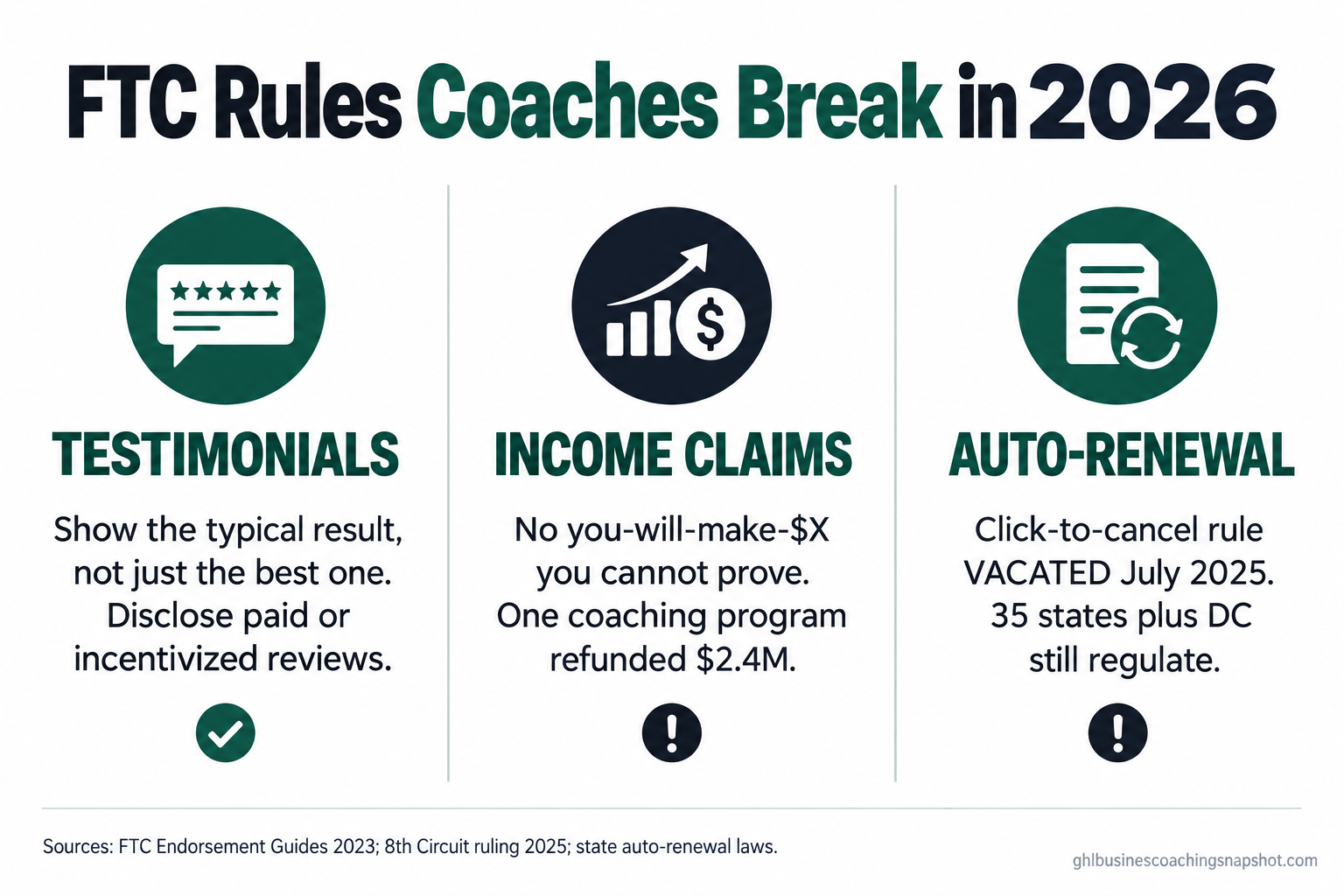
Testimonials: the rule you are almost certainly breaking
This is where most coaches slip. In July 2023 the FTC finalized revised Endorsement Guides, the first major update in over a decade (Federal Register, 16 CFR Part 255). Two parts hit coaches directly.
You must disclose the result a normal buyer should expect
The old habit was to show a standout client and add “results not typical.” The 2023 Guides go further: when a testimonial describes a result most buyers will not get, you have to clearly communicate the result a typical buyer can generally expect, and a tiny disclaimer does not carry that weight. You can still show your best win, you just show it next to the realistic picture. “One client grew from $8K to $40K months. That is not the average. Most who finish report a steady increase over six to twelve months, and some see no change” is compliant framing. A grayed-out “results not typical” under a giant number is what draws a letter.
You must disclose material connections, clearly
The second piece: any “material connection” between you and the person giving a review must be disclosed clearly and conspicuously. That means any relationship a reader would not expect that might sway the endorsement: payment, free or discounted coaching, an affiliate commission, a family or business tie. The practical hit list for coaches is short:
- Affiliate links. Earn a commission when a reader buys a tool you recommend? Say so, near the link, not only in a footer.
- Incentivized reviews. Gave a client a discount or bonus to leave a review? That review needs a disclosure.
- Staff or friends. A glowing testimonial from your operations manager or your sister needs the relationship disclosed.
And here is how testimonials break in real coaching businesses. The screenshot wall is the classic: a page of client wins with no context on typical outcomes, where every screenshot is an implied claim and the wall reads as “this is what you will get.” The close second is the recycled review written before you changed your program, still describing an experience buyers no longer have.
Income and earnings claims: the expensive one
If testimonials are the common trap, income claims are the expensive one, and this is where the FTC has been most aggressive with coaches specifically.
Any time you tell a prospect what they can earn, that is an earnings claim, and it needs a reasonable basis at the time you make it plus written materials that substantiate it, available on request. That standard comes from the FTC’s Business Opportunity Rule and its broader authority against deceptive claims (FTC Business Opportunity Rule materials). In January 2025 the FTC proposed expanding that rule to explicitly cover business coaching, which tells you exactly where their attention is (FTC, January 2025).
“Coach the coaches” and “build a business” programs sit closest to the fire, because they sell the promise of income directly. If your program teaches people to make money, your earnings claims are in scope.
The rule of thumb that keeps you safe: do not state or imply an income a typical buyer will not achieve. “Clients have grown to six figures” implies your buyer will too. “Make $10K a month in 90 days” is a specific promise. “Imagine replacing your salary by spring” still reads as a claim. Unless most buyers actually do it, cut it. The safest posture is to sell the mechanism and the work, not the number, which also converts the skeptical, high-ticket buyer who has heard every guru promise.
Money the FTC clawed back from money-making and coaching programs over deceptive earnings claims, in millions of dollars. Sources: Lurn refunds, Automators AI / related orders, and a June 2025 refund action (FTC). Figures are illustrative of enforcement scale, not a complete list.
The auto-renewal rules: forget click-to-cancel, watch your state
For over a year the advice was: “get ready for the FTC’s click-to-cancel rule.” That rule, formally the Negative Option Rule, was set to take effect in mid-2025. Then on July 8, 2025 the Eighth Circuit vacated it in its entirety days before enforcement (Sidley, Cooley). So the federal mandate is not in force, and any template still telling you to comply with it is out of date.
That does not make you free. Two things still bind you. First, the FTC can still act against deceptive subscription practices under its general authority, so hiding a cancellation path is still risky. Second, and this is the real deadline, state auto-renewal laws are alive and getting stricter. As of 2025, 35 states plus Washington, D.C. have at least one, and California, Colorado, Connecticut, Maryland, Minnesota, and Utah added or tightened theirs in 2025 (Kelley Drye 2025 round-up). California’s amended law (AB-2863) took effect July 1, 2025 and requires express consent to the renewal terms, easy cancellation, and advance notice before certain price increases (Olshan).
You sell nationally and your clients are in many states, so the practical move is to build to the strictest common denominator (mostly California) and apply it everywhere:
- Get clear, separate consent to the recurring charge. A distinct line the buyer actively agrees to, not buried in a wall of terms.
- State the terms plainly before the sale. Price, frequency, what renews, and how to cancel, in text the buyer sees.
- Make cancellation genuinely easy, and send a renewal or price-change reminder. If they signed up online they should be able to cancel without a phone-tag obstacle course, and several states require notice before a renewal or increase anyway.
If you run monthly retainers, this is also where failed payments and silent cancellations quietly drain revenue, a billing-hygiene problem as much as a legal one. The mechanics of clean recurring billing are covered in why your coaching retainers are failing silently.
The coaching-versus-therapy scope line
One more rule, and it is state law, not FTC. Most states restrict who can call themselves a therapist and who can treat mental health conditions. Coaching is generally unregulated, which is why the line matters: cross it and you can be accused of practicing a licensed profession without a license. The safe posture for a coach:
- Market outcomes, not treatment. “I help founders make decisions faster” is coaching. “I treat your anxiety” is a clinical claim.
- Avoid clinical language. Words like diagnose, treat, therapy, cure, and specific condition names pull you toward the regulated side.
- Refer out, and say you will. State plainly that coaching is not therapy and that you refer clients to licensed professionals when something clinical shows up.
This one genuinely varies by state, so it is where you most want a quick review from a local lawyer. The consequences are licensing-board ones, not just a marketing correction.
Steal this: paste-ready disclosure copy
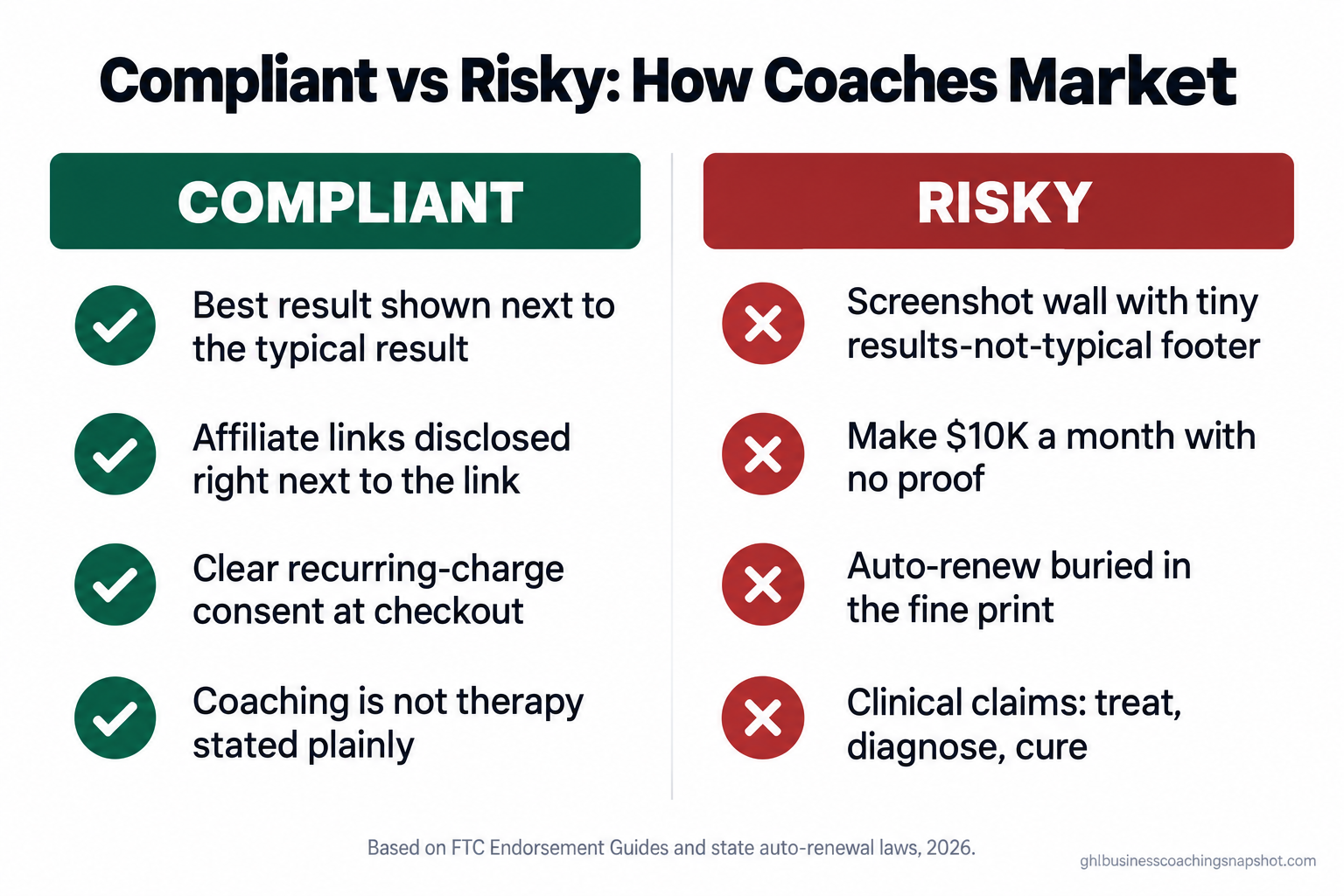
Here is language you can adapt today, mapped to the rules above. Change the specifics to fit your program, then have a lawyer in your state review the final version. A starting point, not legal advice.
1. Results and testimonials disclaimer (put it near any testimonial, not only in the footer):
The results shared here are from specific clients and are not typical or guaranteed. Coaching outcomes depend on your situation, effort, and market. Most clients who complete the program report gradual progress over several months, and some see little or no change. We show standout results to illustrate what is possible, not to promise what you will achieve.
2. Income and earnings disclaimer (for any page that touches money or business growth):
We make no guarantee of income or business results. Any figures, case studies, or examples are illustrative of individual experiences and are not a promise or projection of your earnings. Your results will vary based on your effort, skills, market, and factors outside our control. Building a business involves risk, including the risk of not earning back what you invest.
3. Material connection / affiliate disclosure (place it beside the link or at the top of a recommendations page):
Some links on this page are affiliate links. If you buy through them, we may earn a commission at no extra cost to you. We only recommend tools we actually use or have vetted, and the commission does not change our recommendation.
4. Recurring billing consent (as a distinct, actively-agreed line at checkout, not buried):
I understand this is a recurring subscription of $[amount] billed [monthly/quarterly] and that it will renew automatically until I cancel. I can cancel anytime at [link or email], and cancellation stops future charges. I agree to these terms.
5. Coaching-is-not-therapy scope statement (on your about page, your agreement, and your intake form):
Coaching is not therapy, counseling, or medical or mental-health treatment, and it is not a substitute for care from a licensed professional. I am a coach, not a licensed therapist or clinician. If a clinical or medical issue arises, I will encourage you to seek help from a qualified licensed provider, and I may pause or end coaching to support that.
6. Review-request wording that stays compliant (when you ask a client for a review):
We would love an honest review of your experience. Please share what actually happened for you, good or bad. If we gave you a discount or bonus for reviewing, please mention that in your review.
The pattern across all six: say the true thing plainly, put it where the reader sees it, and never lean on a tiny footer to carry a big claim.
Three compliance setups: solo, boutique, scaling
The rules are the same at every size. The setup that makes them stick is not.
1. Solo coach, first clients
The whole job is copy and a billing habit.
- Do this week: add disclaimers 1, 2, and 5 to your sales and about pages, add the recurring-consent line (4) at checkout, and rewrite any testimonial that shows an atypical result without context.
- Watch out for: the screenshot wall and the “results not typical” footer. Your sales page is your riskiest surface, because income and testimonial claims live together there. You need honest claims and clear consent, not a 12-page terms document.
2. Boutique, 2 to 8 people with retainers
Multiple people now write copy and talk to prospects, and you bill retainers, so the risk shifts from your page to your process.
- Do this month: write one approved claims-and-testimonials standard your team uses, so nobody freelances a “you’ll make six figures” line on a proposal. Build auto-renewal terms and a cancellation path into your standard retainer agreement.
- Watch out for: a salesperson’s verbal earnings promise on a call. It counts, and you cannot see it, so train it out and put the honest framing in the script.
3. Scaling past solo, cohorts and a course
Group programs, a course, affiliates, maybe a “coach the coaches” tier. This is the profile the FTC watches most, and where income-claim rules bite hardest.
- Do this quarter: get a lawyer to review your income claims and Business Opportunity Rule exposure. Set an affiliate-disclosure standard, and keep written substantiation for any results you cite.
- Watch out for: affiliates and testimonials you do not control. Their claims become your problem, so give them approved language and a short “what you cannot say” list. At this size the downside is real dollars and a ban from selling coaching.
What happens when you get it wrong
The clearest example is Lurn, an online business-coaching operation the FTC sued in 2023 over unfounded money-making claims. In 2024 the FTC sent more than $2.4 million in refunds to consumers who had paid (FTC). In other actions it has secured multi-million-dollar orders and, in the worst cases, lifetime bans on selling coaching programs (FTC, Automators AI).
Those are the deliberate bad actors, but the same rules apply to an honest coach with a sloppy sales page. The realistic risk for a legitimate coach is not a ban. It is a warning letter, a demand to change your marketing, a refund obligation, or a class claim over billing, all avoidable with the copy and billing setting above.
Common objections
“Click-to-cancel got struck down, so I don’t have to worry about billing, right?”
Wrong, and this is the exact trap. The federal rule is gone, but 35 states plus D.C. have their own auto-renewal laws that bind you wherever your clients live. Build clear consent and easy cancellation anyway. It cuts chargebacks and disputes on top of keeping you legal.
“Do I really need a lawyer, or are your templates enough?”
The templates get you most of the way and beat nothing. But scope-of-practice law varies by state and the “coach the coaches” income-claim rules carry the highest stakes. If you sell a make-money program or you are past the solo stage, a short paid review is worth it. Treat the templates as the draft you hand the lawyer, and keep every disclosure short and human so it reads as competence, not fear.
FAQ
FTC rules for coaches: quick answers
Do I need a disclaimer on my coaching testimonials?
Yes, if the testimonial shows a result a typical buyer will not get. The FTC's 2023 Endorsement Guides require you to clearly communicate the generally expected result, not just add a small 'results not typical' line, and to disclose any material connection like a discount or payment given for the review.
Is the FTC click-to-cancel rule still coming?
No. The Eighth Circuit vacated the FTC's Negative Option Rule in its entirety on July 8, 2025, before it took effect. Advice telling you to prepare for a federal click-to-cancel mandate is out of date. State auto-renewal laws are what bind you now.
Do state auto-renewal laws apply if I only have a few clients?
Very likely yes. 35 states plus D.C. have auto-renewal laws, and they generally apply based on where your customer lives, not how many clients you have. If you bill any recurring retainer to clients in those states, build clear consent, plain terms, and easy cancellation into checkout.
Can I say a client made a specific amount of money?
Only if it is true, you can substantiate it in writing, and you do not imply it is what a typical buyer will earn. A single client's $40K month is fine if you frame it as exceptional and pair it with the realistic typical outcome. Presenting it as the expected result is a deceptive earnings claim.
How do I stay on the right side of the coaching-versus-therapy line?
Market outcomes, not treatment. Avoid clinical words like diagnose, treat, and therapy. State clearly that coaching is not therapy and that you refer clients to licensed professionals for clinical issues. This line is set by state licensing law, so get a state-specific review if your work touches mental health.
The through-line here is boring in the best way: tell the truth, put it where people can see it, and make it easy for a client to say yes with clear eyes and cancel without a fight. If you want billing, consent, and follow-up wired together so the compliant version is the default one, that is what a consolidated system does, and it is the same reason the true monthly cost of running a coaching business drops when you stop stitching five tools together. For the platform side, see GoHighLevel vs Kajabi for coaches, and to keep the clients you sign, reducing coaching client churn.