

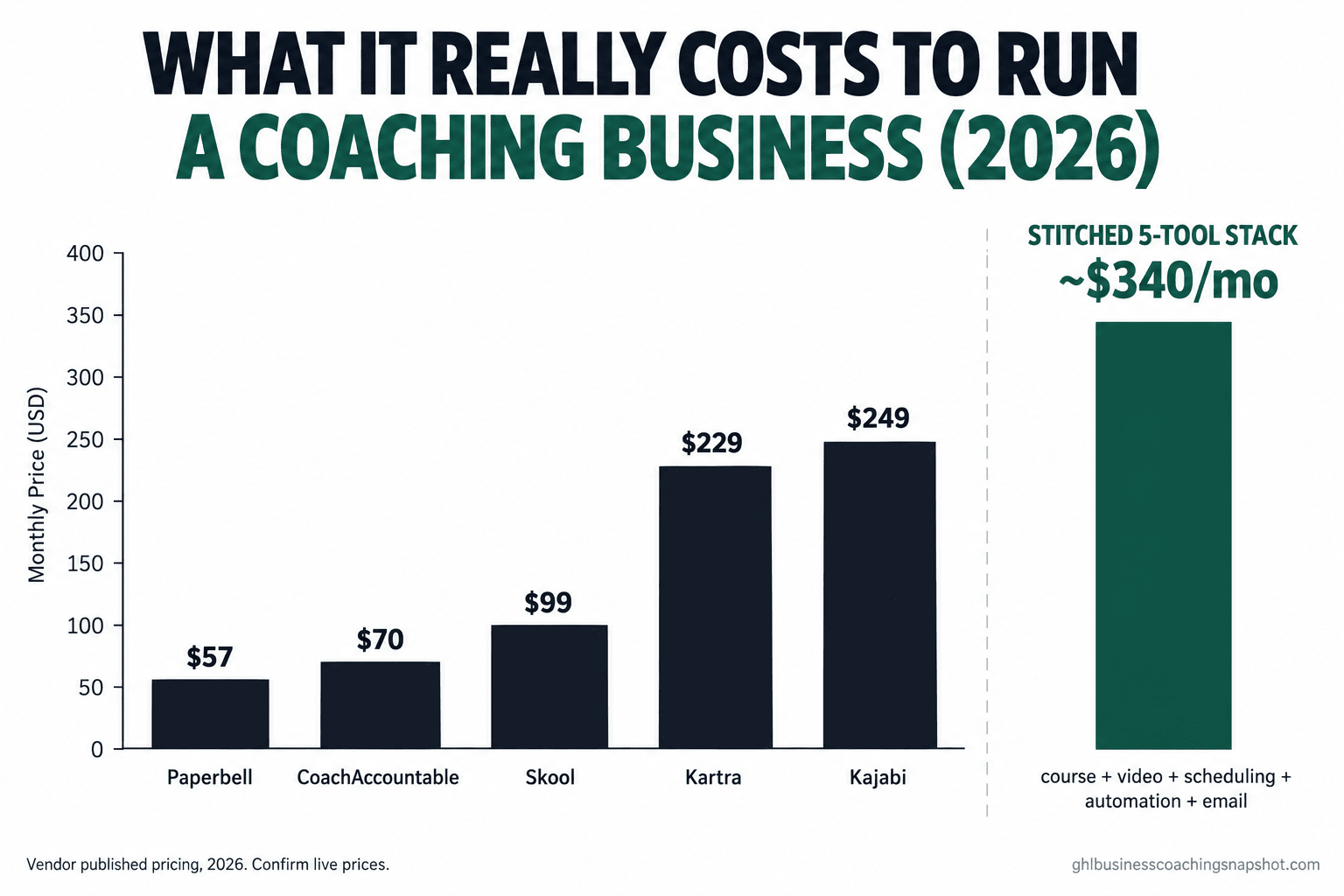
Short answer: most coaches pay far more to run their practice than they think, because the cost is spread across four or five tools that never talk to each other. In 2026 a single owned platform like Kajabi runs about $149 to $399 a month on annual billing, but that only covers courses and email. Add video, scheduling, an automation tool, and a real CRM, and a working solo stack lands near $340 a month and climbs from there. A boutique with a couple of coaches and retainer clients is often $400 to $700 a month. Below is the teardown of every major coaching tool, what each is for, where the price jumps bite, and three budgets you can copy. Prices are the vendors’ published 2026 rates, linked to their own pages; confirm the live number before you budget, because this niche changes pricing often.
What does it actually cost to run a coaching business in 2026?
It is a Tuesday night. You just closed the laptop after a call that ran long, and you are looking at five browser tabs across five logins: your course platform, Zoom, Calendly, the automation tool you set up last year and half-forgot, and the email app where your list lives. Somewhere in there is your money, and you are not sure how much, because each one bills on a different day.
That is the real cost of running a coaching business, and it is bigger than any single invoice. When people ask “what does the software cost,” they picture one number. The honest answer is that a practice runs on a bundle. If you sell courses, you pay a platform like Kajabi. If you run 1:1 or group clients, you pay a tool like CoachAccountable or Paperbell, or run a community on Skool. On top of that sits the plumbing everyone forgets to count: video, a scheduling link, an automation tool, and email. Add it up and the working number for a solo coach is around $340 a month, growing with your roster and your team.
Stitched-stack figure is illustrative math from the tool prices below. Coaching-industry figures: ICF 2025 Global Coaching Study; the 57% consulting figure is from its executive summary.
There is a second cost that never appears on an invoice: your attention. Every tool is another login, update, and context switch. Research on app sprawl from Asana’s Anatomy of Work Index found knowledge workers lose close to an hour a day moving between apps and hunting for information (Asana). For a coach whose billable time is the whole business, that hour is expensive, especially when the 2025 ICF study reports U.S. coaches average only about 12.7 coaching hours a week (ICF); the rest is admin, where tool sprawl feeds. So the real question is not “which tool is cheapest.” It is “what does the whole system cost, in dollars and hours, and how much is duplicated.”
The five platforms coaches actually pay for
Five names come up in almost every coach’s stack. They are not really competitors, because they do different jobs. Knowing which job each does is how you stop paying three tools that overlap.
Kajabi: the course and membership platform
Kajabi hosts, sells, and delivers digital content: courses, memberships, downloads, and the checkout and email around them. Pricing in 2026 runs roughly $149 to $399 a month on annual billing (Basic, Growth, Pro), with month-to-month closer to $179 to $499, plus a cheaper Kickstarter entry around $71 to $89 (Kajabi pricing). No platform transaction fee on paid plans; card-processing fees still apply.
Where it bites: Kajabi meters contacts, so a growing list pushes you up a tier for reasons unrelated to revenue, and it is not a sales CRM: no visual pipeline, no native two-way SMS, the gap coaches feel fastest when a hot lead needs a text back tonight. Full breakdown: GoHighLevel vs Kajabi for coaches.
Kartra: the all-in-one funnel platform
Kartra is Kajabi’s closest rival: pages, funnels, email, memberships, and checkout in one place. Its 2026 tiers run $59 (Essentials), $119 (Starter), $229 (Growth), and $549 (Professional) a month, with discounts on annual billing (Kartra pricing).
Where it bites: the $59 Essentials tier caps you near 500 contacts and one site and adds a 5% transaction fee on sales. That fee disappears on higher tiers, but the entry price is a loss leader once you sell anything, and contacts are capped on every tier.
Skool: the community and cohort platform
Skool hosts a group, a simple course area, and a gamified feed, and it has become the default home for masterminds. Pricing is simple: $99 a month per group, with a cheaper $9 Hobby tier (Skool pricing).
Where it bites: the $99 is per group, so two communities cost $198, and the Hobby tier takes a 10% cut of payments (the $99 plan drops that to card processing). Skool is a community, not a CRM or booking system, so it never replaces the rest of the stack. Retention angle: reducing client churn.
Paperbell: the simple 1:1 coaching admin tool
Paperbell handles the basics: scheduling, packages, contracts, payments, and a client portal, for solo coaches who want one clean tool. Pricing is the simplest here: a flat plan around $57 a month (about $47 annually), with unlimited clients and a free tier for one client (Paperbell pricing). No per-client ladder, no contact caps.
Where it bites: simplicity is the tradeoff. Paperbell is light on marketing automation, has no sales pipeline for chasing leads, and no two-way SMS. Great admin for a coach with a full calendar, weak growth tool for one without.
CoachAccountable: the client-delivery and accountability tool
CoachAccountable is the delivery engine: session notes, action items, worksheets, metrics, and the between-session accountability that drives renewals. It prices by active clients on a long ladder: about $20 for 2 clients, $40 for 5, $70 for 10, $120 for 20, $250 for 50, and $400 for 100, then roughly $4 per client above (CoachAccountable pricing).
Where it bites: the per-client ladder is cheap at three clients and climbs steadily as you fill up. It is a delivery tool, not an acquisition tool, so it sits alongside whatever books your calls. Those check-in cadences are the jobs we automate in coaching client onboarding.
Kajabi, Kartra, Skool, Paperbell, CoachAccountable side by side
Read the “watch out” column before the price. The price only means something once you know the job.
| Platform | Core job | 2026 entry price | Top price | Watch out for |
|---|---|---|---|---|
| Kajabi | Courses + memberships | ~$149/mo (annual) | ~$399/mo | Contact caps; no real CRM or SMS |
| Kartra | All-in-one funnels | $59/mo | $549/mo | 5% fee on the $59 tier; contact caps |
| Skool | Community / cohorts | $9/mo (Hobby) | $99/mo per group | 10% fee on Hobby; per-group pricing |
| Paperbell | 1:1 coaching admin | Free (1 client) | ~$57/mo flat | Light marketing; no pipeline or SMS |
| CoachAccountable | Client delivery | $20/mo (2 clients) | $400+/mo (100+) | Per-client ladder climbs as you fill |
Representative monthly cost of one mid-tier plan per platform (CoachAccountable at its 10-client tier; Kajabi and Kartra at Growth, month-to-month). Sources: Paperbell, CoachAccountable, Skool, Kartra, Kajabi, 2026. Confirm live prices before budgeting.
The hidden line item: the stitched-together stack
Here is the part that surprises people. None of those five platforms runs an entire coaching business alone. Kajabi does not book calls with reminders or run a pipeline. Paperbell does not nurture a cold list. CoachAccountable does not host your masterclass. So coaches assemble a second layer of tools, and that layer is where the money leaks. A typical stitched stack for a working solo coach:
| Line item | Common tool | 2026 monthly | Source |
|---|---|---|---|
| Course / membership home | Kajabi Growth | ~$249 | Kajabi |
| Video calls | Zoom Workplace Pro | ~$17 | Zoom |
| Scheduling link | Calendly Standard / Teams | ~$12 to $20 | Calendly |
| Automation glue | Zapier Professional | ~$30 to $74 | Zapier |
| Email marketing | ActiveCampaign / Kit | ~$15 to $39 | ActiveCampaign |
| Working total | ~$323 to $399 |
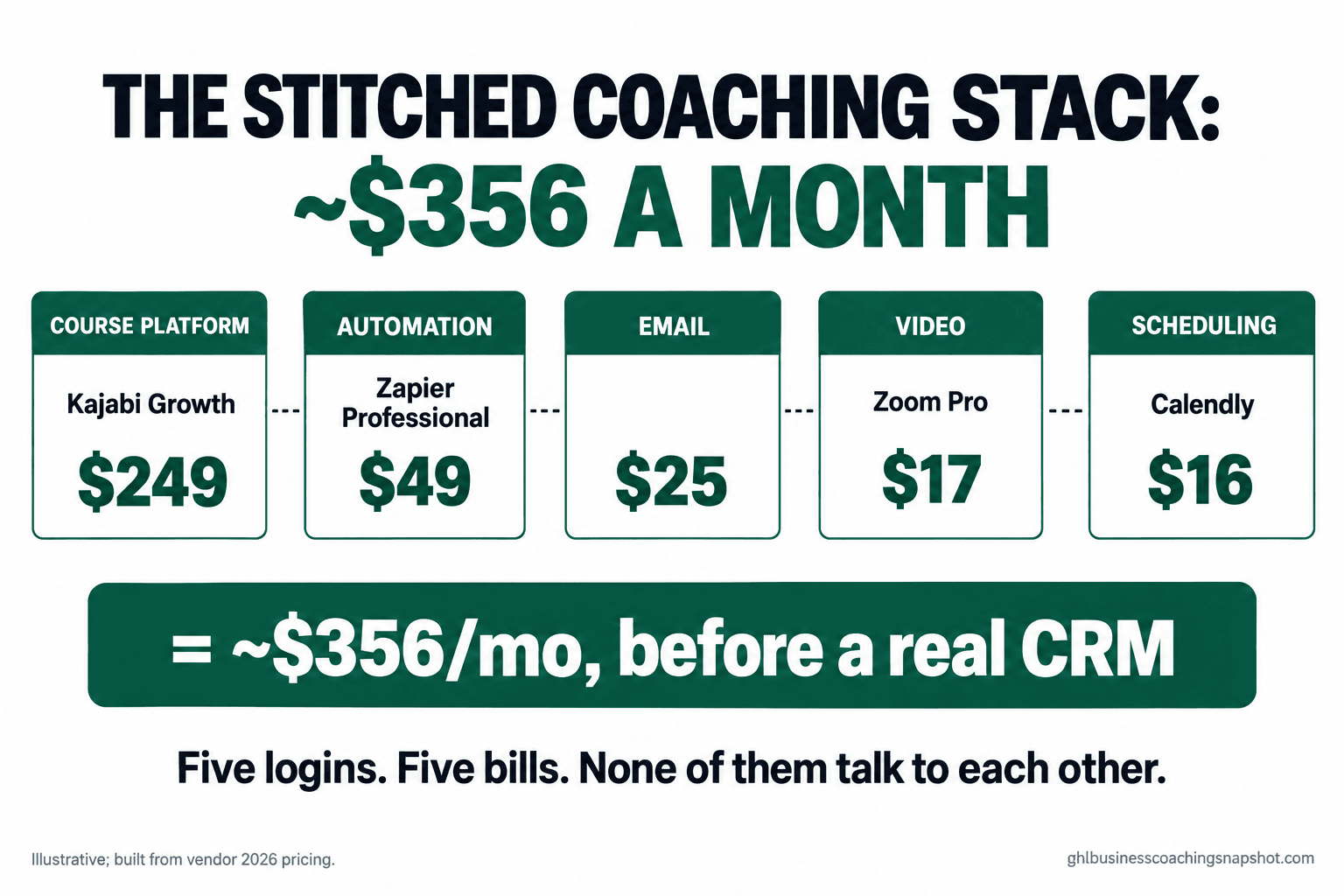
Call it north of $340 a month, and that is before you add a real CRM, because none of these do that job well. The exact number moves with your list size and tiers, so treat it as illustrative math, not a fixed quote. But the shape is real, and most coaches are surprised the first time they add up their own version.
Illustrative monthly cost of one common stitched stack, adding to roughly $356/mo before a dedicated CRM. Built from the vendor prices above (mid-tier selections); your total varies with list size and tiers.
The dollars are half of it. The stitched stack has three failure modes that cost more than the subscriptions:
- Integrations break silently. A Zapier task fails at 2am, a new lead never gets tagged, and you find out a week later when they book with someone else.
- Data goes out of sync. A client updates their email in your course platform; your email tool never hears about it, so your sequence bounces and your reporting is wrong, multiplied across every tool.
- You pay the tax on your own time. Every tool is a login, an update, and a place to look when something is off. That is the app-sprawl hour a day, spent on plumbing instead of coaching.
Stitched stack vs one consolidated system
5 logins, 5 bills on 5 dates, integrations you babysit, data that drifts out of sync, no single view of the pipeline. Roughly $340+/mo plus an hour a day of admin.
One login, one bill, lead capture to booking to pipeline to follow-up to billing in one place, one dashboard. The admin runs itself.
This is the real case for consolidation. When one platform captures the lead, books the discovery call with reminders, runs the pipeline, sends the two-way SMS follow-up, onboards the client, and recovers a failed retainer payment, you are not paying five vendors or maintaining five integrations. That is the idea behind a coaching CRM and sales pipeline, and it is why speed-to-lead gets easier: reaching a web lead within an hour makes you roughly 7 times more likely to qualify it, per Harvard Business Review’s audit of 2,241 firms (HBR), and that only happens when the booking tool and the messaging tool are the same tool.
Three real budgets: solo, boutique, scaling
The right answer differs by stage. Three budgets you can copy, each with the cheap path and the consolidated path.
1. Solo coach, first 10 clients
The problem is a thin pipeline, and every dollar and hour counts.
- Lean path: Paperbell $57 plus Zoom Pro $17 plus a free email tier, about $74/mo, but no pipeline, no SMS, no automated follow-up.
- Consolidated path: one GoHighLevel-based system from about $97/mo (HighLevel) doing capture, booking, pipeline, and follow-up. Here the cheap tools save $30 and cost you the clients you never followed up with.
- The trap: buying a $249 course platform before you have a course or an audience. Do not pay for delivery when acquisition is the bottleneck.
2. Boutique, 2 to 8 people with retainers
A couple of coaches, some fractional-CxO retainers, a real roster. Now the stitched stack is in full bloom.
- Stitched path: Kajabi Growth $249 plus Zoom seats ~$40 plus Calendly Teams $20 plus Zapier Professional $49 plus ActiveCampaign $49, about $400 to $500/mo across five vendors and five renewal dates.
- Consolidated path: a GoHighLevel Unlimited account at $297/mo, unlimited contacts and users, in one place. Five bills become one and the maintenance hours come back.
- The trap: per-seat and per-contact creep. Every new coach adds seats; a growing list bumps Kajabi and ActiveCampaign up a tier faster than revenue grows.
3. Scaling past solo, cohorts and a course
Group cohorts, a signature course, and a community, past the point where one person watches everything.
- Stitched path: Kajabi Pro $399 plus Skool $99 plus Zoom Business plus Calendly Teams plus Zapier plus email, easily $700+/mo, with tool coordination now a part-time job.
- Consolidated path: GoHighLevel with course and community delivery inside it, or GoHighLevel plus one delivery tool, typically well under the stitched total with the integration maintenance gone.
- The trap: paying for overlap. At scale, coaches often pay Kajabi, ActiveCampaign, and a community tool all for email at once. Audit duplicated features before price.
The cost audit you can run this week (steal this)
You cannot cut what you have not counted. Here is the worksheet I give coaches. It takes about 30 minutes and usually finds $50 to $150 a month of waste on the first pass.
Step 1: List every recurring charge. From the last two months of bank and card statements, write down every subscription, its price, and its billing date. Include the ones you forgot: the old funnel builder, the second Zoom account, the tool you tried once.
Step 2: Label each tool with its one job. Courses, scheduling, video, email, CRM, community, delivery, automation. If two tools share a label, you have found overlap.
Step 3: Ask the four questions. For every tool:
- What one job does this do, and does anything else I pay for already do it?
- If I cancelled it tomorrow, what breaks, and who notices?
- Is it metered by contacts or clients, and where is the next tier jump?
- Is it connected to my other tools, or am I moving data by hand or by Zap?
Step 4: Sort into keep, consolidate, cancel. Keep the unique jobs done well, consolidate the ones a single system could absorb, and cancel the overlap and the “tried it once” tools today.
Step 5: Send the cancellation. The message to send for a tool you are dropping:
Subject: Cancel my subscription
Hi, please cancel my account effective at the end of the current billing period and confirm in writing that no further charges will be made. I am not requesting a refund, only that auto-renewal is stopped and confirmed. Please also confirm how I export my data before the account closes. Thank you.
It asks for written confirmation (your proof if they bill you again) and for data export before you lose access. Save the reply.
The compliance line most coaches forget
Cost is also what a sloppy sign-up or cancellation flow can cost you in a complaint or a fine. Three rules matter, and none of this is legal advice, so get a real review.
Auto-renewal is more regulated than most content admits. You may have read that a federal “click-to-cancel” rule was coming. The FTC’s Negative Option Rule was vacated by the Eighth Circuit on July 8, 2025 on procedural grounds and is not in force (Reuters). That is not a free pass: more than 25 states have their own automatic-renewal laws, some stricter, so recurring retainers still need clear disclosure and an easy cancellation path. Most competing articles still say the federal rule is coming. It is not, and the state laws bind you.
Testimonials have rules. The FTC’s 2023 Endorsement Guides require that a testimonial showing an atypical result carry a clear disclosure of the generally expected result, or substantiation, and that any material connection be disclosed clearly and conspicuously (FTC). The “my client made six figures” screenshot needs a real disclosure beside it.
“Coach the coaches” programs have their own rule. If you sell a program teaching people to make money as coaches, the FTC Business Opportunity Rule (16 CFR Part 437) can require an Earnings Claim Statement with substantiated numbers (FTC). A consolidated system that handles consent, disclosures, and a clean cancellation flow in one place is cheaper than getting these wrong across five disconnected tools.
Common objections
“I already pay for Kajabi and it works.” Then keep it for what it is good at: hosting and selling your course. The teardown is not an argument to rip Kajabi out. It is an argument to stop paying four other tools to do the jobs Kajabi cannot, and to put the acquisition-and-follow-up half of your business on one system. Many coaches keep Kajabi purely for course delivery and run a consolidated CRM for the practice; the GoHighLevel vs Kajabi comparison shows where that line sits.
“Consolidating into one platform sounds like lock-in.” Fair worry. The answer is to consolidate onto something standard and exportable, not proprietary. A GoHighLevel-based system is built on ordinary workflows, forms, calendars, and webhooks you own and can edit, and your data exports cleanly. Weigh that against the very real lock-in of five tools whose integrations you hand-built and cannot easily rebuild.
“Isn’t the cheaper tool always smarter for a small practice?” No, and this is the costliest myth in the niche. A $40 delivery tool with no pipeline is cheaper on the invoice and more expensive in missed clients, because the leads who needed a follow-up text never got one. If a $97 system books two extra discovery calls a month that a $40 tool would have dropped, it paid for itself several times over. Cheap per tool is not cheap per client.
“Do I need to be technical to run a consolidated system?” Less than you need to be to babysit five integrations. Maintaining a stitched stack is the technical job: you debug the broken Zap and re-sync the mismatched data. A pre-built system arrives already wired, which is why done-for-you setups exist. Setup is a one-time cost you can hand off, not a monthly one.
FAQ
What is the cheapest way to run a coaching business in 2026?
For a solo coach, the cheapest honest path is a flat tool like Paperbell at about $57 a month, or CoachAccountable's low tier at $20 to $40, plus a free Zoom or email tier. But cheapest only holds if acquisition is not your bottleneck. If you need a fuller pipeline, a consolidated system from about $97 a month books more clients than a cheaper tool with no follow-up, so it costs less per client.
How much does a full coaching software stack really cost per month?
A working solo stack of a course platform, video, scheduling, automation, and email lands around $340 a month in 2026 at current published prices. A boutique with a couple of coaches and retainer clients is commonly $400 to $700, and a scaling practice with cohorts and a course can pass $700. The number depends on your list size and tiers.
Is Kajabi or Kartra cheaper for coaches?
Kartra's entry Essentials tier is cheaper on the sticker at $59 versus Kajabi's roughly $149 annual, but the $59 tier caps you near 500 contacts and adds a 5% transaction fee that erases the savings once you sell anything. Compare the tiers you would actually use at your real contact count, and read the fee line, not just the headline.
Are there hidden fees in coaching platforms?
Yes. Watch three: transaction fees (Kartra's cheapest tier charges 5%, Skool's Hobby tier 10%), contact or client caps that push you up a tier as you grow (Kajabi and Kartra meter contacts, CoachAccountable meters clients), and payment-processor fees of roughly 2.9% plus 30 cents almost everywhere. Add these before you compare.
Is it cheaper to use one all-in-one platform or several separate tools?
For most coaches, one consolidated system is cheaper once you count everything, because a stitched stack of four or five tools commonly runs $340 or more a month plus an hour a day of maintenance. A single system for capture, booking, pipeline, follow-up, and billing beats that on dollars and hours, if you consolidate onto an open, exportable platform.
The Tuesday-night tabs, closed
Back to those five browser tabs. The fix was never a cheaper version of each one. It was noticing that four of them did jobs a single system could do at once, and that the real cost was never the subscriptions anyway. It was the hour a day of plumbing and the leads who slipped through the gaps between tools.
Do the audit this week. Add up what you actually pay, label every tool with its one job, and cancel the overlap. Most coaches find the number higher than they guessed and the waste easier to cut than they feared. Then decide, with the whole cost in front of you, whether five tools or one system runs your practice better.
If you want the consolidated version already built, that is what the Coaching Snapshot is: lead capture, booking, pipeline, follow-up, onboarding, and retainer billing recovery in one GoHighLevel account in 24 hours. If you are setting up GoHighLevel to run it, you can start through our GoHighLevel partner link. That is an affiliate link, so we may earn a commission at no extra cost to you.
Pricing on this page reflects each vendor’s published 2026 rates and is linked to the vendor’s own pricing page; third-party software pricing is set by the vendor and changes often, so confirm the current number on the live page before budgeting. Nothing here is legal, tax, or financial advice; consult a qualified professional on auto-renewal, endorsement, and earnings-claim compliance. Outcome examples are illustrative, and we do not guarantee revenue, client count, or income gains; actual results depend on your offer, audience, and execution.