

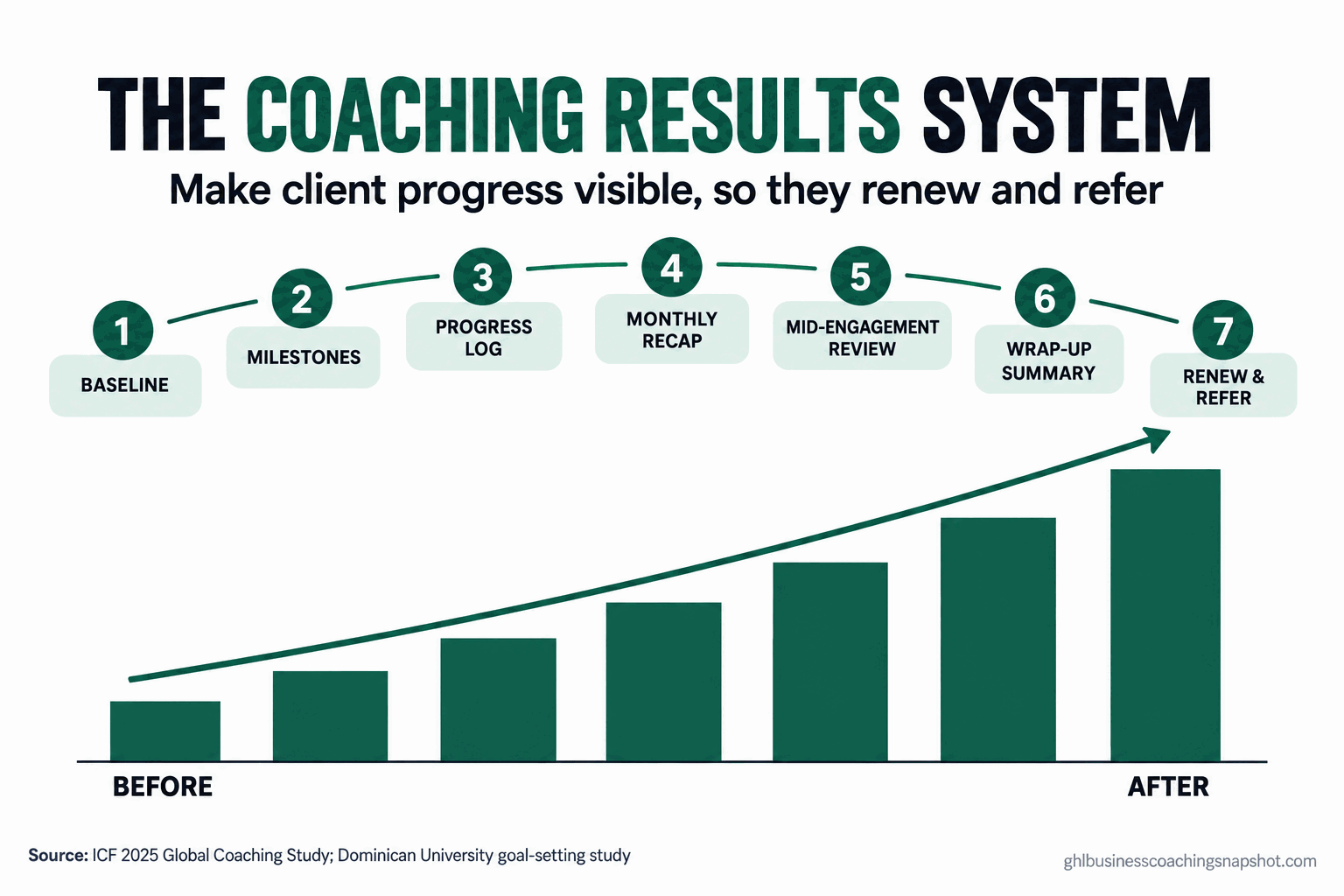
Short answer: most coaching clients do not quit because the work stopped helping. They quit because they lost sight of how far they have come. The session felt good in the moment, but by week eight they cannot point to anything concrete, so the recurring invoice starts to feel optional. The fix is a results system: a small set of steps that capture where a client started, track what changes, and show them their own progress on a schedule, so “is this working?” never gets a chance to form. That same system hands you the proof you need for renewals, testimonials, and referrals. Below is the whole thing, stage by stage, with the real copy and the ways each step breaks.
Why do coaching clients really churn?
A client signs on fired up. The first few sessions feel like a breakthrough a week. Then month two arrives, the novelty fades, the hard middle of the work sets in, and the sessions start to feel like talking rather than moving. Nothing has gone wrong. The client is actually progressing. But they cannot feel it, because progress in coaching is slow and quiet and easy to forget week to week.
That is the moment the renewal is decided, long before the renewal conversation happens. A client who can point to three concrete things that changed renews almost automatically. A client who feels vaguely better but cannot name why starts doing the math on your fee. Same coaching, opposite outcome, and the only difference is whether they could see the change.
This is why “deliver great sessions” is not a retention strategy on its own. The job is not just to create progress. It is to make progress visible, on a schedule, so the client’s own memory does not get the only vote.
What invisible progress costs you
Start with the market, because the problem is not demand. The 2025 ICF Global Coaching Study counts 122,974 coach practitioners worldwide, up about 15% since 2023, generating roughly $5.34 billion in annual revenue, with 57% of coaches also offering consulting (ICF). There are more buyers than ever. What swings is whether the clients you already have stay long enough to pay you what they are worth.
Market figures: ICF 2025 Global Coaching Study. Goal-tracking figure: Dominican University, Matthews goal-setting study. Retention-to-profit range: Harvard Business Review, “Zero Defections.”
Invisible progress costs you three ways. It shortens engagements, because a client who cannot see movement leaves at the first natural exit, so a relationship that should have run a year ends at four months. It kills your referrals and testimonials, because a client who cannot describe what changed has nothing to say when a friend asks what you did for them. And it caps your price, since you can only charge for value a client can perceive.
The retention math is not soft. The classic Harvard Business Review study on service businesses found that cutting customer defections by just five percentage points raised profits by 25% to 85% (HBR). Coaching is a service business with recurring billing, which is exactly the shape where retention compounds hardest. Every client you keep for a second term is one you do not have to sell from scratch.
The results system: seven stages
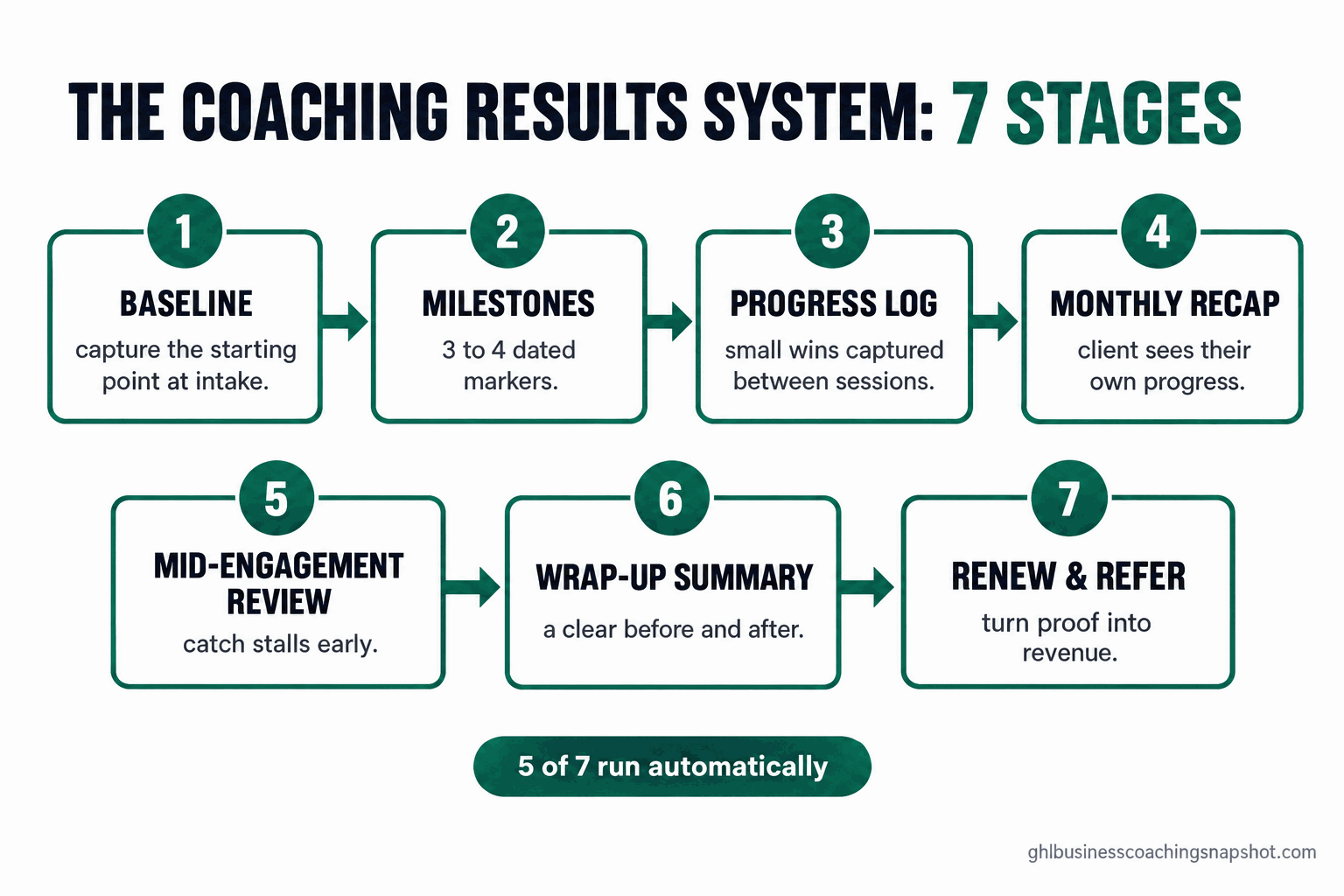
A results system is not a fancy dashboard. It is seven small steps that run across the life of an engagement, most of them automatable, that together make sure a client always knows how far they have come. Here they are in order, then each in detail with the setup, the real copy, the timing, and how it breaks.
- Baseline captures where the client starts, so there is a before to measure against.
- Milestones turn a vague goal into three or four dated, checkable markers.
- The progress log captures small wins between sessions without extra work for you.
- The monthly recap shows the client their own progress on a schedule.
- The mid-engagement review catches a stall before it becomes a cancellation.
- The wrap-up summary turns the whole engagement into a clear before-and-after.
- Renew and refer converts that proof into a second term, a testimonial, and an intro.
Stage 1: Capture the baseline at intake
What it does: records exactly where a client starts, in their own words and in numbers, so months later you can both point to how far they came. No baseline, no proof. This is the most skipped step and the one that makes every later stage possible.
Setup: add a short intake form that fires the moment a client signs, before the first session. Capture the starting state three ways: a number they care about (revenue, hours worked, leads per week, whatever the work is about), a one-to-ten rating on the thing they came to fix, and a sentence on what they want to be true in ninety days. Store it in the client record, not an email thread.
The copy (steal this), the baseline intake:
Before our first session, three quick questions so we can measure progress honestly later. 1) What is the one number you most want to move in the next 90 days, and where does it sit today? 2) On a scale of 1 to 10, how would you rate {the thing they came to fix} right now? 3) Finish this sentence: “In 90 days, I will know this worked if…”
Timing: immediately on signup, as part of onboarding, so the first session starts with the baseline already captured. The intake is the opening move of the first-30-days onboarding system, not a separate chore.
How it breaks: you rely on memory. Three months in, you “sort of remember” where they started, which means you cannot prove anything and neither can they. The fix is writing it down at intake, in numbers where you can, so the before is a record and not a feeling.
Stage 2: Turn the goal into milestones
What it does: breaks the big ninety-day goal into three or four dated markers, so progress is checkable every few weeks instead of being a single far-off finish line the client stops believing in by week six.
Setup: in the first session, work the baseline goal backward into three or four milestones with rough dates. Each is a yes-or-no: either it happened or it did not. “Launch the group offer by week four.” “Have the hard conversation with the business partner by week six.” Write them into the client record as checkable items, not vibes.
This is where the research earns its place. In the Dominican University study, people who wrote their goals down and sent weekly progress updates reached their goals at roughly 70%, compared with about 35% for people who kept their goals private and unwritten (Dominican University). Written, dated, and tracked is not a motivational nicety. It roughly doubles the odds your client actually gets the result they hired you for, which is the result you both need them to see.
Share of participants who achieved their goal, by method. Source: Dominican University (Matthews), 267 participants. Writing goals down and reporting progress weekly roughly doubled the achievement rate.
How it breaks: the goal stays one giant, far-off lump. “Grow the business” has no checkpoint, so the client cannot feel movement until the very end, if ever. Break it into dated yes-or-no markers and you create a progress signal every few weeks instead of one at the finish.
Stage 3: The between-session progress log
What it does: captures the small wins and actions between sessions, so by the time you meet, the progress is already recorded and does not depend on the client remembering what they did eleven days ago.
Setup: send one light touch between sessions, a two-question check that takes under a minute. The answers log automatically to the client’s record and become raw material for the monthly recap and the mid-engagement review. This is the same accountability rhythm covered in accountability check-ins that do not feel creepy, pointed at results rather than attendance.
The copy (steal this), the between-session log:
Quick midweek check, {first name}. Two things: 1) What is one thing you did this week that moved you toward {their goal}? 2) What is the one thing most in your way right now? Reply in a sentence each. I will have it in front of me for our next session.
Timing: once between each session, mid-cycle, not the day before. One touch, not a stream. The point is a steady record, not more homework.
How it breaks: it turns into a generic “just checking in” with no real question, which trains the client to ignore it, or it asks for a five-paragraph journal nobody fills out. Two specific questions, one minute to answer, every cycle. If the client misses two in a row, that silence is itself a signal, and it is your cue to reach out personally.
Stage 4: The monthly results recap
What it does: shows the client their own progress once a month, in writing, so they see the distance traveled instead of only feeling the current session. This is the single highest-impact step in the system, because it attacks the churn mechanism directly: it makes invisible progress visible on a schedule.
Setup: once a month, send a short recap that pulls from the baseline, the milestones, and the progress log. It is three lines: where you started, what has changed, and what is next. Most of it can be assembled automatically from the records you already captured, so this is a two-minute personalization on your end, not a report you write from scratch.
The copy (steal this), the monthly recap:
{First name}, a quick month-in-review. When we started, you rated {the thing} a 4 out of 10 and {starting number} was where you were. This month you hit {milestone} and {number} is now {current}. That is real movement, and I want you to see it, not just feel the grind. Next month we are focused on {next milestone}. Proud of the work you are putting in.
Timing: monthly, on a fixed date tied to their start date, so it never gets forgotten in a busy stretch. Triggered by the calendar, not by you remembering.
How it breaks: it never gets sent, because writing it by hand each month is the task that dies the week you are slammed. That is why it has to be a triggered, templated step that assembles itself from the records, with you adding the human line on top. The other failure is making it generic (“great progress this month!”), which reads as an autoresponder. Tie every recap to the actual numbers in their record.
Stage 5: The mid-engagement review
What it does: a deliberate checkpoint at the halfway mark that pulls the client up out of the weekly grind to look at the whole arc, catching a stall or a quiet disappointment before it hardens into a cancellation.
Setup: schedule one review session at the midpoint of the engagement, booked in advance, not improvised. Walk through the baseline, the milestones hit and missed, and ask one direct question about whether they are getting what they came for. This is the conversation that surfaces the “honestly, I expected to be further along” before it becomes a non-renewal, while you still have time to adjust.
The copy (steal this), the mid-engagement review opener:
{First name}, we are at the halfway point, so I want to zoom out before we keep going. I will bring where you started, what you have hit so far, and what is left. The one thing I want you to come ready to answer honestly: are you getting what you came here for? If the answer is “not quite,” that is exactly what I want to hear now, while we can still change course.
Timing: at the midpoint of the engagement, booked at onboarding so it is already on both calendars.
How it breaks: you skip it when things feel fine, and “fine” is the dangerous state, because a quietly underwhelmed client feels fine right up until they cancel. Run the review on schedule regardless, and treat any hesitation as information. This is the checkpoint that most directly prevents the month-two and month-three drift covered in how to reduce coaching client churn.
Illustrative pattern of a client’s perceived progress across a 13-week engagement. The dip around weeks 5 to 9 is the hard middle, where churn decisions get made. A monthly recap and a mid-engagement review are what pull the line back up. Not real data; it shows the shape most coaches recognize.
Stage 6: The wrap-up transformation summary
What it does: turns the completed engagement into a single clear before-and-after, in numbers and in the client’s own starting words, so the result is undeniable to the client and usable by you.
Setup: in the final weeks, assemble the baseline against the current state: the starting number versus today, the starting one-to-ten versus today, the ninety-day sentence versus what actually happened. Present it in or just before the last session. This is the document that makes a renewal feel obvious and a testimonial easy, because you are handing the client the words to describe what changed.
The copy (steal this), the wrap-up summary:
{First name}, here is the whole picture. You started rating {the thing} a 4 and said you would know this worked if {their sentence}. Today you are at an 8, {number} went from {start} to {end}, and you hit {milestones}. You did the work. I want you to have this in writing so the progress does not blur the second life gets busy again.
How it breaks: there is no before to compare to, which sends you right back to Stage 1: a wrap-up is only as good as the baseline you captured at intake. The second failure is burying it, mentioning the results in passing in the last session instead of putting them in writing. Write it down and send it, because a client who has their transformation in writing is a client who renews, refers, and gives you a testimonial without being chased.
Coaching without a results system vs with one
You deliver good sessions, but nobody tracks the arc. By month two the client cannot name what changed, the fee starts to feel optional, and they leave at the first natural exit with nothing to say when a friend asks what you did.
Baseline, milestones, a monthly recap, and a wrap-up summary keep progress visible the whole way through. The client can see the distance traveled, renews because the value is obvious, and refers because they can finally describe it.
Stage 7: Turn proof into renewals and referrals
What it does: converts the documented result into a second term, a testimonial, and an introduction, because the moment right after a client sees their own transformation is the highest-intent moment in the whole relationship, and it is usually wasted.
Setup: three moves, triggered off the wrap-up. The renewal offer, started two to three weeks before the engagement ends, not in the awkward final session. The testimonial request, sent right after they have seen the wrap-up summary, when the result is fresh. And the referral ask, made to a happy client at peak satisfaction. Running all three off one trigger is how you stop leaving the easiest revenue in the practice on the table.
The copy (steal this), the renewal opener:
{First name}, we are about three weeks out from the end of our block, and before we get down to the wire I want to talk about what is next. You went from a 4 to an 8 on {the thing} and hit {milestone}. The next 90 days could focus on {next goal}. Want 20 minutes next week to map it out? No pressure to continue, but I would rather plan it with you than let it just end.
The copy (steal this), the testimonial request:
{First name}, you just saw the full before-and-after, and I would love to use your words to help the next person decide. Two quick questions: what was it like before we started, and what is different now? Even two or three honest sentences would mean a lot, and I will only use what you are comfortable with.
Why this sequencing works: people act on proof from people they trust, and 88% of people trust a recommendation from someone they know over any other form of marketing (Nielsen). A documented result turns a happy client into exactly that recommendation. The full engine for making those introductions systematic is in the referral system for business coaches, and the mechanics of collecting and displaying the testimonials sit in review harvesting for coaches.
How it breaks: the renewal gets left to the last session, when the client has already mentally packed up, or the testimonial ask goes out cold weeks later, when the result has faded. Trigger all three off the wrap-up, while the proof is fresh, and you convert at a different rate than a generic “would you leave a review” sent into the void.
Three versions: solo, cohort, boutique
The seven stages do not change. What changes is where you spend your effort and how much you automate.
1. Solo coach, 1:1 retainers
You are the whole operation, so the recap and the review are the steps most likely to die when you get busy, and the ones that save you the most. Automate hard: baseline, the between-session log, and the monthly recap should assemble themselves, leaving you the human line on top and the two live conversations. Your highest-payoff move is the monthly recap, because for a solo coach a lost client is a full cold-start to replace.
2. Group cohort operator
You cannot write a personal recap for forty people, so your tracking leans on shared milestones and a cohort-wide check-in rhythm, with the baseline and wrap-up still captured per person. The individual before-and-after is what fills your next cohort, because members who can see their own results become your enrollment engine for the following round. Pair this with the move from 1:1 to group coaching if you are building the cohort model now.
3. Boutique, 2 to 8 coaches with retainers
Your risk is inconsistency: one coach tracks results beautifully, another keeps it in their head, and renewals swing by coach rather than by client. Your move is a shared standard in one CRM, so every client gets the same baseline, recap, and wrap-up whichever coach they see. That also lets you spot a struggling client early, because the progress log is visible to the whole team. The shared-pipeline setup is covered in the coaching CRM and sales pipeline.
The compliance line on client results
Tracking results is not just a retention play. It is also what keeps you on the right side of the rules when you start using those results in your marketing. None of this is legal advice; get a real review of your setup.
The FTC’s 2023 Endorsement Guides require that if you show a testimonial describing results that are not typical, you either disclose the generally expected result or have substantiation for the claim, and that any material connection between you and the endorser is clear and conspicuous (FTC). In plain terms, “my client tripled her revenue” cannot stand alone on your site. You need either a disclosure about what a typical client should expect, or real evidence behind the claim.
Here is the quiet payoff of this whole system: a documented baseline and wrap-up for every client is that substantiation. With the real before-and-after on file, the testimonial stops being a liability and becomes a defensible claim. Most coaches who get into trouble with the FTC are not lying. They simply never kept the records that would prove the results were real. The full rundown of testimonial rules, income claims, and the auto-renewal laws that apply to coaching retainers is in the FTC rules for coaches.
Common objections
“My coaching is about mindset and confidence. You cannot put a number on that.” You can put a signal on it, which is enough. The one-to-ten self-rating at baseline, repeated monthly, turns a feeling into a trackable line, and the client’s own before-and-after sentence captures the qualitative shift in their words. You are not reducing the work to a spreadsheet. You are giving an intangible change a visible shape, which is the entire point.
“My clients will not fill out trackers and logs.” They will if it is one minute and two specific questions, and they will not if it is a journal. The failure is always length and vagueness, never the idea of a check-in. Keep the between-session log to two pointed questions, and make the monthly recap something you send them, not more work you hand them.
“Won’t all this tracking make the relationship feel clinical?” Only if the copy is cold. Read the examples above: every one points at the client’s specific goal, their win, their own words. Tracking is what lets you be more personal, not less, because you are referencing exactly where they started instead of a generic “how’s it going.” The automation decides the timing. You decide the words, and the words are warm.
“I already know my clients are doing well. I do not need a system to tell me.” You might know it. The question is whether they know it, and whether you can prove it to the next prospect. The system is not there to inform you. It is there to make the progress visible to the client, so they renew, and provable to the market, so you can charge what the work is worth.
FAQ
Why do coaching clients stop renewing even when the coaching is good?
Usually because they lost sight of their progress, not because progress stopped. Coaching gains are slow and easy to forget, so by month two or three a client who is genuinely improving may not be able to name what changed, and the recurring fee starts to feel optional. The fix is to make progress visible on a schedule through a baseline, a monthly recap, and a wrap-up summary, so the client's fading memory does not get the only vote on whether it worked.
How do you track progress for mindset or life coaching where there is no obvious number?
Use a simple one-to-ten self-rating on the thing the client came to work on, captured at intake and repeated monthly, plus a before-and-after sentence in the client's own words. The rating turns an intangible shift into a trackable line, and the sentence captures the qualitative change. You do not need a hard metric like revenue. You need a consistent signal the client can see move over time.
What should a coaching client baseline include?
Three things, captured at intake before the first session: one number the client wants to move and where it sits today, a one-to-ten rating of the problem they came to solve, and a sentence finishing 'I will know this worked if...' Those three give you a measurable before, an emotional before, and a definition of success in the client's own words, which is everything you need to prove progress later.
How often should I send a client a progress update?
A light between-session log once per cycle to capture wins, and a fuller results recap once a month on a fixed date tied to the client's start date. Monthly is frequent enough that progress stays visible but not so frequent that it becomes noise. The monthly recap is the highest-impact touch in the system because it directly attacks the churn mechanism of forgotten progress.
Does tracking client results help with FTC compliance?
Yes. The FTC's 2023 Endorsement Guides require substantiation or a generally-expected-results disclosure for testimonials showing atypical results. A documented baseline and wrap-up for each client is that substantiation, which turns a results-based testimonial from a liability into a defensible claim. Most coaches who run into trouble were not lying; they simply never kept the records that would prove the result was real.
Can a results-tracking system be automated, or do I have to do it by hand?
Most of it automates. Baseline intake, the between-session log, the monthly recap assembly, and the renewal trigger can all run on a CRM and fire on schedule, leaving you the human line on top and the two live conversations, the mid-engagement review and the renewal talk. The steps that die by hand during a busy week are exactly the ones you automate so they survive it.
The renewal that felt automatic
Picture the renewal conversation you want. The client sits down, you hand them the before-and-after, and they say some version of “I had not realized how far I have come.” At that point you are not selling. You are agreeing with the proof in front of both of you. That is what a results system buys you: renewals that feel obvious, testimonials that write themselves, and referrals from clients who can finally describe what you did.
None of it comes from better sessions alone. It comes from capturing the baseline at intake, breaking the goal into dated milestones, logging the small wins, showing the client their progress every month, catching the stall at the midpoint, and writing down the transformation at the end. Build the two bookends first, the baseline and the wrap-up, then add the recap and the review.
If you would rather have the whole thing already built, that is what the $997 Coaching Snapshot installs: baseline intake, milestone tracking, the monthly recap, the mid-engagement review, and the renewal trigger as standard GoHighLevel workflows in one account in about 24 hours.
Market figures reflect the ICF 2025 Global Coaching Study and are linked to the source; confirm current numbers before citing. The goal-setting figures are from the Dominican University (Matthews) study, and the retention-to-profit range is from the Harvard Business Review “Zero Defections” study. Nothing here is legal advice; consult a qualified professional on FTC endorsement and auto-renewal compliance. Outcome examples are illustrative, and we do not guarantee revenue, retention, client count, or income gains; actual results depend on your offer, audience, and execution.