

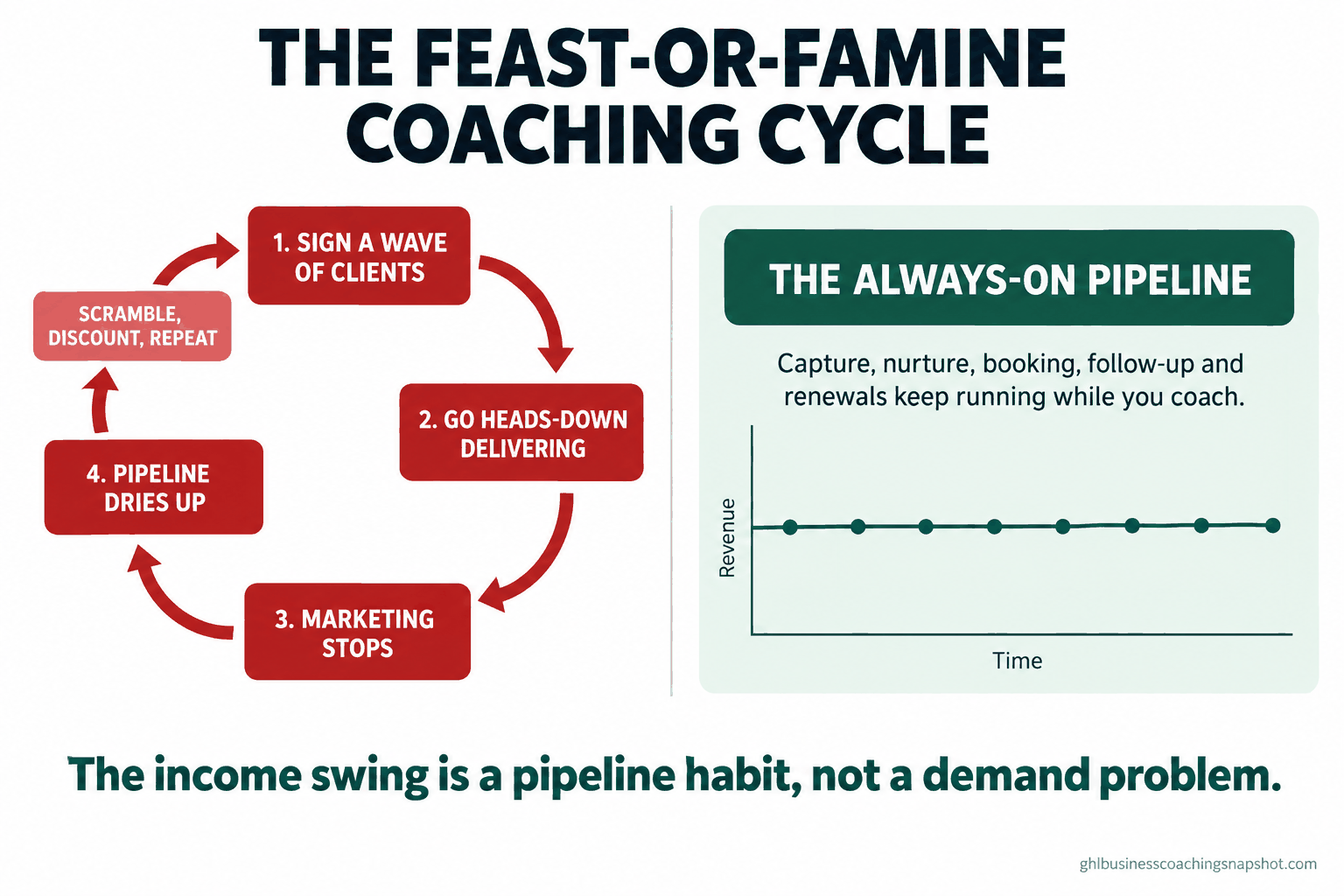
Short answer: coaching income swings between booked-solid and scary-quiet because most coaches only sell when they are not delivering. You close a few clients, go heads-down coaching them, and the marketing that filled the pipeline goes silent for eight or ten weeks. By the time those clients wrap, the pipeline is empty and you are scrambling. The fix is not working harder during the famine. It is a small set of systems that keep capturing, nurturing, and booking while you coach, so the pipeline never actually goes quiet. Below is that system, stage by stage, with the real message copy and the ways each part breaks.
What does feast-or-famine actually cost you?
It is the second week of the month and your calendar is beautiful. Six clients mid-engagement, sessions stacked back to back, a wait-list forming. Then those engagements start wrapping, all around the same time because you signed them all around the same time, and next month’s calendar is a field of white space. No discovery calls booked. No warm leads to call. Just the familiar dread of starting the marketing engine cold, again.
That is feast-or-famine, and it costs money three ways. The famine forces discounting: an empty calendar makes you say yes to a bad-fit client at a cut rate because you need the cash. The feast forces turning good clients away or rushing delivery, because you are full when demand shows up and thin when it does not. And the swing caps your growth, because you cannot plan, hire, or invest against a revenue number that lurches every quarter.
Industry figures: ICF 2025 Global Coaching Study. Speed-to-lead figure: Harvard Business Review, audit of 2,241 US firms.
None of this is a demand problem. The coaching market grew, not shrank: the ICF puts global coaching revenue at about $5.34 billion in 2025, up from $4.564 billion in 2023, with 122,974 coach practitioners worldwide (ICF). There are more buyers than there were. The swing is not the market turning off. It is you turning off, because there are only so many hours and delivery eats them first.
Total global coaching revenue in US$ billions, 2023 vs 2025. Source: ICF 2025 Global Coaching Study (2023 figure from the ICF 2023 study). The market is growing; the income swing is a pipeline habit, not a demand problem.
Why the coaching pipeline swings
The mechanism is simple once you see it. Marketing and delivery compete for the same hours, and delivery always wins, because it is what clients paid for and what you enjoy. So the moment you sign a wave of clients, your marketing time drops to near zero. You stop posting, stop nurturing the list, stop taking discovery calls. That is the feast.
Then comes the lag. Coaching engagements run weeks or months, so the marketing you dropped does not hurt today. It hurts in eight to twelve weeks, when those clients wrap and the pipeline you stopped feeding is empty. It always feels like the famine came out of nowhere, when really you scheduled it yourself the day you went heads-down.
Illustrative pattern of new-client revenue for a coach who markets only between engagements. The peaks are feasts, the troughs are famines, and each trough trails a peak by two to three months. Not real data; it shows the shape most solo coaches recognize.
Willpower cannot fix this. Telling yourself to “just keep marketing while I deliver” fails every busy week. The only thing that survives a heavy delivery month is a system that runs when you are not touching it. That is the whole idea of an always-on pipeline: move the parts that do not need you off your plate, so the pipeline keeps filling during the exact weeks you have no time for it.
The always-on pipeline: six parts
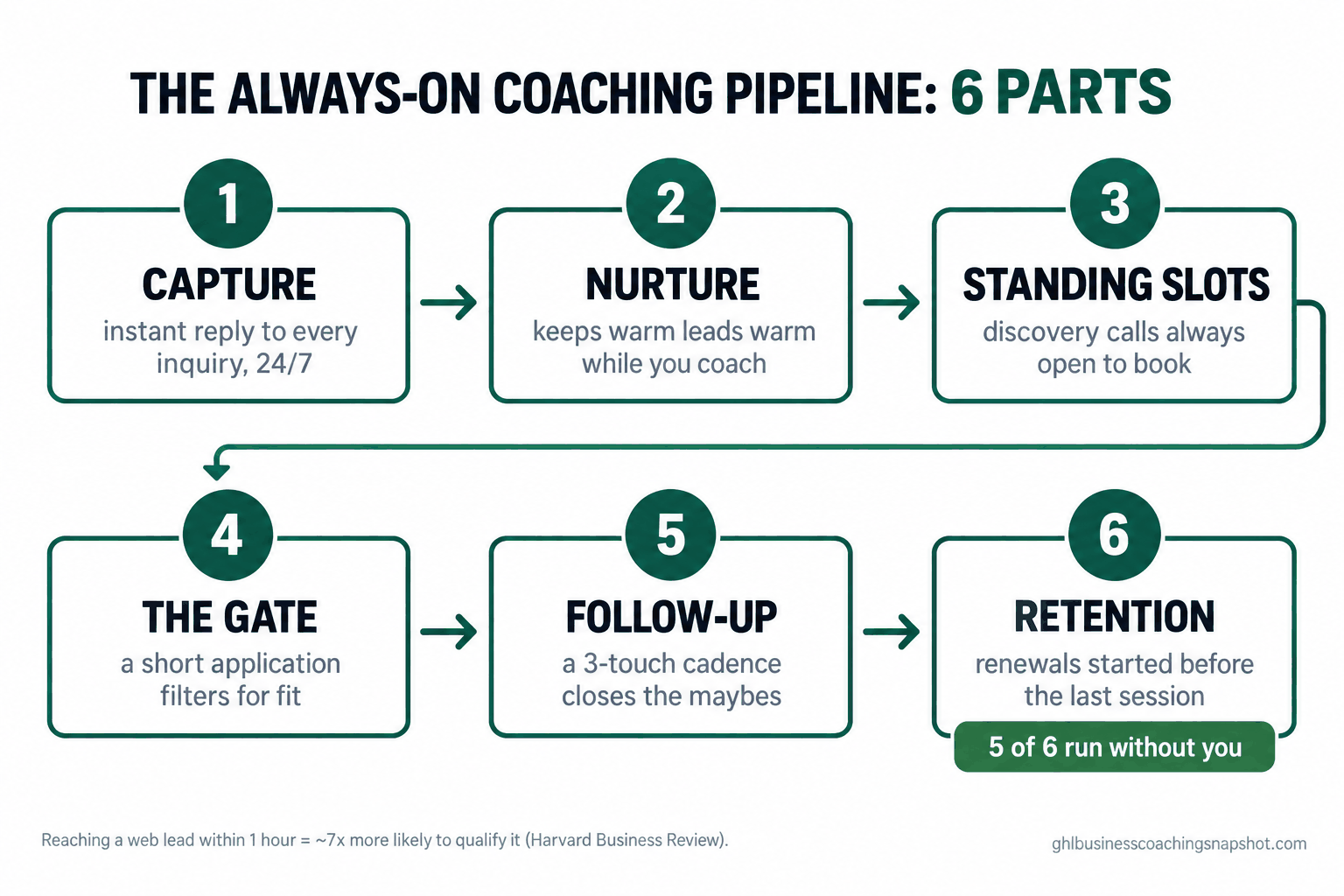
An always-on pipeline is not one big funnel. It is six small systems that hand off to each other. Five can run mostly without you; only one, the actual coaching conversation, needs you in the room. Here they are in order, then each in detail with the setup, the real copy, the timing, and how it breaks.
- Capture catches every inquiry instantly, day or night.
- Nurture keeps warm leads warm while you are heads-down.
- Standing call slots keep discovery calls booking on their own.
- The gate filters for fit so your calendar holds real prospects.
- Follow-up chases the maybes so they do not slip away.
- Retention keeps current clients longer, so you replace fewer.
Stage 1: The always-on capture layer
What it does: the second someone raises a hand, from your site, a DM, a webinar reply, or a referral, they get an instant, personal-feeling response and a path to book. No lead waits for you to surface from a coaching block.
Setup: put a form or chat on every entry point that writes straight into one CRM, then fire an automatic reply within seconds that confirms you got them, answers the first obvious question, and drops a booking link. This is where speed pays: reaching a web lead within an hour makes you about 7 times more likely to qualify it, per Harvard Business Review’s audit of 2,241 firms (HBR). During a feast you will not hit that hour by hand, so the automation has to.
The copy (steal this):
Hi {first name}, it is Dana, thanks for reaching out about coaching. I want to make sure it is a fit before we book anything, so here are two things: a 90-second overview of how I work, and my calendar. Grab a time that suits you and I will come prepared. If now is not the moment, just reply here and we will pick it up later.
Timing: instant auto-reply, then a single nudge at 24 hours if they have not booked. That is it for capture.
How it breaks: capture lands somewhere you do not watch. A form emails an inbox you check twice a week, or DMs pile up with no reminders, and a lead arrives and sits unseen. The fix is one destination (the CRM) and an automatic first touch, so “unseen” is impossible. See speed to lead for coaches for the response-time math in full.
Stage 2: The nurture that runs while you coach
What it does: keeps the not-yet-ready leads warm for weeks or months without a single manual email, so when they are ready, they think of you, not whoever stayed in front of them.
Setup: one nurture sequence, four to six emails over three to four weeks, that a new lead enters automatically if they do not book. It is not a hard sell. It teaches one useful thing per email (a common mistake, a framework, a short client story) and ends each with a soft “when you are ready, here is my calendar.” After the sequence, they roll onto a lighter monthly note so you never fully go dark.
The copy (steal this), one email in the middle of the sequence:
Subject: the month-three wall (and how to see it coming)
Most coaches I work with hit a wall around month three, not because the plan was wrong, but because the early energy faded and nothing replaced it. Here is the check-in question that catches it early: “What did you do this week that your past self would not have?” If the answer is “nothing,” that is the signal. Reply and tell me where you are stuck, and if you want to work through it together, my calendar is here.
Timing: email 1 the day after they opt in, then every three to four days for the sequence, then monthly.
How it breaks: it goes stale (the same five emails running for a year while your offer changed), so refresh it quarterly. Or it gets needy, “just checking in” with nothing useful, which trains people to ignore you. Every touch has to give before it asks. The reactivation version, for leads who went cold months ago, is its own play: see database reactivation for coaches.
Stage 3: Standing discovery-call slots
What it does: keeps a fixed number of discovery-call slots open every week, protected on your calendar, so booking never depends on you remembering to “open some times.”
Setup: block four discovery slots a week, permanently, on the two days you protect for selling, and wire your booking link to only offer those. When they fill, they fill; when they do not, they wait for the next lead. The door is open by default, not opened by hand when you notice the pipeline thinning, which is already too late.
The copy (steal this), the confirmation and reminders:
Confirmation: You are booked for {date/time}. 30 minutes, no pitch, we figure out if this is a fit and what your first 90 days would look like. Come with the one problem you most want off your plate.
Reminder, 2 hours before: See you at {time}, here is the link: {join link}. If something came up, reschedule here: {link}.
Timing: confirmation instant, reminders at 24 hours and 2 hours. That cadence is what pulls no-shows down.
How it breaks: the slots collapse under delivery. A busy week comes, you “borrow” the discovery slots for client sessions, and the selling time quietly disappears, which is the feast-or-famine machine in one habit. Protect the slots like client sessions, and never ship them without reminders: the full reminder system is in reduce discovery-call no-shows.
Stage 4: The qualification gate
What it does: filters who reaches your calendar, so your protected slots hold real prospects, not free-advice hunters. A famine tempts you to drop the gate to fill the calendar, which is exactly when you need it most.
Setup: a short application in front of the booking link, four or five questions: what they want, where they are now, their timeline, and their budget range. Answers that fit book straight in; answers that clearly do not get a kind redirect to a lower-cost resource instead of a call. This is not gatekeeping for ego, it is protecting the scarce hours you set aside to sell.
The copy (steal this), the polite redirect for a no-fit application:
Thanks for the detail, {first name}. Based on what you shared, a full 1:1 engagement is probably more than you need right now. I would start here instead {link to a guide, workshop, or lower tier}, and if things change in a few months, my door is open. I would rather point you to the right-sized help than book a call that is not a fit for either of us.
Timing: instant. The application decides the routing the moment they submit.
How it breaks: too tight and you starve, screening out good clients over one imperfect answer; too loose and your calendar fills with people who were never going to buy. Tune it to your real close data, not your fears. The mechanics of a screen that qualifies without scaring off good buyers are in the application form that actually qualifies.
Stage 5: The follow-up cadence that closes the gap
What it does: chases the “let me think about it” prospects automatically, because most coaching sales happen after the first call, not on it, and follow-up is the first thing that dies in a feast.
Setup: when a discovery call ends without a yes, the prospect enters a short follow-up cadence: a same-day recap, a value touch a few days later, and a clear final check a week or so out. It is polite, finite, and runs whether or not you have a spare minute. Left to willpower, this is the step that vanishes the week you get busy, and it is the highest-value step in the pipeline.
The copy (steal this), the three-message cadence:
Same day: Great talking, {first name}. Quick recap: you want {their goal}, and the first 90 days would focus on {the plan}. Here is the proposal {link}. Take your time, and tell me what is on your mind.
Day 3: One thing I forgot to mention {a relevant client example or resource}. No pressure on the decision, I just thought this would help either way.
Day 8: I do not want to chase you, so this is my last note on it. If the timing is right, here is the link to start {link}. If not, no hard feelings, and I will keep you on my monthly note so we stay in touch.
Timing: same day, day 3, day 8. Then they roll back to the monthly nurture, not silence.
How it breaks: it quits too early (one email and done) or turns into nagging (six “just following up” texts that make you look desperate). Three useful touches then a graceful exit is the balance. The full sequence, including how to handle a “not now,” is in discovery-call follow-up for coaches.
Stage 6: The retention loop that smooths revenue
What it does: keeps current clients longer and turns wrap-ups into renewals, which is what flattens the revenue line. Every client who continues is one you do not have to replace next quarter, so retention is a pipeline tool, not just a delivery nicety.
Setup: two moving parts. A between-session check-in cadence so clients feel progress, and a renewal conversation that starts two to three weeks before the engagement ends, on purpose, not in the awkward final session. The renewal is a scheduled step, triggered by the engagement end date, so it never gets forgotten in a busy stretch.
The copy (steal this), the renewal opener:
{First name}, we are about three weeks from the end of our current block, and I want to talk about what is next before we are down to the wire. You have made real progress on {specific win}, and the next 90 days could focus on {next goal}. Want to grab 20 minutes next week to map it out? No pressure to continue, but I would rather plan it with you than let it just end.
Timing: check-ins on a steady weekly or biweekly rhythm, the renewal touch at “engagement end minus three weeks.”
How it breaks: renewals get left to the last session, when the client has already mentally moved on, or check-ins turn into generic “how’s it going” texts that feel like an autoresponder. Tie each check-in to something specific the client is working on. The churn side of this, why clients drift at month two or three, is in reduce coaching client churn.
On-off marketing vs an always-on pipeline
You market between engagements. Sign a wave, go heads-down, pipeline goes quiet, and two months later you are cold-starting the whole engine while discounting to fill fast. Revenue lurches.
Capture, nurture, booking, follow-up, and renewals keep running during your busiest weeks. Leads arrive and get worked without you, so the pipeline is never empty when clients wrap. Revenue steadies.
Steal this: the gap-week outreach
Here is the fastest way to fill a soft week without discounting. When a week shows unexpected white space, you do not need new leads, you have a warm list already. The gap-week outreach is one message to two audiences: recent “not now” leads, and past clients who finished on good terms.
To warm leads who never booked or said “not now”:
Hi {first name}, I had a spot open up this week and thought of you, since we talked about {their goal} a while back. If the timing is better now, here is my calendar {link}. If not, no worries at all, just wanted to reach out while the door was open.
To past clients who wrapped well:
{First name}, been thinking about you and {their win}. I have room for one or two returning clients this month and wanted to offer it to people I have already worked with first. If you have a next goal in mind, reply and we will find a time. If you know someone who would be a fit, I would be grateful for the intro too.
That last line matters: past clients are your best referral source, and 88% of people trust a recommendation from someone they know more than any other channel (Nielsen). The full referral engine is in the referral system for business coaches. Run this the moment you spot a soft week, not after it has gone quiet.
Three versions: solo, cohort, boutique
The six stages are the same. What changes is where the swing hits hardest, so weight your effort accordingly.
1. Solo coach, 1:1 retainers
Your swing is the sharpest, because you are the whole delivery team and the whole sales team. When delivery is full, selling is at zero. Weight your energy on capture and standing slots: the automation has to book calls during your heavy weeks because you cannot. Protect four discovery slots a week like client sessions, and let the auto follow-up carry the maybes. Retention is your highest-payoff move, since replacing a solo client is a whole cold-start.
2. Group cohort operator
Your swing is calendar-driven: you sell hard for a launch window, fill the cohort, then go dark until the next launch, which is feast-or-famine with a fancier name. The fix is a rolling nurture and a wait-list so your next cohort fills while the current one runs, instead of a cliff every few months. See the group program cohort kickoff for the enrollment-to-onboarding handoff.
3. Boutique, 2 to 8 people with retainers
Your swing is masked until it is not: multiple coaches smooth the average, so a thin pipeline hides for a while, then a few retainers end at once and it hits everyone. Your best move is a shared pipeline and the qualification gate, so leads route to the right coach and no one runs dry while another is slammed. One CRM the whole team works from makes the swing visible early, when you can still fix it. The coaching CRM and sales pipeline piece covers the shared-pipeline setup.
The compliance line for automated outreach
An always-on pipeline sends a lot of automated texts and emails, so a few rules matter. None of this is legal advice; get a real review of your setup.
Consent and opt-out for SMS. Automated texts to US contacts fall under TCPA and carrier rules: you need real consent to text someone and a working opt-out (a “reply STOP” that actually stops). Build consent into your forms and honor opt-outs automatically. At any volume, US carriers also require A2P 10DLC registration; the plain-English version is in A2P 10DLC for coaches.
Testimonials in your nurture. If your emails show client results, the FTC’s 2023 Endorsement Guides require that an atypical result carry a disclosure of the generally expected result, or substantiation, and that material connections be disclosed (FTC). The “my client tripled revenue” line needs a real disclosure beside it, same as on your site.
Renewals and auto-billing. If your retainer auto-renews, more than 25 states have automatic-renewal laws requiring clear disclosure and an easy cancel path, even though the federal “click-to-cancel” rule was vacated in 2025. The full rundown is in the FTC rules for coaches.
Common objections
“I do not have time to build all this while I am slammed.” That is the whole point, and the trap. You build it once, in a calmer stretch, precisely so it runs during the slammed weeks when you cannot. Building it mid-famine under pressure is why the famine keeps repeating. Start with the two stages that save you the most during a feast, capture and follow-up, and add the rest later.
“Won’t automated messages feel impersonal and hurt the relationship?” Only if they are generic. The copy above sounds like a person because it points at real specifics: their goal, their win, their next step. Automation decides the timing and sending; you decide the words. A same-day recap that lands while the call is fresh reads as attentive, not cold.
“I get all my clients from referrals, so I do not need a pipeline.” Referrals are the best leads you get, and the least predictable, which is a big reason the income swings: you cannot schedule when a client sends someone your way. A pipeline does not replace referrals, it catches and works them properly and fills the gaps between them, so a quiet referral month is not a famine. The gap-week play above runs on exactly your warm network.
“Do I need to be technical to run this?” Less than you need to be to keep doing it by hand. The manual version is the harder job: you are the automation, remembering every follow-up during your busiest weeks, which is why it fails. A pre-built coaching CRM and workflow system arrives wired together, so the technical part is a one-time setup you can hand off, not a weekly chore.
FAQ
What causes feast-or-famine in a coaching business?
It is a scheduling problem, not a demand problem. Marketing and delivery compete for the same hours, and delivery wins, so your lead generation stops the moment you sign a wave of clients. Because coaching engagements last weeks or months, the empty pipeline does not hurt until those clients wrap, two to three months later, which is when the famine hits and feels like it came from nowhere.
How do I keep marketing while I am busy delivering coaching?
Do not rely on willpower, because it fails every busy week. Move the parts that do not need you (lead capture, nurture emails, booking reminders, and post-call follow-up) onto automation that keeps running during heavy delivery weeks. You keep only the parts that need a human, the actual selling conversations and renewal talks, and protect those on your calendar.
How many discovery calls should I keep open each week?
Enough that a normal close rate keeps your roster full, and keep them open permanently rather than opening them by hand when the pipeline thins. Many solo coaches protect around four slots a week on set days. The number matters less than the habit: the slots stay open by default, and you do not borrow them for client sessions during a busy stretch, which is how selling time quietly disappears.
What is the fastest way to fill a suddenly quiet week?
Work your warm list, not cold traffic. Send a short, no-pressure message to recent 'not now' leads and past clients who finished well, letting them know a spot opened up. Warm contacts convert far faster than new ones, so a gap-week outreach usually books calls within days, without the discounting a cold-start famine forces on you.
How does client retention reduce feast-or-famine?
Every client who renews is one you do not have to replace, so retention directly flattens the revenue line. Start the renewal conversation two to three weeks before an engagement ends, tied to the end date so it never gets forgotten, and keep steady between-session check-ins so clients feel progress. Longer engagements mean less of your pipeline has to be rebuilt from scratch each quarter.
The white-space month, avoided
Back to that field of white space on next month’s calendar. It did not appear because the market dried up or you are bad at marketing. It appeared because your marketing turned off the day delivery turned on, and the bill came due two months later. The demand is real and the leads were always reachable. They just needed something to catch and work them during the weeks you had no time.
That is all an always-on pipeline is: the five parts that can run without you, running without you, so the sixth part, the coaching, has room to be great. Build capture and follow-up first, protect your standing slots, and start the renewal conversation before the last session. Do that, and the feast stops being followed by a famine.
If you want the whole thing already built, that is what the Coaching Snapshot installs: capture, nurture, booking, the application gate, follow-up, and retainer billing recovery in one GoHighLevel account in about 24 hours. If you are setting up GoHighLevel to run it yourself, you can start through our GoHighLevel partner link. That is an affiliate link, so we may earn a commission at no extra cost to you.
Industry figures reflect the ICF 2025 Global Coaching Study and are linked to the source; confirm current numbers before citing. Nothing here is legal advice; consult a qualified professional on TCPA, endorsement, and auto-renewal compliance. Outcome examples are illustrative, and we do not guarantee revenue, client count, or income gains; actual results depend on your offer, audience, and execution.