
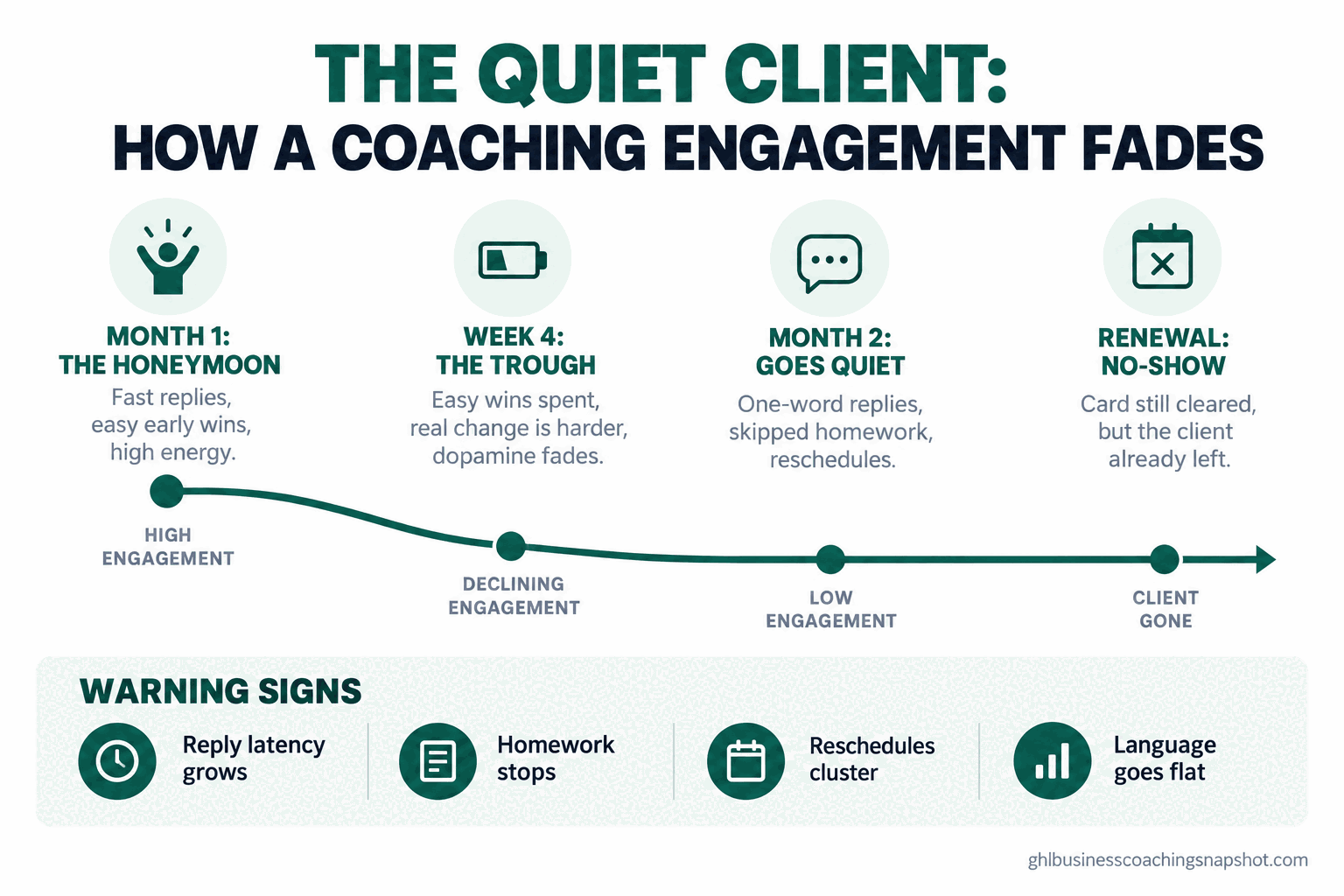
It is a Tuesday and you are prepping for a call with a client who, six weeks ago, could not stop talking. She replied to every message, did the homework early, and told you this was the best investment she had made in her business. Now your last three notes have one-word answers, a rescheduled session, and a “so sorry, crazy week” you have heard before. The card still cleared on the first. On paper she is a happy client. In reality she left three weeks ago. She just has not told you yet.
That gap, between the client who has mentally checked out and the one who finally cancels, is where most coaching revenue quietly dies. The answer to “why do my clients drift?” is almost never that the coaching was bad. It is that the client went quiet around month two, nobody named it, and silence got mistaken for “fine.” This post is about reading that silence: why it happens, what it is telling you, and how to catch the fade while you can still fix it, instead of in a cancellation email you never saw coming.
Sources: ICF 2025 Global Coaching Study; University of Pennsylvania via Higher Ed Dive; Dominican University (Matthews); OnRamp 2025. Course and onboarding data are proxies for self-directed behavior change, not coaching-specific.
What the quiet actually costs you
Most coaches track the wrong number. You watch new leads and discovery calls booked, because the top of the funnel is loud. Meanwhile a hole in the bottom drains the tank without a sound, because a client who fades does not ask for a refund or leave a bad review. They just do not renew, and a non-renewal is invisible in a way a complaint never is.
Run the math on one quiet client. You carry 15 clients at $1,500 a month. One who was on track to renew, but fades at month two and leaves at month four, is roughly $12,000 of lifetime value gone, plus the ad spend, call time, and onboarding to replace them. Harvard Business Review puts the gap plainly: winning a new customer runs 5 to 25 times more expensive than keeping one you already have (HBR). And it matters more every year: the 2025 ICF Global Coaching Study counted a record 122,974 coach practitioners worldwide, up 15% since 2023, pulling an estimated $5.34 billion in revenue (International Coaching Federation). More coaches chasing the same prospects makes a brand-new client more expensive every quarter. The client you already have is the cheapest growth you will get, and the quiet ones are the ones you are about to lose for free. If your income swings because of it, that is the feast-or-famine pipeline problem, and retention is half the fix.
The honeymoon, and why it always ends
Every coaching engagement has a honeymoon. The client just made a decision they are proud of, and the brain works hard to prove it was smart. The first session surfaces obvious wins, the low-hanging fruit you can always find in week one. Energy is high, replies are fast, and it feels like this one will be easy.
Then week four arrives and the easy wins are spent. The next layer of progress is harder, slower, and less visible, and the dopamine of the purchase has worn off before results have compounded. That is the trough. It is not a sign your coaching failed. It is a predictable dip every behavior-change relationship passes through, and for most engagements it lands in month two.
Here is the problem. From the client’s side the trough feels like “maybe this is not working.” And the human response to that, plus “I am a little embarrassed I have not done the homework,” is not to tell you. It is to go quiet. Silence is the sound of a client sitting in the trough, deciding whether to climb or quit, usually without involving you at all.
The six real reasons clients go quiet
When you dig into why a specific client faded, it is almost always one or more of these six. Learn to spot which one you are looking at, because the fix is different for each.
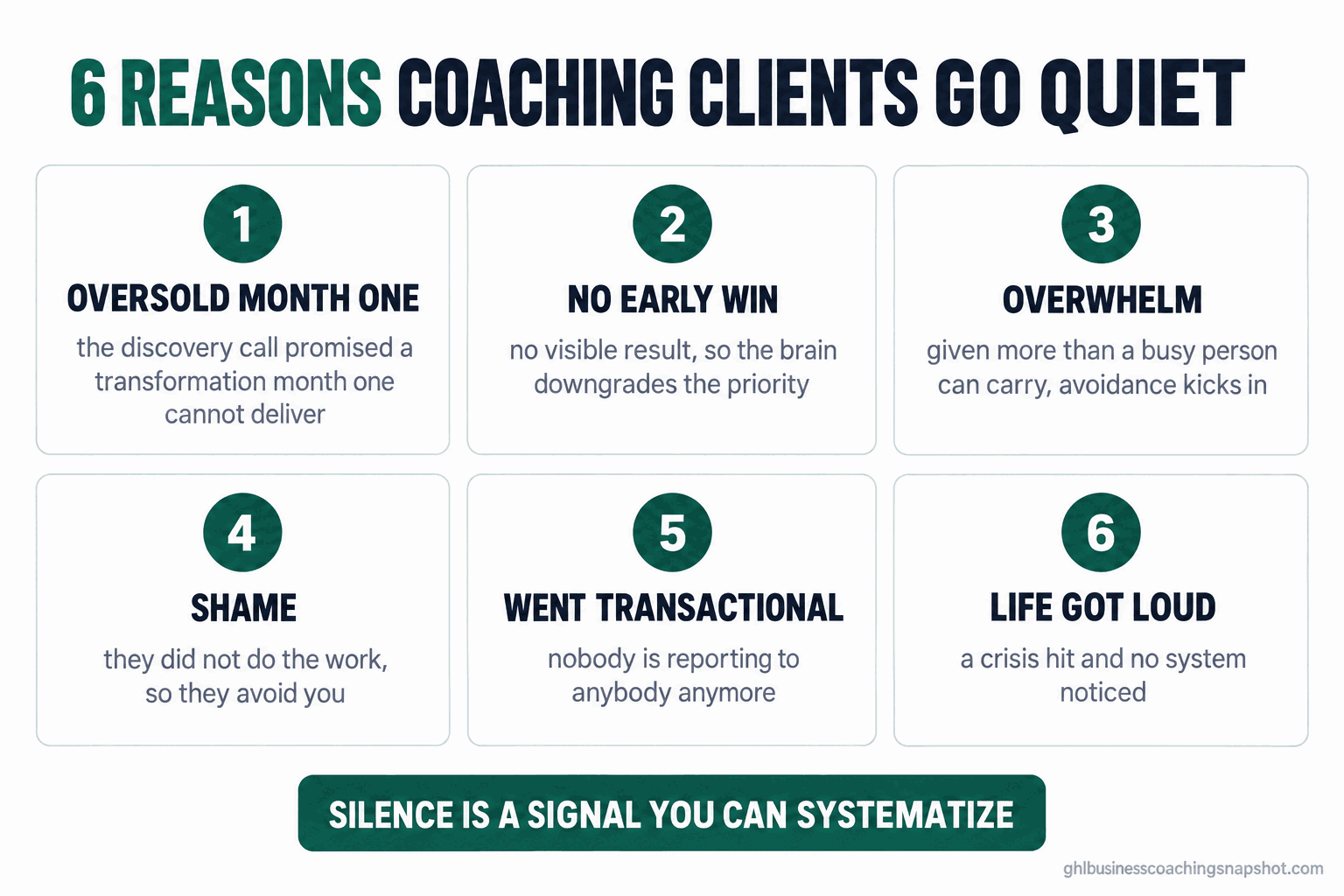
1. The sale promised a month one that month one could not deliver. If your discovery call sold a fast, dramatic transformation, the client measures week four against a fantasy, and the gap reads as failure. A call that sets an honest arc (“the first month is setup and quick wins, the real change compounds in months two and three”) buys you the exact window where clients usually fade. If your calls oversell, fix the discovery-call conversation before you touch retention.
2. No early win, so the brain quietly downgrades the priority. People do not stay engaged with things that have not paid off yet. The evidence outside coaching is brutal: across about a million registrants in 16 free University of Pennsylvania online courses, only roughly 4% finished (Higher Ed Dive). Self-directed effort, with no visible return and nobody waiting, collapses. In a survey of 161 onboarding leaders, 48% said customers abandon when they do not see value quickly (OnRamp). If month one produced no concrete, nameable win, month two is already at risk. Manufacturing that early win is the whole job of client onboarding.
3. Overwhelm. You gave them more than a busy human can carry. Enthusiastic coaches over-prescribe: three frameworks, a workbook, a reading list, a daily practice, all in two weeks. The client falls behind, the backlog piles up, and avoidance kicks in. They go quiet because opening your message means facing everything they have not done. The fix is counterintuitive: give less, and make the next single step obvious.
4. Shame. They did not do the work, so now they are avoiding you. This is the big one, and the one coaches misread most. A client who committed and then did not follow through feels caught, and showing up means admitting it to your face. So they reschedule, then reschedule again, then go dark. From your side it looks like disinterest. From theirs it is embarrassment wearing the mask of “crazy week.” Name it gently and you can often rescue the engagement in one conversation.
5. The relationship went transactional, and nobody is reporting to anybody. Accountability is not a soft idea, it is measurable. In Dr. Gail Matthews’s study at Dominican University, 149 participants were split by how they handled their goals. Those who sent weekly progress reports to a supportive person scored 7.6 out of 8 on goal achievement. Those with unwritten goals and no one to report to scored 4.28 (Dominican University). When your engagement drifts from “I report to Tara every week and she sees my numbers” to “I have a session whenever,” you have removed the single most powerful ingredient. A client reporting to no one stalls, and a stalled client goes quiet.
Mean goal-achievement score (8-point scale) by accountability condition, over four weeks, among 149 adults from businesses and networking groups. Source: Dr. Gail Matthews, Dominican University of California.
6. Life got loud, and you were not in the room when it did. Sometimes nothing is wrong with your coaching or your sale. A client’s quarter blew up, a parent got sick, a launch went sideways, and coaching dropped down the list for a few weeks, as it should have. The failure is not that life happened. It is that your system had no way to notice and no gentle way to say “I am still here, take the pressure off, let’s pick a smaller next step.” Without that, a three-week crisis becomes a permanent exit, because reappearing after a long silence feels awkward, so they just do not.
How to read the silence before it reads you
You cannot hold 15 or 20 clients in your head and feel which ones are drifting. The engaged clients are loud and pleasant, so they soak up your attention, while the quiet ones fade in the gaps precisely because they are quiet. By the time a fade is obvious, the client is already composing the cancellation. Reading the silence means watching for signals on purpose, not waiting to feel a problem.
The signals that actually predict a fade, roughly in the order they show up:
- Reply latency stretches. A client who answered in an hour now takes three days. This moves before anything else does.
- Homework stops arriving. The pre-work, the worksheet, the between-session action. When it goes missing two sessions running, the client is sliding into the shame loop, not just busy.
- Reschedules cluster. One reschedule is life. Two in a row, especially with vague reasons, is avoidance.
- Language goes flat. “Good, thanks” and “all good” replace specifics. Enthusiasm has a vocabulary, and so does checking out.
- They stop asking questions. An engaged client pushes back and asks what is next. Silence of curiosity comes right before silence of contact.
The reach-out window is narrow: flag silence at around seven to ten days and send your first note the same week, while the client is still in the trough and deciding, not after a skipped renewal. A fade caught at week six is a conversation. The same fade caught after a missed renewal is a win-back campaign, which is far harder and rarely works.
The move is not to memorize these, it is to build something that watches for them so you do not have to. A simple engagement status in your CRM and workflow automation, green for on-track, yellow when two signals fire, red when a client goes dark for a set number of days, turns an invisible problem into a list you work on a Friday afternoon. That is what a progress-tracking system is for, and the accountability check-ins that do not feel creepy are how you act on it. Automating it does not replace your judgment. It makes sure the quiet client lands on a list instead of in a blind spot.
The month-two check-in, two ways
You have a loose sense most clients are fine. A thriving one takes up your Monday. The quiet client, silent for nine days, does not cross your mind until the renewal date passes and she emails that she is going to 'pause for now.' You never saw the fade, so you never got a shot at it.
Your CRM flags that she has not replied in seven days and skipped last week's action. She lands on your Friday 'yellow list.' You send a two-line, pressure-free note that afternoon. She admits she fell behind and felt embarrassed. You reset the plan to one small step. She re-engages, and renews in month five.
Steal this: the messages that reopen a quiet client
The instinct when a client goes quiet is to either chase (“Hey! Haven’t heard from you!”) or retreat and give them space. Both are wrong. Chasing adds pressure to someone already avoiding you. Retreating confirms the relationship went cold. What works is a short, warm, low-pressure note that removes the shame and makes the next step tiny. Here is the exact copy to keep ready.
Three things make this work. You name the silence, which breaks the shame spiral. Every message shrinks the ask, so re-entry costs almost nothing. And the final note gives permission to be honest, converting a silent drifter into either a re-engaged client or a clean, respectful exit. Both beat a ghost.
The other piece of copy to keep loaded is the win-capture note, because the real cure for the fade is a visible result landing before the trough does.
That note manufactures the sense of progress that keeps a client out of the trough, logs a result you can use for renewals and testimonials, and reminds the client why they hired you right before the stretch where they usually forget.
The fade looks different at every stage of practice
The quiet-client problem is universal, but the right response depends on how you deliver and how many people you carry.
The solo coach with 8 to 15 one-to-one clients. The fade is personal and catchable, which is the trap. You can message every quiet client yourself, so the barrier is not capacity, it is attention. You get absorbed in delivery and the quiet ones slip because nothing forces them in front of you. Your fix is light: an engagement flag and a saved set of re-engagement messages, so “reach out to the yellow list” becomes a 20-minute Friday ritual instead of a thing you mean to do.
The group or cohort operator. The fade hides inside the crowd. In a cohort of 30, the loud ones fill the group calls and the channel while three people quietly stopped showing up weeks ago. Those three will not renew or refer, and you will not know until the numbers come in. You need tracking that works at the individual level inside a group: who opened the module, who attended live, who went silent in the channel. The re-engagement still has to be personal, because the reason they faded is that a group made it easy to disappear.
The 2 to 8 person boutique with fractional retainers. At $5,000 and up a month, one quiet client is a five-figure problem, and disengagement here is sophisticated. They will not ghost crudely, they will stop looping you in, cancel a meeting for a “conflict,” and start treating the retainer as optional. By the time it is obvious, procurement is asking what the retainer is for. Your fix is executive-grade: a named owner per account, a visible cadence of reported outcomes the client’s boss can see, and a flag the moment a decision-maker stops engaging. At this price, catching the fade early is the difference between a renewed contract and a budget line that gets cut.
Objections I hear from coaches
“Won’t reaching out when they’ve gone quiet seem needy or desperate?” It seems needy when the note is about you (“please rebook so I hit my numbers”). It seems like care when it is about them and removes pressure (“life got loud, no rush, let’s pick one small thing”). The copy above is built so the client feels seen, not chased. Done right, the most common reaction is relief, not annoyance.
“I already do check-ins. Why am I still losing people?” Because “how’s it going?” is not a check-in, it is a question that invites “good, thanks” and tells you nothing. A real check-in is structured: here is what we set out to change, here is what has moved, here is what is stuck, here is the one commitment for the next stretch. Generic check-ins actively hide the fade, because “good” is the exact word a checked-out client uses to dodge the conversation.
“What if they genuinely just want to be left alone?” Then the third message gives them a graceful way to say so, and you respect it. The goal was never to trap anyone, it was to replace a guess with an answer. A client who tells you they are pausing is a gift next to one who silently lets the renewal lapse, because the first might come back and will still refer.
“I’m not technical. This sounds like a lot to build.” The judgment is yours, the system is not. Deciding what to say to a struggling client, and coaching them through the trough, is the human part only you can do. Watching 20 inboxes for reply latency, flagging the ones that crossed a line, and queuing the first gentle note is the robotic part, and it should be automated. You are not replacing the relationship. You are making sure it gets a chance before the silence wins.
One compliance note before you capture wins
The win-capture habit does double duty, because the results you log become the testimonials you sell with, and that comes with a rule. The FTC’s 2023 Endorsement Guides require that a testimonial showing an atypical result, the client who tripled revenue, carry a clear disclosure of what a typical client should expect, or be backed by substantiation. You cannot present your single best outcome as if it were normal, and material connections like a discount for a testimonial have to be disclosed clearly (Federal Trade Commission).
None of this is legal advice, and the coaching-versus-therapy scope line varies by state, so a quick review with a lawyer who knows your market is cheap insurance. We cover the testimonial rules, income-claim limits, and the auto-renewal laws most coaching content gets wrong, with paste-ready disclosure copy, in the FTC rules for coaches. Capture every win. Just present them honestly.
FAQ
Why do coaching clients go quiet instead of telling me they want to stop?
Usually because they are embarrassed, not uninterested. A client who committed and then fell behind feels caught, and telling you means admitting it to your face, so they reschedule and then go silent. It is avoidance wearing the mask of a 'crazy week.' Naming the silence gently, with no pressure, often rescues the engagement in one conversation.
When do coaching clients usually start to disengage?
Most commonly around month two. The honeymoon has worn off, the easy early wins are spent, and the harder, slower part of change arrives before results have compounded. That dip is predictable in almost any behavior-change relationship. If you know it is coming, you can reach out during the trough rather than after a missed renewal.
How do I tell a client who is just busy from one who is churning?
You often cannot from the outside, which is the point. Reach out with a short, pressure-free note that shrinks the ask to one small step. A busy client re-engages, a done client tells you, and either answer is useful. Assuming a quiet client is 'just busy' is how coaches lose renewals they could have saved with a two-minute message.
What should I say to a coaching client who has gone quiet?
Keep it short, warm, and about them. Name the silence without blame ('things went a little quiet, which usually just means life got loud'), remove the pressure, and make re-entry tiny ('we just pick one small thing'). Avoid 'please rebook' energy, which reads as needy. If there is still no reply after a couple of notes, ask a clean question that gives them permission to pause.
Can I automate catching clients before they disengage?
You can automate the watching, not the caring. A CRM can flag reply latency, missed homework, and days of silence, then surface a 'quiet list' and queue the first gentle message. What you should not automate is the coaching through the trough. The system puts the right client in front of you at the right time. The conversation is still yours.
Related reading
- How to reduce coaching client churn: the full retention system
- Coaching client onboarding: the first-30-days system that cuts churn
- How to track coaching client progress
- Daily accountability check-ins without being creepy
- The coaching discovery-call script that sets an honest arc
Go back to that client from the opening, the one with the one-word replies. The coach who loses her and the coach who keeps her are not different in talent. One of them had a system that put her on a list the moment she went quiet, sent a note that took the pressure off, and reset the plan to one small step while she was still deciding. The other found out at the renewal that never came. The silence was telling both coaches the same thing. Only one was listening.