
A prospect who is about to spend $6,000 with you is not reading your sales page for your framework. They are hunting for one thing: proof that someone like them got the result they want. Testimonials are that proof, and most coaches collect them the worst possible way, by firing off a single “mind writing me a quick review?” the week a client wraps, then pasting whatever comes back onto a page in Comic Sans. This post gives you the whole system instead: a repeatable path from client win to published, compliant proof, with the exact words to ask, how to shape a quiet “thanks so much” into a story that sells, and how to stay on the right side of the FTC while you do it.
You already have the wins. You are just not capturing them, and the ones you do capture are too vague to move anyone. That is fixable, and none of it takes talent. It takes a sequence you run the same way every time.
What missing testimonials actually costs you
Picture the version most coaches run. A client finishes a six-month engagement, you feel good about it, and three weeks later you remember you never asked for a testimonial. You send a text: “Hey, would you mind leaving me a quick review?” They are busy, the win is no longer fresh, and you get back “Loved working with you, highly recommend!” You paste it on your site next to four others that all sound the same. None of them name a result. None of them sound like a real person. And your next prospect scrolls past all five.
That costs you money in a way you can measure. Studying real retail data, Northwestern University’s Spiegel Research Center found that simply displaying reviews on a product could raise its conversion rate by as much as 270%, and that the lift was far bigger on expensive items, around 380% on higher-priced products versus roughly 190% on cheaper ones (Spiegel Research Center). Coaching is a high-priced, high-trust purchase. Proof is not decoration on your sales page. It is the single lever doing the most work to turn a visitor into a booked call.
Put it in your own numbers. If your discovery page converts visitors to booked calls at 3% and credible, specific proof moves that even to 4%, that is a third more calls off the exact same traffic. You did not spend a dollar more on ads. You just stopped throwing away the proof you already earned.
The market is real and it is shopping. The International Coaching Federation counted 122,974 coach practitioners worldwide in its 2025 Global Coaching Study, up about 15% since 2023, and 57% of coaches also sell consulting, so your prospect has plenty of other options in the tab next to yours (ICF, 2025). The coach whose proof is specific and believable wins the ones who are deciding between you and someone else.
The 6-stage coaching testimonial system at a glance
A testimonial system is not a single ask. It is a path with six stages, each with a job, and each with a specific way it breaks when you skip it. Get the sequence right and testimonials stop being a thing you chase and start being a thing that arrives.
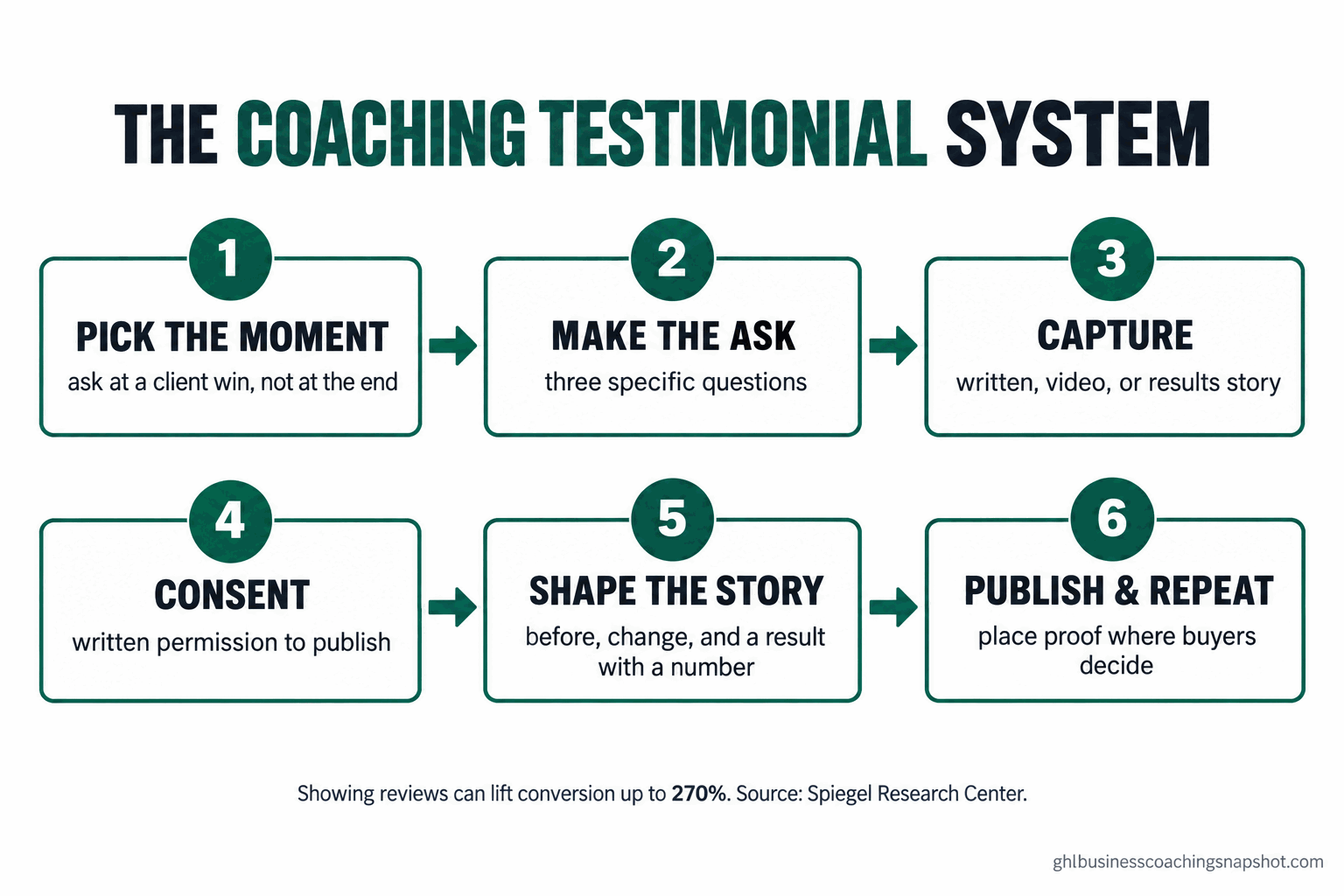
The stages below spend as much time on how each one fails as on how to run it, because the failure is where the testimonials quietly go to die.
The same client, two ways you can ask
Sent three weeks after the engagement ended, it reads: 'Mind leaving me a quick review?' No structure, no prompt, no example. What comes back is 'Loved working with Tara, highly recommend!' It names no outcome and sounds like every other one on the page.
Sent the day the client hit a milestone, it asks three specific questions about the before, the change, and the number, with a short example to anchor the tone. What comes back is 'I walked in with 4 clients and no system. Twelve weeks later I had 11 and a waitlist.' It names the result and sounds like a real human.
Stage 1: Pick the moment to ask
The most common testimonial mistake is timing, not wording. Coaches ask at the end of an engagement, which feels logical and is exactly wrong. By the end, the dramatic early wins have faded into the client’s new normal, and the relationship is winding down, so the emotional charge that makes a testimonial vivid is gone.
Ask at the win instead. The moment a client lands their first high-ticket sale, fills their cohort, hits a revenue number, or says some version of “this changed how I run my business,” that is your window. The feeling is hot, the before-and-after is sharp in their memory, and they want to tell someone. Let them tell you.
The real copy: tie the ask to a trigger you can actually see. Good triggers are a milestone logged in your tracker, a specific session where the breakthrough happened, a payment that marks a result, or a spontaneous thank-you in your messages. When one fires, that is the day you ask, not the day the contract ends.
How it breaks: the trigger fires and nobody asks, because the ask lives in your head instead of in a system. You are in a session, the client says the magic words, you think “I should get that in writing,” and then you never do. The fix is to make the trigger launch the request automatically, which is Stage 6. For now, the rule is simple: ask at the peak, not at the finish line.
Stage 2: Make the ask (steal this copy)
A vague ask gets a vague answer. “Can you leave a review?” hands the client a blank page, and busy people fill blank pages with clichés. Your job is to make answering almost effortless by asking specific questions that pull out the story and the number.
Use three questions. The first establishes the before. The second surfaces the change. The third gets the result in their own words, ideally with a figure. Give them an example answer so they know how long and how specific you want them to be.
How it breaks: you ask for too much and the client stalls. A five-question survey or a “can you record a 10-minute video” request gets ignored because it feels like homework. Keep the written ask to three questions, and when you want video, make it a loom-style recording they can do in one take from their phone, not a production. The best testimonial you will ever get is the one that was easy enough to actually send.
A second failure: you ask and then go silent. People mean to reply and life happens. One friendly nudge four days later, “no pressure at all, just floating this back up,” roughly doubles your response rate without any awkwardness. That nudge is a prime candidate to automate.
Stage 3: Capture it in the format you need
Not all proof is equal, and not all of it belongs in the same place. Before you ask, decide what format you actually need, because the format changes how you ask and where it goes.
There are three workhorse formats, and a good system uses all three over time.
| Format | Effort for the client | Where it wins | FTC care needed |
|---|---|---|---|
| Written testimonial | Low (a few sentences) | Sales pages, email, proposals | Standard: disclose incentives, keep claims honest |
| Video testimonial | Medium (one phone take) | Sales pages, ads, VSLs | Higher: a real person making a results claim is powerful and scrutinized |
| Results story / mini case study | Higher (you do the writing) | Pillar pages, the case-studies section, high-ticket proposals | Highest: specific numbers need to be true and representative |
Written testimonials are your bread and butter. They are easy to collect, easy to place, and easy to refresh. Video is the heavy hitter because it is hard to fake and easy to trust; people find video testimonials effective precisely because they show an actual person telling their story (Wyzowl). The results story is the format you build around your very best clients, and it is the one that earns links and anchors a high-ticket sale.
Why people say video testimonials are effective. A real face telling a real story out-trusts anything you say about yourself. Source: Wyzowl.
How it breaks: you collect only one format, usually written, and your proof all looks the same. Five text quotes in a row read as interchangeable, and a skeptical buyer discounts the lot. Mix a short video, a results story with a chart, and a few tight written quotes, and the page feels like evidence instead of a wall of praise. Variety is not decoration here. It is what makes the proof believable.
Stage 4: Get consent and usage rights
This is the stage coaches skip, and it is the one that bites. When a client sends you a glowing message, that is not permission to put their name and face on your sales page. You need explicit, written consent, both because it is the decent thing and because publishing someone’s words and likeness without it is a legal and relationship risk you do not want.
Make consent part of the ask, not a separate awkward conversation. One line does it.
Capture the yes in writing and keep it. A reply, a signed form, or a checkbox on your intake all work. Note what they agreed to, because consent to a written quote on your website is not consent to run their face in a paid ad. If you plan to use proof in ads, say so when you ask.
How it breaks: you use a testimonial in a way the client did not expect, they see their face in a Facebook ad they never agreed to, and now you have an angry former advocate and a possible takedown. The other failure is forgetting who said yes to what, so you freeze and stop using any of your proof out of fear. A simple record, kept with the testimonial, solves both. If you store testimonials in your CRM alongside the contact, the consent note lives right next to the quote.
Stage 5: Shape the quote into a results story
Raw testimonials are rarely ready to publish. A client’s reply might ramble, bury the result, or lead with “Tara is so lovely” before getting to the thing that actually matters. Your job is to shape it, keeping every word true and every claim theirs, while cutting to the story that sells.
Shaping is editing, not inventing. You can trim, reorder, and fix a typo. You cannot add a result they did not report, round 8 up to “double,” or stitch two clients into one. The line is simple: the published version has to be something the client would read and say “yes, that’s what I said and what happened.”
A results story follows a shape buyers recognize: the before, the turning point, the after, with a number. Use this skeleton and fill it from the client’s own answers to your three questions.
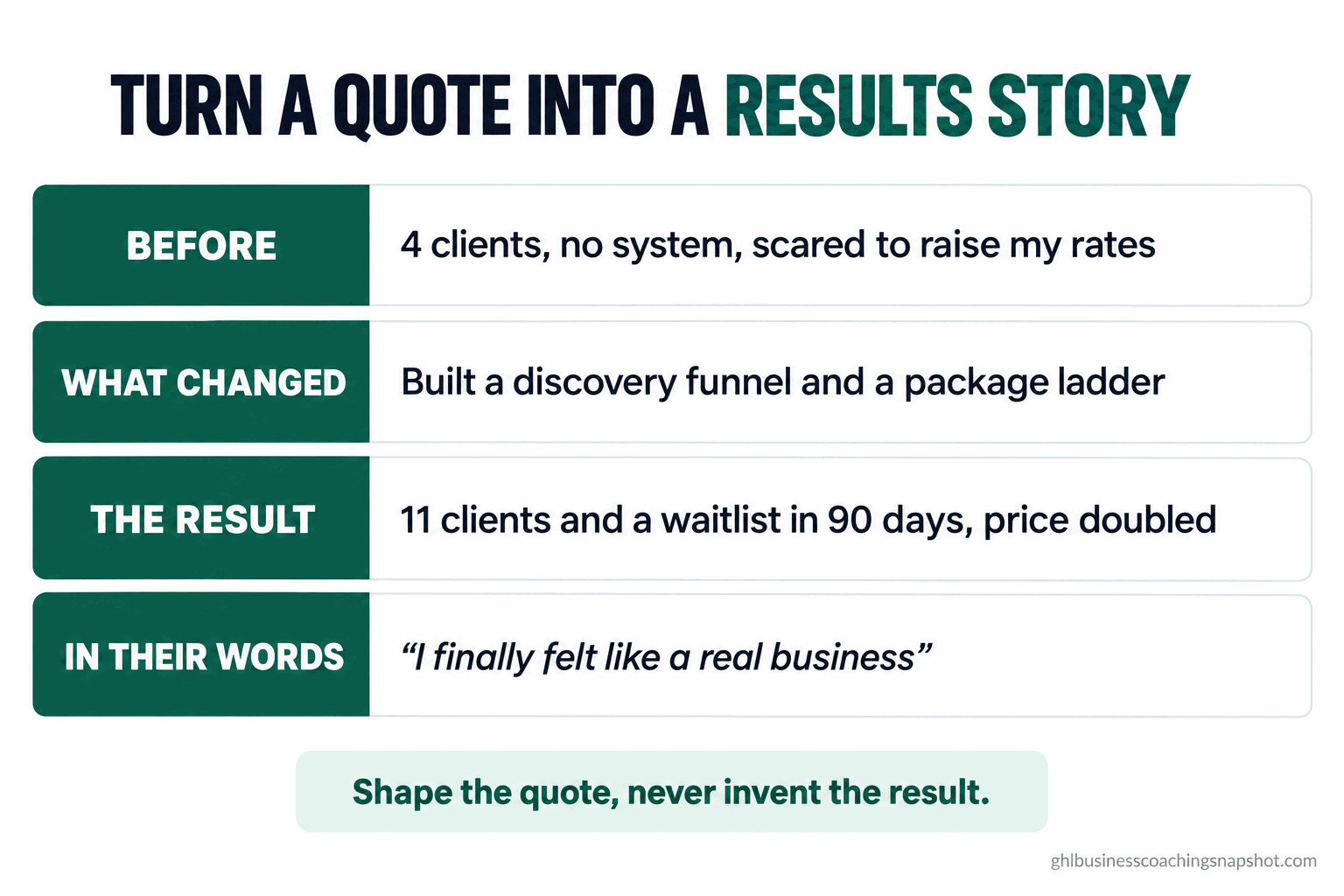
Lead with the number in the headline wherever you can. “From 4 clients to 11 in 90 days” beats “A great experience” every time, because the first one answers the only question your prospect is really asking: will this work for someone like me. Pair the hardest-hitting results stories with the proof your reader can verify, and link them to the matching case studies so a serious buyer can go deeper.
How it breaks: you over-edit into marketing voice, and the testimonial stops sounding like a person. The moment a quote reads like you wrote it, trust evaporates, because buyers are very good at smelling a testimonial the coach ghost-wrote. Keep the client’s actual phrasing in the quoted line, even if it is a little clumsy. Clumsy and real beats smooth and fake. The other failure is cutting the number to keep the quote short. Never cut the number. The number is the point.
Stage 6: Publish it compliantly, then keep it flowing
Proof only works where buyers decide. A testimonial buried on a “reviews” page nobody visits does nothing. Place proof at the point of decision: beside your pricing, on your sales page, inside your application form right before someone commits to a call, and in your proposals. Match the proof to the moment, so a prospect worried about price sees a testimonial about value, and one worried about whether it works for their niche sees a story from their niche.
Remember what Spiegel found: most of the conversion lift comes from the first handful of reviews, not the fiftieth (Spiegel Research Center). You do not need a hundred testimonials to move the needle. You need five believable, specific ones in the right spots. That is reachable for any coach with a few happy clients.
Then make it a loop instead of a one-time scramble. Tie the ask to the milestone trigger from Stage 1, send the request and the four-day nudge automatically, drop the consent into the contact record, and alert yourself when a strong one lands so you can shape it. Run this way and proof accumulates on its own, which is the whole point. For the related play of getting public star ratings on autopilot, see the review-harvesting system; testimonials and reviews are cousins, and the same milestone trigger feeds both.
How it breaks: you collect testimonials and never place them where it counts, or you place them and never refresh them, so your proof is all from 2023 and a sharp prospect notices. Set a light cadence: ask at every milestone, and swap your weakest published proof for a fresher, more specific one whenever a better story arrives. Your proof should always be getting stronger, not just longer.
Run the system three ways
The same six stages run differently depending on your model.
Solo 1:1 coach. You have fewer clients, so every testimonial matters more and you can go deep. Ask at the win, aim for one solid results story per client, and lean on video, since a personal 1:1 relationship produces the warmest, most specific recordings. You do not need volume. You need five to eight strong, specific stories covering your main client types, placed on your sales page and in your proposals. Because you are close to each client, the consent conversation is easy, so get permission for video and ads up front.
Group or cohort coach. You get a burst of wins at the end of each cohort, so batch your asks. Build the request into your cohort wrap, send it to everyone the week results land, and you will collect ten at once. The risk is sameness, since cohort members describe the same program benefit, so steer your three questions toward each person’s specific starting point and number. One standout story plus a reel of short video clips is powerful proof for filling the next cohort, and it feeds your work to fill a group coaching cohort.
High-ticket or fractional. Here proof carries the most weight, because the price is highest and this is exactly where Spiegel’s 380% lift on expensive offers lives. Invest in full case studies, not just quotes: the named client, the real before-state, the engagement, and a verifiable result. Get written sign-off on every number, because a $30,000 engagement citing a client’s revenue figure needs that figure accurate and approved. One deeply credible case study can anchor an entire high-ticket sale.
Staying on the right side of the FTC
Testimonials are regulated, and the rules got stricter in 2023. This is not legal advice, and you should run your specific setup past a qualified professional, but here is the plain version of what the Federal Trade Commission expects.
First, honesty about results. The FTC’s updated Endorsement Guides removed the old safe harbor that let advertisers show an unusual result and cover it with a “results not typical” disclaimer. Now, if you feature a standout result, you are expected to be clear about what people can generally expect, or to have evidence that the featured result is representative (FTC). A “most clients don’t double their income in 90 days” line next to a star story is honest and still enrolls.
Second, disclose material connections. If you gave a client anything in exchange for the testimonial, a discount, a free month, a gift, that connection has to be disclosed clearly and conspicuously, because it changes how much weight a reader gives their words (FTC). A plain “this client received a discount for sharing their story” does the job. A testimonial from a client who got nothing extra needs no such line.
Third, the testimonial has to be real and reflect the person’s honest experience. You cannot write it for them, cannot publish one from someone who never used your service, and cannot keep running a glowing quote from a client whose results later fell apart. If you coach other coaches on how to build a business, be aware there is a separate layer of rules around income claims; the full FTC breakdown for coaches covers testimonials, income claims, and the auto-renewal laws that actually apply in 2026.
Objections to building a testimonial system
Coaches resist systematizing this more than almost anything else, because asking for praise feels uncomfortable. The worries are fair, so here they are, answered.
“Isn’t asking for testimonials kind of needy?”
Only if you ask like it is about you. Framed right, the ask is about the next person who feels stuck the way your client did. “I want other coaches to know this is possible” turns the request from a favor into a mission your client is usually glad to join. Happy clients want to help. You are just giving them the on-ramp.
“What if my clients write something boring?”
That is a question problem, not a client problem. A blank “leave a review” produces boredom. The three-question structure in Stage 2, with an example answer, pulls out the before, the change, and the number almost every time. If a reply still comes back flat, you are allowed to go back once and ask, “This is great; can you tell me the specific result you got?”
“Do I even have enough happy clients for this?”
You need five believable ones, not fifty, and Spiegel’s data backs that up: the bulk of the conversion lift comes from the first handful. If you have coached even a dozen people and helped some of them, you have enough to start. The system is also how you make sure you never again let a win go uncaptured, so your proof compounds from here.
“Isn’t automating this going to feel robotic and cheapen it?”
The automation handles the plumbing, not the warmth. A trigger notices the win and sends a request you wrote in your own voice; you still read every reply and shape every story by hand. What you are automating is the remembering, which is the part humans are bad at, not the relating, which is the part you are good at. Clients never see the machinery. They see a timely, personal ask and a story told well.
Frequently asked questions
When is the best time to ask a coaching client for a testimonial?
Ask at a win, not at the end of the engagement. The strongest testimonial comes right after a client hits a concrete milestone, signs a new client, fills a cohort, or hits a revenue number, while the before-and-after is fresh and the feeling is hot. Asking weeks after a contract ends, once the win has faded into their new normal, is the main reason coaches get vague, forgettable quotes. Tie the ask to a milestone you can see so it fires at the peak every time.
How do I get a specific testimonial instead of 'she's great'?
Ask specific questions. A blank 'can you leave a review' hands the client an empty page, and busy people fill empty pages with clichés. Ask three instead: what was going on before, what changed and what you actually did, and where they are now with a number if they have one. Give a short example answer so they know the length and tone. Structure plus an example pulls out the story and the figure almost every time.
Do I need written permission to use a client testimonial on my website?
Yes. A glowing message is not permission to publish someone's name and likeness. Get explicit written consent and be specific about where you will use it, since consent to a written quote on your site is not consent to run their face in a paid ad. Make it one line inside your ask, telling them how you'll credit them and where it may appear, and have them reply with a yes. Keep that yes on record next to the testimonial.
What does the FTC require for coaching testimonials?
In plain terms: results have to be honest, and since 2023 the FTC removed the safe harbor that let a 'results not typical' disclaimer cover a standout result, so if you feature an unusual win you must be clear about what people can generally expect. Any material connection, a discount or gift given for the testimonial, must be disclosed clearly. And the testimonial must be genuine, never written by you or kept running after the results fell apart. This is general information, not legal advice; check your setup with a professional.
How many testimonials do I actually need?
Fewer than you think. Spiegel's data shows most of the conversion lift from showing reviews comes from the first five, not the fiftieth. Five believable, specific testimonials placed at the point of decision beat a hundred vague ones. Aim for a mix of formats that covers your main client types, a video or two, a results story with a number, and a few tight written quotes, rather than a long wall of praise that all reads the same.
Can I edit a client's testimonial before publishing it?
You can shape it, but you cannot invent. Trimming, reordering, and fixing a typo are fine. Adding a result the client never reported, inflating a number, or stitching two clients into one are not, and can cross into deceptive-testimonial territory. The test: the published version has to be something the client would read and say 'yes, that's what I said and what happened.' Keep their real phrasing in the quoted sentence, because a testimonial that reads like the coach wrote it stops being believed.
It is the day after a client told you the program changed how she runs her business. The old version of you would feel good for an hour and forget. The new version has a system: the win is already logged, the three-question ask is already on its way in your voice, the consent line is right there in it, and when her reply lands you will shape it into a story with a number and drop it onto the page where your next prospect decides. You earned the proof. Now you are finally keeping it.
Related reading
- The Coaching Sales Page Template That Turns Visitors Into Booked Calls
- The Coaching Application Form That Actually Qualifies
- FTC Rules for Coaches: Testimonials, Income Claims & Auto-Renewal
- How to Track Coaching Client Progress (So You Can Prove It)
- How Coaches Get More 5-Star Reviews on Autopilot
- How to Fill a Group Coaching Cohort
Outcome examples on this page are illustrative. We do not guarantee revenue, client count, conversion rate, or income gains; actual results depend on your offer, audience, and execution. Nothing here is legal advice; consult a qualified professional about FTC disclosures, endorsement rules, and your specific use of client testimonials. Third-party statistics are attributed to their sources, some of which come from broader e-commerce and marketing research used as the closest available proxy for coaching sales pages. Pricing for third-party tools such as GoHighLevel is set by the vendor and subject to change.