

A discovery call converts when it stops being a pitch and starts being a structured conversation the prospect leads. The best coaching calls follow a fixed path: you set the frame, you ask more than you talk, you get the prospect to say out loud what staying stuck costs them, and only then do you name a price and a next step. Do that and a “let me think about it” turns into a signed client far more often than any clever closing line ever will. This post gives you the whole script, stage by stage, with the actual words to say, where each stage breaks, and how to run it for a solo 1:1 retainer, a group cohort, and a high-ticket fractional engagement.
You do not need to be a natural closer. You need a repeatable structure, so the call goes the same good way every time, whether it is your third discovery call or your three-hundredth.
What a bad discovery call really costs you
Picture the version most coaches run. Ten minutes of small talk, then the coach explains their framework, their certifications, and their packages, and ends with “so, let me know if you want to move forward.” The prospect says they need to think about it, and never replies. The coach blames the lead.
The lead was fine. The call had no structure, so it filled with the coach talking. That is the core mistake, and it is measurable. Studying more than 500,000 sales conversations, Gong found top performers spend most of the call listening, holding a talk-to-listen ratio around 43:57, while weaker performers talk far more (Gong Labs). A coach who monologues about their method has already lost, because the prospect never got to say their own problem out loud, which is the thing that actually makes them buy.
Now put a number on it. The International Coaching Federation counted 122,974 coach practitioners worldwide in its 2025 Global Coaching Study, up about 15% since 2023, producing an estimated $5.34 billion in annual revenue (ICF, 2025). Your prospect has options. If you book eight discovery calls a month and close two into a $6,000 engagement because your calls wander, then tighten the script and close four, that is not a marketing win that cost you ad spend. It is $12,000 more a month from leads you already had.
The good news: none of this is talent. It is a sequence you can learn and repeat.
The 7-part discovery-call script at a glance
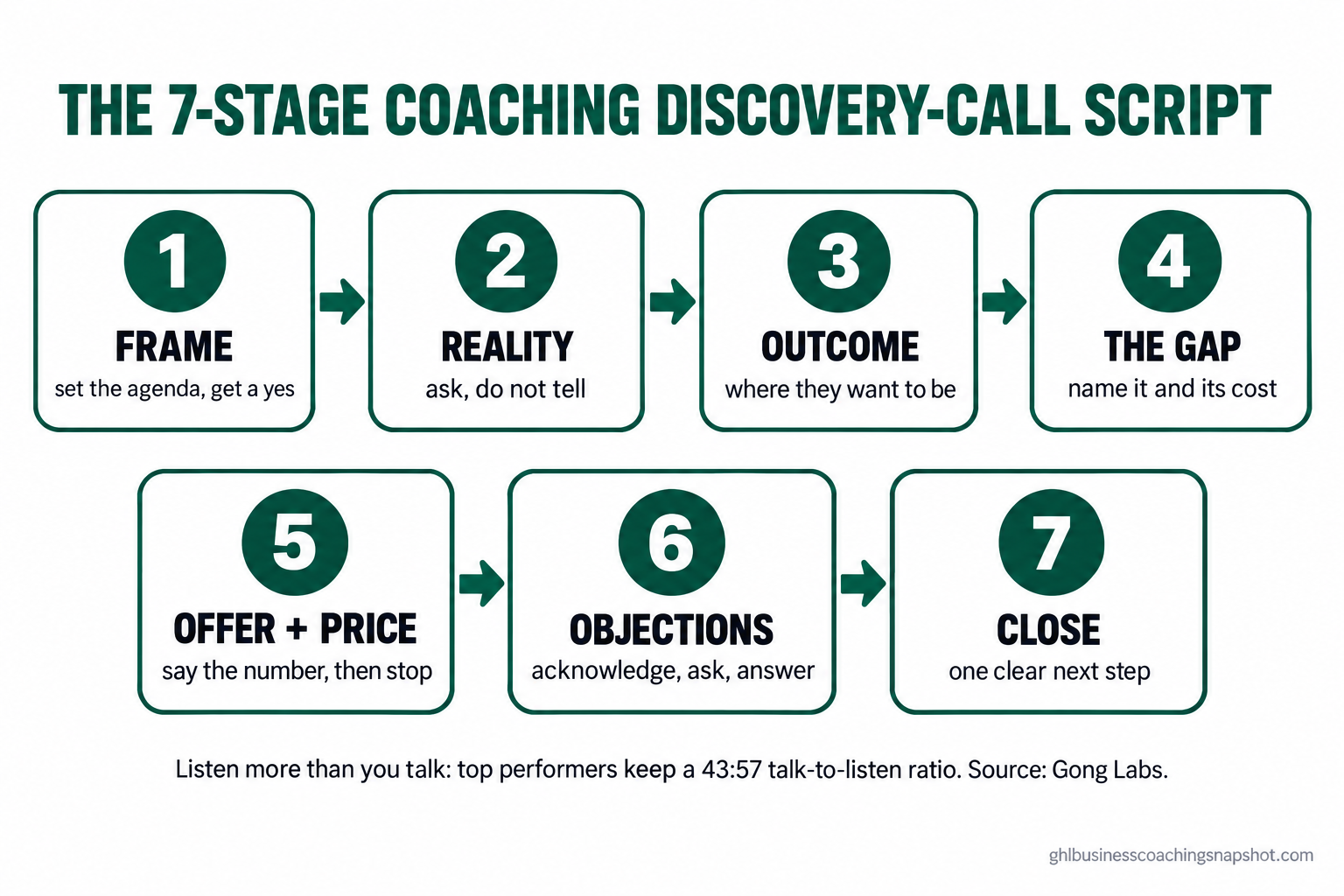
A discovery call is not a slot to fill with information. It is a path with seven stages, each with a job. Skip one and the call collapses in a predictable way, which is why the failure notes below matter as much as the scripts.
Two ways the same call goes
Small talk, then the coach explains their method, packages, and credentials, then 'let me know what you think.' Prospect ghosts.
Coach sets the agenda, asks about the prospect's reality and goal, reflects the gap back, names the price plainly, answers objections, and books the next step on the call.
Here is the whole arc. Notice how much of it is the prospect talking, not you.
Roughly how much of each stage you should be the one talking (%). You lead the frame, the offer, and the close; the prospect leads the middle. Directional guide based on the top-performer listening pattern in Gong Labs’ talk-to-listen research.
Work them in that order every time. Here is each stage, the words to say, and how it breaks.
Stage 1: Set the frame (the first two minutes)
The first two minutes decide the tone of the whole call. Your job is to take control gently, so the prospect relaxes into a structure instead of bracing for a pitch. You do most of the talking here, and only here at the start.
Say something close to this, in your own voice:
That short paragraph does four things. It sets the agenda so you can steer without feeling pushy. It promises a real recommendation, including “no.” It signals that price will come up, so the number is not a surprise later. And it asks for a small yes, which starts the pattern of the prospect agreeing with you.
How this breaks: coaches skip the frame and open with “so tell me about yourself,” then never regain control of the call. Or they over-explain the frame for five minutes. Two sentences of agenda plus “sound fair?” is enough. Get the yes and move.
Stage 2: Map the current reality (ask, don’t tell)
This is the heart of the call and the stage coaches rush. Your only goal is to understand, in the prospect’s own words, where they are and why now. You should be quiet most of the time. If you are talking here, you are doing it wrong.
Ask open questions and then stop. Let the silence do work. There is a sweet spot here: analyzing hundreds of thousands of sales calls, Gong found that success peaks when a rep asks roughly 11 to 14 targeted questions on a discovery call (Gong Labs), enough to understand the problem, not so many it feels like an interrogation. A tight set that fits almost any coaching niche:
Question four is the one most scripts miss. “Why now” tells you whether the prospect has a deadline or a wound driving them, which is the difference between someone who buys this week and someone who is browsing. Question five starts to surface the cost of staying stuck, which you will use in Stage 4.
Keep asking follow-ups: “say more about that,” “what do you mean by [their word],” “and how does that affect the rest of the business.” Every minute they talk, they are convincing themselves they have a problem worth solving.
How this breaks: the prospect gives a short answer and the coach fills the gap by talking about their own method. Resist it. When they pause, count to three and let them keep going, or ask “what else?” The pitch comes later. Right now you are listening your way to a sale.
Stage 3: Get to the desired outcome
Once you understand where they are, pivot to where they want to be. This is quick, but you cannot sell a bridge until both banks are visible.
Push for specifics. “More clients” is not an outcome. “Two new retainer clients a month and my evenings back” is. The more concretely they describe the win, the more real your offer feels when it maps to exactly that.
How this breaks: the coach accepts a vague goal and moves on. A vague outcome makes a vague offer, which is easy to refuse. If they cannot describe the win, help them: “some coaches I work with want X, others want Y. Which is closer?”
Stage 4: Name the gap and its cost
Now you reflect. You have the current reality and the desired outcome. The space between them is the gap, and your job is to say it back plainly so the prospect hears their own problem in a clear sentence.
This is not manipulation. You are repeating their words, not inventing pain. When a prospect hears their own situation summarized cleanly, two things happen: they trust you, because you clearly listened, and they feel the weight of the gap, because you have made it concrete. That is the moment they lean toward change.
How this breaks: coaches either skip the reflection, so the prospect never feels understood, or they exaggerate the pain and it reads as a manipulation the prospect can smell. Use their exact words. Understatement is more persuasive than pressure.
Stage 5: Make the offer and say the price
Only now do you talk about how you work. And you keep it short, because the prospect has already sold themselves on solving the gap. Your offer is the bridge across it, described in terms of their outcome, not your features.
Say the price and then stop talking. This is the single hardest habit to build and the most important. The first person to speak after the number often loses. If you rush to justify the price, you signal that you think it is too high. Let them react.
Two rules for the number. Say it plainly, as a fact, the same way you would say your address. And never discount on the call to rescue a silence. A discount offered in the first thirty seconds of hesitation teaches the prospect that your price is negotiable and your confidence is thin.
How this breaks: the coach buries the price in a wall of features, or floats it as a question (“so it would be around, maybe, six thousand?”). Both signal doubt. State the offer, state the number, ask if they want to begin, and wait.
Stage 6: Handle objections without pushing
An objection is not a rejection. It is a request for information or reassurance, and it usually means the prospect is still in the conversation. The move is always the same: acknowledge, ask a question to understand the real concern, then answer the real concern, not the surface words.
Here is the steal-this copy for the four you will hear most.
“It’s too expensive / I can’t afford it right now.”
“Totally fair, it’s a real investment. Can I ask, is it that the number is more than you can put toward this at all, or that you’re not yet sure it’s worth it? Those are different problems and I want to answer the right one.” If it is genuinely budget, talk payment terms. If it is value, go back to the gap they named.
“I need to think about it.”
“Of course, this shouldn’t be an impulse decision. Just so I can be useful, what specifically do you want to think through? Is it the money, the timing, whether it’ll work for you, or something else?” You are not fighting the stall. You are finding the one real hesitation hiding behind a polite phrase.
“I need to talk to my spouse / business partner.”
“Makes sense, this affects them too. What do you think their main question will be?” Then help them answer it. If you can, offer a short three-way call. A decision “taken home” without the real questions surfaced is usually a slow no.
“I’ve tried coaching before and it didn’t work.”
“I hear that a lot, and it’s a fair worry. Can you tell me what happened last time?” Their answer tells you exactly how your approach differs, and lets you address the specific failure instead of defending coaching in general.
How this breaks: the coach hears an objection and immediately argues or drops the price. Slow down. Acknowledge first, ask one clarifying question, and answer the concern underneath. Nine times out of ten the words on the surface are not the real issue.
Stage 7: The close and one clear next step
The close is not a trick. It is simply making the next step obvious and easy, then being quiet enough to let them take it. If Stages 1 through 6 went well, the close is a formality.
Notice it assumes the yes and describes the mechanics, so the decision is “do we start” rather than “should I buy.” If they are ready, they say yes and you send the paperwork while you are still on the call, because momentum dies the moment you hang up.
If they are a genuine “not yet,” do not chase. Book the specific next step before you end the call: “let’s do this, I’ll follow up Thursday. If it’s a yes, we start Monday. If it’s a no, tell me and I’ll stop, no hard feelings.” A booked follow-up beats a vague “I’ll email you,” every time.
How this breaks: the coach ends with “let me know,” which puts all the work on the prospect and guarantees a slow fade. Always leave the call with a defined next action and a date on the calendar. The discovery-call follow-up sequence is what carries the “not yet” prospects across the line after you hang up.
Run the script three ways: 1:1, group cohort, and high-ticket
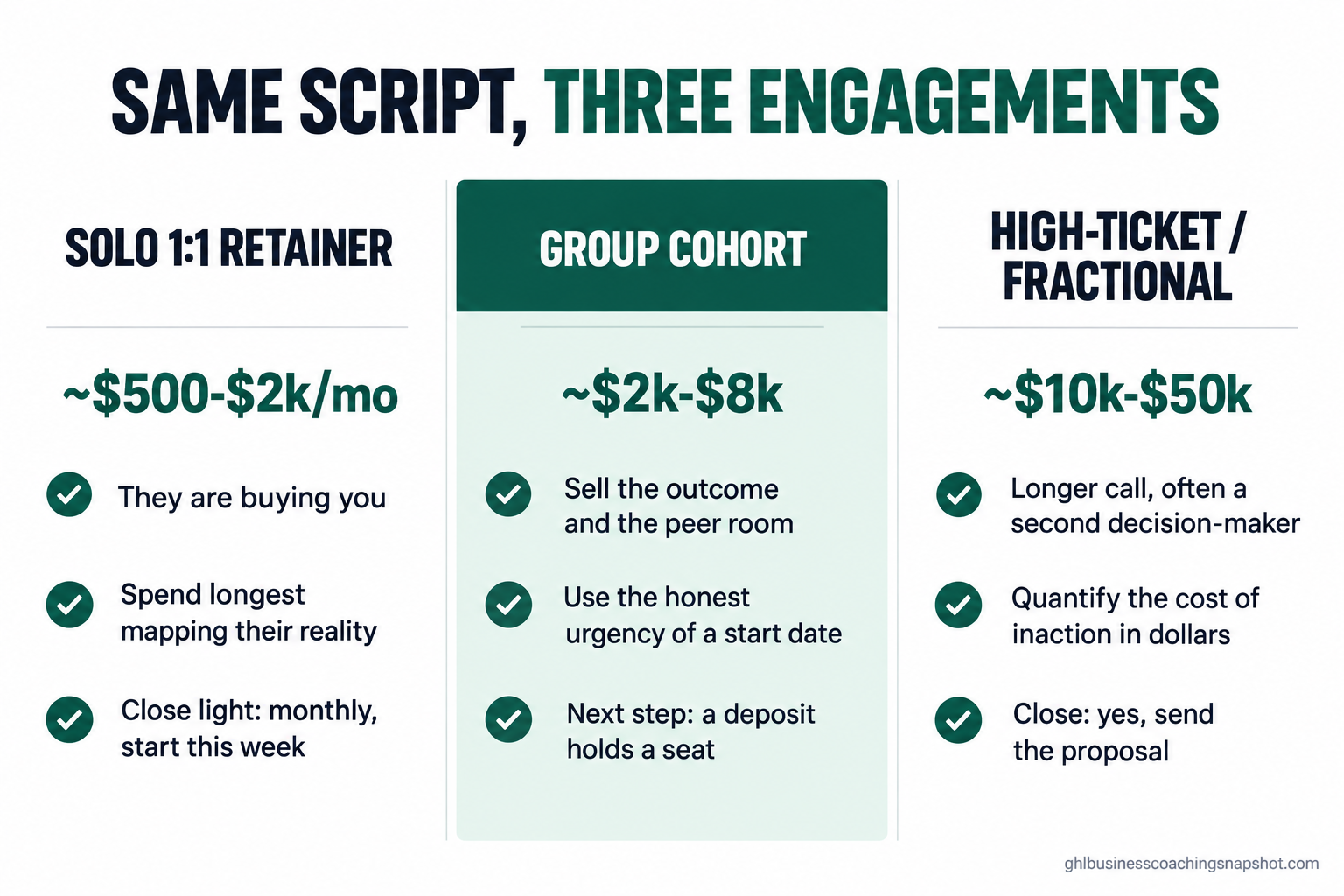
The seven stages hold no matter what you sell, but the emphasis shifts with the format and the price. Here is how the same script flexes across the three shapes most practices run.
Same script, three engagements
| Plan | Solo 1:1 retainer | Group cohort recommended | High-ticket / fractional |
|---|---|---|---|
| Price | ~$500-$2k/mo | ~$2k-$8k | ~$10k-$50k |
| Feature 1 | Fit and chemistry matter most; the prospect is buying you | Sell the outcome and the peer room, not just your time | Expect a longer call and a second stakeholder |
| Feature 2 | Spend longest in Stage 2; personal 'why now' is the trigger | Add a start-date urgency: cohorts fill and then close | Stage 4 cost-of-inaction must be quantified in real dollars |
| Feature 3 | Price reveal is simple; often monthly, low friction | Handle the 'will I get attention in a group' objection head-on | Price reveal often paired with a scoped proposal |
| Feature 4 | Close on the call, start within a week | Common next step is a deposit to hold a seat | Close may be a 'yes, send the proposal' plus a booked review |
For a solo 1:1 retainer the prospect is mostly buying you, so spend the most time in Stage 2 and keep the close light: monthly terms, start this week. For a group cohort you are selling an outcome and a room of peers, so lean on the honest urgency of a start date and answer the “will I get enough attention” worry before they raise it. For a high-ticket or fractional engagement expect a longer call, often a second decision-maker, and a Stage 4 where you translate the gap into hard dollars; the close is frequently “yes, send the proposal,” so book the proposal-review call before you hang up. Our proposal, contract, and invoice system covers what happens after that yes.
Staying on the right side of the FTC when you talk results
A discovery call is a sales conversation, and the moment you cite results, US advertising rules apply. This is not legal advice, and you should get your own review, but the shape of the rules is worth knowing so your honest script stays honest on paper too.
The FTC updated its Endorsement Guides in 2023. Two points matter on a coaching call. First, if you share a client’s standout result, you generally need to disclose the result people can typically expect, not just the best case, or have substantiation for the claim (FTC, 2023). “One client tripled her revenue” is a claim you have to be able to back up and contextualize. Second, any material connection behind a testimonial, such as a discount or an affiliate relationship, has to be clear.
If your program teaches other people how to make money coaching, note that the FTC’s Business Opportunity Rule and its guidance on earnings claims can apply, which is a stricter world. And keep in mind that some states restrict how far “coaching” language can edge toward licensed therapy. When in doubt, describe outcomes as illustrative and never guarantee income. Our deeper walk-through of FTC rules for coaches covers the disclosures in detail.
The follow-up that turns “let me think” into a yes
Even a perfect call does not always close on the call, and that is normal. The mistake is treating the “not yet” as a “no.” It takes an average of eight touches to land a meeting, top performers average around five, and 52% of sellers need five to ten touches just to connect (RAIN Group). Most coaches give up long before that. The ones who win the “let me think” prospects are simply the ones who follow up in a structured, un-annoying way.
Average number of touches it takes to land a first meeting. Persistence is normal, not pushy, and 52% of sellers need 5 to 10 touches just to connect. Source: RAIN Group.
A clean post-call cadence looks like this. Within an hour, send a short recap: the gap you both named, the outcome they want, the offer, and the next step, in four lines. On day two, send one piece of value tied to their specific problem. On day four, a direct check-in: “still a fit, or has something changed?” Then stop the pressure and drop them into your longer nurture. Speed matters here too, because reaching a lead within five minutes rather than thirty makes you far likelier to connect (MIT / InsideSales), and the average firm takes 42 hours to respond (HBR).
Doing this by hand at 9pm is how it stops happening. The recap, the value touch, the check-in, and the nurture hand-off can all run as one automation tied to the call outcome, so every “not yet” gets the same disciplined follow-up as your best-organized week.
Objections to using a script at all
Coaches push back on the idea of a script more than on any line in it. The worries are fair, so here they are, answered.
“Won’t a script make me sound robotic?”
Only if you read it like one. A script is a structure, not a teleprompter. You learn the seven stages and what each is for, so you never freeze, ramble, or forget to ask the price question, and the words come out in your own voice. Actors work from scripts and still sound human. So will you.
“What if the prospect can tell I’m running a script?”
The parts they might notice, the agenda-setting and the reflection, are what make you look more professional, not less. Nobody minds a doctor who follows a diagnostic process; they mind one who guesses. And the middle of the call cannot feel scripted, because it is the prospect’s own words.
“Do I have to be salesy for this to work?”
The opposite. The whole script removes the salesy behaviors, the pitching, the pushing, the discount-flinging, and replaces them with listening and a plain offer. Coaches who adopt it usually report feeling less like a salesperson, because they spend the call helping the prospect think clearly instead of talking them into something.
“My leads are just price shoppers.”
Some are. But constant price resistance is usually a sign the gap was never made vivid, which is a Stage 2 and Stage 4 problem, not a lead-quality one. A better discovery-call funnel that pre-qualifies leads helps too, so the calls you take are warmer to begin with.
Frequently asked questions
How long should a coaching discovery call be?
For most 1:1 and group offers, 30 to 45 minutes is plenty, and telling the prospect the length up front (in your Stage 1 frame) raises show rates and lowers pressure. High-ticket or fractional engagements often need 45 to 60 minutes because there is more to diagnose and sometimes a second stakeholder. The goal is not to fill the time; it is to move cleanly through the seven stages. If you have covered the gap, the offer, and the objections in 25 minutes, close and get the next step booked.
Should I say the price on the discovery call or send it after?
Say it on the call, in Stage 5, after the prospect has articulated the gap and the outcome. Hiding the price and sending it by email later removes your chance to handle the reaction in real time, and it trains the prospect to make the decision alone, where a 'no' is easy. Name the number plainly, then stop talking and let them respond. For high-ticket work, you may pair the number with a scoped proposal, but the prospect should still leave the call knowing roughly what it costs.
What is a good discovery-call-to-client conversion rate for coaches?
It varies widely by how warm and pre-qualified your leads are, so treat any universal benchmark with caution. What matters more is your own trend: track the percentage of held calls that become clients, run the seven-stage script consistently for a month, and compare. Coaches who move from an unstructured call to a structured one often see the biggest lift not from the call itself, but from following up properly with the 'not yet' prospects instead of writing them off.
How do I handle 'I need to think about it' without being pushy?
Do not fight the stall, and do not immediately discount. Acknowledge it, then ask one clarifying question to find the real hesitation: 'Of course. Just so I can be useful, what specifically do you want to think through, the money, the timing, or whether it will work for you?' Nine times out of ten the surface phrase hides one concrete concern. Surface it, answer it, and book a specific follow-up date before the call ends rather than leaving it at 'I'll email you.'
Can I automate the discovery-call process?
You cannot automate the call itself, and you should not try; the conversation is the human part. But everything around it automates well: booking and reminders so the call happens, an instant post-call recap, a structured multi-touch follow-up for prospects who need time, and a hand-off into long-term nurture for the ones who say not now. Running those touches by hand is where most coaches lose deals. Tying them to the call outcome in a CRM like GoHighLevel means every prospect gets the same disciplined follow-through.
It is 2:59pm and your next discovery call starts in a minute. The old version of you would spend it rehearsing the pitch. The new version knows the pitch was never the point. You are going to set the frame, ask more than you talk, reflect the gap back in their own words, name your price without flinching, and leave the call with a clear next step. That is the whole job. Run the seven stages, follow up like you mean it, and let the structure do what talent alone never could.
Related reading
- How to Reduce Discovery-Call No-Shows: The 2026 Playbook for Coaches
- The Discovery-Call Follow-Up Sequence That Books the Second Call
- The Coaching Application Form That Actually Qualifies
- Proposal to Contract to Invoice: The Coaching Close System
- FTC Rules for Coaches: What You Can and Can’t Say
Outcome examples on this page are illustrative. We do not guarantee revenue, client count, close rate, or income gains; actual results depend on your offer, audience, and execution. Nothing here is legal advice; consult a qualified professional about FTC disclosures and state coaching regulations. Third-party statistics are attributed to their sources, several of which come from broader B2B-sales research used as the closest available proxy for coaching discovery calls. Pricing for third-party tools such as GoHighLevel is set by the vendor and subject to change.