

It is a Tuesday night and a founder you would love to work with just clicked the link in your Instagram bio. She runs a seven-figure agency, she is drowning, and she has about ninety seconds of patience left. Your page opens with “Welcome! I’m so passionate about helping ambitious women unlock their potential.” She scrolls past a stock sunrise, a paragraph about your certification, and a contact form at the very bottom. She leaves. She was ready to pay you $8,000, and your page never told her what she would get or asked her to book a call.
A coaching sales page has one job: move a specific person from “maybe” to “booked.” It does that by answering nine questions in a fixed order. This guide gives you each section, the copy to fill it, how it breaks, and how the page changes whether you sell 1:1, run a group cohort, or fill a high-ticket mastermind. Steal the structure, swap in your specifics, and the page does the selling you have been doing by hand at 11pm.
What a weak sales page costs you
Most coaches do not have a traffic problem. They have a page problem. You can run the smartest coaching webinar funnel in your niche and send warm DMs all day, and it all lands on a page that fumbles the handoff. The money leaks at the last step, the most expensive place to leak, because you already paid for the click.
The leak is measurable. Across 464 million visitors and 41,000 landing pages, Unbounce put the median landing page conversion rate at 6.6%, with industry medians from 3.8% to 12.3% (Unbounce 2024 Conversion Benchmark Report). Two coaches with the same traffic and offer can sit at opposite ends of that range purely on how the page is built.
It is also a crowded field. The International Coaching Federation counted 122,974 coach practitioners worldwide in 2025, generating an estimated $5.34 billion in revenue (ICF 2025 Global Coaching Study), up from $4.564 billion in 2023 (ICF 2023 Executive Summary). A vague page tells your prospect you are one of 122,000. A sharp page tells her you are the one person who gets her exact problem.
Estimated global coaching revenue, USD billions. Sources: ICF 2023 and ICF 2025 Global Coaching Study. A bigger market means more competing pages, not easier sales.
The sales page is a system: nine sections
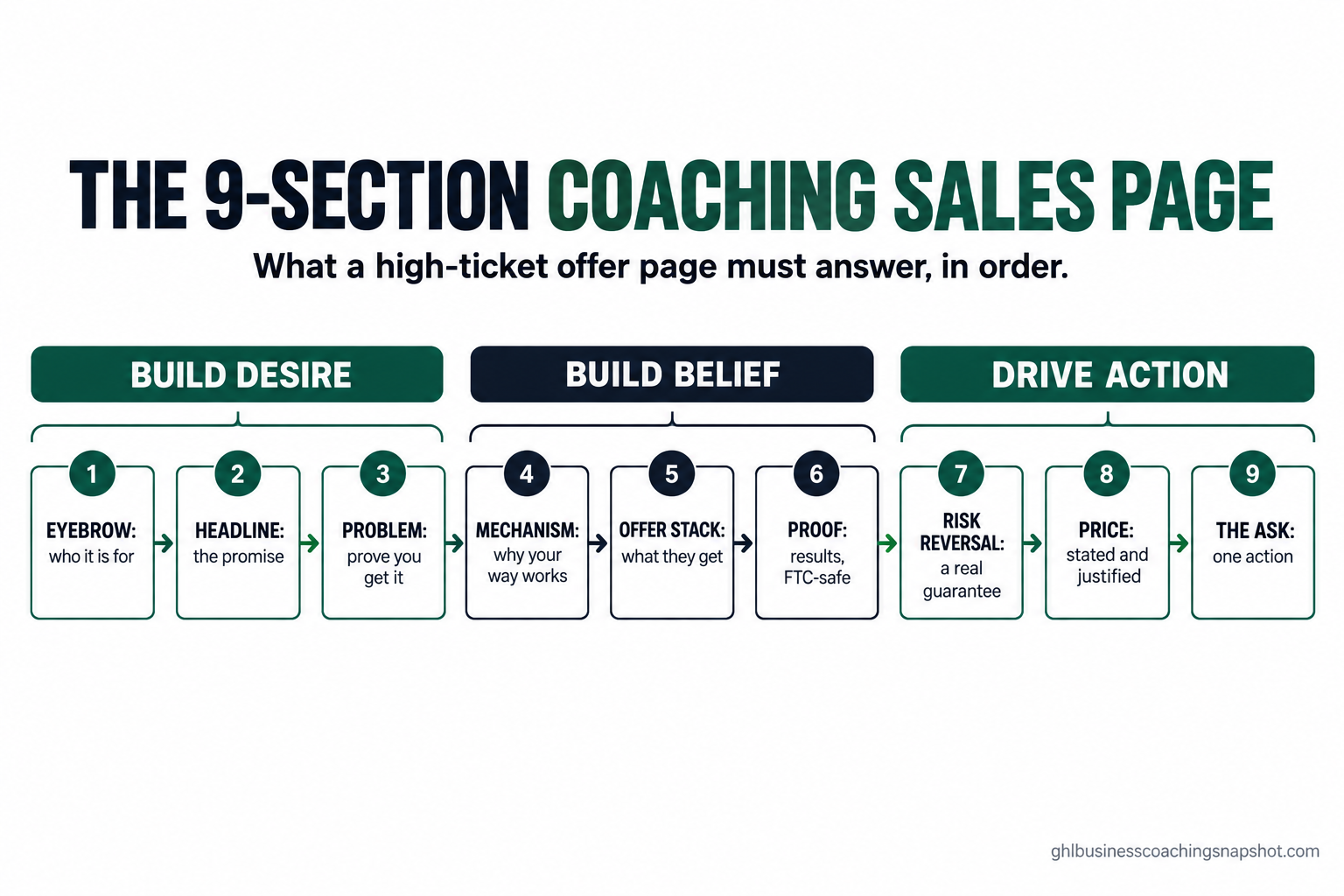
Stop thinking of a sales page as writing and start thinking of it as a sequence of answered questions. A good buyer runs this checklist in her head whether she knows it or not, and she leaves the moment one answer is missing:
- The eyebrow. Is this for someone like me?
- The headline. What is the outcome, exactly?
- The problem. Do you understand what I am dealing with?
- The mechanism. Why would your approach work when others have not?
- The offer stack. What do I actually get?
- The proof. Has this worked for people like me?
- The risk reversal. What if it does not work for me?
- The price. What does it cost, and is that reasonable?
- The ask. What do I do right now?
The order is fixed because each answer unlocks the next question. Nobody cares what you deliver until they believe you understand their problem. Nobody looks at the price until they want the outcome. A page that leads with the price and the booking button is asking for a yes before it has earned the question.
The nine-section coaching sales page, top to bottom
| Plan | Top: build desire | Middle: build belief recommended | Bottom: drive action |
|---|---|---|---|
| Price | 1 to 3 | 4 to 6 | 7 to 9 |
| Feature 1 | Eyebrow: name the exact reader | Mechanism: why your way works | Risk reversal: a real guarantee |
| Feature 2 | Headline: the concrete outcome | Offer stack: what they get | Price: stated and justified |
| Feature 3 | Problem: prove you get it | Proof: results, FTC-safe | Ask: book the call, one action |
| First screen | The case | The close |
Section 1: The eyebrow (who this is for)
The small line above your headline tells the reader, in a glance, whether she is in the right place. When she self-identifies in the first line, she reads the whole page as “about me” instead of “about coaching in general.” Make it a plain statement of the person and the stage.
The copy to steal:
“For agency owners stuck between $40K and $80K months who are doing the work of five people and cannot see the way up.”
Section 2: The headline (the promise)
Nearly everyone reads the headline and only a fraction read the body, so the headline carries the offer alone. The best coaching headlines name a concrete outcome and, where you can, a timeframe. They sell the destination, not the process, and they avoid dollar figures, which are claims you usually cannot control.
The copy to steal:
“Rebuild your agency so it runs a full week without you, in 90 days.”
If pinning down your promise is hard, the offer itself is fuzzy, and the fix is upstream in how you price and package the offer.
Section 3: The problem (name the 2am worry)
Before anyone believes your solution, they have to believe you understand their problem. Here you describe her situation back to her so precisely she thinks, “this person has been in my business.” You are not teaching, you are mirroring, so get concrete about the lived Tuesday, not the abstract pain.
The copy to steal:
“You did not start this business to spend Sundays writing proposals and Wednesdays chasing an invoice that was due three weeks ago. But here you are. Every new client is a win that somehow makes your week worse, because there is no system underneath you, just you, a calendar, and a sense that scaling means more of the thing already burning you out.”
Section 4: The mechanism (why your way works)
Your reader has tried to fix this before, so the unspoken question is “why would this work when the course and the cheaper coach did not?” The mechanism is your answer: the named, specific reason your approach gets the result. Give your framework a name and three to five stages, each with a one-line purpose. A named method is something she can repeat to her business partner.
The copy to steal:
“Most sales coaching bolts tactics onto a broken foundation. The Pipeline-First Method works in the opposite order. Stage 1, we fix what you sell and to whom. Stage 2, we build the one repeatable way you get in front of them. Stage 3, we install the follow-up so no lead dies in your inbox. You do not get 40 tactics. You get one working machine, in that order.”
Section 5: The offer stack (what they get)
Now that the reader wants the outcome and believes your method, she needs to see what she is buying. List real deliverables and, next to each, the job it does for her. “Weekly 1:1 calls” is a feature. “Weekly 1:1 calls, so you never stay stuck on a decision for more than seven days” is a feature doing a job. Components with a purpose read as a system; components without one read as padding.
The copy to steal:
Inside the 12-week engagement:
- Weekly 90-minute strategy sessions so every week has a clear next move.
- A built-out sales pipeline in your CRM so you see every opportunity instead of guessing.
- Async messaging, Monday to Thursday, so a stuck decision never costs you a week.
- The full template vault (proposals, follow-ups, onboarding) so you are not building from scratch.
Section 6: The proof (without breaking FTC rules)
Proof converts the fence-sitter, and it is also the section most likely to get a coach in legal trouble. The strongest proof for high-ticket coaching is rarely a dollar figure. It is a specific, believable transformation in someone the reader recognizes as herself: “Maria took every call and closed maybe one in ten. Twelve weeks later she had a qualification process that let her say no, and she closed one in three of the calls she kept.” Vivid, about the system, no income claim.
The copy to steal (a disclosure that sits next to the testimonials, not in the footer):
“Results vary and depend on your market, your effort, and factors outside any coach’s control. These are individual experiences, not a promise of what you will achieve.”
Section 7: The risk reversal (a guarantee you can keep)
The reader’s last silent objection is “what if I spend this and it does not work for me?” For coaching, a pure money-back guarantee is usually a bad idea, because the outcome depends on the client doing the work. The defensible version is a conditional, process guarantee: you promise effort and access, which you control, not an outcome, which you do not.
The copy to steal:
“Here is my commitment. If you show up to every session and complete the work between them, and by the end you do not have the system we set out to build, I will keep coaching you at no additional cost until you do. I can stand behind the process because I control it. I only ask that you do your half.”
Section 8: The price (stated, justified, not buried)
Whether you put the exact number on the page or hold it for the call, you must address price somewhere, because a reader who finds no signal of cost assumes the worst and leaves. For standardized packages, state the number. For heavily customized or very high-ticket work, state a range or floor and resolve specifics on the call. Either way, justify the price on the value of the outcome and the scope of the work, never on what clients earn.
The copy to steal:
“The investment for the full 12-week engagement is $6,000, payable in full or across three monthly payments. That buys the complete system, the weekly sessions, the template vault, and direct access, built around your business specifically.”
Section 9: The ask (one action, repeated)
The page ends, and repeats throughout, with one clear action. For high-ticket coaching that is almost never “buy now.” It is “apply” or “book a call,” because a five-figure decision wants a conversation. The button says what happens next, not “submit,” and there is exactly one action, repeated down the page, never a menu of five.
The copy to steal:
“Ready to build the system? Apply below. It takes about three minutes, and if we are a fit I will send you a link to book a call. If we are not, I will tell you honestly and point you somewhere better.”
Button: Apply for a strategy call
The best-converting ask is a short application that doubles as a qualifier. We cover the exact fields in the application form that actually qualifies, and what to do on the call in the coaching discovery call script.
Three versions: 1:1, group, mastermind
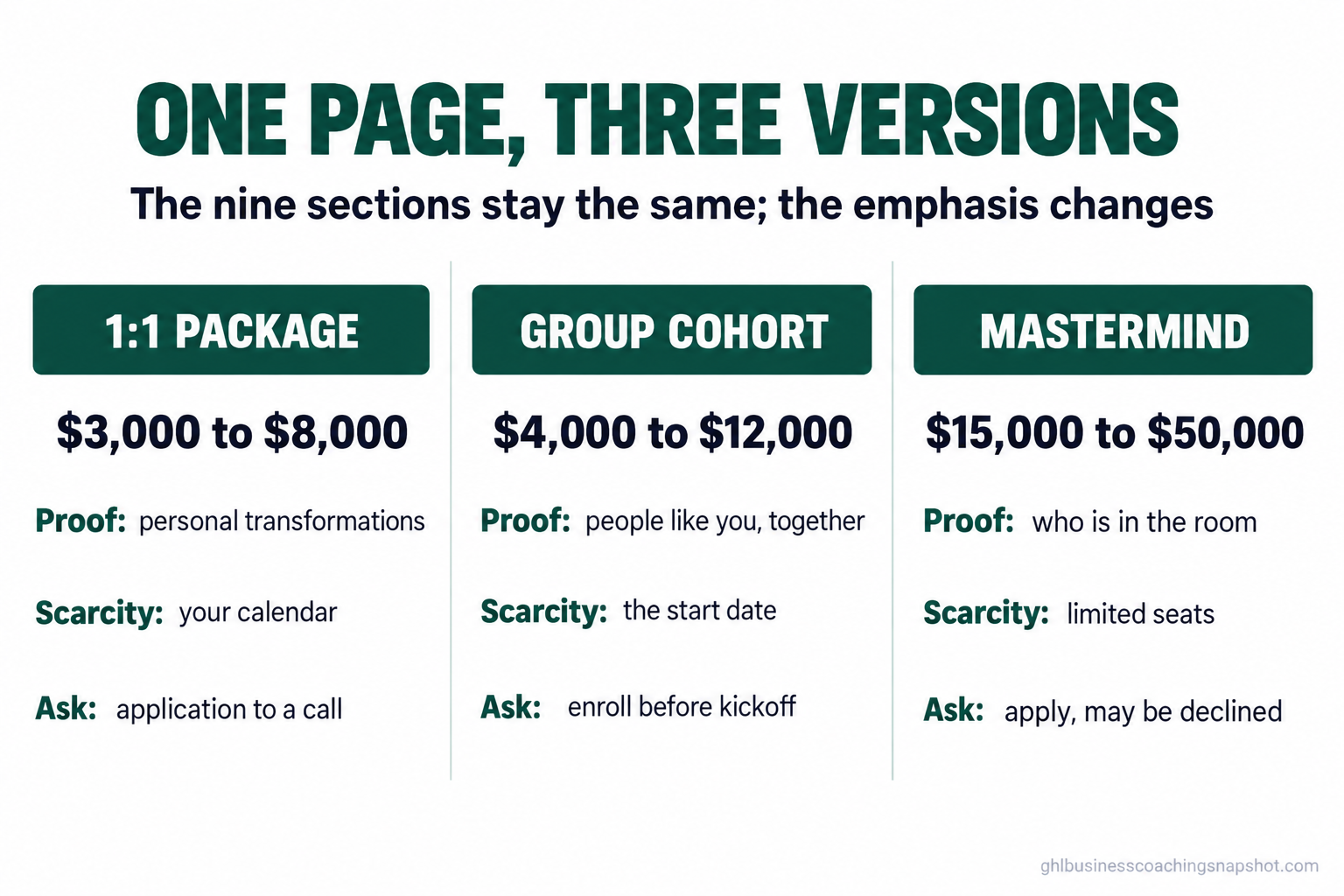
The nine sections do not change. What changes is the emphasis, the proof, and how hard the page qualifies, because the buyer and the price are different.
The 1:1 package (roughly $3,000 to $8,000). The buyer is purchasing access to you specifically, so the mechanism and proof lean personal and your judgment is the product. The ask is an application into a direct conversation, and because your calendar is the constraint, the page can honestly use limited availability.
The group cohort (roughly $4,000 to $12,000). The buyer is also buying the room, so the page sells the peer group as a feature. The stack adds the cohort structure and the start date, and that start date is your real scarcity. Proof shifts toward “people like you, together.” The economics are in moving from 1:1 to group coaching, the mechanics in filling a group coaching cohort, and the positioning on the group coaching page.
The mastermind (roughly $15,000 to $50,000). At this price the page qualifies hard, because the wrong member damages the room for everyone. The eyebrow and application do real screening, proof is as much about who is in the room as what they achieved, and scarcity is genuine. The price often moves fully to the call, and the positioning sits on the masterminds service page. The higher the price, the more the page’s job is to filter rather than persuade.
Illustrative mid-range price point, USD thousands, for each coaching model. Illustrative structure, not a quote or a projection. As the price rises, the page shifts from persuading to qualifying.
The compliance line on proof and claims
Everything persuasive about a sales page lives next to a line you should not cross, and for coaches that line is income and results claims. The moment your page says or implies what a buyer will earn, you have made a claim the Federal Trade Commission can regulate, and you need a reasonable basis and written substantiation for it.
The 2023 FTC Endorsement Guides are the specific rule most coaching pages run into. A testimonial depicting results stronger than a typical buyer gets must carry substantiation or a clear and conspicuous disclosure of the generally expected result (FTC’s Endorsement Guides: What People Are Asking). “Clear and conspicuous” is a real standard: the FTC’s .com Disclosures guidance weighs placement, proximity to the claim, and prominence, which rules out the tiny gray footer. The disclosure has to sit where the reader sees it, next to the claim.
The safe posture, which also converts better, is to build proof around process and transformation, not dollar figures. “She went from reactive to a repeatable system” needs no earnings substantiation. “She made $50K in 60 days” is a claim you must prove is typical or prominently qualify. Our full FTC guide for coaches has paste-ready disclosure language and the auto-renewal rules that apply if you bill in installments. None of this is legal advice, so have a lawyer review your final page.
Common objections
“My offer is custom, I cannot write one page for it.” Your offer has a core promise and a repeatable shape even when delivery flexes, and that core is what the page sells. The page qualifies and books the call; the custom scoping happens on the call and in the proposal. If you cannot name one core promise, the problem is the offer, not the page.
“Long pages feel sleazy, my audience is sophisticated.” Sophisticated buyers do not object to length, they object to fluff. A long page full of specifics, real proof, and a clear offer reads as thorough. The reader scans first and reads deeply only where she is interested, so give her the substance to find.
“Won’t stating the price scare people off?” It scares off the people who were never going to pay, which is a feature, because those are the calls that waste your week. A stated or ranged price filters for fit. The only people a well-justified price loses are the ones who would have ghosted anyway.
FAQ
How long should a coaching sales page be?
Long enough to answer all nine questions and no longer. Completeness is the goal, not length. The reader scans first and reads deeply only where she is interested, so a longer page with clear subheads and bullets beats a short page that skips the problem or the proof.
Should I put my price on the sales page?
State it if your packages are standard, because it filters out poor-fit buyers before they book. Hold the number for the call if your work is heavily customized or very high-ticket, but still signal a range. Never make a good-fit prospect book a call just to learn whether she can afford you.
What is the biggest mistake on coaching sales pages?
Making the page about the coach instead of the reader. Pages that open with certifications, passion, and the coach's journey lose the reader, who only cares whether this solves her problem. Lead with her situation, prove you understand it, then earn the right to talk about your method. The second mistake is ending with no single clear action.
Can I show client income results on my coaching page?
Be very careful. Under the 2023 FTC Endorsement Guides, a testimonial depicting an atypical result needs substantiation or a clear, conspicuous disclosure of what buyers can generally expect, and a faint footer does not count. The safer, better-converting approach is to build proof around process and transformation rather than dollar figures.
Do I need a different sales page for each coaching offer?
Yes, as a rule. One page should speak to one reader about one offer, because a page that sells 1:1, group, and a mastermind at once forces the reader to self-sort and most will not. The nine-section structure stays the same; the eyebrow, proof, scarcity, and how hard the page qualifies change with the offer and price.
The founder from the top of this page is still out there, and still drowning. The only variable you control is whether the next page she lands on tells her, in order, that it is for her, what she gets, that you understand her problem, why your way works, what it includes, that it has worked before, what happens if it does not, what it costs, and exactly what to do next. Answer those nine questions in that order and the page does the selling for you. Build it once, and it works while you sleep. If you would rather not build it alone, you can book a walkthrough and see the application-to-booking funnel that sits under a page like this.