

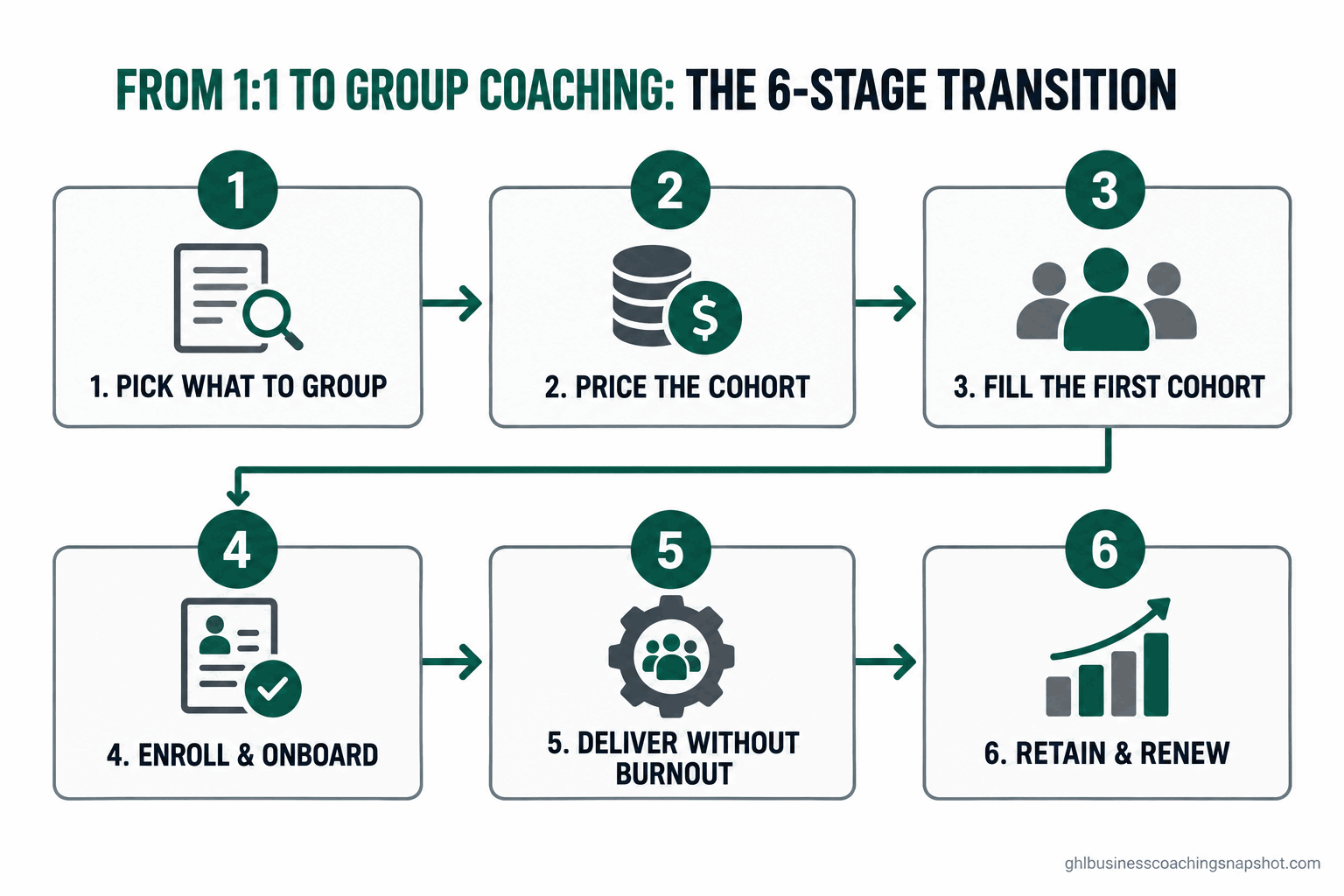
Short answer: you move from 1:1 to group coaching by treating it as an operations change, not a marketing idea. Pick the work that teaches better in a room, price the cohort so it beats your hourly rate, fill it with a real enrollment push, then build onboarding and delivery so ten clients do not create ten times the admin. The coaches who stall launch the offer and skip the plumbing underneath it. Below is that plumbing, stage by stage, with the message copy and the ways each stage breaks.
What moving to group actually buys you
A 1:1 practice has a hard ceiling, and the ceiling is your calendar. Coach 20 clients at $500 a month, two billable hours each plus admin, and you are near full. To earn more you raise the rate until the market pushes back, or add hours you do not have. The 2025 ICF study puts the average U.S. coach at only about 12.7 coaching hours a week (ICF); the rest of the week is sales, admin, and content, so there is not much slack to add.
Group coaching changes the shape of that ceiling. Instead of one client per hour, you serve eight or twelve in the same hour. That does not mean charging each of them your 1:1 rate, or that the group is worth less. It means the delivery hour carries more revenue, and you get hours back to sell, build, or breathe.
Sources: coaching hours and consulting share from the 2025 ICF Global Coaching Study executive summary; revenue from the ICF 2025 revenue release; lead-response figure from HBR.
Demand is not the problem. Global coaching revenue grew to roughly $5.34B in 2025 from $4.564B in 2023 (ICF), and more than half of coaches already run a blended model (ICF). The market will carry a group tier. What usually breaks is operations: a program that fills once, exhausts you, and never runs again.
The chart below is illustrative example math, not a promise, built to show the shape of the change.
Illustrative example math only, not a guarantee of results: revenue carried by one delivery hour at an example $500/mo 1:1 rate versus a $200/mo group seat filled to 6 and 12. Your numbers depend on your offer, price, and fill rate.
The 6-stage transition system
Treat this like installing a machine, not launching a campaign. Six stages, and skipping any one is where coaches lose the cohort or lose their weekends.
| Stage | What it does | The failure if you skip it |
|---|---|---|
| 1. Pick what to group | Separates teachable work from 1:1 work | A group that does confidential 1:1 work in public and fails both |
| 2. Price and package | Makes the cohort beat your hourly rate | A price that scares people off, or earns less per hour than 1:1 |
| 3. Fill the first cohort | Enrollment push with real follow-up | Empty seats and a launch you quietly cancel |
| 4. Enroll and onboard | Turns a buyer into a prepared member | No-shows on week one and refund requests by week three |
| 5. Deliver without burning out | Runs the cohort on a repeatable rhythm | Ten clients creating ten times the admin |
| 6. Retain and renew | Feeds the next cohort from this one | Starting from zero every intake, forever |
Stage 1: Pick what to group
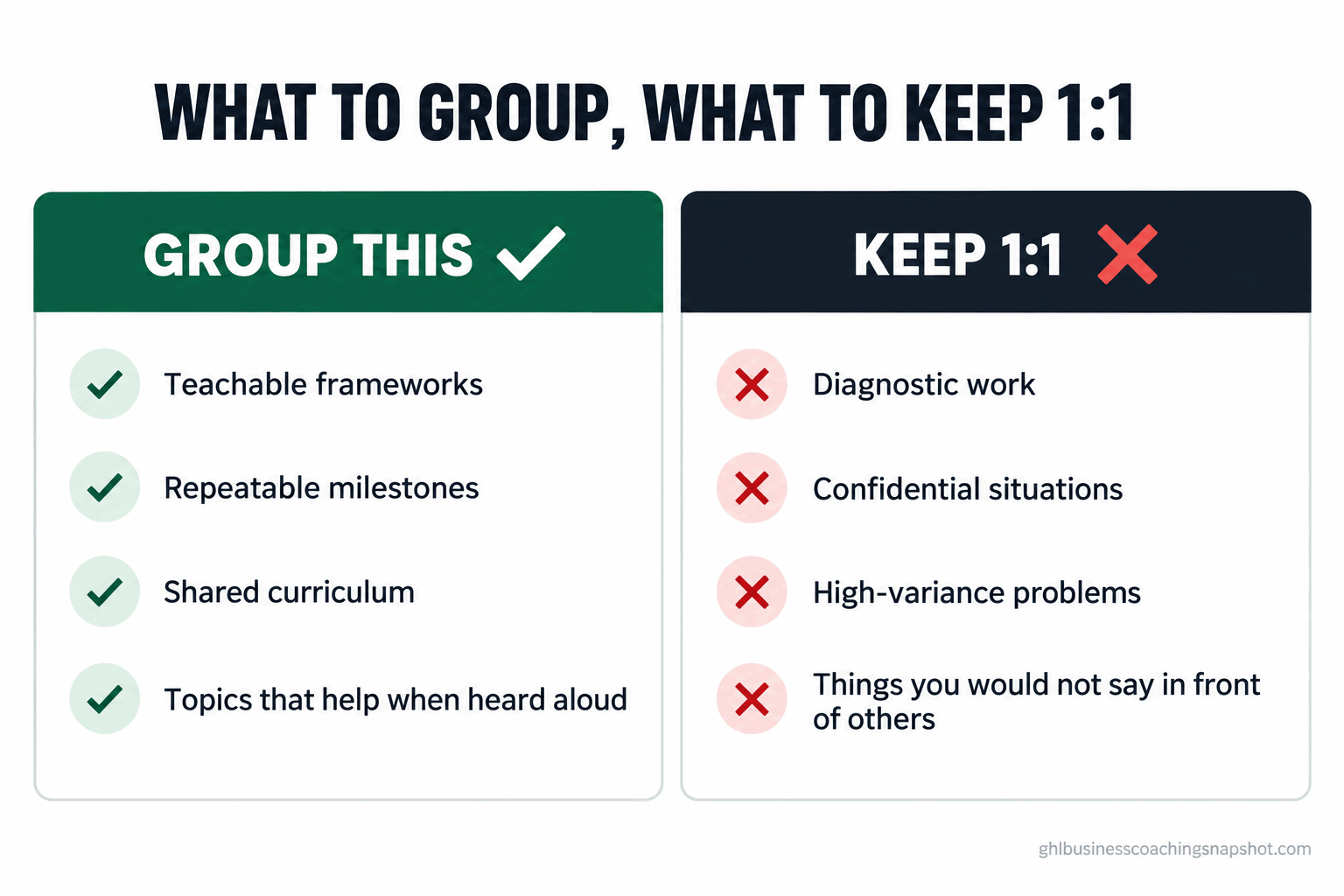
The first mistake is grouping the wrong thing. Not all of your coaching teaches better in a room, and some of it is worse in public.
Group this: the teachable, repeatable parts. The framework you walk every client through. The milestones most people hit in roughly the same order. The topics where hearing someone else ask the question helps. A planning method, a sales process, a 12-week transformation with a clear curriculum: all gain from a cohort.
Keep this 1:1: diagnostic work, confidential situations, anything high-variance. A cofounder dispute, a performance problem on someone’s own team, a health client with a sensitive history: none of that belongs in a group chat. Many coaches run a hybrid: group for the curriculum, a few private sessions for the parts that need a closed door.
How it breaks: building a group that is really twelve separate 1:1 engagements on the same call. Everyone waits their turn, nobody learns from anyone else, and you are more tired than if you had coached them one at a time. If your draft curriculum is just “hot seats for everyone,” you have not designed a group yet. Build a spine of taught content first, then add hot seats as the seasoning, not the meal.
Stage 2: Price and package the cohort
The goal is a seat price that, filled to a realistic number, earns more per delivery hour than your 1:1 rate, while still being an obvious deal for the client compared to buying you privately.
Work it backwards. Decide the revenue you want the cohort to carry, divide by a conservative fill number (not your dream number), and that is your seat price floor. Want a 10-week group to carry $24,000 and confident you can fill eight seats? That is $3,000 a seat, about $300 a week of program. Against a $500 session, that reads as a bargain and still beats your hourly math once the room is half full.
Package it as an outcome with a container, not a pile of calls. Name the transformation, the length, the cadence, and what is included: the live calls, the curriculum, the community space, any private time. A clear container is easier to sell and easier to deliver.
How it breaks: underpricing to guarantee it fills. A rock-bottom seat price fills the room with people who are not committed, tanks attendance by week four, and earns less per hour than the 1:1 work you gave up. Price for commitment, then do the work to fill it. That is the next stage.
Stage 3: Fill the first cohort
A quiet announcement to your list is not a launch. Cohorts have a start date, which means built-in urgency, and urgency is the one advantage a group has over an always-open 1:1 slot. Use it. The reliable fill sequence has four parts:
- A waitlist you build for a week or two before you open, so you launch to warm people, not cold ones.
- An open window with a real deadline (seats and a date), announced across email, your 1:1 clients, and anywhere you already have attention.
- A booking path that lets interested people grab a short enrollment call or buy directly, with instant confirmation.
- A follow-up cadence that chases everyone who showed interest and did not finish, because most will not act the first time.
That last part is where speed bites. Someone replies “tell me more” at 9pm while you are offline, and if nothing reaches them until lunch the next day, the moment is gone. Replying within the hour makes you about 7x more likely to qualify that person (HBR), and during a launch you cannot do that by hand. This is where a system that auto-replies, books, and reminds pays for itself.
How it breaks: launching to a cold list. If you have not warmed people first, the open week is shouting into a quiet room. Build the interest list before you open, and seed it from your 1:1 clients, past leads, and anyone who downloaded something from you. A database reactivation pass across old contacts is often where the first cohort comes from.
Stage 4: Enroll and onboard
The window between “bought a seat” and “showed up to week one” is where groups quietly leak. A buyer who hears nothing for ten days after paying starts to doubt, and doubt becomes a refund request or a ghost on the first call. Onboarding turns a payment into a prepared, committed member. A clean one does five things, mostly on autopilot:
- Confirms the purchase immediately, with the start date and what happens next.
- Collects what you need through a short intake form: goals, context, the one thing they want.
- Adds them to the room (community space, calendar invites, resource hub) without you doing it by hand.
- Primes them for week one with a short “how to get the most out of this” note a few days before kickoff.
- Reminds them the day before and the hour before the first call, because a no-show on week one often never comes back.
Write these once and they run for every future cohort with only the dates changed. That is the difference between a program you dread relaunching and one that reopens on a schedule. The same logic drives a solid client onboarding sequence for 1:1 work, and the cohort kickoff playbook goes deeper on week one.
How it breaks: manual onboarding. If adding each member to the calendar, community, and email sequence is a to-do list you work by hand, you will do it well for the first three buyers and sloppily for the next five. Automate the mechanical parts so your attention goes to the intake answers, not the data entry.
Stage 5: Deliver without burning out
This stage decides whether you ever run a second cohort. A group should take less of your time per client than 1:1, but only if you run it on a rhythm instead of improvising every week.
Build a repeatable weekly loop: a taught segment, a worked application, and group discussion or hot seats, in the same shape every week so clients know what to expect and you are not redesigning the call each time. Record the calls so a client who misses one stays in the flow instead of falling behind. Use the community space for between-call questions that used to land in your DMs, so one good answer serves everyone.
1:1 delivery vs a running cohort
Twelve separate calls to schedule, twelve sets of notes, the same question answered privately five times, and a calendar full of delivery with no room to sell.
One weekly call on a fixed rhythm, shared notes and recordings, questions answered once in the group, and delivery hours that free up time instead of eating it.
The biggest delivery leak is the quiet drifter: the client who misses week three, feels behind, and never comes back. In 1:1 you notice. In a group of twelve you might not, until they ask for a refund. So watch attendance like a metric. If someone misses two in a row, a short, human check-in (“noticed you missed the last two, everything okay? here’s the recording, and the one thing to catch up on”) pulls more people back than you would expect. It can fire automatically off attendance, but the message has to read like you, not like a system.
How it breaks: scope creep inside the room. A cohort where every call drifts into one person’s crisis teaches the other eleven nothing and burns you out faster than 1:1 ever did. Hold the curriculum spine, route the deeply personal stuff to a private session or office hours, and protect the group’s time.
Stage 6: Retain and renew
A group that starts from zero every intake is a treadmill. The model compounds only when each cohort feeds the next, through renewals, an ascension offer, or referrals from people who got a result.
Build the renewal moment into the program instead of bolting it on at the end. Around three-quarters of the way through, while results are landing, is when you open the next step: a continuation group, an alumni tier, a 1:1 upgrade, or simply the next cohort. People renew at the peak of their momentum, not after the energy has faded.
Referrals work the same way: ask when the result is fresh. A client who just hit the outcome they came for is your best source of the next cohort’s enrollments, and a simple “who else do you know who needs this?” at the win moment beats any cold campaign. Keeping clients long enough to get that result is the whole game, which is why reducing client churn and running group delivery well are really the same project.
How it breaks: asking too late. If your first mention of “what’s next” is the final week after the content is done, you are asking people whose momentum has already dropped. Seed the next step at the peak, not the goodbye.
Run the numbers: solo, boutique, scaling
Same six stages, different emphasis depending on where you start.
The solo coach running their first group
You are fully booked 1:1 and want to lift the ceiling without hiring. Start small and specific: one cohort, 6 to 8 seats, your most teachable framework, run alongside your existing 1:1 roster. Do not blow up the 1:1 practice to do this. Price seats to beat your hourly rate at half-full, fill the first cohort from your own list and past leads, and lean hard on automation for onboarding and reminders because you have no team to catch what you drop. The win is proving the model once and getting a few hours a week back.
The 2-to-8 person boutique layering group onto retainers
You run fractional-CxO or 1:1 retainers with a small team, and group serves the clients who cannot afford the retainer, or warms future retainer clients. Here the group is often the front of a ladder: a cohort that delivers real value and ascends the best-fit members into higher-touch work. The operational focus is handoffs, making sure a group member who raises their hand for more gets routed to the right person fast and the pipeline between tiers does not leak. A shared CRM and pipeline matters more here than for a solo coach.
The coach scaling past solo into repeatable cohorts
You have run a group once or twice and want it on a calendar, several cohorts a year, maybe with a facilitator helping. Now the system is the product. Every stage needs to be documented and automated enough that a launch is a checklist, not a heroic effort, and a second facilitator can run the rhythm without you on every call. This is where the tooling choice stops being optional: see the best platform for mastermind and group coaching for how community, booking, and billing fit together at scale.
The compliance bit you cannot skip
Group programs put results in public, which raises the stakes on a few U.S. rules. None of this is legal advice, and a sensitive program should get a real review, but here is the shape of it.
Testimonials and results. If you market the group with client wins, the FTC’s 2023 Endorsement Guides apply: a testimonial showing an atypical result needs a clear disclosure of what people can generally expect, or substantiation, and any material connection (a discount, an affiliate tie) must be clear and conspicuous (FTC). “Results not typical” buried in grey 8-point text does not clear that bar.
Income claims. If your group teaches people to make money (a sales cohort, a “grow your practice” program), be careful with earnings claims. A program that is really “coach the coaches” can fall under the FTC Business Opportunity Rule, which requires an Earnings Claim Statement (FTC). When in doubt, describe the process, not a promised number.
Auto-renewing cohorts. If you bill the group as a recurring membership, know that the FTC’s federal “click to cancel” Negative Option Rule was vacated by the 8th Circuit in July 2025, so the federal rule most content still warns about is not in force (Cooley). That is the contrarian catch: more than 25 states have their own auto-renewal laws, some stricter, so clear cancellation still matters. Full breakdown in FTC rules for coaches.
Objections, answered
“Won’t my 1:1 clients feel downgraded if I start a cheaper group?” Only if you position the group as the discount version of you. Position it as a different product, peer momentum and a structured curriculum, and keep your 1:1 offer as the premium, high-touch tier. Most coaches find the group feeds the 1:1 practice, because members who want more raise their hands for private work.
“Won’t a group dilute results, or my premium price?” It dilutes both only if you run twelve private coachings on one call. A real group, with a taught spine and peer accountability, produces results a lone 1:1 client often does not get, because the room does some of the motivating. The price holds when the value is visibly different, not cheaper.
“Do I need special software to run this?” You need four jobs covered: a way to collect interest and enroll, an onboarding sequence, a community space, and reminders. You can stitch that from a course platform plus Zoom plus a scheduler plus email, the roughly $340-a-month stitched stack most coaches end up with, or run it from one system. The jobs matter, not the brand names.
“What if I can’t fill the first cohort?” Then you under-filled, not failed. Set a conservative seat floor, and if you only get four committed people, run it as a pilot, deliver hard, collect the wins, and use them to fill the next one. A small, successful first cohort gives you the proof and testimonials that make the second launch easier.
FAQ
How many people should be in my first group coaching cohort?
Start with 6 to 8 committed seats. Small enough that everyone gets attention, big enough to create peer energy and to beat your 1:1 hourly math once it's half full. Grow cohort size once the delivery rhythm is proven.
Should I stop taking 1:1 clients when I launch a group?
No. Run the first cohort alongside your existing 1:1 roster. The group lifts your income ceiling while 1:1 work stays your premium tier and often feeds the group. Only consider shrinking 1:1 once the group reliably fills and delivers.
How do I price a group program against my 1:1 rate?
Work backwards from the revenue you want the cohort to carry, divided by a conservative fill number. The seat price should beat your 1:1 hourly rate at half-full while still reading as a clear deal versus buying you privately. Price for commitment, not to guarantee it fills.
What's the biggest reason group programs fail?
Two tie: under-filling because the launch was a quiet announcement instead of a real enrollment push with follow-up, and burning out in delivery because the cohort runs without a repeatable weekly rhythm. The six-stage system above prevents both.
How do I keep group members from drifting away mid-program?
Watch attendance like a metric. Record every call so missers can catch up, use the community space for between-call questions, and send a short human check-in when someone misses two sessions in a row. The quiet drifter who feels behind is the one who churns.
Do I need GoHighLevel or a specific platform to run group coaching?
You need four jobs covered: enrollment, onboarding, a community space, and reminders. You can stitch those from separate tools or run them from one system like GoHighLevel. The Coaching Snapshot ships these as pre-built workflows so you don't assemble them by hand.
It is the Tuesday night you pictured, your calendar full of delivery with no room to sell. The way out is not more hours. It is one offer that serves more people per hour and runs on a system you wrote once. Pick the part of your work that teaches well in a room, price it to beat your rate, fill it with a real launch, and make onboarding and delivery run themselves. Do that, and the next cohort opens on a calendar instead of a scramble.