

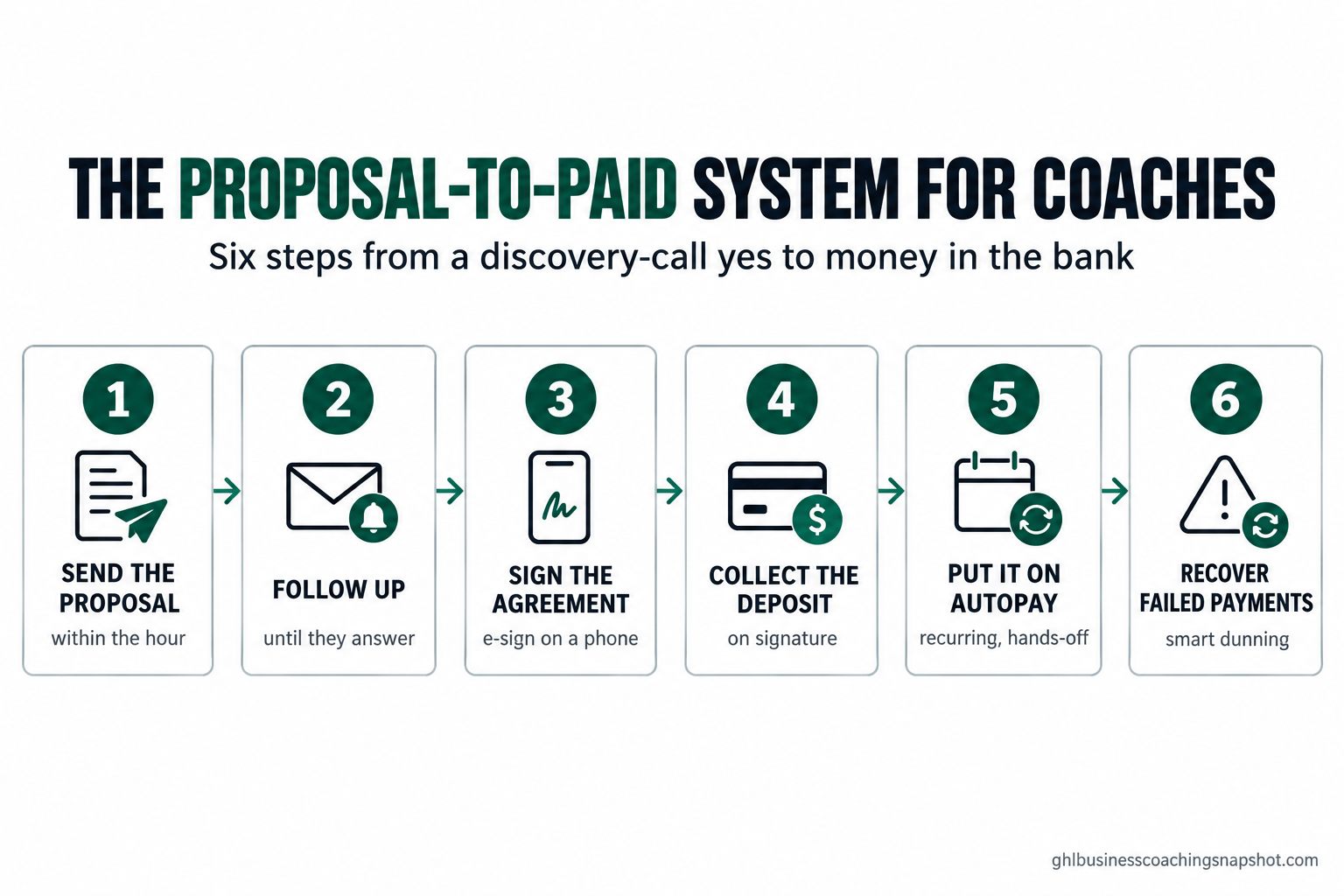
Short answer: the money you lose in coaching is rarely on the call. It leaks in the days after, in the gap between a prospect saying “yes, let’s do it” and the first payment clearing. A proposal that goes out three days late, a contract that sits unsigned, a deposit nobody asked for, a card that declines in month two and never gets fixed. Each is a client who was ready to pay and quietly cooled off. The fix is a system that moves every yes through six fixed steps on autopilot: send the proposal within the hour, follow up until they answer, get the agreement signed, collect a deposit, put the rest on autopay, and recover the payments that fail. Below is the whole thing, with the real message copy and where each step breaks.
What happens between yes and paid
It is 4:50pm on a Thursday. You just finished a discovery call that went well, and the prospect said the words you wait to hear: “This sounds exactly like what I need, send me the details.” You say you will get something over. Then a client emails, the school run happens, and the proposal you meant to send in ten minutes goes out Monday. By then the prospect has cooled, talked to a spouse, or booked with someone faster. The deal did not die on the call. It died in the gap.
That gap is the least-managed part of most coaching practices, and it is where the money is. Coaching is a real industry now: the 2025 ICF Global Coaching Study counts 122,974 coach practitioners worldwide and $5.34 billion in global revenue, up from $4.564 billion in 2023. Yet its executive summary shows US coaches average only about 12.7 coaching hours a week. The rest is admin, and the proposal-to-paid chase is the worst of it: high stakes, easy to drop, invisible until the pipeline is leaking.
Follow-up figures: ZoomInfo, 2026. Involuntary-churn range: Kaplan Group, 2025. Weekly hours: ICF 2025 executive summary.
Getting paid is not one event. It is a chain of six links, and a chain breaks at its weakest one. You can run a flawless call and still lose the client because the proposal was slow, the contract was a hassle, or the deposit never got collected. So you stop trying harder on the call and fix the chain instead. Each step below can fire automatically the moment the previous one finishes, so no yes ever sits waiting on you again.
The system at a glance
Six steps. Each has a trigger (what starts it), a job (the one thing it does), and a failure mode (what goes wrong by hand at 4:50pm on a Thursday). Automation’s real value is not speed, it is that the trigger fires whether or not you remember.
| Step | Trigger | Job | Where it breaks by hand |
|---|---|---|---|
| 1. Proposal | Call marked won | Send scope + price fast | Goes out days late, deal cools |
| 2. Follow-up | No reply yet | Nudge until they answer | You forget, or feel like a pest |
| 3. Agreement | Proposal accepted | Get it signed | PDF back-and-forth stalls |
| 4. Deposit | Contract signed | Collect first money | Never asked for |
| 5. Autopay | Deposit paid | Schedule the rest | Manual invoices, chased monthly |
| 6. Recovery | Payment fails | Fix the declined card | Nobody notices for weeks |
Illustrative split of where a coaching practice loses committed clients: most loss sits after the call, not on it. Failed-payment share reflects involuntary-churn benchmarks from Kaplan Group, 2025; the rest is illustrative from the workflow gaps below.
The exact percentages vary by practice. The point is the shape: almost none of the loss is on the call. It is spread across the five handoffs after it, and every one of those handoffs is automatable.
Step 1: Send the proposal within the hour
The highest-leverage change most coaches can make is to send the proposal within an hour of a good call, not by end of week. Prospects open proposals fast, so the warm window is short. Proposal vendors report a tighter process lifts close rates by roughly 18%, and sending a series of reminders makes you about 30% more likely to close (PandaDoc). Speed is most of that lift.
Setup. Build one proposal template you send in two minutes, not a document you write from scratch each time. It needs four things: a one-line restatement of the problem the prospect described (in their words), the scope, the price with two or three package options, and a single button to accept. When your CRM marks a call “won,” a workflow drops their name and problem into the template and sends it. You tweak and it goes.
Timing. Under 60 minutes. If you cannot personalize that fast, send a short holding message now and the full proposal within a few hours.
How it breaks. Two failures: slowness and blandness. Bland is worse, because a generic proposal tells the prospect you were not really listening. The fix for both is a template with one required field (their problem, their words) that the automation forces you to fill before it sends. The pre-call and on-call half is handled in the discovery-call follow-up sequence.
Step 2: Follow up until they answer
Most proposals get neither a yes nor a no. They get silence. This is where coaches leave the most money, because following up feels like nagging, so they do it once and stop. The data says persistence wins: about 80% of sales require five or more follow-ups, yet 48% of sellers never send one (ZoomInfo). The gap between one follow-up and five is a lot of signed clients.
Setup. Build a sequence that triggers when a proposal is sent but not accepted. Change the angle each touch so it never reads as the same “just checking in” text three times, and stop it the instant they reply.
Timing (a cadence that works without nagging):
- Day 1: a short “did it come through” check.
- Day 2: answer the likely objection (price, timing, “let me think”).
- Day 4: add value, a relevant result, no ask.
- Day 7: a clear “should I close this out?” that makes it easy to say not now.
How it breaks. First, you resend the same message reworded, which trains the prospect to ignore you. Every touch needs a new reason to exist. Second, the sequence keeps running after they reply, so a client who already paid gets a “still interested?” text and wonders if you are paying attention. Both are solved by a CRM that varies the message and exits on any reply. The full logic lives in the coaching CRM sales pipeline.
Step 3: Get the agreement signed
A verbal yes and an accepted proposal are not a contract. Until something is signed, you have no scope protection, no payment terms, and no clean record in a dispute. The signature is also a commitment device: signing turns a maybe into a decision. The trouble is the old way, emailing a PDF to print, sign, scan, and return, adds days of friction exactly when you want none.
Setup. Use an e-signature agreement the prospect can sign on their phone in under a minute. The moment they accept the proposal, the workflow sends the agreement with scope and price already filled from the package they chose. It should state scope, session cadence, price and payment schedule, cancellation and refund terms, and, if the retainer renews automatically, a plain line saying so (see compliance).
Timing. Send within minutes of acceptance, while intent is highest. Auto-remind if unsigned after 24 and 72 hours.
How it breaks. The classic failure is treating the contract as paperwork for “once they pay,” which reverses the order and leaves you coaching with no signed terms. The other is a contract so long and lawyerly it scares a warm prospect. Keep it clear, keep it short, make it signable on a phone, and send it the instant the proposal is accepted.
Step 4: Collect the deposit
The signature commits them. The deposit makes it real. Collecting money at the moment of signing protects you from the client who signs and then ghosts, and removes the awkward “so, about payment” conversation. Asked as the natural next step after signing, it is not awkward at all.
Setup. Wire the payment request to fire the second the agreement is signed. Offer the structure that fits your model: pay in full (often with a small discount), a deposit plus a plan, or the first month of a retainer. Make it a card-payable link on their phone, not a bank transfer that takes a week. Capturing the card here also sets up autopay for step five.
Timing. Immediately on signature. The gap between “I signed” and “here’s how to pay” should be zero.
How it breaks. Coaches under-ask here more than anywhere. They skip the deposit “to seem easygoing,” deliver a first session before any money moves, and learn how fast a free-feeling arrangement gets deprioritized. The other failure is a clunky method, an invoice to download, a bank detail to copy, a portal login to create. Every extra step is a place to abandon. One card-payable link, sent the instant they sign, collects far more than a formal invoice sent tomorrow.
Step 5: Put the plan on autopay
If you sell retainers or payment plans, this step pays your mortgage. A one-time deposit is nice. Recurring revenue that collects itself is the business. The goal: after the first payment, every future payment runs on schedule with no invoice to send and no reminder to write, and the client barely notices because it just works.
Setup. When the deposit clears with a saved card, schedule the remaining payments as an automated recurring charge: monthly retainer, or the agreed installments. Send a receipt after each successful charge, and a heads-up a few days before any larger charge so nothing is a surprise. This is also where a paid invoice should trigger onboarding, not a manual “let me set you up.” That handoff is the client onboarding system.
Timing. Charges run automatically. Pre-charge notice goes out three days ahead for any payment above a threshold you set.
How it breaks. The failure is manual monthly invoicing: you send an invoice, they pay late, you send a reminder, and you have quietly rebuilt a collections job. The second failure is silent charging with no receipt, which feels sneaky and generates “what was this charge?” emails. Autopay plus a receipt plus a pre-charge heads-up collects reliably and keeps the relationship warm. For the renewal play, see reducing coaching client churn.
Step 6: Recover the payments that fail
Here is the leak almost no coach measures. Cards expire. Banks decline for reasons the client never sees. Balances run short for a day. When a recurring payment fails and nobody chases it, that client silently stops paying, and often stops showing up, without ever deciding to leave. This is involuntary churn, and it is big: for subscription businesses, failed-payment churn runs roughly 20% to 40% of total churn (Kaplan Group). A retainer is a subscription. Most of it is recoverable with a polite sequence, because the client wanted to keep paying.
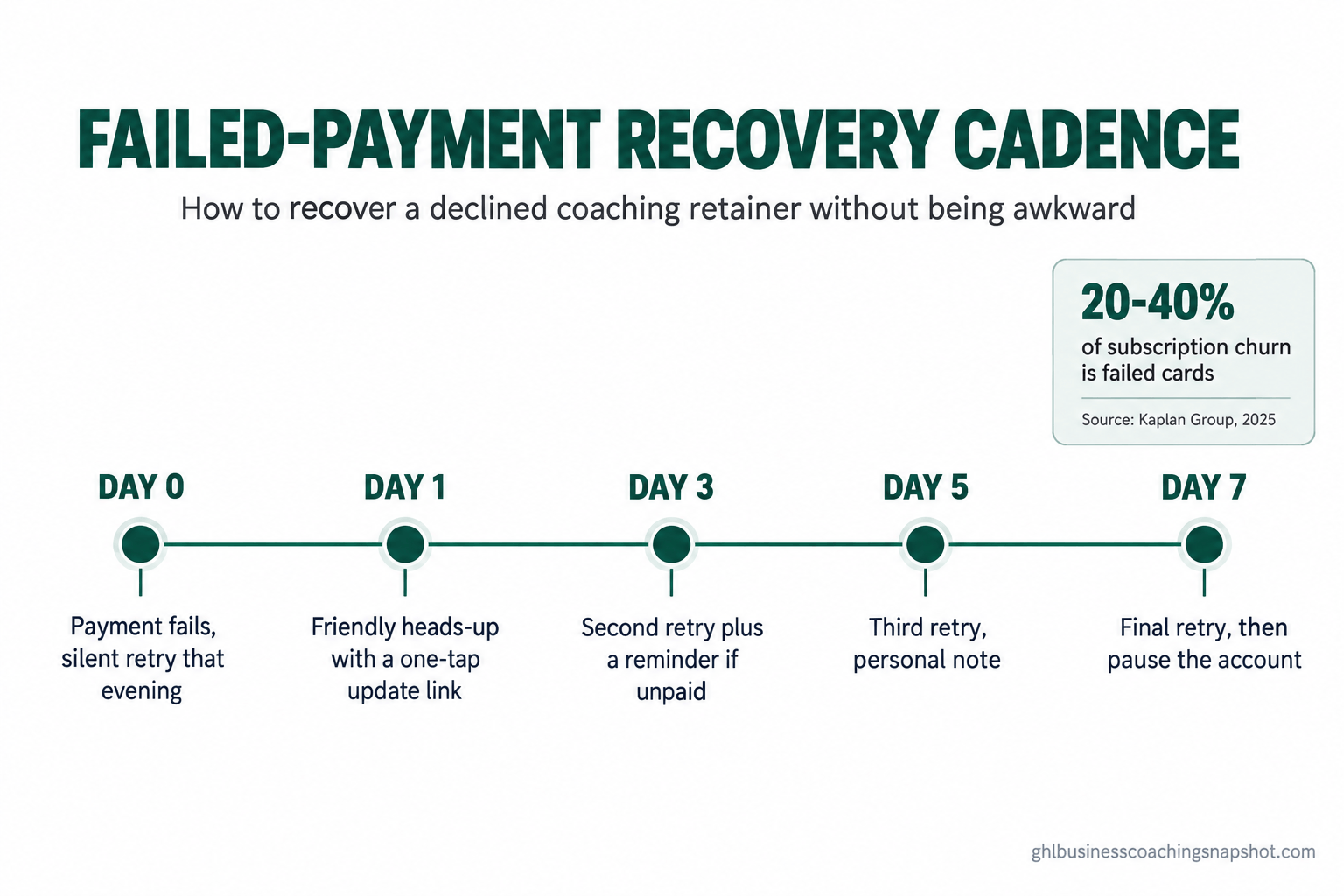
Setup. Build a dunning sequence that triggers on a failed charge. It retries the card on a smart schedule and, alongside the retries, sends a short, friendly note with a one-tap link to update the card. Tone matters: this is a helpful nudge, not a debt letter.
Timing (a recovery cadence that works):
- Day 0: payment fails, silent retry that evening.
- Day 1: friendly “your card didn’t go through” with an update link.
- Day 3: second retry, plus a reminder if still unpaid.
- Day 5 and 7: final retry and a personal note before pausing the account.
How it breaks. The default failure is that nobody notices for weeks, by which point the client has drifted and the “you owe me for two months” conversation is unavoidable. The other failure is tone: a cold “PAYMENT OVERDUE” that treats a good client like a deadbeat over a routine decline. Warm, fast, and card-update-in-one-tap recovers the money and keeps the relationship. The deep-dive is retainer billing recovery.
Three ways to run it
The six steps are the same for everyone. The shape changes with the business.
The solo coach signing 1:1 retainers
You are the whole sales team, so the win is that the system does the chasing you have no time for. Keep it simple: one template, a four-touch follow-up, an e-sign agreement, a deposit on signature, monthly autopay with recovery. Your biggest gains are step two (follow-up) and step six (recovery), the two you drop most when you are also delivering. In your first ten clients, resist over-engineering: a clean, fast chain beats a fancy one you never finish.
The group cohort or mastermind
You sell to many people at once against a deadline (the start date), and payment plans are common because the ticket is higher. Follow-up matters more because you are managing a roomful of maybes, and the deposit becomes an enrollment deposit that holds a seat. Autopay carries the plan across the cohort, and recovery matters more because one failed card can quietly become a member who stops attending. The true cost of running a coaching business breaks down the tool spend at this stage.
The boutique with high-ticket retainers
Two to eight people, larger contracts, and sometimes a buyer who is not the person you coached. The agreement gets more formal, invoices may be net-15 or net-30 rather than pay-now, and a real CRM record matters because more than one person touches the deal. The system still holds, but “paid” might mean an invoice marked paid in 30 days rather than a card charged on signature, so your follow-up tracks invoice status, not just contract status.
The compliance line on recurring billing
Steps five and six put you into recurring billing, which has rules. Most coaching content still warns that the FTC’s federal “click-to-cancel” rule is coming. It is not. On July 8, 2025 the Eighth Circuit vacated the FTC’s Negative Option Rule in full, on procedural grounds, days before it was due to take effect (Cooley). So the federal rule is not in force. That is the part most articles get wrong.
The part they miss: it does not let you off the hook. More than two dozen states have their own automatic-renewal laws, several stricter than the vacated federal rule. California amended its law effective July 1, 2025 to require consent to the auto-renewal terms themselves, and states keep tightening disclosure and cancellation rules (Kelley Drye). For your retainer that means three plain practices: state the renewal terms clearly before the client signs, get affirmative consent (not a pre-checked box), and make cancelling as easy as signing up. Your agreement is where the disclosure lives; your autopay is where consent matters.
Two more lines to keep clean. If your proposal or site shows client results, the FTC Endorsement Guides require testimonials showing atypical results to carry a disclosure or substantiation, with any material connection made obvious. And a “coach the coaches” or make-money program can trigger the FTC Business Opportunity Rule and its earnings-claim statement. None of this is legal advice, and the coaching-versus-therapy line varies by state, so run your agreement and claims past a lawyer where you practice. Fuller rundown: FTC rules for coaches.
Common objections
“Won’t a deposit and a contract scare people off?”
It scares off tire-kickers, which is the point. Serious clients expect a contract and a deposit, because that is how professional services work. What costs you clients is the opposite: a vague, paperwork-later arrangement that signals you are unsure of your own value. Asked as the next step after signing, with a clear card-payable link, the deposit closes more than a soft “pay whenever.”
“I already use Stripe and a course platform. Do I need another tool?”
Maybe not another tool, but you need them connected. The problem is rarely a missing tool. It is that the proposal lives in one app, the contract in another, the payment in Stripe, and the reminders in your head. The gaps are where deals leak. Wiring it so a signed contract triggers the invoice, and a paid invoice triggers onboarding, is the win, whichever way you build it. The true cost teardown shows what the stitched version really costs.
“Won’t automated payment chasing feel cold?”
Only if you write it cold. The messages above are warmer than what most coaches send by hand, because they are written once, carefully, in a calm moment, not fired off annoyed after you notice the money is late. Automation does not mean robotic. It means the polite, human message you would want to send actually gets sent, on time, instead of when you finally remember.
“Do I need to be technical to set this up?”
You need to write the messages, which you already can, because they are your voice. The wiring is a one-time build. You can learn it, hire it out, or start from a pre-built system and edit the copy to sound like you. It is a weekend or a done-for-you install, not a skill you maintain forever. What you do not want is to keep running the whole chain by hand at 4:50pm on a Thursday.
FAQ
How fast should I send a coaching proposal after a discovery call?
Within an hour if you can, same day at the latest. Prospects open proposals fast and interest cools after the call, so a same-hour proposal built from a template with one personalized field (their problem, in their words) closes far more than a polished one sent by end of week. If you cannot personalize it in an hour, send a short holding note now and the full proposal within a few hours.
Should I ask for a deposit before starting coaching?
Yes, in almost every case. A deposit at signing protects you from clients who sign and disappear, and makes payment the natural next step rather than an awkward conversation. Offer pay-in-full, a deposit-plus-plan, or a first retainer payment, and send a card-payable link the instant the agreement is signed, when commitment is highest.
How do I recover a failed coaching payment without being awkward?
Treat it as a routine card hiccup, because usually it is. Build a dunning sequence that retries the card automatically and sends a short, friendly note with a one-tap update link on days 1, 3, 5, and 7. Keep the tone helpful, not accusatory. Most failed payments are recoverable because the client wanted to keep paying, and an expired card is not a decision to leave.
Is the FTC click-to-cancel rule still in effect for coaching retainers?
No. The Eighth Circuit vacated the FTC's federal Negative Option (click-to-cancel) rule in full on July 8, 2025, so the federal rule is not in force. But more than two dozen states have their own automatic-renewal laws, some stricter, so you still must disclose renewal terms clearly, get affirmative consent, and make cancellation easy. This is general information, not legal advice; check your state's rules.
Can one system handle proposals, contracts, invoices, and follow-up?
Yes. Rather than a proposal app, a separate e-signature tool, a payment link, and a spreadsheet of reminders, the whole chain can run inside one platform like GoHighLevel, where a signed contract triggers the invoice and a paid invoice triggers onboarding. Consolidating the handoffs is what closes the gaps where committed clients slip away.
The Thursday call, closed
Back to that 4:50pm call. In the old version, the proposal went out Monday and the deal cooled. In the new version, the moment you mark the call “won,” the proposal is already drafted from what the prospect told you, sent within the hour, followed up on a schedule you never have to remember, signed on a phone, deposited on signature, and set to collect every month with a recovery sequence standing by for the one card that will inevitably decline. You did none of the chasing, and you got paid faster.
That is the point of building the chain once: the gap between yes and paid stops being where your money leaks and becomes the part of your practice you never think about. Start with the one link you drop most (for most coaches it is follow-up or recovery), get it running, then add the rest.
If you would rather not wire it together yourself, the Coaching Snapshot is this exact chain, proposals, agreements, deposits, autopay, and failed-payment recovery, pre-built inside one GoHighLevel account and installed in 24 hours. Or book a walkthrough and we will show you the gap in your own pipeline first.
This article is general information for coaching-business operators, not legal, tax, or financial advice. Auto-renewal, endorsement, and earnings-claim rules vary by state and change often; consult a qualified professional in your jurisdiction before finalizing agreements or making results claims. Third-party statistics are linked to their sources and reflect figures published as of 2025 to 2026; confirm the current number before relying on it. Outcome examples are illustrative, and we do not guarantee revenue, client count, or income gains; results depend on your offer, audience, and execution.