

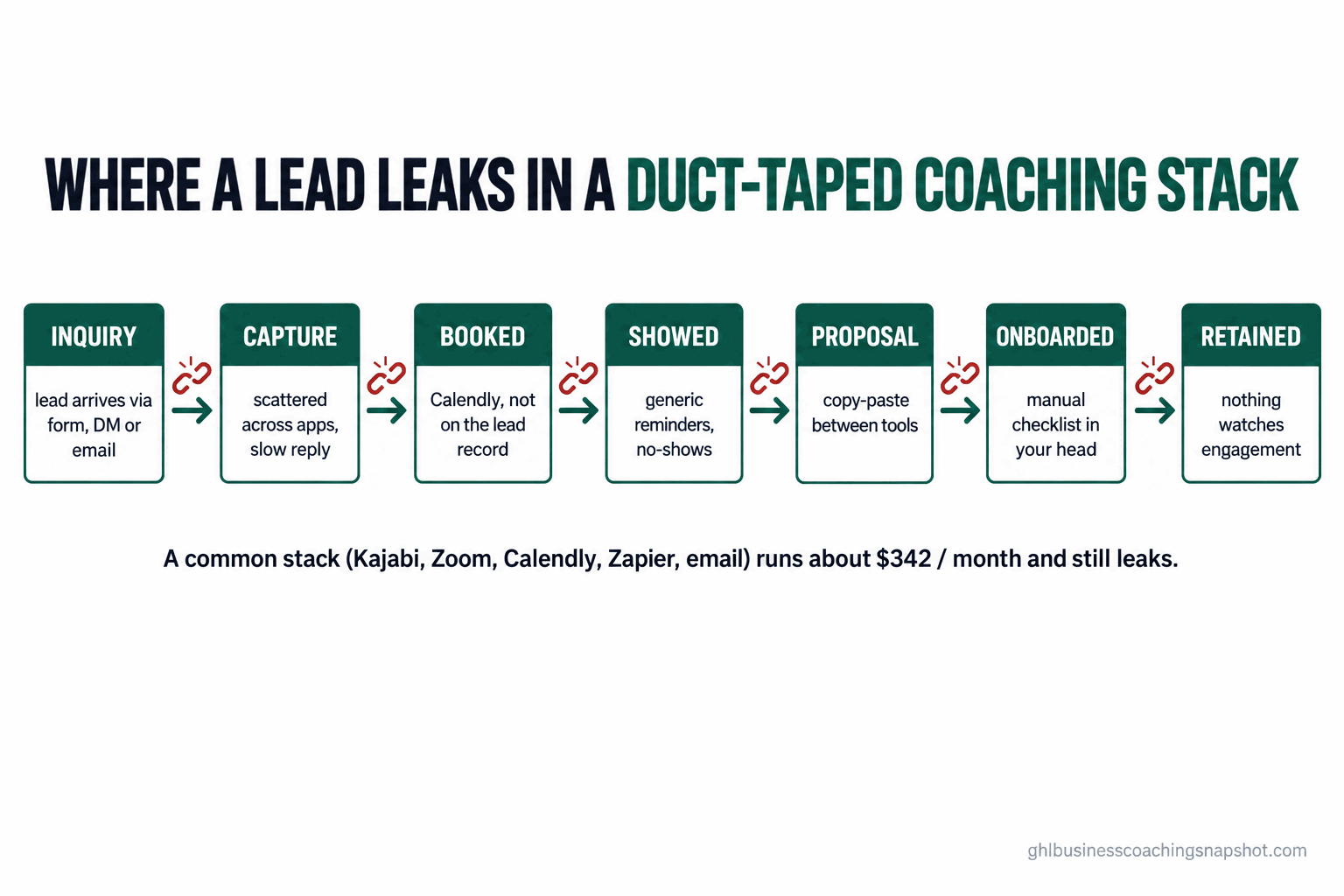
Short answer: your coaching tools don’t talk to each other because each one was built to own its own slice of data and nothing sits underneath them to join it up. Your course platform knows who bought. Calendly knows who booked. Zoom knows who showed. Your inbox knows who replied. None of them share a single record of the human moving through all four, so you become the integration. Every time you copy a name from one tab to another, or try to remember whether that warm lead ever got a reply, a client is quietly slipping through a crack you built by accident. Below is where the leaks happen, handoff by handoff, with the real copy to plug them and the fix that does not mean throwing out tools you like.
What does a disconnected stack actually cost you?
It is 9:15 on a Tuesday. A good-fit prospect filled out the contact form on your course platform last night. You see the notification now, between a client session and school pickup. You copy her email into Gmail, write a warm reply, paste in your Calendly link, and hit send. She books for Thursday. Calendly emails her a confirmation. Zoom generates a link. You make a mental note to send her the intake questions beforehand. Then your next client logs on and the mental note evaporates.
Thursday comes. She no-shows. Not because she lost interest, but because Calendly’s reminder was generic, the intake never arrived, and nothing nudged her the morning of. No single system held her record and decided what she needed next. There was just you, holding five tabs and a memory that was already full.
That cost shows up three ways. Slow, patchy response, because capture and reply are separate chores you do by hand. Leaks at every handoff, because each tool hands the lead back to you instead of to the next step. And the toggle tax on your own hours, the time you burn moving data between apps instead of coaching or selling.
Toggle figures: Harvard Business Review, five-week study of 137 users across three Fortune 500 firms. Speed-to-lead figure: HBR, audit of 2,241 US firms. Stack cost estimated from current vendor pricing (see below).
That toggle number is knowledge-work data, not coaching data, but it lands harder on you. When a salaried analyst loses four hours a week to app switching, the company eats it. When you lose it, that is four hours not spent in a paid session or on a discovery call. At any real billable rate, your duct tape has an hourly cost you pay every week, whether or not a lead goes missing.
Then there is the bill for the tools themselves. Here is what a fairly normal coaching stack costs today, on month-to-month pricing, before you count a minute of your time.
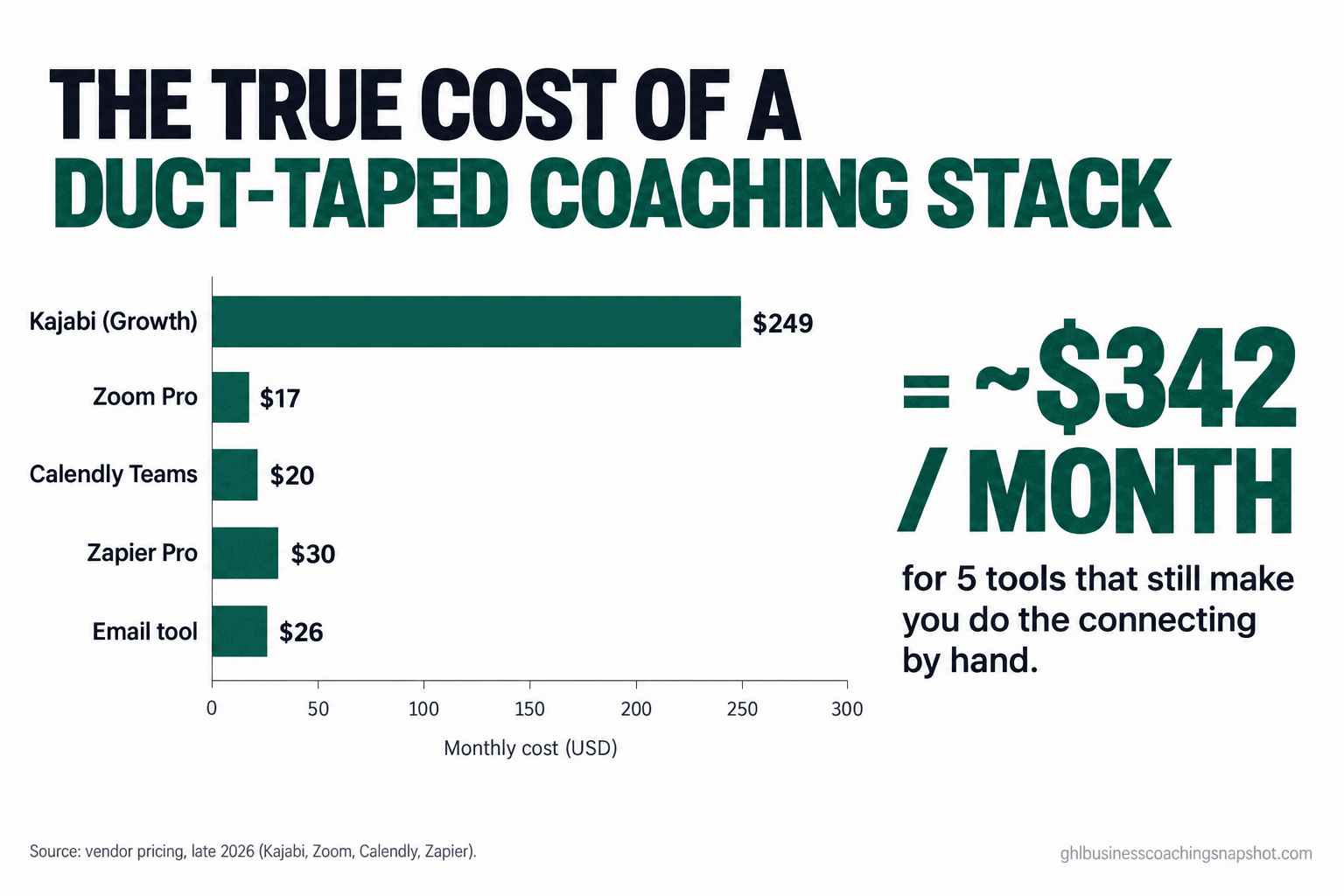
Approximate monthly cost per tool, month-to-month billing, late 2026. Sources: Kajabi (Growth $249/mo), Zoom (Pro ~$17/mo), Calendly (Teams ~$20/seat), Zapier (Professional ~$30/mo), plus a typical email-marketing tool around $26/mo. Total: about $342/month. The full teardown is in the true monthly cost of running a coaching business.
So you pay about $342 a month for five tools that still make you do the connecting by hand. The point is not just that the stack is expensive. It is that it is expensive and still leaks. The pure-cost version lives in the true monthly cost of running a coaching business. This piece is about the leaks.
Why your coaching tools don’t talk to each other
Each tool in your stack was designed to be the center of your world. Kajabi wants to be your business. So does Kartra. So does your email platform. Each one keeps its own list of contacts, its own idea of who a person is, and its own events (bought, opened, clicked, booked). None of them was built to defer to a shared record, because deferring to a shared record is the opposite of being the center.
That leaves a gap underneath the whole stack where a customer-relationship record should sit. A CRM, in plain terms, is just that shared record: one row per human that every tool reads from and writes to, so “Sarah booked a call” and “Sarah bought the course” and “Sarah stopped opening emails” are facts about the same Sarah, visible in one place. Most solo coaches never had one. They had a course platform, then added Zoom, then Calendly, then an email tool, then Stripe, each solving a real problem, none of them joined up.
So people reach for the duct tape, which is usually Zapier. Zapier is good software, and it can pass a name from one tool to another when something happens. But a pile of individual zaps is not a shared record. It is a web of one-way messages, and when a zap breaks quietly, and they do break quietly, the message just stops arriving. You find out when a client asks why they never got their welcome email. That is automation without memory: the tools still do not know each other, and a note thrown over the wall sometimes fails to land.
The seven handoffs where a lead leaks
Follow one person from first contact to paid, renewed client. There are seven points where your tools hand off to each other, and in a duct-taped stack, each handoff hands the work back to you instead. Here is each one: what should happen, where it breaks, and how to plug it.
Handoff 1: Inquiry to captured lead
What should happen: someone fills out a form, sends a DM, or emails you, and that person lands as a record in one place, instantly, no matter which door they came through.
Where it breaks: your inquiries arrive in four places. The course-platform form emails you. Instagram DMs sit in Instagram. The “book a call” people land in Calendly. Direct emails sit in Gmail. There is no single inbox for leads, so some get answered in minutes and some get buried under a client email for two days. You cannot see your own pipeline because it is scattered across apps.
The fix: route every entry point into one record. Forms, DMs, and booking requests should all create or update the same contact, so a new lead is a new lead regardless of the door. That is the whole point of speed-to-lead for coaches: you cannot respond fast to a lead you cannot see in one place.
Handoff 2: Captured lead to booked call
What should happen: a new lead gets an instant, personal first touch and an easy path to book, and the booking is tied to their record.
Where it breaks: the instant touch does not exist, because sending it is a manual chore you do when you surface from delivery. By the time you paste your Calendly link into a reply, the lead has cooled, booked with a coach who answered faster, or forgotten they reached out. And when they do book, Calendly knows it, but your lead record does not, so you are back to copy-pasting.
The fix: an automatic first reply within minutes, with the booking link built in, and a calendar that writes the booking straight onto the lead’s record. Speed is not a nicety here. Reaching a web lead inside an hour makes you roughly 7 times more likely to qualify it than waiting even a few hours (HBR), and a disconnected stack almost guarantees you miss that window.
Handoff 3: Booked call to showed-up call
What should happen: the person who booked actually turns up, warmed and prepared, with reminders that feel like they came from you.
Where it breaks: reminders live inside Calendly or Zoom, not tied to the rest of the relationship. They are generic, they do not carry your intake questions, and they do not escalate when someone goes quiet. So you get no-shows that were preventable, and you blame the lead when the real culprit was a reminder system that did not know anything about them.
The fix: a reminder cadence that runs off the booking and includes a text, not just an email, plus the intake prompt that gets them invested before the call. This is most of the battle in reducing discovery-call no-shows: the confirmation, the day-before nudge, and the morning-of text all firing from one place.
Handoff 4: Call to proposal, contract, and invoice
What should happen: a yes on the call turns into a sent proposal, a signed agreement, and a paid invoice without a three-day gap while you assemble it by hand.
Where it breaks: this is the copy-paste capital of the duct-taped stack. The proposal lives in one tool, the contract in another, the invoice in Stripe, and you stitch them together between sessions. Every hour of delay is a chance for the yes to go cold or for a competitor to close first. The proposal-to-paid system only works when these three steps share the same client record.
The fix: template the proposal, the agreement, and the invoice so a “yes” triggers the sequence, and the client’s details flow through all three without you retyping anything.
Handoff 5: New client to onboarded client
What should happen: payment kicks off a clean welcome: course access, scheduling, the welcome packet, the first session on the calendar, all arriving in order.
Where it breaks: onboarding is a checklist in your head. You manually invite them to the course platform, send the Zoom details, email the welcome doc, and book the first session. Miss one step during a busy week and the client’s first experience is confusion, which is exactly when buyer’s remorse creeps in. A messy start is a leading cause of early churn, which is why client onboarding deserves to be a system, not a memory test.
The fix: one onboarding sequence that fires on payment, handles access and scheduling and the welcome in a set order, and does not depend on you remembering it at 9pm.
Handoff 6: Active client to retained client
What should happen: something watches engagement and prompts a check-in or a renewal conversation before a client drifts.
Where it breaks: nothing is watching. A client who stops booking sessions or goes quiet in month two does not trigger anything, because the signal (fewer bookings) lives in your calendar tool and the action (reach out) lives in your head. By the time you notice, they have mentally left. The whole mechanism is covered in reducing coaching client churn.
The fix: tie check-ins and the renewal conversation to the engagement timeline so they fire on a schedule, and flag clients whose activity drops so you can reach out while it still matters.
Handoff 7: Billing to recovered payment
What should happen: a failed card triggers a calm, automatic recovery sequence, and you keep the client and the revenue.
Where it breaks: Stripe’s dunning emails are cold and easy to ignore, and they are disconnected from your actual relationship with the client. So an expired card quietly becomes a lost retainer, and you do not even notice until you reconcile the month. For a coach on recurring retainers, this is pure leakage. The fix lives in retainer billing recovery.
The fix: a recovery sequence that sends a warm, personal note from you (not just Stripe’s auto-email), retries the card on a schedule, and pings you if it is still unpaid after a few days.
Illustrative example of how 100 inquiries thin out across seven disconnected handoffs. Not real data; it shows the shape of compounding leakage, where a small drop at each step leaves barely a fifth of your inquiries as retained clients. Close even two or three handoffs and the end number changes a lot.
No single handoff is a disaster. Each loses a slice. But seven slices compound, and by the end you keep a fraction of the people who first raised a hand. No one tool failed. The gaps between them, added up, are where most of your pipeline goes.
Steal this: the handoff audit and the copy that plugs the gaps
Before you buy or build anything, run a ten-minute audit. For each of the seven handoffs, answer one question: when this happens, does a system act, or do I act? Write “system” or “me” next to each. Every “me” is a leak, ranked by how often it happens. Most coaches find handoffs 1, 2, and 5 are all “me,” which is why leads and new clients are where they bleed the most.
Then plug the two fastest leaks with real copy. Here is the copy, ready to steal.
The instant first reply (handoff 2), sent within minutes of any inquiry:
Hi {first name}, thanks for reaching out about coaching. I read your note about {their goal} and I think there’s a real chance I can help. The fastest next step is a short call so I can understand where you are and whether we’re a fit. Here’s my calendar: {link}. If none of those times work, just reply here and we’ll sort something out.
The morning-of reminder (handoff 3), sent as a text a few hours before the call:
Hi {first name}, looking forward to our call at {time} today. Here’s the link: {zoom link}. One thing to think about beforehand: what would have to be true in 90 days for you to call this a win? Come with a rough answer and we’ll make the call count. See you soon.
The onboarding kickoff (handoff 5), sent the moment payment clears:
{First name}, welcome aboard, I’m genuinely glad we’re doing this. Three things to get you started: (1) your access link is {link}, (2) book your first session here {link}, and (3) reply to this email with the one outcome you most want from our work together. That last one takes two minutes and it shapes everything we do. Talk soon.
The failed-payment note (handoff 7), sent from you, not from Stripe:
Hi {first name}, quick heads-up: the card on file for your coaching didn’t go through this month, which is almost always just an expired card. You can update it here {link} and it’ll sort itself out. Nothing changes with our sessions in the meantime. Let me know if you’d rather handle it another way.
None of this copy is clever. It works because it is specific and it is timed, and it arrives whether or not you remembered. The tools decide the timing. You decide the words once, and then they run. That is the difference between automation that feels hand-sent and the generic autoresponder everyone can smell.
Duct-taped stack vs one shared record
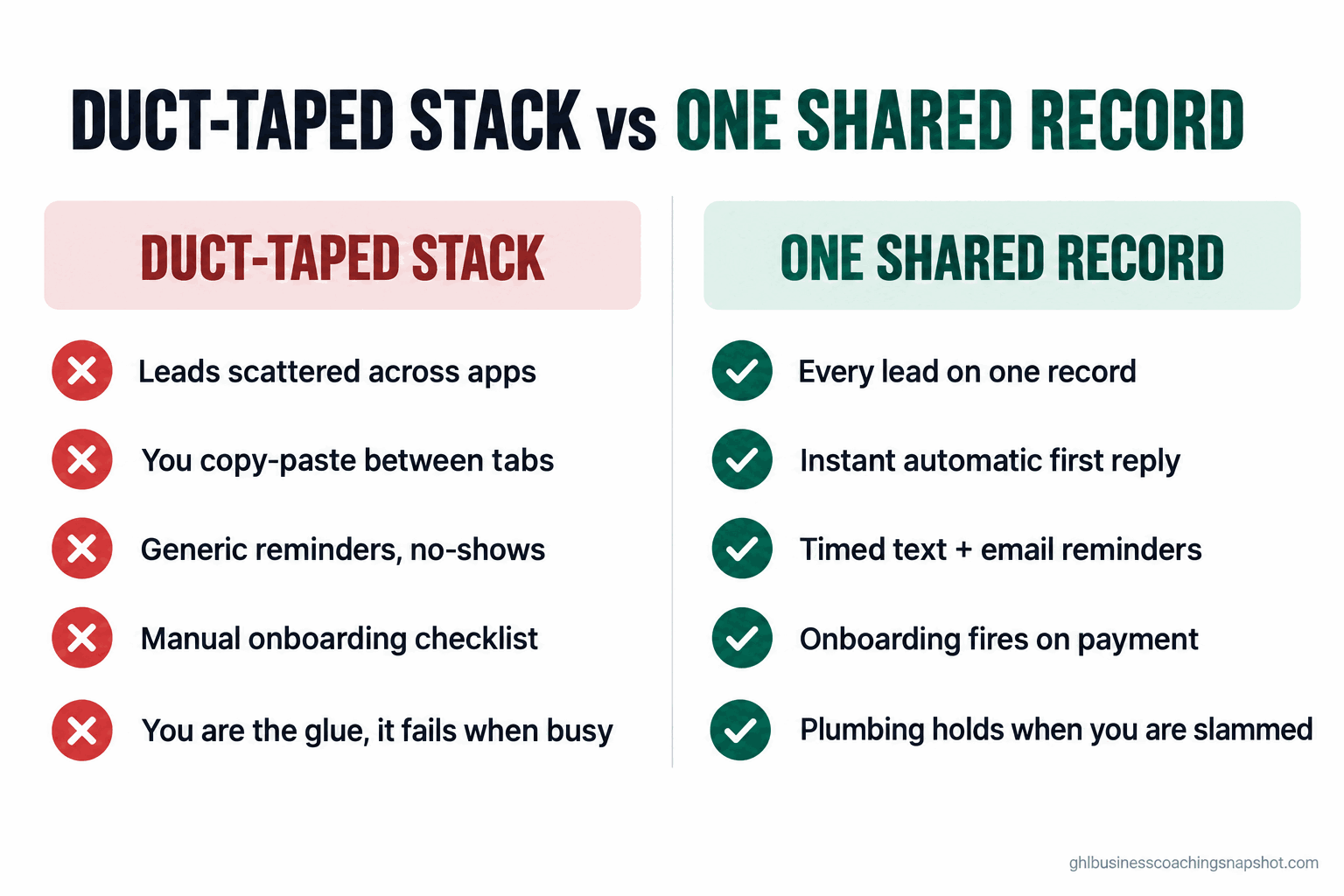
A lead arrives on your course platform, you copy it to email, paste a Calendly link, hope they book, hope they show, assemble a proposal by hand, manually onboard them, and find out about a failed payment when you reconcile the month. You are the glue, and the glue fails on busy weeks.
A lead arrives through any door and lands on one record. The instant reply, booking, reminders, onboarding, check-ins, and payment recovery all read and write to that record and fire on their own. You step in for the call and the coaching. The plumbing holds when you're slammed.
Three versions: solo, scaling past solo, and a boutique
The seven handoffs are the same for everyone. Where the leak hurts most depends on your stage, so fix in this order.
1. Solo coach, first clients, 1:1 or a small group
Your biggest leaks are handoffs 1 and 2: capture and the instant reply. You are the whole sales team, so when you are delivering, nobody answers leads, and slow answers are lost answers. Start there. Get every inquiry landing in one place and an automatic first reply going out within minutes. Do not try to automate all seven at once. Close the two that bleed fastest, feel the difference, then add the rest. The feast-or-famine pipeline piece explains why capture and follow-up are the pieces that have to survive your busiest week.
2. Scaling past solo, more volume than your memory can hold
Your leaks move to the middle: handoffs 4, 5, and 6. You have enough volume now that the proposal-to-paid gap and the onboarding checklist genuinely lose clients, and nobody is watching engagement. This is the stage where a real shared record stops being optional, because you have passed the number of people you can track in your head or a spreadsheet. The coaching CRM and sales pipeline setup is built for exactly this crossover.
3. Boutique, 2 to 8 people with retainers
Your leaks are the ones that hide: handoffs 6 and 7, retention and billing, because multiple coaches smooth the average and mask a problem until several retainers lapse at once. Your highest-value fix is one shared record the whole team works from, so a client going quiet is visible to someone, and a failed payment is not lost in the gap between whoever handles billing and whoever coaches that client. Disconnection is most dangerous when it is invisible, and a team stack hides it longest.
The compliance line nobody mentions
Disconnected tools are not just a leak problem. They are a compliance risk, because consent and records get fragmented too. None of this is legal advice, so get a real review of your own setup.
Consent lives in one place, texts go out from another. The moment you send automated reminders and follow-ups by SMS to US contacts, you are under TCPA and carrier rules: you need real, provable consent to text someone, and a working opt-out. When your form (where consent is captured) and your texting tool (where messages go out) are different disconnected apps, it is easy to text someone who never actually opted in, or to keep texting someone who replied STOP in a channel the other tool never saw. One shared record is what keeps consent and sending on the same page. The plain-English version is in A2P 10DLC for coaches.
Testimonials and results claims. If your onboarding or nurture emails show client wins, the FTC’s 2023 Endorsement Guides require that an atypical result carry a disclosure of the generally expected result, or substantiation, and that any material connection be disclosed (FTC). Scattered tools make it easy to let an old “my client tripled revenue” email keep sending without the disclosure you added everywhere else.
Auto-renewal disclosure. If your retainer auto-renews, more than 25 states have automatic-renewal laws that require clear disclosure and an easy cancel path, even though the federal “click-to-cancel” rule was vacated in court in 2025. When billing and client communication are different systems, the cancel path and the disclosure drift apart. The full rundown is in the FTC rules for coaches.
Common objections
“I actually like my tools. I don’t want to switch everything.” You might not have to. The problem is rarely the individual tool, it is the lack of a shared record underneath. For some coaches the cleanest fix is to consolidate into one platform. For others it is to keep a favorite tool and put a real CRM beneath the rest so the handoffs stop depending on you. The audit above tells you which. Switching for its own sake is just a new stack to duct-tape.
“Isn’t Zapier enough? I already have zaps for this.” Zaps pass messages, they do not hold a record. They are fine for a one-off handoff, but a dozen of them is a fragile web with no memory and no single view of a lead, and they fail silently. If you cannot open one screen and see every lead and where they are, you have automation without a database, which is the exact gap that leaks.
“I’m a solo coach, this feels like enterprise overkill.” It is the opposite. A big company can throw an ops hire at the gaps. You cannot, so you are the ops hire, doing the copy-paste at 9pm. A shared record matters more when you are solo, because you have the least slack to absorb a dropped handoff. Start with two automations, not twenty.
“I don’t have time to set this up while I’m slammed.” That is the trap that keeps the leaks open. You build the plumbing once, in a calmer week, precisely so it runs during the slammed weeks when the manual version always fails. Building it under pressure mid-famine is why the chaos repeats. If the setup itself is the blocker, a pre-built CRM and workflow system arrives wired together, so it is a one-time install, not a months-long project.
FAQ
Why don't my coaching tools sync with each other automatically?
Because each one is designed to be the center of your business, not a team player. Your course platform, calendar, video tool, and email app each keep their own separate list of contacts and their own events, and none was built to defer to a shared record. So unless you add a layer underneath that every tool reads from and writes to, they stay separate islands and you end up manually carrying data between them.
Do I really need a CRM as a solo coach, or is that overkill?
A CRM is just one shared record per person that every tool can see, and it matters more when you are solo, not less. A larger team can absorb a dropped handoff with an ops hire. A solo coach cannot, so you become the integration, doing the copy-paste and remembering the follow-ups during your busiest weeks, which is exactly when that breaks down. You do not need an enterprise setup, you need one place every lead and client lives.
Isn't Zapier enough to connect my coaching tools?
Zapier is good at passing a single message from one tool to another when something happens, but a pile of zaps is not a shared record. It is a web of one-way messages with no memory and no single view of a lead, and individual zaps break quietly, so you find out only when a client asks why they never got something. If you cannot open one screen and see every lead and exactly where they are in your pipeline, the gap that leaks clients is still open.
Where do coaching businesses lose the most leads in a disconnected stack?
Usually at the first two handoffs: capturing the inquiry and sending a fast first reply. When inquiries scatter across a form, DMs, and email, some get answered in minutes and some get buried for days, and slow replies are lost replies. After that, onboarding and failed-payment recovery are the biggest silent leaks, because nothing fires automatically when a client pays or when a card is declined.
How much does a typical disconnected coaching stack cost per month?
A common setup of a course platform, video tool, scheduler, an automation connector, and an email tool runs roughly $342 a month on month-to-month pricing, before you count the hours you spend connecting them by hand. The real issue is not just the price, it is that you are paying that much for tools that still make you do the integration yourself and still leak clients in the gaps.
Can I fix this without replacing all my software?
Often yes. Run the handoff audit first: for each of the seven handoffs, note whether a system acts or you act. If most of your tools are fine and the problem is only the gaps between them, adding one shared record underneath can close the leaks without a full rebuild. If you are paying for several overlapping tools that each want to be the center, consolidating into one platform is usually cheaper and simpler than duct-taping them together.
The Thursday no-show, avoided
Go back to that prospect who no-showed on Thursday. She did not vanish because she lost interest. She vanished because the system that was supposed to catch her was you, and you were in a session when she needed a nudge. The reminder was generic, the intake never went out, and nothing knew enough about her to act. Every link in that chain was a handoff that got handed back to you.
That is the whole story of a duct-taped stack. The tools are fine. The gaps are where the money goes. Close the two handoffs that bleed fastest, give every lead and client one record to live on, and let the plumbing hold when your week falls apart. Then Thursday’s call happens, because something other than your memory made sure it would.
If you would rather not wire all of that together yourself, that is what the Coaching Snapshot installs: capture, instant reply, booking, onboarding, retention check-ins, and retainer billing recovery, all reading from one shared record in standard GoHighLevel, in about 24 hours. If you are setting up GoHighLevel to build it yourself, you can start through our GoHighLevel partner link. That is an affiliate link, so we may earn a commission at no extra cost to you.
Tool prices reflect published vendor pricing in late 2026 and change often; confirm current rates on each vendor’s own pricing page before deciding. Industry and productivity figures are linked to their sources; verify before citing. Nothing here is legal advice; consult a qualified professional on TCPA, endorsement, and auto-renewal compliance. Outcome examples are illustrative, and we do not guarantee revenue, client count, or income gains; actual results depend on your offer, audience, and execution.