
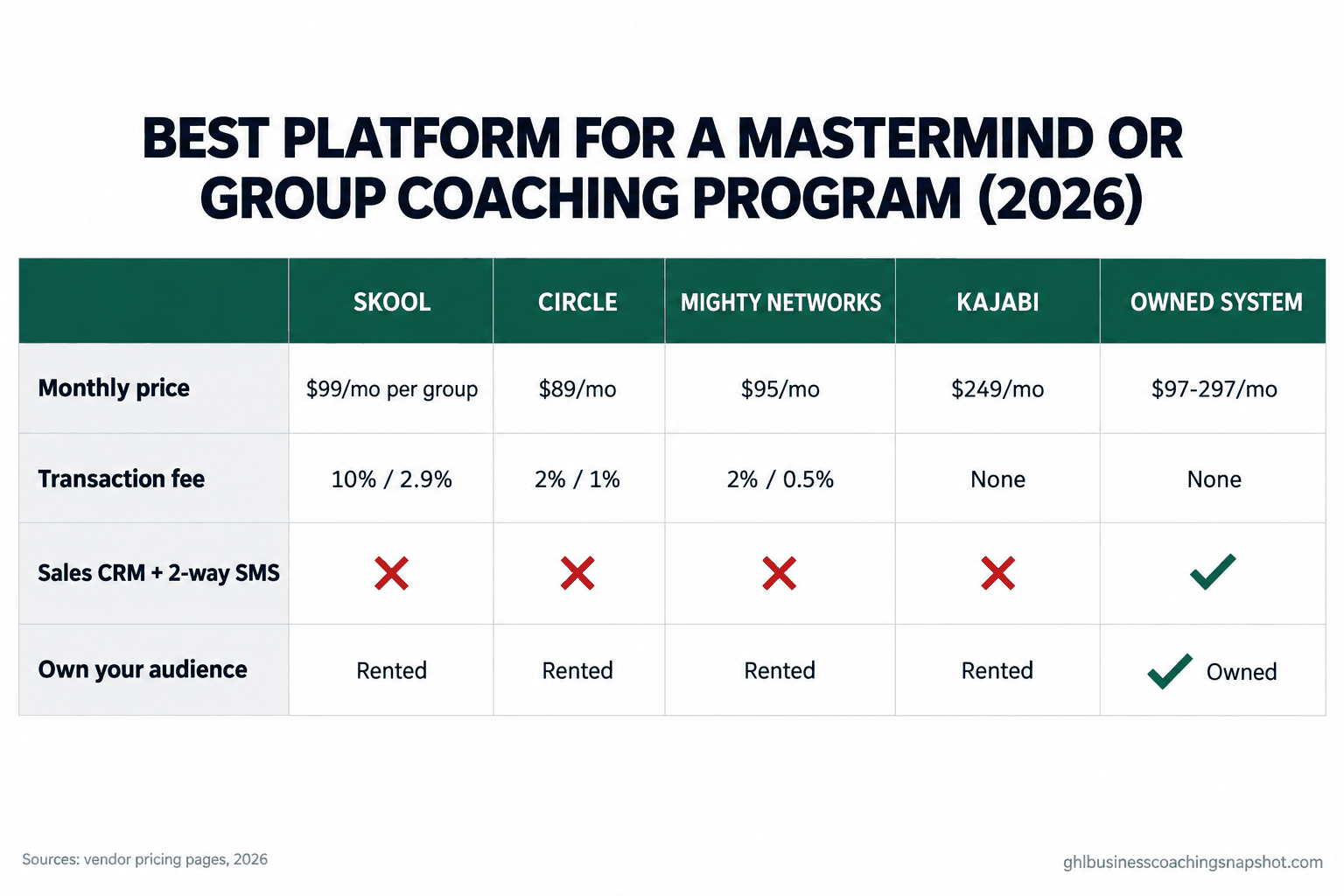
Short answer: if your mastermind lives or dies on daily discussion and a simple course area, Skool at $99 a month per group is the cheapest way to run it, and it is why so many groups start there. If you want a branded, polished member experience with rich course delivery, Circle ($89/mo) or Mighty Networks ($95/mo) win. If you already sell courses and want the community bolted onto that, Kajabi ($249/mo) is the safe default. But none of those four books your discovery calls, runs a sales pipeline, or texts a slipping member back, so once your group is a real business you either bolt a CRM onto the community, or you run the whole thing on one owned all-in-one system from about $97 a month and stop paying per group. Below is the honest comparison across the eight things that actually decide it. Prices are the vendors’ published 2026 rates, linked to their own pages; confirm the live number before you commit.
What is the best platform for a mastermind or group coaching program?
It is Sunday night and you are staring at your group. Twenty-two people paid to be in this cohort, and the feed has gone quiet. Two members have not logged in since week one. One asked a question on Thursday that nobody answered, including you, because it was buried under a Slack thread, a Google Doc, and the course videos you host somewhere else. You have a great program. What you do not have is one place that holds it together.
That is the real question behind “which platform.” It is not about features on a grid. It is about which tool keeps a group of paying humans engaged, learning, and renewing without you personally carrying every thread. The five names coaches shortlist are not the same kind of tool, which is why picking on price alone burns people. Skool, Circle, and Mighty Networks are community platforms first. Kajabi is a course platform that added community. The owned system is a business platform that happens to include a community. Match the tool to the job your program actually depends on, and the choice gets simple.
Industry figures: ICF 2025 Global Coaching Study. Skool fee figures: Skool pricing, 2026.
The market backs up why this matters. The 2025 ICF Global Coaching Study counted a record 122,974 coach practitioners worldwide, up 15% since 2023, and global coaching revenue of $5.34 billion (ICF). Group and cohort models are a big slice of that growth, because one coach can serve many people at once. But group programs live and die on engagement and retention, and the platform is the room they happen in. Choose the wrong room and you fight the tool all cohort.
What does picking the wrong platform actually cost you?
Three costs, and only one of them shows up on the invoice.
The transaction fee. This is the quiet one. Every community platform except Kajabi takes a cut of what you sell through it, on top of Stripe’s roughly 2.9% plus 30 cents (Stripe). On a program doing $10,000 a month, a 2% platform fee is $200 a month you never see itemized, and Skool’s Hobby-plan 10% is $1,000. That is the cost of being on the wrong tier of the right tool, and the full fee math is in the payments section below.
The migration. If you outgrow a platform, moving is not a button. You are exporting members, re-uploading course content, rebuilding the community structure, and asking every paying member to make a new login and learn a new home. Members drop in that gap. Pick a tool you will outgrow in six months and you pay for the move in churn.
The churn you never diagnose. This is the biggest one and it hides completely. Churn quietly caps revenue while you chase new leads, the exact problem we break down in how to reduce coaching client churn. If your platform cannot tell you who has not logged in this week, cannot trigger a check-in, and cannot text a member who has gone dark, you find out someone left when their card fails at renewal. A tool that only hosts a feed is blind to the people quietly leaving.
The five contenders, and the job each one really does
Before the grid, know what each tool is actually for. Half of platform regret is buying a community tool to do a job it was never built for.
Skool: the engagement-first community
Skool is a discussion feed, a simple course area, and a gamified points-and-levels system that keeps people coming back. It has become the default home for masterminds because it is dead simple and the feed is genuinely sticky. Pricing is $99 a month per group, with a $9 Hobby tier (Skool pricing).
Where it bites: the $99 is per group, so two communities cost $198. The Hobby tier takes a 10% cut of payments. And Skool is deliberately minimal, so there is no real course-builder depth, no CRM, and no booking.
Circle: the branded, polished member experience
Circle is the premium-feeling option: rich spaces, courses, live streaming, events, and a clean branded look that does not scream “generic forum.” Pricing runs $89/mo (Professional) and $199/mo (Business) on annual billing, with a custom Circle Plus tier (Circle pricing). Fees are 2% on Professional, 1% on Business.
Where it bites: Circle publishes only annual rates, so the real commitment is $1,068 or $2,388 up front. It is a beautiful community, not a sales system.
Mighty Networks: community plus a branded mobile app
Mighty Networks bundles a community, courses, events, and, on higher tiers, a branded mobile app with your name on it. Entry is the Launch plan at $95/mo ($79 annually), with Scale around $215/mo and a branded-app tier around $179/mo (Mighty Networks pricing). Fees run 2% down to 0.5% by tier.
Where it bites: the branded app that everyone wants sits on a higher tier, and like the others it is a community platform, not an acquisition engine.
Kajabi: courses first, community bolted on
Kajabi is a course and membership platform that added a community feature. If your program is really a course with a group attached, Kajabi keeps it in one place. Pricing is $179 (Basic), $249 (Growth), $499 (Pro) month-to-month, cheaper annually (Kajabi pricing). No platform transaction fee; card processing still applies. Basic and Growth include one community; Pro includes three.
Where it bites: the community is not Kajabi’s strength, it meters contacts as your list grows, and it is not a sales CRM. We compare it head to head in GoHighLevel vs Kajabi for coaches.
The owned all-in-one system: the whole business in one place
The fifth option is not a community tool. It is a business platform (usually built on GoHighLevel) that runs your lead capture, booking, sales pipeline, two-way SMS and email, course area, and a community, from about $97/mo (Starter) to $297/mo (Unlimited) (GoHighLevel pricing). No per-group fee, no per-community fee, and you own the data and the audience.
Where it bites: the community feed is more utilitarian than Skool’s, and you have to build or install the structure. That is exactly the build the Coaching Snapshot ships pre-made.
How they compare across the eight things that matter
Read this grid by the job you actually need, not top to bottom. The “watch out” is usually more useful than the checkmark.
| What matters | Skool | Circle | Mighty Networks | Kajabi | Owned system |
|---|---|---|---|---|---|
| Community feed | Best in class, gamified | Polished, spaces | Strong, mobile-first | Basic | Functional |
| Courses / content | Light | Strong | Strong | Best in class | Strong (installable) |
| Live calls / events | Basic | Built-in streaming | Built-in | Add-on | Via integration |
| Sales pipeline / CRM | None | None | None | None | Yes, native |
| Two-way SMS | No | No | No | No | Yes |
| Transaction fee | 10% / ~2.9% | 2% / 1% | 2% / 0.5% | None* | None |
| Per-extra-program cost | +$99/group | Higher tier | Higher tier | Pro for 3 | $0 |
| You own the audience | Rented | Rented | Rented | Rented | Owned |
*Kajabi has no platform transaction fee; card-processing fees still apply. Sources: Skool, Circle, Mighty Networks, Kajabi, GoHighLevel, 2026. Confirm live prices before you commit.
The community feed and engagement
This is Skool’s whole reason to exist, and it wins. The single feed, the leaderboard, and the levels are designed to pull people back daily, and for a mastermind that daily habit is the product. Circle and Mighty Networks have good feeds too, with more structure through separate spaces, which suits a larger or multi-topic community. Kajabi’s community is fine but plainly secondary to its courses. The owned system’s feed is functional, not gamified, so if pure engagement mechanics are the point, a dedicated community wins there.
How it breaks: a gamified feed is sticky right up until it is a ghost town, and no leaderboard saves a group the coach has stopped showing up in. The tool drives habit; it does not create belonging on its own.
Courses and content delivery
Kajabi is built for this and it shows: proper course structure, drip scheduling, assessments, and a mature checkout around it. Circle and Mighty Networks both deliver courses well and pair them with the community. Skool’s course area is deliberately simple, which is great for a light curriculum and thin for a deep one. The owned system delivers courses and memberships too, and for most coaching programs the content is more “recorded calls plus worksheets” than a polished video academy, so the simpler builders are usually enough.
How it breaks: coaches over-index on course depth and under-index on whether anyone finishes. A beautiful course area with a 6% completion rate is not better than a simple one people actually use.
Live calls, events, and cohort onboarding
Circle and Mighty Networks have live streaming and events built in, a real advantage for a cohort that meets weekly. Skool and Kajabi lean on Zoom for the call and host the replay. Onboarding a cohort, the first 48 hours where a member either activates or drifts, is where all of them are weak, because none automates the welcome sequence, the orientation nudge, or the “you have not logged in” catch. That gap is the whole point of the cohort kickoff that does not eat your Saturday.
How it breaks: the kickoff call goes great, then week two arrives with no structured follow-up and a third of the cohort quietly disengages. Onboarding is a sequence, not an event, and a bare community platform does not run sequences.
Payments and the transaction-fee math
Here is where the sticker price lies. Run the fee at your real revenue. On $10,000 a month in program payments, Skool’s Hobby plan (10%) costs you $1,000 a month in fees, so the $99 Pro plan pays for itself many times over the moment you sell anything real. Circle’s 2% is $200 a month; Mighty’s 2% is the same. Kajabi charges no platform fee, only card processing. The owned system charges no platform fee either. Over a year, those percentages are the difference between platforms that look identical on the pricing page.
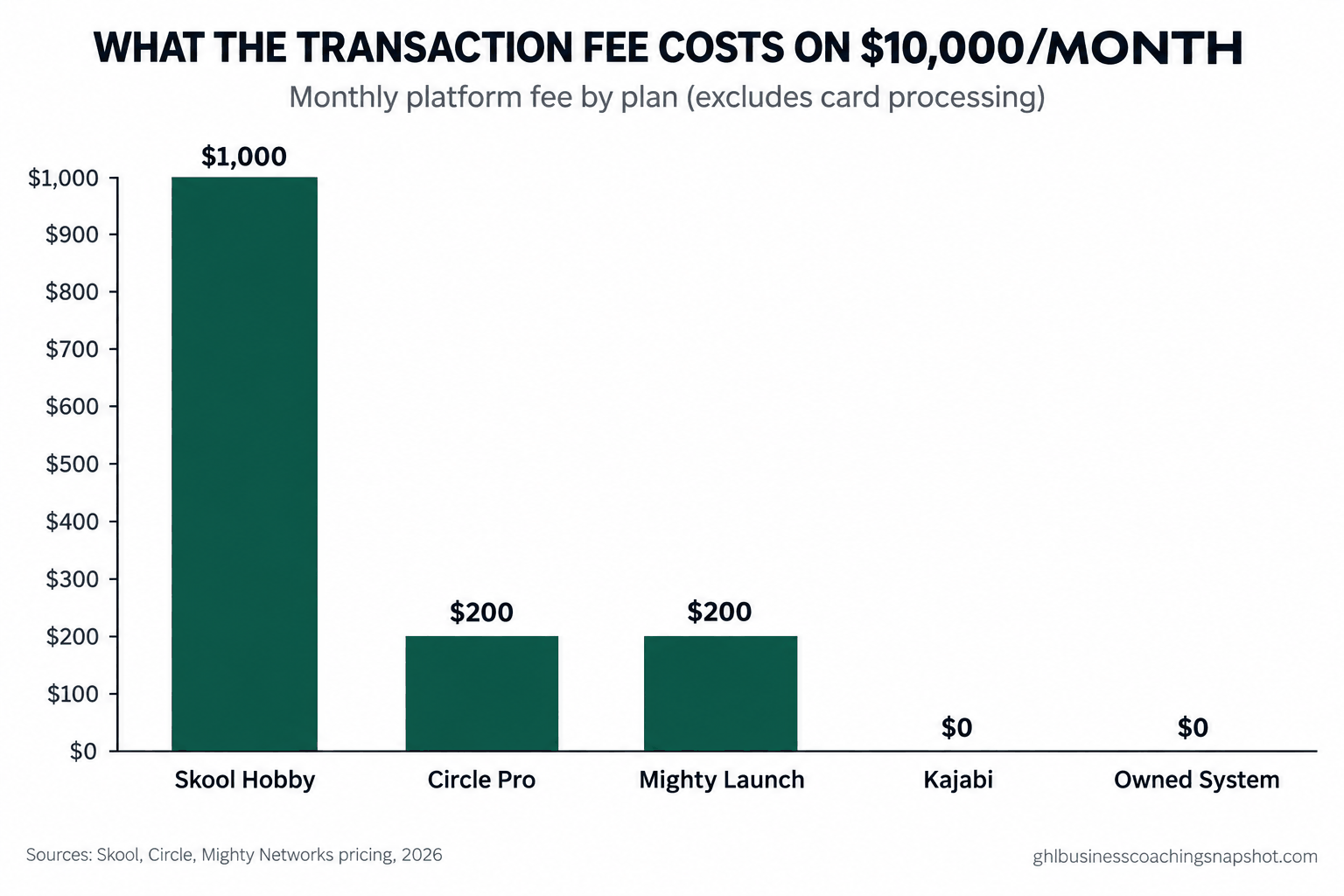
Monthly platform transaction fee on $10,000/mo in program payments, by plan (excludes Stripe’s ~2.9% + 30¢, which applies everywhere). Kajabi charges no platform fee; card processing still applies. Sources: Skool, Circle, Mighty Networks, 2026.
How it breaks: operators start on a cheap plan to save the subscription, then hand the platform far more than they saved in percentage fees. The subscription is the small number.
The CRM gap: pipeline, follow-up, and two-way SMS
This is the one none of the four community tools solves, and it is the one that decides whether your program grows. A mastermind is not just the room; it is the pipeline of applicants who want in, the discovery calls that convert them, and the follow-up that catches a member before they leave. Skool, Circle, Mighty Networks, and Kajabi have no visual sales pipeline and no native two-way SMS. So coaches bolt on a booking tool, an email tool, and sometimes a separate CRM, which is exactly the stitched stack we cost out in the true monthly cost of running a coaching business. The owned system has the pipeline and SMS built in, which is why the whole acquisition and retention loop can live in one place.
How it breaks: the community fills for the first cohort off your existing audience, then the second cohort stalls because there is no system feeding it. A community platform assumes you already have the members; it does not go get them.
Mobile app and branding
Mighty Networks is the standout here: a branded mobile app with your name on it, not the platform’s. Circle offers a branded-app path too on higher tiers. Skool has a solid app but it is Skool-branded. Kajabi has an app for its courses. For a premium mastermind where the experience is part of the price, a branded app is a genuine differentiator, and it is worth the higher tier if brand is your positioning.
How it breaks: operators pay up for a branded app that members open twice. The app matters only if your community habit is already strong; it amplifies engagement, it does not manufacture it.
Ownership, your data, and the cost of leaving
On any hosted community, your members and your ability to export and message them live on that platform’s terms. If it raises prices, changes rules, or you simply outgrow it, moving is painful and members leak in the gap. An owned all-in-one system keeps the list, the pipeline, the tags, and the message history under your control, so leaving is not a hostage situation.
How it breaks: the cheapest platform today becomes the most expensive one to leave in two years. Factor the exit before the entry.
Disclosure: the “Start GoHighLevel” link is our affiliate link. If you sign up through it we may earn a commission, at no extra cost to you. We only recommend the platform our own system is built on.
Three real scenarios: first cohort, scaling past solo, a multi-program boutique
The right answer changes with your stage. Run your own numbers, but here is how it usually shakes out.
Scenario 1: your first cohort (10 to 20 members, one program)
You have an audience and you are launching your first paid group. Your whole job right now is engagement and simplicity, not a sales machine. Skool Pro at $99/mo is the honest pick: cheap, sticky, and you will fill this cohort from your existing list, so you do not yet need a pipeline. Skip the Hobby plan the moment you are charging real money, because the 10% fee will cost you more than the $90 you save. Total realistic spend: about $99/mo plus Zoom. Do not over-buy a platform for members you do not have yet.
Scenario 2: scaling past solo (multiple cohorts, an application process, a waitlist)
Now the constraint has flipped. Filling the next cohort is the hard part, not hosting the current one. You need applications, discovery calls, a pipeline, and follow-up, and the community is only one piece. This is where a bare community tool starts costing you, because you bolt on Calendly, an email tool, and a spreadsheet CRM, and they do not talk. An owned all-in-one system (~$97 to $297/mo) running the community plus the acquisition loop usually beats the stitched stack on both cost and hours, and the applications-to-onboarding flow is what we build in coaching client onboarding. If the branded experience is central to your price point, keep Circle or Mighty Networks for the room and connect it to the CRM.
Scenario 3: a multi-program boutique (2 to 8 coaches, several programs)
Per-group and per-community pricing is now working against you. Two Skool groups are $198, three Kajabi communities need the Pro plan (~$499/mo), and every program you add on a per-seat tool raises the bill. A consolidated owned system with no per-group fee, one pipeline across programs, and shared retention automations is almost always the cheaper and saner base at this stage. For an application-screened mastermind specifically, the intake and member-retention flows are what our masterminds system and group coaching setup are built around.
Skool’s per-group cost as you add programs ($99 each). An owned all-in-one system carries any number of programs on one subscription (~$297/mo on Unlimited), so the lines cross at three programs. Sources: Skool, GoHighLevel, 2026.
Representative 2026 monthly costs by scenario. Sources: Skool, Kajabi, GoHighLevel. Confirm live prices before budgeting.
Steal this: the cohort onboarding and engagement copy
The platform is the room. This is what keeps people in it. None of the community tools sends these for you, which is the point, but you can paste them into whatever you run. Swap the brackets for your details.
Day 0, the moment they pay (SMS or DM):
“Welcome to [Program], [First name]. You are officially in. Two things right now: (1) check your email for your login, (2) reply here with the one result you want by [end date]. I read every one of these before our first call. See you inside.”
Day 1, orientation nudge (email):
“Subject: Your first 3 steps inside [Program] [First name], the members who get the most out of this all do the same three things in week one: post an intro in the community, block our call times in your calendar, and watch the 8-minute Start Here video. Here is the link. Takes 15 minutes total, and it is the difference between a great cohort and a quiet one.”
Day 3, the activation catch (SMS, only if they have not logged in):
“Hey [First name], noticed you have not been in [Program] yet. No judgment, week one is busy. Want me to send you the one video worth watching first so you are not behind for [day]’s call? Just say yes.”
Weekly engagement prompt (community post, same day each week):
“Weekly win + wall. Drop one win from this week (however small) and one thing you are stuck on. I will personally answer every ‘stuck on’ by Friday. This thread is the most valuable 5 minutes you will spend in here.”
The renewal / re-enroll message (2 weeks before the program ends):
“[First name], we are two weeks out from the end of [Program]. Before you go: you told me on day one you wanted [their day-0 goal]. Here is where you are now. If you want to keep this momentum, the next cohort opens [date] and current members hold their rate. Want me to save your seat?”
A cohort on a bare community vs a cohort on a system
Kickoff call, then silence. You find out someone left when their renewal card declines. Filling the next cohort means starting from a cold spreadsheet.
Automated day-0 to day-3 onboarding, a login-based catch for drifters, a renewal message that quotes their own goal, and a pipeline that fills the next cohort while this one runs.
The compliance line most group coaches never check
A group program has three compliance edges the platform will not guard for you. This is general information, not legal advice, so confirm your own situation.
Testimonials and results. The moment you post a member’s “I made $50k” win on your sales page, you are inside the FTC Endorsement Guides. The 2023 revision requires that testimonials showing atypical results carry a clear disclosure of the generally expected result, or be substantiated, and that any material connection (a discount, an affiliate, a free seat) is disclosed clearly and conspicuously (FTC Endorsement Guides). “Results not typical” in tiny gray text is exactly what they warn against.
Auto-renewing memberships. Here is the contrarian bit most coaching content still gets wrong. The FTC’s “click-to-cancel” Negative Option Rule was vacated in full by the Eighth Circuit on July 8, 2025, on procedural grounds, so the federal rule is not in force (Cooley analysis). That does not mean you can ignore it, because more than two dozen states, including California and New York, have their own auto-renewal laws with clear-disclosure and easy-cancel requirements, and some are stricter than the federal rule would have been. If your mastermind auto-renews, follow the strictest state your members live in.
Selling a “coach the coaches” program. If your group teaches people to make money coaching, you may cross into the FTC Business Opportunity Rule (16 CFR 437), which requires an Earnings Claim Statement when you make earnings claims (FTC Business Opportunity Rule). Any income figure you cite triggers documentation you must be able to produce.
Common objections
“Everyone I respect is on Skool, so shouldn’t I just use it?” Skool is genuinely great at the one job it does, engagement, and for a first cohort it is the right call. The mistake is assuming the tool that hosts the room also runs the business. It does not book your calls, screen applicants, or catch a member going quiet. Use Skool for the room if you love it, and put a real system behind acquisition and retention.
“Isn’t an all-in-one system overkill for a small group?” For 15 members you fill from your own audience, yes, and Skool at $99 is fine. The owned system earns its place the moment filling the next cohort is harder than hosting the current one, which is usually cohort two or three. The trigger is not member count, it is whether you have a pipeline problem.
“I already pay for Kajabi. Do I have to switch?” No. If Kajabi already hosts your courses and the community is a nice-to-have, keep it and connect the acquisition and follow-up layer to it. The GoHighLevel vs Kajabi comparison walks through exactly when switching pays off and when it does not.
“Won’t moving my community annoy my members?” Yes, which is the whole argument for choosing a platform you will not outgrow in a year. Migration churn is real, so choose for where you will be in 18 months, not where you are this week.
“Do I need to be technical to run the owned system?” No more than you needed to be to set up Kajabi. The difference is the workflows are pre-built rather than assembled. That is what the Coaching Snapshot is: the whole coaching system installed for you, so you are running it, not building it.
FAQ
What is the cheapest platform for a mastermind?
Skool's Pro plan at $99 a month per group is the cheapest capable option for a single mastermind, and its feed is the stickiest. Avoid the $9 Hobby plan once you charge real money, because its 10% transaction fee will cost more than the subscription you saved. Confirm current pricing at skool.com/pricing.
Skool vs Circle vs Mighty Networks: which is best?
Skool wins on engagement and price. Circle wins on a polished, branded member experience with built-in courses and live streaming. Mighty Networks wins if you want a branded mobile app with your own name on it. For most masterminds the deciding factor is whether daily discussion (Skool) or a premium branded experience (Circle or Mighty) matters more to your price point.
Can I run a group coaching program on GoHighLevel?
Yes. GoHighLevel (from about $97 a month) runs the community, courses, applications, booking, sales pipeline, and two-way SMS in one owned system, so you are not paying per group or renting your audience. It is the only option here with a real CRM and follow-up built in. The Coaching Snapshot installs the coaching-specific version of that build for you.
Do these platforms charge transaction fees?
Most do, on top of Stripe's roughly 2.9% plus 30 cents. Skool takes 10% on Hobby and about 2.9% on Pro. Circle adds 2% (Professional) or 1% (Business). Mighty Networks adds 2% down to 0.5% by tier. Kajabi charges no platform fee, only card processing. An owned GoHighLevel system charges no platform fee. Run the percentage at your real monthly revenue before you compare stickers.
Should I use Kajabi's community or a dedicated community tool?
If courses are the center of your program and the community is secondary, Kajabi's built-in community keeps everything in one place and avoids a second subscription. If daily discussion and engagement are the product, a dedicated tool like Skool, Circle, or Mighty Networks has the stronger feed. Match the tool to whichever job your program actually depends on.
How much does it cost to run two or more programs?
This is where per-group pricing bites. Two Skool groups cost $198 a month, and three Kajabi communities require the Pro plan at roughly $499 a month. An owned all-in-one system has no per-group or per-community fee, so multiple programs run on one subscription with one shared pipeline, which is usually the cheaper base once you pass a single program.
Will my group program comply with FTC rules on these platforms?
The platform does not handle compliance for you. You are responsible for FTC-compliant testimonials (disclose atypical results and material connections), auto-renewal disclosures (the federal click-to-cancel rule was vacated in 2025, but 25-plus state laws still apply), and an Earnings Claim Statement if you sell a coach-the-coaches program that makes income claims. This is general information, not legal advice; confirm your own situation.
Related reading: The true monthly cost of running a coaching business · GoHighLevel vs Kajabi for coaches · How to reduce coaching client churn · Coaching client onboarding · The cohort kickoff that doesn’t eat your Saturday