

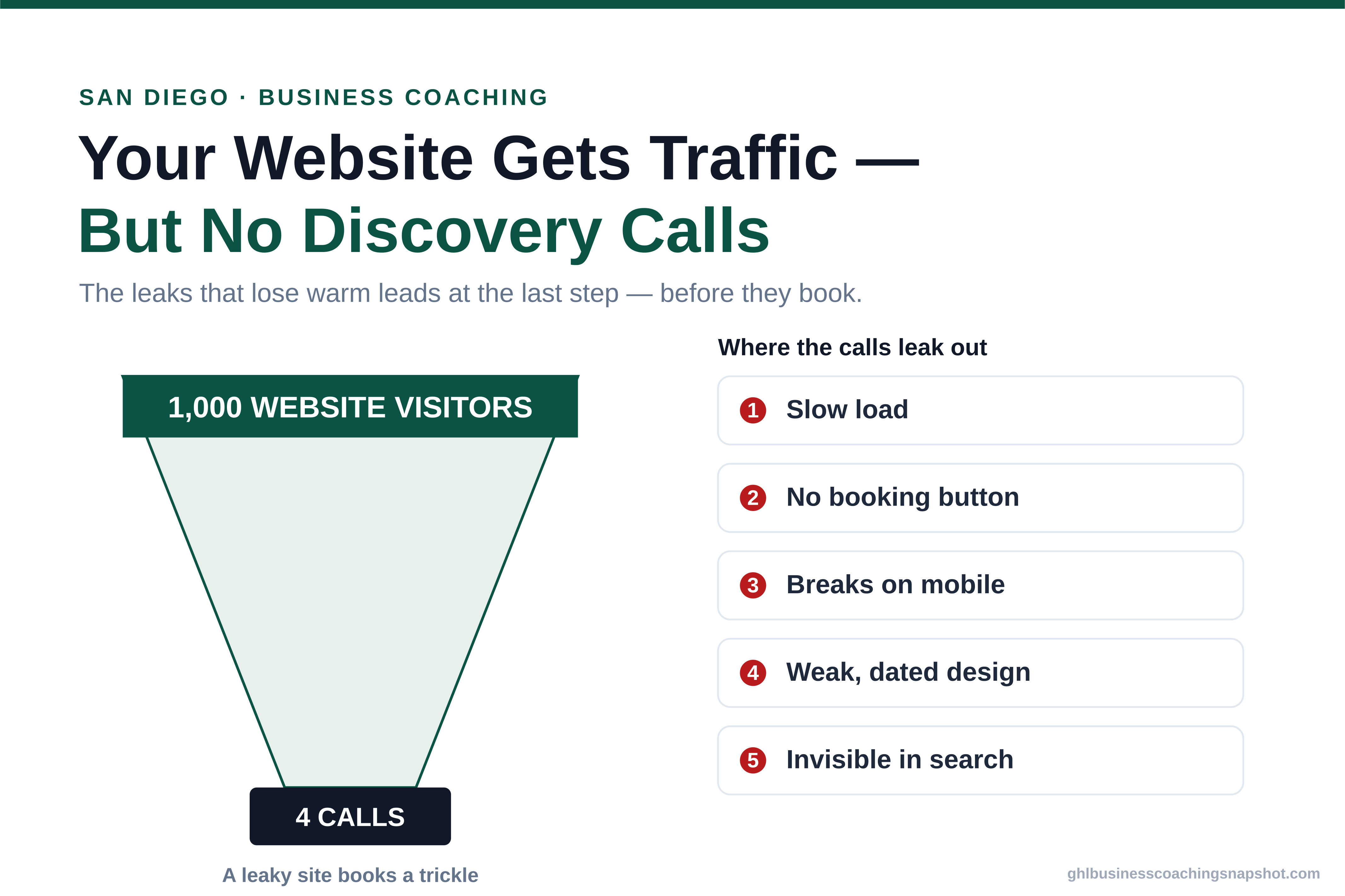
If your coaching website gets visitors but almost no discovery calls, the problem usually isn’t traffic — it’s what happens in the last ten seconds before a warm lead would have booked. A San Diego coach who gets referrals, LinkedIn clicks, and ad traffic can still end the month with an empty calendar because the site loads slowly, hides the “book a call” action, breaks on a phone, looks dated next to a $10K offer, or never shows up when someone searches. This is a pain-points guide to the five places coaching websites quietly leak booked calls, the real cost of each, and how to plug them so the traffic you already have turns into calls on your calendar.
The real problem: you’re losing leads at the last step
Here’s the pattern I see over and over with coaching practices in competitive markets like San Diego. The top of the funnel is fine. A referral sends someone to your site. A LinkedIn post lands. An ad gets a click. People are arriving. And still, at the end of the month, the discovery-call calendar has a handful of slots filled — most of them from people who already knew you.
That’s the tell. When traffic is decent but booked calls are thin, the leak isn’t awareness — it’s conversion. The visitor showed up interested and left without doing the one thing you needed them to do: book a call. Every stage between “landed on your site” and “picked a time” is a place they can drop, and on most coaching sites there are five of them.
The frustrating part is that these leaks are invisible in the way that matters. Your analytics show visits. Your inbox shows the occasional form fill. Nothing shows you the person who opened your site on their phone at 9pm, waited four seconds for it to load, and clicked back to Google to book with the next coach. You never see the miss — you just feel it as a quiet calendar.
Leak 1 — a slow site bounces the lead before they read a word
The first leak happens before your copy ever gets a chance. If the page is slow, the visitor is gone.
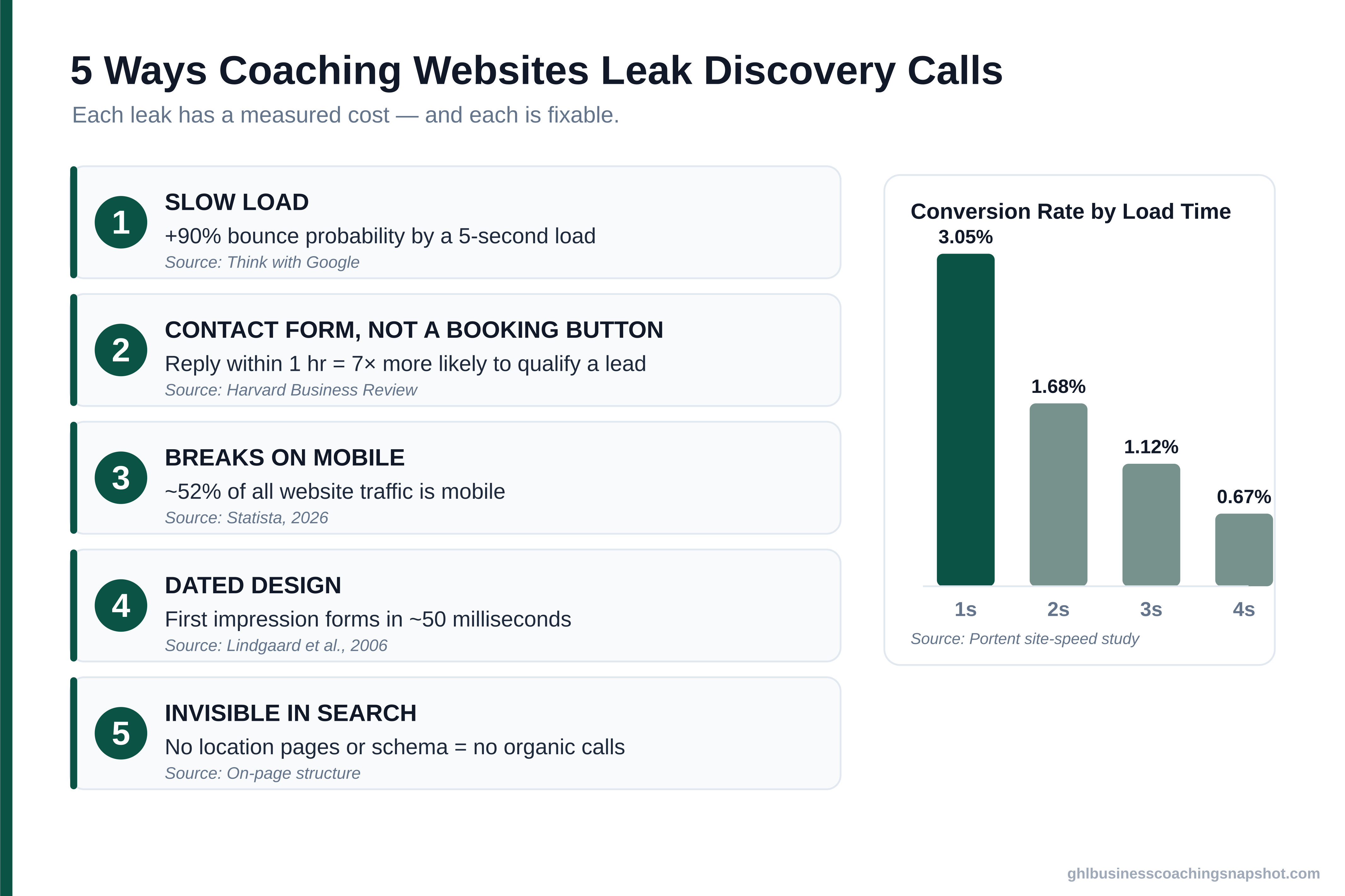
The data here is brutal and consistent. Google’s mobile benchmarks found that as page load time goes from 1 second to 3 seconds, the probability of a bounce rises 32%; from 1 to 5 seconds it rises 90% (Think with Google). And bounces are booked calls that never happen: Portent’s conversion analysis clocked the average site converting at ~3.05% with a 1-second load and just ~0.67% at 4 seconds — better than a 4× swing on speed alone (Portent).
Average website conversion rate (%) by page load time — conversions fall sharply through the first four seconds. Source: Portent, “Site Speed is (Still) Impacting Your Conversion Rate.”
It compounds at small scales, too. Deloitte’s 30-million-session study found that even a 0.1-second improvement in mobile load time lifted retail conversions 8.4% (Deloitte / web.dev). A tenth of a second. That’s how thin the margin is at the last step.
Most coaching sites are slow for the same reason: they’re built on WordPress with a stack of plugins, on a page-builder like Wix or Squarespace, or on a Kajabi/GHL page that’s carrying a lot of script overhead. It looks fine on your fast office Wi-Fi. It does not look fine to a prospect on cellular in a coffee shop. (We wrote the full speed bar in our Philadelphia page-speed breakdown — the thresholds are the same wherever you coach.)
Leak 2 — a “contact form” instead of a booking button
This is the leak that costs the most and gets the least attention. A visitor who’s ready to talk is the hardest lead to earn — they’ve already decided to reach out. Then your site asks them to fill out a “Contact us” form and wait.
Two things go wrong. First, the highest-intent visitor doesn’t want to compose a paragraph about their situation into a blank box — a lot of them just close the tab. Second, even the ones who submit are now in a race you’re losing. The form drops into an inbox; you reply in the morning; by then they’ve filled out two other coaches’ forms and booked with whoever answered first.
That race is measurable. Harvard Business Review’s classic Short Life of Online Sales Leads found firms that reached a lead within an hour were about 7× more likely to have a real conversation with a qualified decision-maker than those who waited just 60 minutes longer — and roughly 60× more likely than those who waited 24 hours. The average company took 42 hours to respond (Harvard Business Review). A static form guarantees you’re on the wrong side of that curve.
The fix is not “reply faster.” It’s to delete the wait entirely. The button on your site should open your live calendar and let a qualified visitor pick a discovery-call time now — which writes straight into your CRM, sends an instant confirmation, and drops them into your reminder sequence so no-shows fall too. For after-hours visitors who want to talk before they book, an AI chat widget can answer and book at 10pm so the lead never cools. Either way, the last step becomes an action, not a form.
9:14pm: a San Diego founder reads your 'Work With Me' page on their phone, taps 'Contact us,' sees a blank 'Tell us about your situation' box, and closes the tab. Your inbox has nothing in the morning. You never knew they were there.
9:14pm: the same founder taps 'Book a Discovery Call,' sees your real availability, and picks a 9:30am Thursday slot. It writes into your GoHighLevel calendar, fires a confirmation text, and lands in your reminder sequence. You wake up to a booked, confirmed call.
Leak 3 — the site breaks on the phone most people use
Roughly 52% of all website traffic is mobile (Statista, 2026) — and for a coach getting traffic from Instagram, LinkedIn, and text-message referrals, the mobile share is usually higher than that. Yet many coaching sites are still designed desktop-first, then “made responsive” as an afterthought.
On a phone, the afterthought shows: text you have to pinch to read, a booking button below three scrolls of hero image, a menu that covers the screen, a form field that won’t focus. Each of those is friction, and friction at the last step is a lost call. The visitor doesn’t email you to say your mobile menu is broken — they just leave.
Mobile isn’t a smaller version of your site. It’s where most of your prospects actually decide. The booking action has to be reachable with a thumb in the first screen, the page has to load fast on cellular (see Leak 1), and the whole flow — read, trust, tap, book — has to work one-handed.
Leak 4 — a dated design that undersells a premium offer
You’re selling a $5K–$50K engagement. Your website is the first and often only evidence a prospect has that you operate at that level. If it looks like a 2015 template, you’ve created a quiet mismatch between your price and your presentation — and prospects resolve that mismatch by not booking.
This isn’t vanity; it’s a documented credibility effect. Visitors form a first impression of a page’s visual appeal in as little as 50 milliseconds — faster than they read a word (Lindgaard et al., 2006). And when Stanford asked roughly 2,700 people how they judge a website’s credibility, visual design was the single most-cited factor, named by 46.1% — ahead of content and reputation (Stanford Web Credibility research). For a coach, that means a dated site is silently discounting your authority before you’ve said a word.
The good news is that “premium” doesn’t mean flashy. It means clean, fast, legible, and current — generous whitespace, clear hierarchy, real proof (client outcomes, logos, specifics), and an obvious next step. A prospect should be able to tell in a glance that you take your practice as seriously as you’ll take their business.
Leak 5 — invisible in search, so you rent traffic forever
The last leak is the one that keeps the calendar dependent on hustle. If your site has no proper location pages, weak or missing schema, and thin meta structure, then Google — and now AI answer engines like ChatGPT, Perplexity, and Google’s AI Overviews — never surface you. Someone in San Diego searches “executive coach San Diego” or asks an AI assistant to recommend one, and you’re not in the answer.
When organic search sends you nothing, every lead has to come from a referral you can’t control or an ad you have to keep paying for. That’s rented traffic. The moment you stop posting or stop spending, the pipeline stops. Coaches who do rank for their city and specialty get a compounding stream of high-intent visitors who were already looking for exactly what they offer — the cheapest discovery calls you’ll ever book. (We break down the fundamentals in SEO for business coaches.)
Getting found is a structural property of the site: fast pages, clean location pages, valid schema, and a proper sitemap/robots/llms.txt so both Google and AI crawlers can read and cite you. It’s not something you bolt on with a plugin after the fact — it’s how the site is built.
What the leaks cost a San Diego coaching practice
Put rough numbers on it. Say you get 400 visits a month from referrals, social, and a little ad spend. On a leaky site converting visitors to booked calls at, generously, 1%, that’s 4 discovery calls a month. Tighten the funnel — fast load, an instant booking button, a mobile-first layout, a site that earns trust — and a 3% booking rate is very achievable. That’s 12 calls a month from the same traffic.
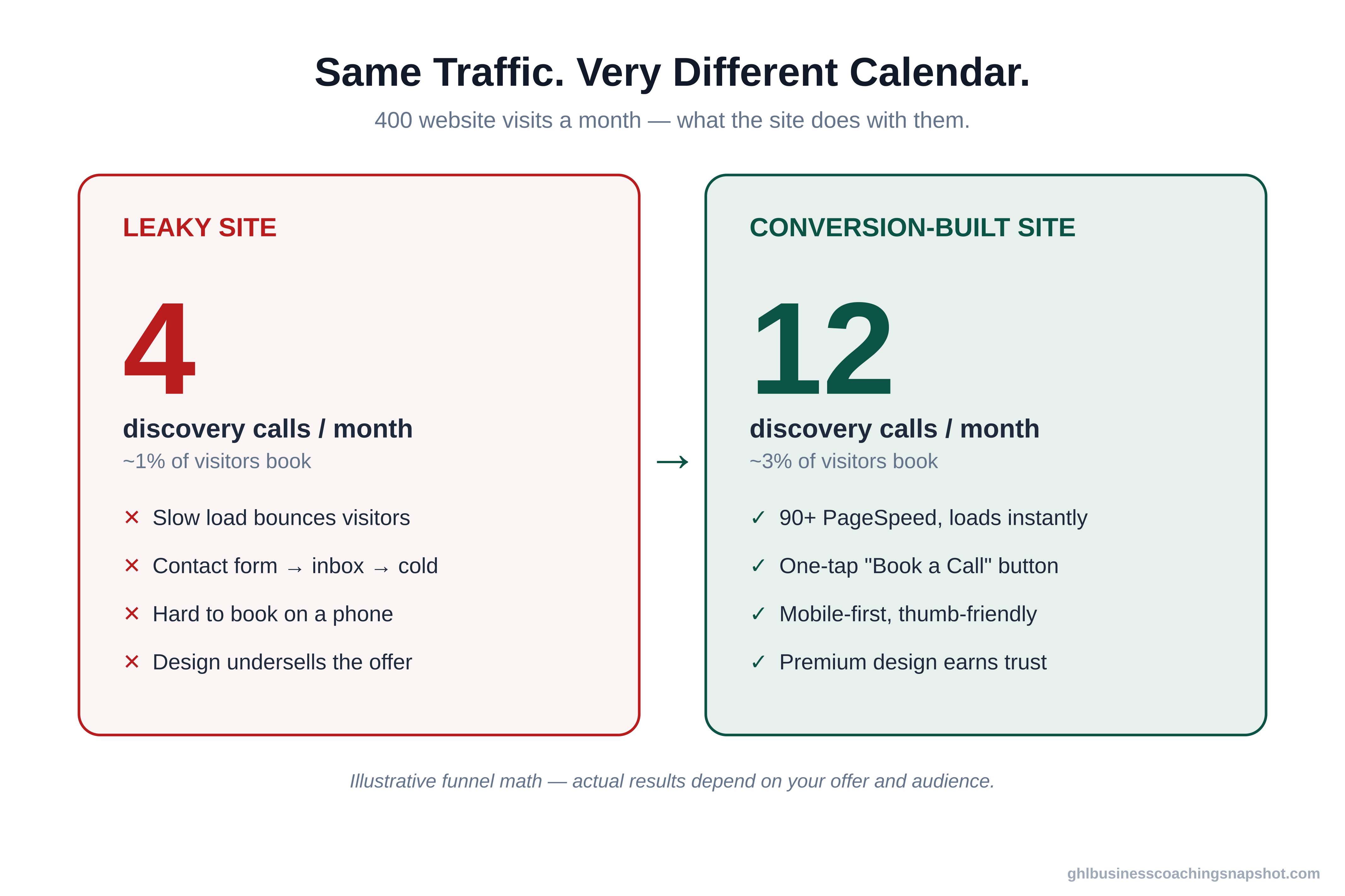
At a $10K program and even a conservative close rate on qualified discovery calls, the gap between 4 and 12 booked calls a month is the difference between a practice that feels stuck and one that’s growing — without spending an extra dollar on traffic. The leaks don’t announce themselves, but they add up to the single biggest lever most coaching practices are ignoring.
And the market is big enough that the leaks matter. U.S. business coaching is a $20.0 billion industry with 76,014 firms in 2025 (IBISWorld). In a dense, affluent coaching market like San Diego, the prospects exist and they’re comparing options. The coach whose site loads instantly, books in one tap, and looks the part wins the ones who were already interested.
The fix: a conversion-built coaching site with booking baked in
You don’t fix five leaks with five plugins. You fix them by rebuilding on a foundation that closes all of them at once. That’s the whole idea behind our coaching website service: a fast, modern, conversion-built site with your booking and follow-up wired in from day one.
Concretely, that means:
- A static-first Astro build with a guaranteed 90+ Google PageSpeed score — often a perfect 100 — so Leak 1 (speed) is closed on both mobile and desktop.
- Booking baked into every page, wired to your GoHighLevel calendar with a prebuilt booking flow and confirmations, so the last step is an instant action, not a form (Leak 2). Add an AI chatbot for after-hours visitors who want to talk first.
- Mobile-first layout where the read → trust → tap → book flow works one-handed (Leak 3).
- A clean, premium design that matches a high-ticket offer and earns trust in a glance (Leak 4).
- Location pages, schema, and a proper sitemap/robots/llms.txt so you show up in Google and AI answers for San Diego searches (Leak 5).
The pricing is deliberately simple: $497 one-time + $97/month, and you only pay the monthly up front — the build fee is charged after the site is live and you’re happy. The monthly covers managed hosting, your domain, SSL, and ongoing changes, so the site stays fast and current without surprise bills.
Why this matters more for San Diego coaches
San Diego is a strong, competitive market to coach in, and that cuts both ways. It’s dense with your buyers — founders across the biotech and startup corridor from Sorrento Valley to downtown, Navy and defense-adjacent executives, and a large small-business base that treats coaching as a normal investment. But that same density means prospects are comparing coaches, and they’re used to software that responds instantly.
Two local realities raise the stakes on conversion:
- Your prospects are on West Coast time and browse late. A San Diego founder comparing coaches at 9pm PT is often deciding when your inbox is closed — so the site itself has to do the booking, or the lead goes to whoever’s does.
- The bar for “credible” is set high. In a market this affluent and design-literate, a slow or dated site reads as “not really running a business.” Fair or not, your website is the credibility test you take before the discovery call.
You don’t need a bigger ad budget to win a San Diego coaching lead. You need to stop leaking the ones you already attract — by being the fast, obvious, trustworthy site that books the call before the prospect clicks back to Google.
Related reading
- How fast should a coaching website load? The 2026 speed bar
- Astro vs GoHighLevel websites for coaches: which should you build on?
- Speed to lead: why the first coach to respond usually wins
- An AI chat widget that books discovery calls around the clock
- Reduce discovery-call no-shows with the right reminders
Frequently asked questions
Why does my coaching website get traffic but no discovery calls?
Almost always because the site leaks leads at the last step — the moment a warm visitor should book. The five common leaks are: slow load (visitors bounce before reading), a 'Contact us' form instead of an instant booking button, a layout that breaks on mobile, a dated design that undercuts a premium offer, and no search visibility so you depend on referrals. Traffic is arriving; conversion is where it's lost.
How fast does a coaching website need to load?
Aim for under ~3 seconds on mobile, ideally 1–2. Google's benchmarks show bounce probability rises 32% as load goes from 1s to 3s and 90% by 5s, and average conversion falls from about 3.05% at 1 second to 0.67% at 4 seconds (Portent). Speed is the first leak because it happens before your copy is even read.
Is a contact form or a booking button better for a coaching site?
A booking button, almost always. A form drops into an inbox and starts a race you usually lose — firms that respond within an hour are far more likely to qualify a lead (HBR), and most don't. A booking button lets a qualified visitor pick a discovery-call time immediately, writes it to your CRM, and sends a confirmation, so the highest-intent moment becomes a booked call instead of a form fill.
Do I need a whole new website, or can I just fix my current one?
It depends where the leaks are. Booking and copy can sometimes be improved in place. But speed, mobile structure, and search visibility are usually properties of how the site was built — on a slow, plugin-heavy or page-builder foundation, patching rarely gets you to a 90+ PageSpeed or clean schema. When four of the five leaks trace back to the build, a fast rebuild is the cheaper fix over a year.
How much does a conversion-built coaching website cost?
Our coaching website is $497 one-time plus $97/month, and you only pay the monthly up front — the build fee is charged after the site is live and you're happy. The monthly covers managed hosting, domain, SSL, and ongoing changes. It's built on Astro with a guaranteed 90+ PageSpeed, GoHighLevel booking on every page, and location pages and schema so you rank in San Diego.
Will a faster, conversion-built site actually get me more clients in San Diego?
It gets more of the traffic you already have to book a call — which is where growth for most coaches actually stalls. We don't guarantee revenue or client counts; outcomes depend on your offer, audience, and how you run discovery calls. What a conversion-built site reliably fixes is the leak between 'interested visitor' and 'booked call' that a slow, form-based, dated, or invisible site creates.
About the author. Tara Iyengar is a Funnel & Client-Experience Designer based in Raleigh, NC, who designs the client-facing surface of coaching practices — application forms, masterclass funnels, accountability check-ins, and the booking flows clients actually complete. She came up writing copy for course launches before specializing in the GHL build that sits underneath them, and she is opinionated about removing every extra step between an interested visitor and a booked call. Outcome examples in this article are illustrative, not guarantees.