
Short answer: coaching clients take over your week because the line between “in your program” and “available to me whenever” was never drawn anywhere they could see it. Each leak is small, the Sunday text, the third reschedule, the “quick question” that runs an hour, and you absorb it to be nice. Added up across a roster, it is the reason you feel on call seven days a week and still behind. The fix is not learning to say no faster. It is building the boundary into the system itself, so the booking page, the autoresponder, the support tier, and the contract hold the line for you. Here is where the leaks are, stage by stage, with the exact copy you can steal and the way each part breaks.
What loose boundaries actually cost you
It is 9:40 on a Sunday night. You are finally off, and a client texts your personal cell: “Hey, so sorry to bug you, quick one.” You know you should leave it until Monday. You answer anyway, because the relationship matters and it is only a text. Twenty minutes later you are three messages deep into a coaching conversation you are not being paid for, on the one evening you had to yourself, and the client has just learned that you reply on Sundays.
That is the real cost, and it bills you in three currencies.
First, it bills you in hours you never recover. Between-session messaging, rescheduling, and “quick questions” do not show up on any invoice, but they fill the gaps in your week until there are no gaps. Small-business owners already lose a big slice of the week to admin. Ueni’s research on microbusiness owners found administrative, legal, and compliance work ate about 22.4% of their time, roughly 79% more than they spent on marketing and sales combined (Ueni). Loose client boundaries stack on top of that baseline.
Second, it bills you in focus. Every interruption carries a tax far bigger than the interruption itself. Gloria Mark’s workplace research at UC Irvine found that when people were pulled off a task, it took an average of about 23 minutes to get back to it (via Gallup). So the client “quick question” that feels like ninety seconds actually costs you the ninety seconds plus the twenty-three minutes it takes to re-enter whatever you were doing. Ten of those in a day and your deep work, your prep, your selling, is gone.
Third, it bills you in resentment, which is the one that ends the relationship. The coach who is quietly furious at a client for over-texting does worse coaching, dreads the session, and eventually either blows up or lets the client churn. Weak boundaries do not protect the relationship. They poison it slowly.
Sources: Ueni microbusiness time-use research; UC Irvine (Gloria Mark) via Gallup; ICF 2025 Global Coaching Study (Executive Summary).
Here is where a typical coaching week actually goes. The sessions, the part you are paid for, are rarely even half of it. The rest is the unbilled surface area where boundaries leak.
Illustrative: hours per week for a solo coach with a full 1:1 roster. Billed session time (14 hours) is less than half the working week. Messaging, scheduling, and admin, the boundary-leak categories, quietly eat the rest.
Why willpower keeps failing (and systems don’t)
Most advice on this tells you to “set stronger boundaries,” which in practice means saying no in the moment, over and over, to people you like and depend on for income. That fails for the same reason every willpower plan fails. The decision lands on you at the worst possible time, when you are tired, when the client is apologetic, when it is “just this once.” You are the bottleneck and the enforcer, and you are outnumbered by a whole roster of reasonable requests.
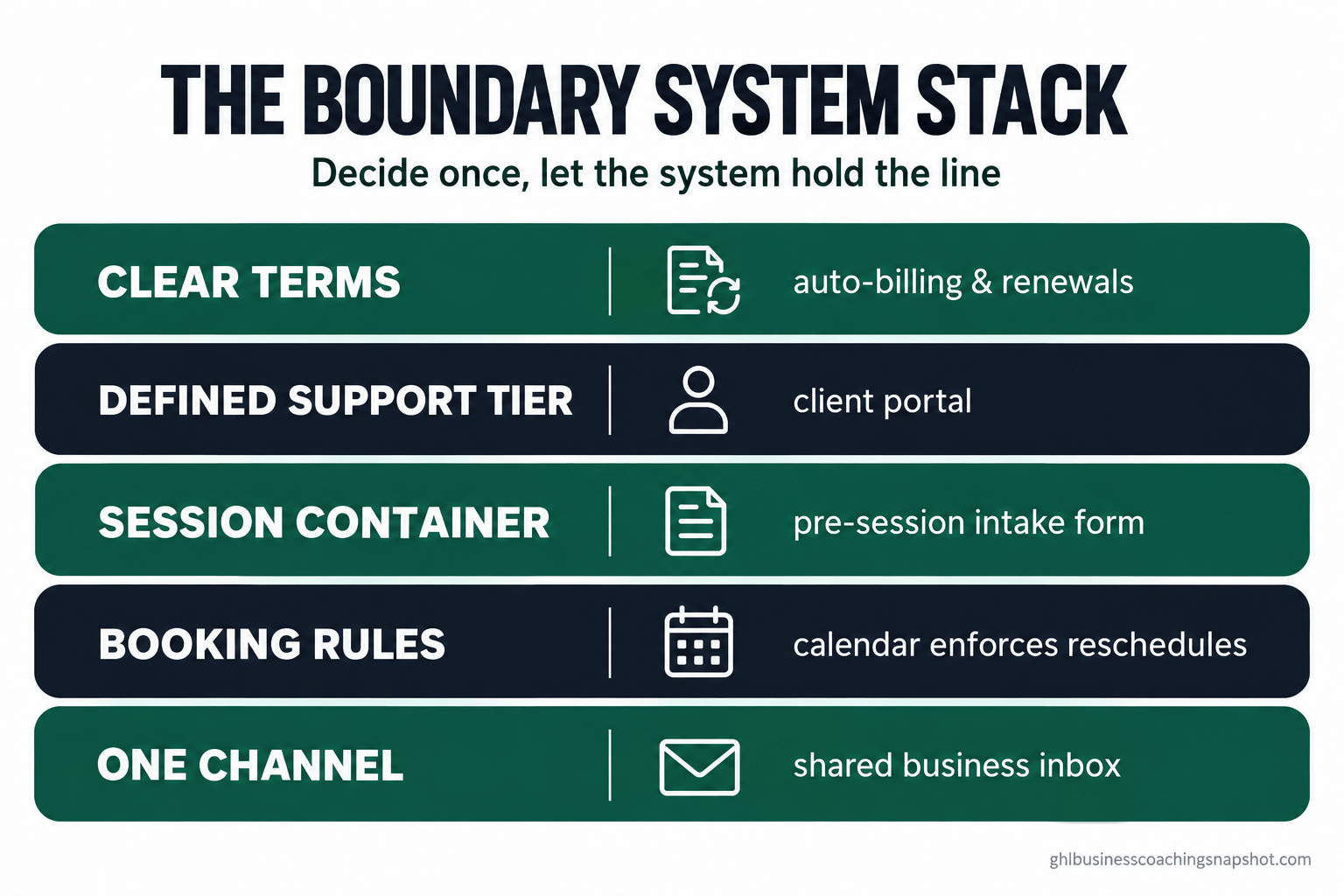
A system moves the decision upstream, to a calm moment, and then holds it automatically. You decide once, when you are rested, that reschedules close 24 hours out. Then the booking page enforces it, every time, with no text from you and no awkward conversation. The client runs into the rule, not into you. That is the whole move: stop being the wall, and build the wall.
This is also why “automation feels cold” gets it backwards for coaching. The cold version is you, exhausted, snapping at a client for the fourth reschedule. The warm version is a clear, friendly policy they agreed to on day one, enforced by a calendar that never gets annoyed. Automation here keeps you present and generous inside the relationship, because you are not quietly keeping score.
The five places boundaries leak
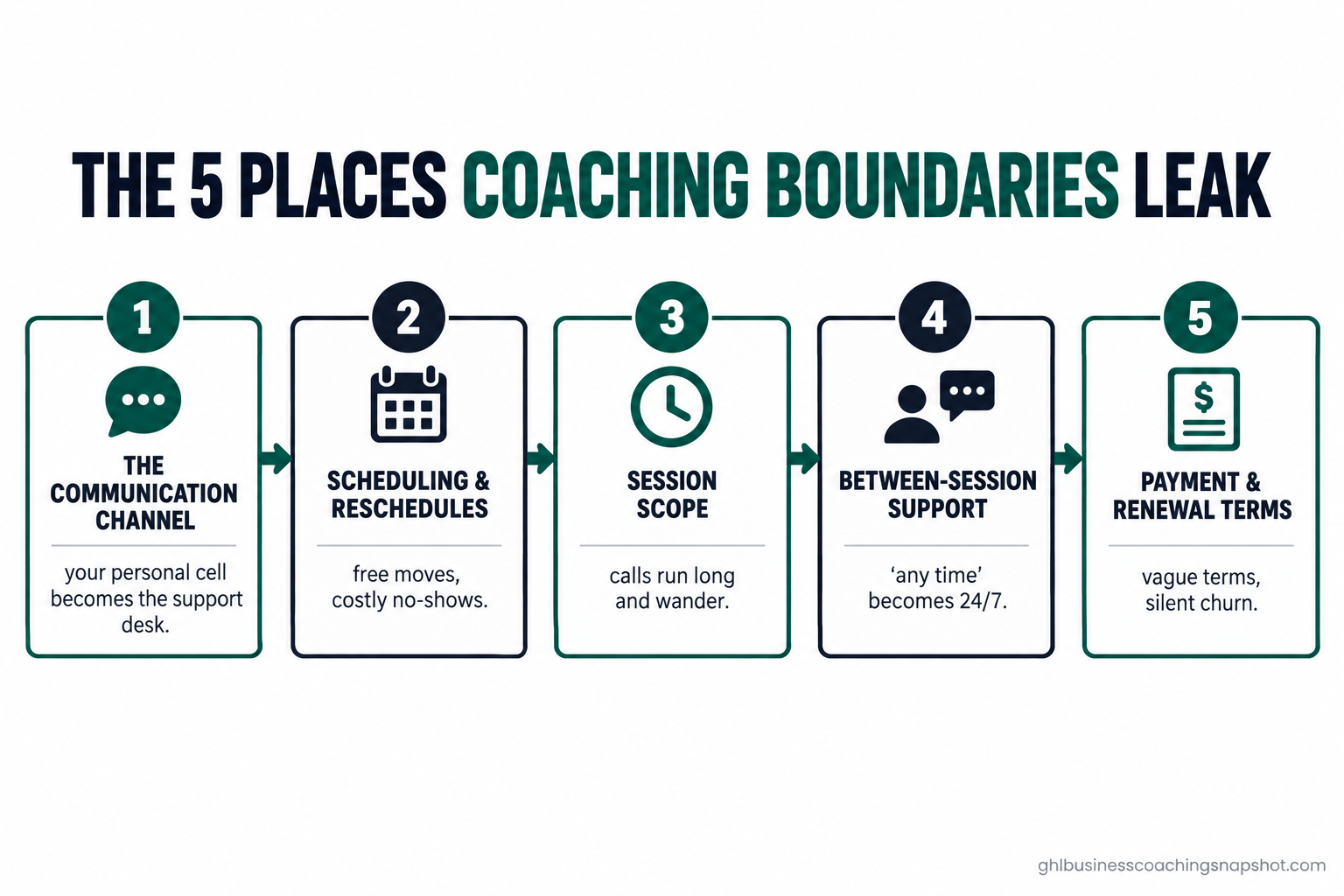
Across coaching practices, scope creep almost always enters through the same five doors. Close them in order. You do not need all five on day one, but you do need to know which one is bleeding the most for you right now.
- The communication channel. Your personal cell or DMs become the support desk.
- Scheduling and reschedules. Clients move sessions freely, and no-shows cost you nothing to them.
- Session scope. Sessions run long and wander off the thing they are for.
- Between-session support. “I’m here if you need anything” becomes 24/7, unpaid.
- Payment and renewal terms. Vague terms mean awkward money conversations and silent churn.
Leak 1: The communication channel
The first thing that goes is your personal phone number. You give it to a new client “in case anything comes up,” and within a month three clients are texting you across three threads, mixed in with your dentist and your group chat, with no record and no off switch. There is no boundary because there is no edge to the channel. A text can arrive any time, and you see it the moment it does.
The fix is to decide where client contact lives and route everything there. One channel, with hours attached, separate from your personal phone. In a CRM like GoHighLevel that means a dedicated business number and inbox, so every client message lands in one place, attached to the client’s record, visible to you on your schedule rather than buzzing your pocket at dinner. Outside your hours, an autoresponder answers instantly with when you will reply and where to go if it is truly urgent. The client gets a fast, warm response. You get your evening.
How it breaks. You set up the channel but keep handing out your cell “for the ones I really like,” and the exception becomes the rule again. Stop giving the number out at all; the business channel is the number. The second failure is an autoresponder that reads like a corporate ticket (“Your inquiry has been received”). Write it like you texting back, warm and human, just not right now. The third is having the channel but still checking it at 11pm, which trains clients that you are always on. Turn off the after-hours notifications so the system can do its job.
Leak 2: Scheduling and reschedules
The second leak is the calendar. A client reschedules twice, then a third time, and you keep absorbing it because each individual move seems fine. But a roster of serial reschedulers turns your week into a moving target you can never plan around, and no-shows cost you a prepped, held hour you can never resell. The problem is that moving a session is free and frictionless for the client and expensive for you.
The fix is a booking page with rules baked in. Reschedules and cancellations close a set window before the session, say 24 hours. Inside that window the slot is gone, same as if they had attended. A short cancellation policy sits right on the booking page, so nobody is surprised. Automated reminders go out the day before and the morning of, which cuts no-shows without you chasing anyone. We go deeper on this in reducing discovery-call no-shows, and the same mechanics protect your paid sessions.
How it breaks. You write the 24-hour policy but then wave it off every time someone asks nicely, so it means nothing. Enforce it kindly and consistently, or do not have it. The second failure is making reschedules impossible, which is its own problem, because life happens and a rigid coach loses good clients. Give each client a reasonable number of free moves, then the policy applies. The third is reminders that are easy to ignore; a reminder that asks for a one-tap “yes, I’ll be there” confirmation performs far better than a one-way “see you tomorrow.”
Leak 3: Session scope and overruns
The third leak happens inside the session. The 60-minute call runs to 80 because you did not want to cut off a breakthrough. Lovely once. A habit, and you have quietly re-priced your time down by a third and blown up the rest of your day, because the overrun eats the buffer you needed before the next client. Worse, the session wanders, because there is no agenda, so you spend the first fifteen minutes figuring out what you are even working on.
The fix is a container. A short pre-session intake form, sent automatically a day before, asks the client what they want from the call and what has happened since last time. You walk in with a focus already set, so no time is burned finding one. The session has a hard stop that you hold, with the next client’s buffer protected on your calendar. If something big surfaces at minute 55, you name it and book it into the next session rather than running 30 over.
How it breaks. You add the intake form but do not read it before the call, so it is just homework the client resents. Read it; it is the whole point. The second failure is treating the hard stop as rude. It is not. Ending on time is a kindness to the next client and to you, and clients respect a coach who runs a tight, valuable hour. The third is letting the intake form get long. Two or three questions, every time. A form nobody fills out protects nothing.
Leak 4: Between-session support
This is the big one for premium coaches. You tell a new client “reach out any time, I’m here for you,” because it closes the sale. Then you discover “any time” is a promise you cannot keep across a full roster, and either you burn out trying or you go quiet and the client feels abandoned. Between-session support was never defined, so the client’s expectation and your capacity were never the same number.
The fix is to define the support tier and deliver it through something other than your personal attention on demand. Decide what is actually included between calls: a certain number of async messages, a 24-hour weekday response time, a weekly check-in, whatever fits your offer and price. Then deliver it in a place with structure. A client portal or a dedicated async channel, where questions queue and you answer them in a batch during a set block, beats a live text thread that pulls you out of your day. A scheduled check-in cadence does the “I’m thinking about you” work without you being on call. We cover that cadence in accountability check-ins without being creepy, and the retention payoff in how to track coaching client progress.
How it breaks. You define the tier but never say it out loud, so clients still assume 24/7 access. Put it in writing at onboarding, in plain language. The second failure is answering async messages the instant they arrive, which just recreates the always-on problem through a nicer app. Batch them. The third is defining support so thin that the offer feels stingy. The point is not to give less; it is to give a known amount, reliably, instead of an unknown amount, resentfully.
Leak 5: Payment and renewal terms
The last leak is money, and it is where loose boundaries turn into lost revenue. Vague terms mean every renewal is an awkward conversation, every failed card is a thing you have to notice and chase, and clients who want to leave just go quiet, so you keep a slot open for someone who is already gone. Unclear money terms are the same disease as the rest: the expectations were never set, so you are stuck enforcing them by hand.
The fix is terms that are clear up front and billing that runs itself. The engagement length, what renewal looks like, and how to cancel are all written down and agreed before the first session. Recurring payments run on autopilot, and a failed-payment sequence recovers the declined card without you playing debt collector mid-week. Renewal is a scheduled conversation on your calendar, not a thing you remember in a panic the day a term ends. We lay out the money machinery in retainer billing recovery and the paperwork in the coaching client agreement template.
How it breaks. You automate the billing but leave the terms vague, so clients are surprised by a renewal charge and you get a chargeback. Clear terms first, then automate. The second failure is a dunning sequence that sounds like a collections agency; keep it warm, because most failed cards are expiries, not deadbeats. The third is never scheduling the renewal conversation, so clients drift out at the term end instead of re-committing. Put it on the calendar a few weeks before every term closes.
Illustrative: hours of protected, uninterrupted time a solo coach gets back per week as each boundary system comes online. The gains compound, because every closed leak also removes the refocus tax the interruptions used to carry.
Steal this: the boundary copy that doesn’t sound cold
The reason coaches avoid boundaries is they imagine them as cold. They are not, if you write them as a warm, clear description of how good coaching works. Here is the actual copy you can adapt. Say it once at onboarding, put it in writing, and let the system carry it from there.
Notice what these have in common. None of them say no. They say here is how yes works. The boundary is framed as the thing that makes the coaching good, which is true, and the client agreed to it before there was ever a conflict. That is the difference between a boundary and a fight.
A coaching week, before and after the boundary systems
Clients text your cell at all hours. You answer, because it's only a text. Sessions run 20 minutes over. Reschedules land whenever. 'Reach out any time' turned into always-on. Renewals are awkward and some clients just vanish. You feel on call seven days a week.
One channel, with an autoresponder holding your off-hours. Sessions start focused from the intake form and end on time. The booking page enforces the 24-hour rule for you. Between-session support is a known amount, delivered in batches. Billing and renewals run on rails. You're fully present in sessions and genuinely off after them.
Three versions: solo, cohort, boutique
The five leaks are universal, but which one bleeds most depends on how you run.
Solo coach, 1:1 retainers. Your risk is the personal relationship bleeding into personal time, because the bond is close and the client has your number. Leak 1 (the channel) and Leak 4 (between-session support) are your priorities. Get client contact off your cell and into one channel with hours, and define the support tier out loud before the first session. You are the whole business, so an hour of protected focus you win back is worth more to you than to anyone. This matters most in your first dozen clients, when the temptation to over-give to keep everyone happy is strongest.
Group or cohort operator. Your risk is the many-to-one flood. Thirty cohort members all texting one coach is a different scale of problem, and it does not respond to individual willpower at all. Your priorities are Leak 1 and Leak 3: one structured channel for the whole group, usually a portal or community space rather than DMs, and a tight session container so a live group call does not get hijacked by one person’s edge case. Define what is group support and what is a paid 1:1 upgrade, so the line between the two is clear. See moving from 1:1 to group coaching for the operating model underneath this.
Boutique, 2 to 8 coaches, fractional retainers. Your risk is inconsistency. One coach answers texts at midnight, another enforces every rule, and clients learn to route around whoever is softest. Here the boundary has to live in the shared system, not in each coach’s personality, so the booking rules, the support tiers, and the terms are identical across the team and enforced by the same CRM. Leak 5 (payment and renewal terms) matters most, because a boutique’s revenue depends on clean, consistent billing nobody has to think about. The system becomes the standard that every coach and every client runs on.
Which leak to close first, by stage of practice
| Plan | Solo (1:1) | Cohort / group recommended | Boutique (2-8) |
|---|---|---|---|
| Price | First dozen clients | Scaling past solo | Fractional retainers |
| Feature 1 | Priority: channel + support tier | Priority: one channel + session container | Priority: consistent terms + billing |
| Feature 2 | Get contact off your personal cell | Portal or community, not DMs | Boundaries live in the system, not the person |
| Feature 3 | Define between-session support out loud | Split group support from paid 1:1 | Identical rules across every coach |
| Feature 4 | Protect focus time, it's your scarcest asset | Tight agendas so calls stay on track | Clean renewals the team never chases |
| See the Snapshot | Book a walkthrough | Compare plans |
The compliance line on automated contact and renewals
Two of these fixes touch rules you should get right, because the boundary systems send automated messages and bill recurring money.
Consent for automated texts. The moment your reminders, check-ins, and autoresponders go out by SMS, you are in TCPA territory. Automated or mass texts need prior express consent, captured with a clear opt-in at the point the client gives you their number, and every message needs an easy opt-out. For a one-to-one reply inside an existing paid relationship this is usually straightforward, but the enrollment form that kicks off your sequences should carry the consent checkbox. We keep a plain-English version in A2P 10DLC for coaches.
Renewal and cancellation terms. If you bill retainers that auto-renew, the terms are a legal boundary, not just a courtesy. The federal “click-to-cancel” Negative Option Rule was vacated by the 8th Circuit in July 2025 and is not in force, despite a lot of coaching content still saying it is coming. That does not let you off the hook, because more than two dozen states have their own auto-renewal laws, and some are stricter than the vacated federal rule. Make renewal terms clear up front and cancellation genuinely easy, everywhere, regardless.
Testimonials, if your boundaries page shows results. If you market the calm, well-run version of your practice with client results, the FTC’s 2023 Endorsement Guides require a clear statement of what clients can generally expect, or substantiation, plus disclosure of any material connection (FTC). The full rundown is in FTC rules for coaches. None of this is legal advice; check your own state.
Common objections
“Won’t boundaries make me seem cold and cost me clients?” The opposite, almost always. Clients do not leave coaches who run a clear, calm practice; they leave coaches who are flaky, resentful, or burned out, which is exactly what loose boundaries produce. A client who knows your response time and your reschedule rule trusts you more, not less, because you are predictable. The cold coach is the exhausted one, not the organized one.
“My clients pay premium rates. They expect access.” Premium does not mean unlimited, it means excellent and reliable. A client paying $5,000 a quarter is buying your best thinking and a result, not the right to interrupt your dinner. In fact, high-ticket clients tend to respect clear boundaries more, because they run their own businesses on them. Define a generous, specific support tier and deliver it flawlessly. That reads as premium. “Text me whenever” reads as amateur.
“Automating this feels impersonal for a relationship business.” The coaching is the relationship, and none of this automates the coaching. It automates the plumbing around it: the reminder, the booking rule, the after-hours reply, the billing. You do those things badly when you are tired and on call, so handing them to a system makes the human parts better, not worse. A rested coach who is fully present for the session beats an always-on coach who is half-there for everything.
“I’m afraid to enforce a cancellation policy and lose someone.” Enforce it warmly and you rarely lose anyone good. The clients a fair policy drives away are the ones who cost you the most: the serial reschedulers who never valued the time. If the rule keeps slipping, it is usually because it is stitched across five tools that do not talk to each other; see the disconnected coaching tools problem.
FAQ
How do I set boundaries with coaching clients without sounding cold?
Frame every boundary as how yes works, not as a no. Instead of 'I don't answer texts at night,' say 'I reply within one business day so you get my best thinking, not a rushed answer.' Say it once at onboarding, put it in writing, and let a system (an autoresponder, a booking rule, a defined support tier) enforce it so you never have to say no in the moment. A clear, calm boundary reads as professional, not cold.
What is scope creep in coaching, exactly?
It is the slow expansion of what a client expects beyond what they're paying for: the 10pm texts, the sessions that run long, the extra deliverables, the 'quick questions' between calls. Each instance is small, so you absorb it to be nice, but across a roster it adds up to a practice where you feel on call constantly and are effectively working for free a chunk of every week. It happens because the line between 'in the program' and 'available anytime' was never drawn where the client could see it.
Should I give coaching clients my personal phone number?
No. Route client contact to one dedicated business channel with hours attached, separate from your personal phone, ideally inside a CRM so every message is logged against the client's record. An after-hours autoresponder gives them a fast, warm reply without putting you on call at dinner. Handing out your cell feels generous on day one and becomes an always-on support desk by week four.
How do I stop coaching clients from constantly rescheduling?
Put the rule in the booking page, not in your willpower. Set reschedules and cancellations to close a fixed window (commonly 24 hours) before the session, show a short cancellation policy right on the page, and give each client a reasonable number of free moves before it applies. Automated reminders with a one-tap confirmation cut no-shows further. The client runs into the rule, so you never have to have the awkward conversation.
How much between-session support should a coaching package include?
Whatever you can deliver reliably across your full roster, defined as a specific amount rather than 'any time.' That might be a set number of async messages, a one-business-day response time, or a weekly check-in. The exact number matters less than that it is known, written down at onboarding, and delivered through something structured (a portal or batched async channel) instead of a live text thread that pulls you out of your day.
Can GoHighLevel enforce these boundaries automatically?
Yes, that's the point of running them through a CRM. A dedicated business number and inbox contain the channel, the calendar enforces reschedule and cancellation rules, an intake form sets the session focus, a client portal houses between-session support, and recurring billing with failed-payment recovery handles the money. You decide each rule once, in a calm moment, and the system holds it every time without you being the enforcer.
It is 9:40 on a Sunday night again, a quarter later. A client texts the business channel with a quick one. This time the autoresponder replies in two seconds, warm and clear: offline now, back to you first thing Monday, and here is your booking link if it is about a time. You see none of it, because the notifications are off and you are having dinner. Monday morning you answer properly, in your support block, with your full attention. The client got a faster reply than your old frazzled self ever managed, and you got your evening back. That is what a boundary is when you stop carrying it yourself and let the system hold the line.