

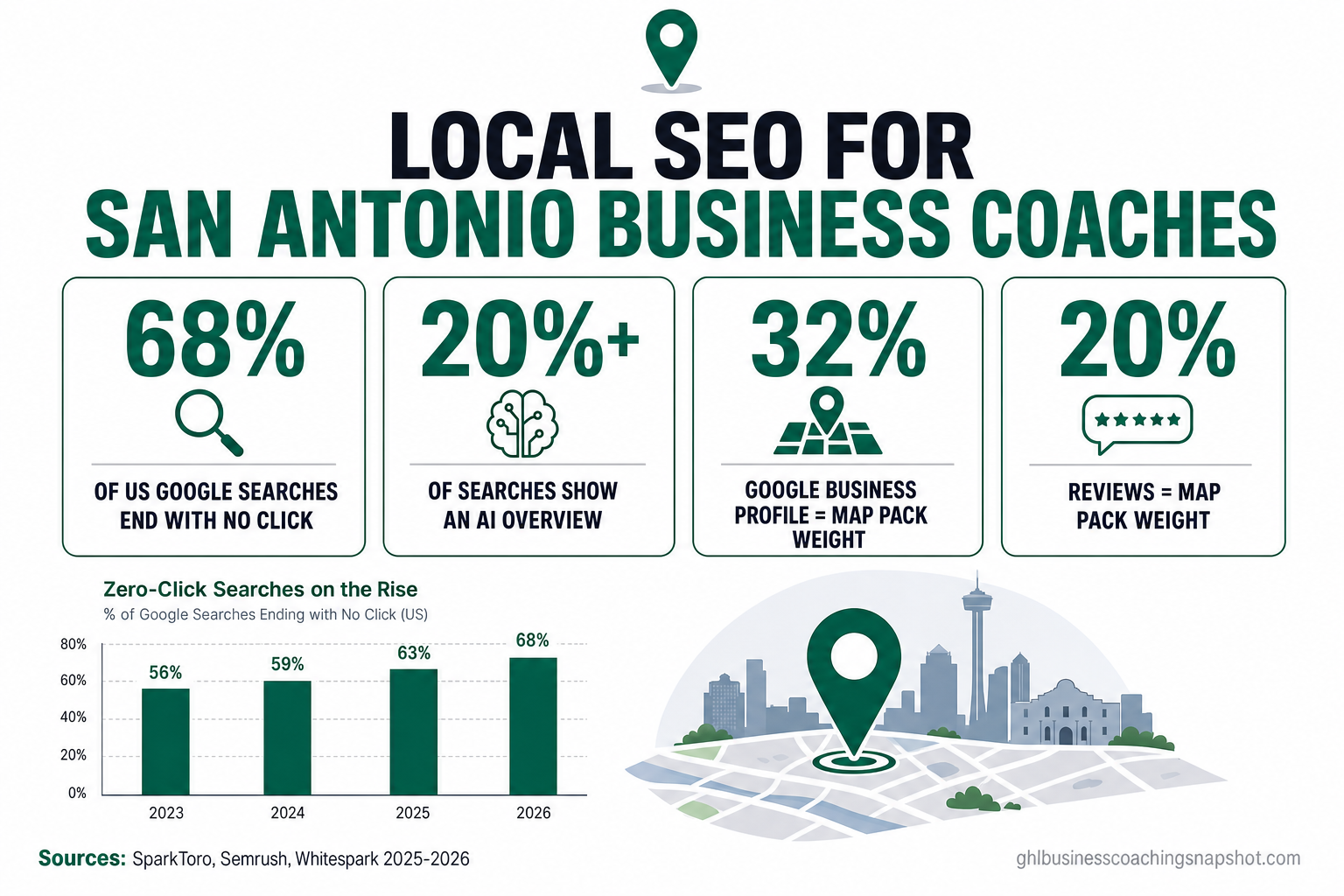
To rank a San Antonio coaching practice in Google’s Map Pack and get quoted by AI Overviews, you need three things working together: a fully optimized Google Business Profile, a fast website with San Antonio location pages and correct schema, and a steady stream of recent reviews. That’s the short version. The longer version matters, because the search page a San Antonio founder sees in 2026 barely resembles the one from three years ago — the ten blue links have been pushed below an AI-generated answer, a Map Pack, and a wall of “People also ask” boxes. This is a how-to guide for winning the part of that page that still sends coaches clients.
Why local search changed for San Antonio coaches
For years, the local-SEO advice for a coach was simple: get on Google, collect a few reviews, wait for the phone to ring. That advice is now half-true and getting more dangerous by the quarter, because the search results page has quietly reorganized itself around answers, not links.
Start with the number that reframes everything: in the first months of 2026, roughly 68% of US Google searches ended without a click to any website — up from about 60% in 2024 (SparkToro, analyzing Similarweb clickstream data). People are getting their answer on the results page itself and moving on. A big driver is AI Overviews — Google’s AI-generated summary that now appears on more than 20% of searches, and when it shows, click-through rates to the links below it fall by nearly 60% (Search Engine Land). A randomized field experiment put the causal effect at roughly a 38% reduction in organic clicks on queries where an AI Overview appeared (Search Engine Journal, reporting Agarwal & Sen).
This isn’t a fringe behavior. Pew Research found that 60% of US adults read the AI-generated summary at the top of search results, and 49% now use AI chatbots — up from 33% in 2024 (Pew Research Center). Increasingly, the first place a San Antonio founder hears your name is inside an answer written by a machine, not in a list of links they scroll.
Sources: SparkToro/Similarweb, Search Engine Land, Pew Research Center, Search Engine Journal.
Here’s why none of this is a reason for a coach to give up on search — quite the opposite. AI Overviews are less common on the searches that matter most to you. The prevalence of AI Overviews climbed through 2025, spiked mid-year, then settled: Semrush’s analysis of 10M+ keywords found they appeared on about 6.5% of queries in January 2025, peaked near 24.6% in July, and stabilized around 15.7% by November (Semrush AI Overviews Study). And crucially, Google leans away from AI Overviews on high-intent local and commercial queries — the “business coach near me” and “executive coach San Antonio” searches — because those are exactly where it still shows the Map Pack. That local three-pack sits at the top of the page and takes its own healthy share of the remaining clicks.
Share of Google queries showing an AI Overview across 2025 (percent of 10M+ tracked keywords). Prevalence peaked mid-year, then stabilized. Source: Semrush AI Overviews Study.
So the game has two boards now. Board one is the Map Pack — win it and you capture high-intent local searchers before they ever scroll. Board two is the AI answer — structure your site so ChatGPT, Perplexity, and Google’s AI Overview can read it, quote it, and name you when someone asks for a recommendation. The good news for coaches: the same foundational work wins both.
Why San Antonio is a market worth ranking in
San Antonio is not a sleepy market you can dominate with a half-finished profile. It was the fourth fastest-growing city in the United States by numeric growth, adding roughly 23,900 residents in a single year according to the latest Census estimates (U.S. Census Bureau QuickFacts). The regional economy has kept pace — the Federal Reserve Bank of Dallas reported the San Antonio Business-Cycle Index rising at a 7.2% annualized rate in spring 2025, with payrolls expanding (Dallas Fed, San Antonio Economic Indicators). Bexar County counts roughly 53,000 small businesses in the metro core (Bexar County).
Translate that into your pipeline: more founders, more executives, more sales leaders — and more coaches chasing them. Business coaching is a ~$20 billion US industry with roughly 76,000 coaching enterprises and rising (IBISWorld). Density means choice, and choice means the tiebreaker is visibility. When a San Antonio founder searches “executive coach near me” — or asks ChatGPT “who’s a good business coach in San Antonio?” — the coach who shows up in the Map Pack and gets named in the AI answer wins the introduction. Everyone else is invisible at the exact moment a five-figure buyer is deciding.
That’s the difference between local SEO for a coach and generic SEO for business coaches: national SEO chases broad keywords; local SEO and AEO chase the specific, in-market searcher in your city at the moment of intent. For a practice selling $5K–$50K engagements, a handful of those searchers a month is a transformed year.
Local SEO vs. AEO: what a coach actually needs to win
Two acronyms, one goal. Here’s the plain-English version:
- Local SEO (search engine optimization) is how you rank in Google’s local results — the Map Pack (the three businesses shown with a map), Google Maps itself, and localized organic listings. It’s driven by your Google Business Profile, your reviews, your website’s location relevance, and local citations.
- AEO (answer engine optimization) — sometimes called GEO, generative engine optimization — is how you get cited and named by AI answer engines: Google’s AI Overviews, ChatGPT, Perplexity, and Copilot. It’s driven by clear, answer-first content, structured data (schema), and a site AI crawlers can actually read.
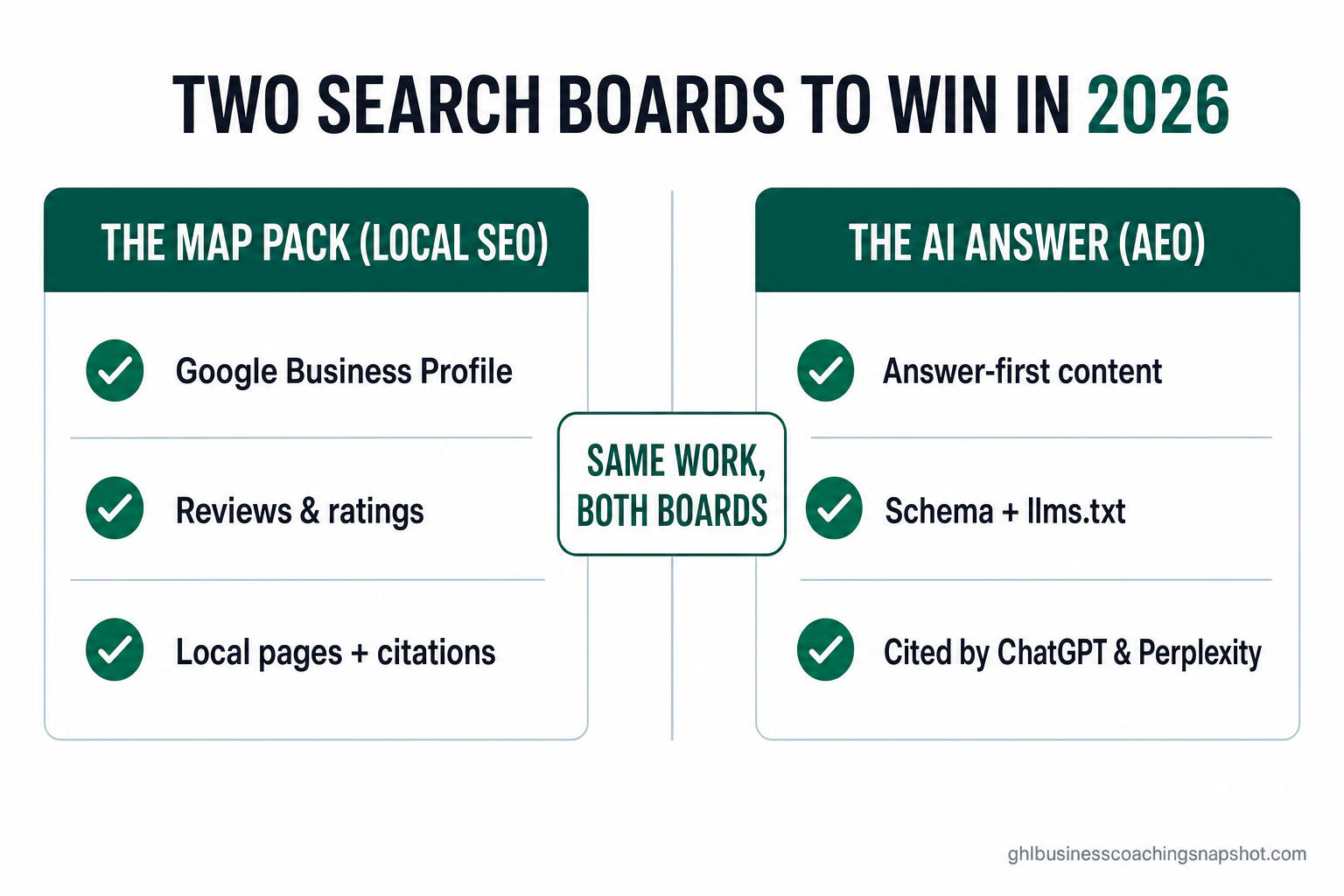
They overlap more than they compete. An answer-first FAQ that helps you win a “People also ask” box is the same content an AI Overview pulls from. The schema that helps Google understand you serve San Antonio is the same signal that helps Perplexity cite you. Reviews that lift your Map Pack rank are the same social proof an AI weighs when it decides which coach to recommend. Do the work once; it pays on both boards.
The San Antonio local-SEO playbook (step by step)
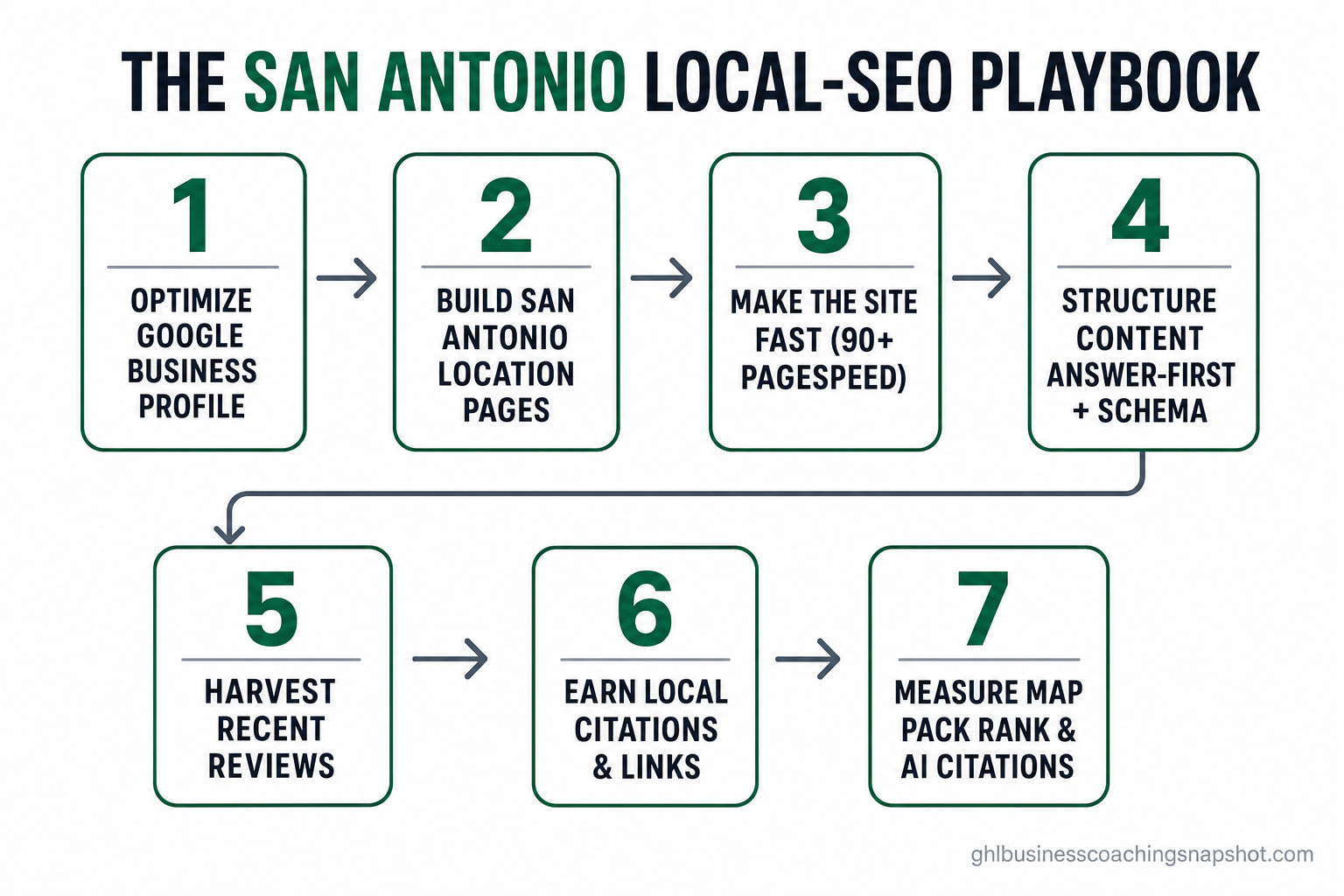
This is the sequence I’d run for a San Antonio coaching practice, in priority order. You don’t need all seven live in week one — but you do need them in this order, because each one makes the next more effective.
Step 1 — Fully optimize your Google Business Profile
Your Google Business Profile (GBP) is the single biggest local lever: profile signals make up roughly 32% of Map Pack ranking weight (Whitespark). Claim it, verify it, and complete every field. For a coach, that means: the correct primary category (Business Management Consultant, Business Coach, or Life Coach as fits your offer), a service-area set to San Antonio and the neighborhoods you serve (Alamo Heights, Stone Oak, the Pearl, downtown), your real hours, a keyword-honest business description, and photos of you actually working — not stock. Add your services with descriptions, turn on messaging, and post updates regularly. An incomplete profile is the most common reason a good coach never appears in the pack.
Step 2 — Build San Antonio location and service pages
Google can’t rank you for “San Antonio” if your website never convincingly says San Antonio. On-page and website signals are about 19% of local ranking weight (Whitespark), and they’re the part you fully control. Create a dedicated page for each core service and, where it’s honest, a location page that speaks to serving San Antonio founders — the local market, the neighborhoods, the kinds of businesses you work with. Not thin doorway pages stuffed with the city name, but genuinely useful pages a local reader benefits from. This is exactly the structural gap most coaching sites have — the same one we cover in why a coaching website stops converting: no location relevance, no service depth, nothing for Google or a buyer to grab onto.
Step 3 — Make the site fast (this is not optional anymore)
Speed is both a ranking input and a conversion tax. Portent’s research found conversion rates drop steadily as pages get slower, with the fastest sites converting several times better than sluggish ones (Portent). Most San Antonio coaching traffic arrives on a phone, mid-scroll, from a DM or a search — and a page that takes four seconds to load has already lost a share of those people before your headline renders. Google’s Core Web Vitals bake speed into ranking, and a slow site quietly caps everything else you do. If your site is on a page-builder or a bloated theme, this is usually the highest-leverage fix available — see our deeper dive on coaching website speed.
Step 4 — Structure every page answer-first, with schema
This is where local SEO and AEO merge. AI Overviews and chatbots pull from content that’s clearly structured and answers the question directly. For each important page: lead with a one- or two-sentence answer to the exact question a searcher asks, use question-shaped H2/H3 headings, and add an FAQ. Then mark it up with schema — LocalBusiness or ProfessionalService with areaServed set to San Antonio, Service for each offering, and FAQPage for your FAQs. Schema is how you tell Google and the AI engines, in a language they don’t have to guess at, what you are, where you work, and what you answer. Pair it with an llms.txt file that gives AI crawlers a clean map of your site. This is the difference between being readable by an AI and being invisible to it.
Step 5 — Harvest recent reviews (and keep them coming)
Reviews are about 20% of Map Pack ranking weight — up from 16% two years ago (Whitespark) — and they’re the strongest trust signal a high-ticket buyer weighs. Around 92% of consumers read reviews of local businesses before a first visit, and 38% say a business needs at least a 4-star average before they’ll consider it (BrightLocal Local Consumer Review Survey 2025). The catch: coaches under-collect, because the win is private and delayed and asking feels awkward. The fix isn’t discipline — it’s a system that asks every happy client at the right moment. Google has reported that most people will leave a review when simply asked, yet the ask rarely gets sent manually. Automate it: our review-harvesting build for coaches shows the exact GoHighLevel sequence that requests, routes, and posts reviews on autopilot. Recency matters as much as volume — a steady drip signals a practice that’s currently delivering.
Step 6 — Earn local citations and links
Citations (consistent name, address, phone across directories) and links are smaller but real factors — roughly 15% links and 7% citations of local weight (Whitespark). Get listed accurately in the major directories, join the San Antonio Chamber of Commerce and relevant local business groups, and earn a few genuine local mentions — a guest spot on a San Antonio business podcast, a quote in a local outlet, a partnership page. Consistency is the whole point: mismatched addresses and phone numbers across the web confuse Google and quietly suppress your ranking.
Step 7 — Measure the right things
Track your Map Pack rank for your core terms (“business coach San Antonio,” “executive coach near me”), your GBP insights (calls, direction requests, website clicks), and — new for 2026 — whether AI engines cite you. Periodically ask ChatGPT and Perplexity “who’s a good business coach in San Antonio?” and see if you’re named. That’s your AEO scoreboard. What gets measured gets improved, and the coaches winning in 2026 are the ones who treat their AI visibility as seriously as their Google rank.
Estimated weighting of Google Local Pack ranking factors (percent). Your profile, reviews, and website carry the most weight. Source: Whitespark Local Search Ranking Factors.
Why your website is the foundation everything else sits on
Look at that ranking-factor chart again. Three of the top items — on-page signals, the speed that gates Core Web Vitals, and the schema that feeds AI answers — all live on your website. Your Google Business Profile matters enormously, but Google cross-references it against your site, and AI engines quote your site directly. If the site is slow, thin, or unreadable to machines, you’ve capped your ceiling before you start.
This is where most coaching sites fail, and it’s usually the platform’s fault, not the coach’s. Page-builders and heavy templates load slowly, make location and service pages hard to spin up, bury your meta structure, and offer little real control over schema or an llms.txt file. You end up optimizing a foundation that’s working against you.
Same coach, opposite ranking ceiling
Slow on mobile, with Core Web Vitals in the red and conversions leaking. No San Antonio location pages, so there's nothing local for Google to rank. Weak or missing schema and no llms.txt, so AI engines can't parse what you offer — and meta titles and headings are hard to edit, so pages never quite target the search.
90+ PageSpeed on mobile and desktop, served from the edge. Dedicated San Antonio service and location pages built to rank. LocalBusiness, Service, and FAQPage schema on every page, plus answer-first content and an llms.txt AI engines can read — with clean titles, meta, and internal links tuned to local intent.
That’s the exact foundation we build. Our Get a Website service ships a coaching site on the Astro framework with a guaranteed 90+ Google PageSpeed score, San Antonio location and service pages, schema and answer-first structure on every page, and an llms.txt that AI engines can read — all the on-site pieces of this playbook, done for you. It’s the difference between doing local SEO on a foundation that fights you and one that’s built to win both boards. Prefer to talk it through first? Book a quick walkthrough and we’ll show you where your current site is leaking rank.
FAQ
How do business coaches in San Antonio rank in Google's Map Pack?
Three levers do most of the work. First, a fully optimized Google Business Profile — correct category, San Antonio service area, complete fields, real photos, regular posts (profile signals are roughly 32% of local ranking weight). Second, recent reviews (about 20% of the weight), collected on autopilot from happy clients. Third, a fast website with San Antonio location and service pages plus correct schema (on-page signals are about 19%). Get those three right and you're competing for the top three map results before anyone scrolls.
What is AEO, and how is it different from SEO for a coach?
SEO gets you ranked in Google's links and Map Pack. AEO — answer engine optimization, sometimes called GEO — gets you cited and named by AI answer engines like Google's AI Overviews, ChatGPT, and Perplexity. They overlap heavily: answer-first content, clear headings, an FAQ, and structured data (schema) help you win a Map Pack spot and get quoted by an AI. Since 60% of US adults now read AI search summaries and 49% use AI chatbots (Pew Research Center), a coach who's invisible to AI engines is invisible to a growing share of buyers.
Do AI Overviews mean local SEO no longer matters for coaches?
No — if anything the opposite. AI Overviews appear on 20%+ of searches and cut clicks to the links below them, but Google shows them less often on high-intent local and commercial queries, where it still surfaces the Map Pack. So 'business coach San Antonio' and 'executive coach near me' remain winnable through local SEO. The right response isn't to abandon search; it's to win the Map Pack and structure your site so the AI answer names you too.
How many reviews does a San Antonio coach need to rank?
There's no magic number, but volume, recency, and rating all matter — reviews are about 20% of Map Pack ranking weight, and 38% of consumers won't consider a business under a 4-star average (BrightLocal 2025). More important than any single count is a steady, recent stream: a review this month signals a practice that's currently delivering, while glowing reviews from two years ago read as coasting. The practical fix is an automated system that asks every satisfied client at the right moment, rather than remembering to ask manually.
Why does website speed affect my local ranking?
Google's Core Web Vitals make loading speed a direct ranking input, and speed also drives conversion — Portent found conversion rates fall steadily as pages get slower. Most San Antonio coaching traffic lands on a phone, where a four-second load loses people before your headline appears. A slow site caps everything else you do in local SEO, which is why moving off a bloated page-builder onto a fast, static-first framework is often the single highest-leverage fix.
Can I do this myself, or should I have it built?
You can absolutely run your own Google Business Profile, ask for reviews, and get listed in local directories — start there today. The part that trips coaches up is the website foundation: fast load times, San Antonio location and service pages, correct schema, and an llms.txt AI engines can read. If your current site is slow or you're on a page-builder that fights you, having the on-site half built for you is usually the fastest path — that's exactly what our Get a Website service delivers, with a 90+ PageSpeed guarantee.
Related reading
- Local SEO Fundamentals for Business Coaches — the national-level SEO strategy this local playbook builds on.
- Why Your Coaching Website Isn’t Converting — the on-page gaps that quietly cost you clients.
- Coaching Website Speed: Why Slow Pages Lose the Booking — the Core Web Vitals fix behind Step 3.
- Review Harvesting for Coaches — the GoHighLevel build that keeps recent reviews flowing (Step 5).
- Astro vs. GoHighLevel Websites for Coaches — why the platform under your site decides your speed and schema ceiling.
About the author. Dana Whitfield is a GHL Automation Strategist for Coaches based in Austin, TX, who has spent the last eight years building GoHighLevel systems and conversion-ready websites for 1:1 and group coaching practices across Texas. She is fascinated by the line between automation that feels personal and automation that feels like a robot wrote it.
Outcomes described on this site are illustrative, not guaranteed. Statistics are drawn from third-party research linked inline; some figures (notably older Google “near me” and review-when-asked data) are noted where they predate 2024, and ranking-factor weightings are estimates that vary by study. Your results depend on your offer, market, and execution.