

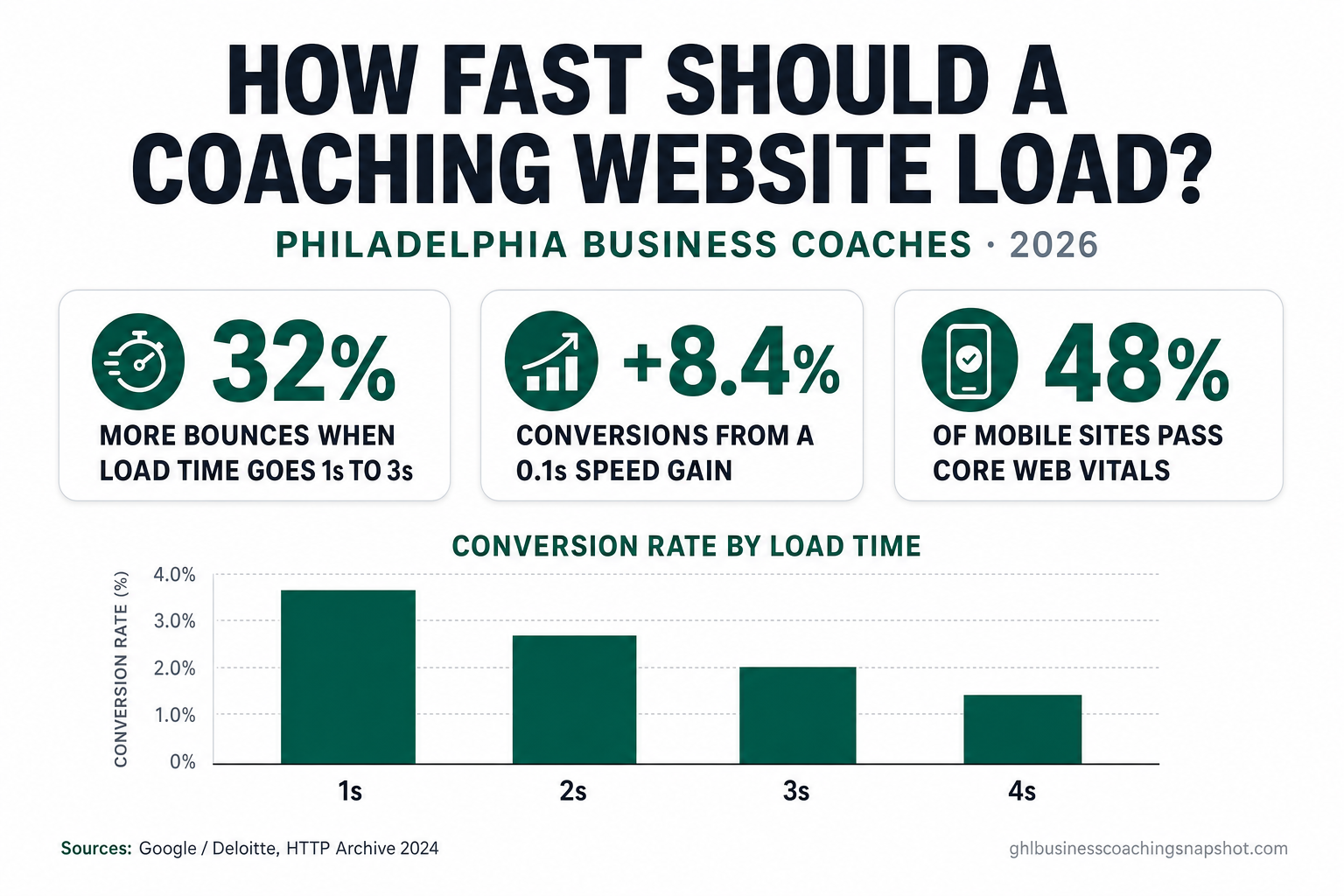
Short answer: if you coach out of Philadelphia in 2026, your website has about three seconds on mobile before most prospects click back to Google — and roughly half the mobile web already loads faster than that (HTTP Archive Web Almanac 2024). Every extra second is a booked discovery call quietly leaking out the bottom of the funnel. This post is the honest speed bar: what the numbers actually say, why so many Philly coaching sites miss it, and the exact fix a solo executive coach in Center City or a group-program operator out in King of Prussia can ship this month.
Why Philadelphia coaches keep losing calls before they ever ring
Walk into any of the coworking spaces along Market Street, or a Wednesday-morning coffee at La Colombe in Rittenhouse, and you’ll hear the same conversation from independent coaches: “the leads are there — they just don’t convert.” What almost nobody says out loud is that a chunk of those “leads” never made it far enough to be a lead. A prospect googled “executive coach Philadelphia”, tapped a result on their iPhone waiting for the El, watched a spinner for four seconds, and jumped back to the SERP before the hero even painted.
That’s not a bounce. That’s a coach paying rent on a website that is quietly telling qualified buyers to try somebody else. Philadelphia is not a small pond — it’s the sixth-largest US metro with a dense concentration of professional-services and biotech buyers, plus Wharton and Penn on the doorstep — and the search competition matches the opportunity. Being the fast site in a market that crowded is one of the few edges a solo or boutique coach can actually build in a month.
The 2026 mobile speed bar, in real numbers
There is a common bit of coaching-website advice that says “aim for under 3 seconds.” That number is fine as a floor, not a target. Here is what the research actually shows for 2026:
- 1s → 3s = +32% bounce probability. 1s → 5s = +90%. 1s → 6s = +106%. 1s → 10s = +123%. These are Google’s own mobile industry benchmarks from a 5.7-million-session study (Think with Google).
- 0.1s faster = 8.4% more retail conversions, 10.1% more travel conversions. Deloitte analyzed 30M mobile sessions across 37 brands and found that a one-tenth-of-a-second speed gain moved every step of the funnel (web.dev — Milliseconds Make Millions).
- 1s sites convert ~2.5x better than 5s sites. Portent’s cross-industry analysis clocked the average site’s conversion rate falling from ~3.05% at 1 second to ~0.67% at 4 seconds (Portent).
- Only 48% of the mobile web passes Core Web Vitals. In other words, half the coaching sites you’re competing with in Philadelphia’s SERP are already failing the bar (HTTP Archive Web Almanac 2024).
Read those together and the target for a Philadelphia coaching site is not “under 3 seconds.” It’s Largest Contentful Paint under 2.5 seconds on a mid-range Android over 4G, with room to spare, so that even a prospect on the Regional Rail with two bars gets a page that paints before they lose signal.
Estimated average site conversion rate by mobile load time, in percent. Source: Portent, “Site Speed is (Still) Impacting Your Conversion Rate”.
What “slow” actually looks like on a coaching site
Slow isn’t always what coaches think it is. Most sites don’t feel slow on the coach’s own MacBook plugged into a Comcast fiber line in their office off Broad Street. Slow shows up on a prospect’s iPhone 13 with a weak LTE signal in a Wawa parking lot in Delaware County. The three most common symptoms:
- The hero image pops in late. The visitor sees blank white space where your headshot or program mock should be. Google measures this as Largest Contentful Paint (LCP) — how long until the biggest visible thing paints.
- The tap-to-book button jumps around while loading. The visitor tries to hit “Book a discovery call”, and a late-loading testimonial pushes it down. That’s Cumulative Layout Shift (CLS) — and it does more damage than most coaches realize, because it kills the exact tap that would have started your sales cycle.
- The site “feels” fast but the form takes half a second to react. That gap between tap and response is Interaction to Next Paint (INP) — the newest Core Web Vital and the one where most 2026 sites now fail (Digital Applied — 2026 CWV benchmarks).
Core Web Vitals for coaches, in plain English
Google grades every URL on three numbers, updated regularly, and uses them as a page-experience signal in ranking (Google Search Central). The 2026 pass/fail lines:
Core Web Vitals — the numbers Google grades your coaching site on
| Plan | LCP · Largest Contentful Paint | INP · Interaction to Next Paint recommended | CLS · Cumulative Layout Shift |
|---|---|---|---|
| Price | ≤ 2.5s | ≤ 200ms | ≤ 0.1 |
| Feature 1 | How long until the biggest visible element paints | How long between a tap and a visible response | How much the page jumps around while loading |
| Feature 2 | Good: under 2.5 seconds | Good: under 200 ms | Good: under 0.1 |
| Feature 3 | Needs work: 2.5 – 4.0 seconds | Needs work: 200 – 500 ms | Needs work: 0.1 – 0.25 |
| Feature 4 | Poor: over 4.0 seconds | Poor: over 500 ms | Poor: over 0.25 |
You can check any of your pages yourself at PageSpeed Insights — it pulls real user data from Google’s Chrome UX Report where enough traffic exists, and simulates the rest.
The cost of a slow coaching site (in booked discovery calls)
Let’s put a real Philadelphia number on this. Suppose a mid-market executive coach in Center City spends $2,000 a month on Google Ads targeting “leadership coach Philadelphia” and adjacent terms. Average cost per click in that vertical runs $8 to $18; call it $12 for a mid-point. That’s roughly 167 paid visitors per month landing on the coaching site.
- If the site loads in 2 seconds, and the coach’s discovery-call booking rate is 3.0%, that’s about 5 booked calls a month from paid — say $10,000 in pipeline at a 20% close rate on a $10K package.
- If the site loads in 4 seconds (which is normal for a WordPress or Wix build with a page-builder theme), the same funnel converts closer to 0.67% (Portent) — about 1 booked call a month, or $2,000 in pipeline.
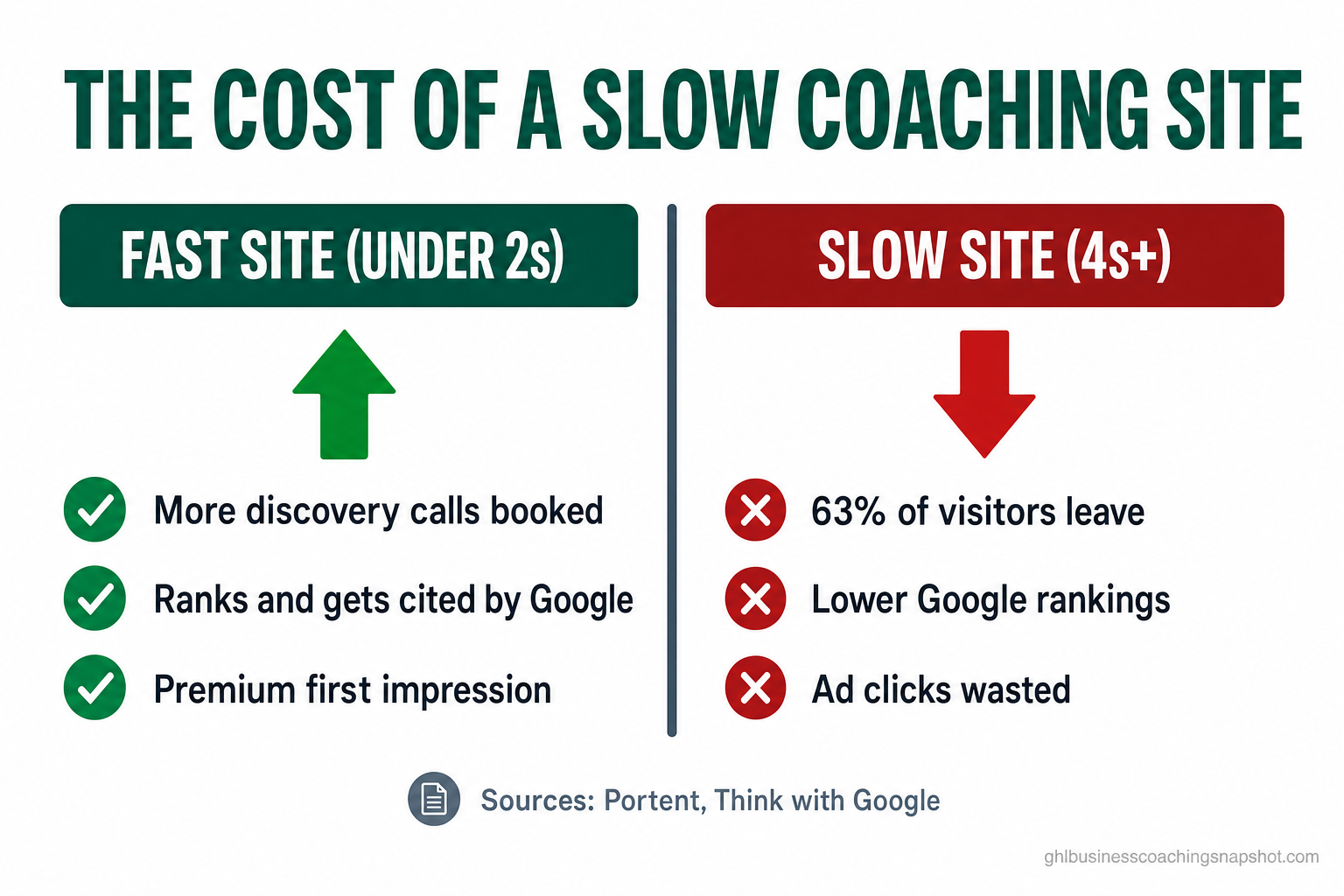
That is a 4x swing in booked calls from a single infrastructure choice — and it repeats every month, forever, whether the coach ever runs another ad or not. Organic traffic feels the same drop, just less visibly, because slow pages also earn fewer clicks in the SERP and fewer AI Overview citations.
Why WordPress, Wix, GHL, and Squarespace sites are usually slow
None of these platforms are “bad.” Each is optimized for a specific job that is not “serve a lightning-fast public marketing page.” The common pattern:
- WordPress + a page builder (Elementor, Divi, Bricks) + 12 plugins. Every plugin adds JavaScript and CSS that runs on every page. The plugin ecosystem is what makes WP powerful and what makes it slow.
- Wix and Squarespace. They ship a heavy visual-editor runtime on the front end so the drag-and-drop can work. Fine for a static portfolio, expensive for a coaching site that competes on speed.
- GoHighLevel funnels and page-builder sites. GHL is one of the best all-in-one CRMs in the market for coaches (we build inside it every day), but its page and funnel builder ships heavy JavaScript — the same pattern that keeps most page-builder sites from passing Core Web Vitals. It’s a CRM engine, not a static-site engine (our full Astro vs GoHighLevel breakdown).
- Kajabi + native course-hosting sites. Optimized for course delivery, not for landing pages. Same issue as GHL’s builder — heavy runtime, hard to hit 90+ PageSpeed.
The industry-wide data agrees: only about half of mobile sites pass Core Web Vitals, and page-builder-heavy platforms disproportionately fill the failing half (Web Almanac 2024).
The Philadelphia-specific SEO + GEO angle
For a Philadelphia-based coach, speed unlocks three specific advantages that a national competitor can’t easily match:
- Local pack + Google Business Profile. Google’s local ranking rewards fast, mobile-friendly sites for near-me queries. “Business coach Philadelphia”, “executive coach Center City”, “leadership coach Main Line” — all of these have local intent, and a fast, schema-annotated site is far more likely to earn the local three-pack.
- AI Overview + Perplexity + ChatGPT citations. AI answer engines heavily favor pages they can crawl fast and parse cleanly. A static Astro page with proper schema (LocalBusiness, Service, FAQPage, BreadcrumbList) is dramatically more citation-ready than a JavaScript-heavy Wix or GHL page.
- Location pages for the metro’s neighborhoods. Center City, University City, Rittenhouse, Fishtown, Manayunk, Old City, King of Prussia, Bala Cynwyd, Cherry Hill — a Philly coach can and should have a fast, individually optimized location page for each. On a slow platform this is a nightmare; on a static-first framework it’s a build-time function of a data file.
The fix: a 4-step upgrade playbook
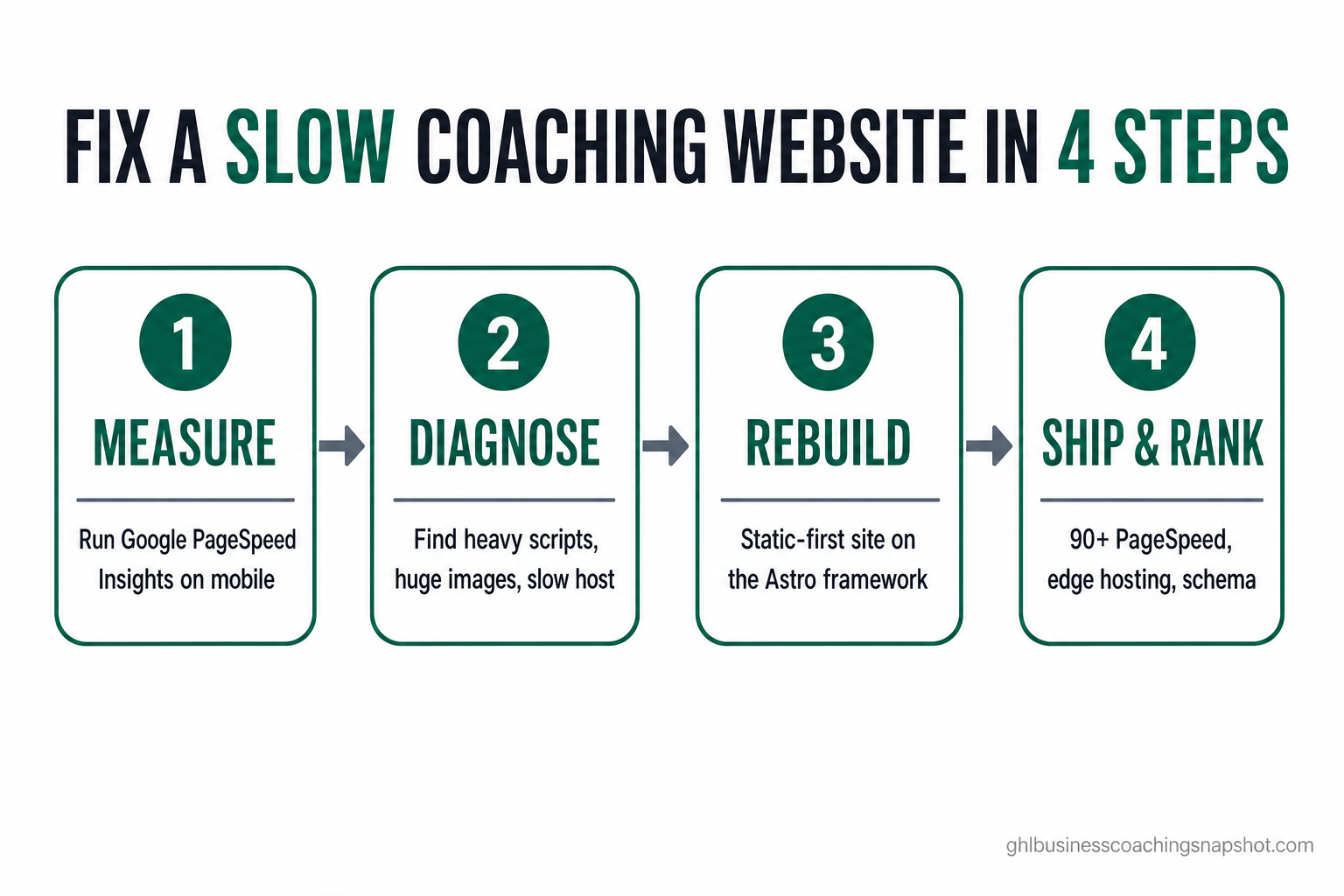
You do not have to burn your business down to fix this. The order that actually works:
Step 1 — Measure, don’t guess. Open pagespeed.web.dev on your current coaching site. Run the mobile score, not desktop. Save the four numbers: Performance, LCP, INP, CLS. If Performance is below 70 or LCP is above 2.5s, you are losing calls right now.
Step 2 — Diagnose the three usual culprits. Ninety percent of slow coaching sites are slow for the same three reasons: (a) a 3–8 MB unoptimized hero image, (b) five to fifteen third-party scripts (heatmaps, chat widgets, tag manager, ad pixels, testimonial widgets, cookie banners) each blocking render, and (c) a page-builder theme that ships 400+ KB of JavaScript before any real content.
Step 3 — Rebuild on a static-first framework. For a coaching site — homepage, services, about, blog, contact, book-a-call — the single highest-leverage move is to rebuild on a static-first framework like Astro. Astro ships near-zero JavaScript by default and only hydrates the interactive bits (“islands”), so pages load in a blink. That’s the same pattern the fastest sites on the web use, and it’s exactly what our $497 + $97/mo Get-a-Website service does for coaches — with a 90+ Google PageSpeed guarantee.
Step 4 — Ship it on the edge, with real schema. Host on Cloudflare (or a similar global edge) so a prospect in Philadelphia hits a server 20ms away, not one across the country. Add proper JSON-LD (LocalBusiness, Service, FAQPage, BreadcrumbList) so Google — and AI answer engines — can parse the page in one pass.
A typical Philadelphia coaching site — before vs after the speed rebuild
Mobile PageSpeed 42. LCP 4.8s. INP 620ms. 5 booked calls / month from 167 paid visitors. WordPress + Elementor + 11 plugins on shared hosting.
Mobile PageSpeed 98. LCP 1.4s. INP 90ms. 15+ booked calls / month from the same 167 paid visitors. Astro + Cloudflare edge + native GoHighLevel forms.
Astro vs the usual coaching-site stacks
We wrote the full Astro vs GoHighLevel head-to-head if you want the deep version. The short version for a Philly coach picking a stack in 2026:
- Astro (static-first). Ships near-zero JS. Renders on Cloudflare’s edge. Trivially hits 90+ PageSpeed. Location pages are a build-time loop over a JSON file. Best-in-class for SEO/AEO/GEO. This is what we build.
- GoHighLevel funnels / websites. Perfect for the CRM, calendar, pipeline, and follow-up layer. Not built for public-marketing speed. Keep it — but not for your homepage.
- WordPress + page builder. Powerful, extensible, and consistently slow without an aggressive perf engineer on retainer. Fine for content-heavy media sites; overkill (and slow) for a coaching practice.
- Wix / Squarespace / Kajabi pages. Convenient. Slow. Poor at location pages. Fine for a hobbyist site; not for a coach charging $5K–$50K engagements.
- Webflow. Faster than WP but still ships more JS than Astro. Reasonable middle-ground; more expensive than a managed Astro build; still weaker on AEO/GEO than a purpose-built static site.
What to keep in GoHighLevel and what to move to Astro
The single biggest mistake we see Philadelphia coaches make is thinking this is an either/or. It isn’t. GoHighLevel and Astro do different jobs. The hybrid that wins:
- Stays in GoHighLevel: discovery-call calendar and Zoom link, application/intake forms, SMS + email follow-up, pipeline stages, invoicing and failed-payment recovery, accountability check-ins, review harvesting, AI chat, AI receptionist. Everything the coaching snapshot automates.
- Moves to Astro: the public marketing site — homepage, services, sub-niche pages (executive, startup, life, career, group, mastermind), location pages, blog, about, case studies, comparisons, contact. Forms on the Astro site push the lead straight into GoHighLevel via webhook, so nothing changes for the coach’s operations.
That split gives you the best CRM in the industry running the back office, and the fastest static-site framework in the world running the front door — which is the only combination that consistently ranks and converts in a competitive metro like Philadelphia.
FAQ
How fast should a coaching website load in 2026?
The current best-practice target is under 2.5 seconds for Largest Contentful Paint on mobile, under 200ms Interaction to Next Paint, and under 0.1 Cumulative Layout Shift — Google's three Core Web Vitals. Under 3 seconds total load on a mid-range mobile device on 4G is a reasonable minimum bar. Every second slower than that measurably raises bounce probability (Think with Google: 1s→3s = +32% bounce probability; 1s→5s = +90%).
Does website speed actually affect Google rankings for a Philadelphia coach?
Yes. Core Web Vitals are an official Google page-experience signal, and page experience is used as a tiebreaker between similar-quality pages. In competitive local markets like Philadelphia — where 'executive coach Philadelphia' and 'leadership coach Center City' have many strong contenders — page speed is often the difference between page-one and page-three.
My coaching site is on GoHighLevel or Wix and it's slow. Do I have to switch platforms?
Not for the CRM — you should keep GoHighLevel for calendars, forms, pipelines, and follow-up. But for the public marketing site (homepage, services, location pages, blog), the fastest path to 90+ PageSpeed is to rebuild on a static-first framework like Astro and host on Cloudflare's edge. The GHL forms and calendar still work — they just live inside a faster page.
How much does a fast coaching website cost?
Our managed Get-a-Website service is $497 one-time and $97/month, guaranteeing a 90+ Google PageSpeed score. That includes hosting on Cloudflare's edge, your domain, SSL, and monthly maintenance. For coaches with multiple offers or sub-brands, we do up to 5 sites for a $1,200 one-time + $297/month bulk plan. See /get-a-website for the current details.
What's the fastest way to make my current coaching site faster this week?
In order of impact: (1) compress and resize every image over 300KB — most 'hero images' should be under 150KB, (2) remove any third-party script you're not actively using, especially old tag-manager tags and abandoned chat widgets, (3) switch to a lighter theme or turn off unused page-builder modules, (4) move hosting to an edge provider like Cloudflare. This will typically move a 40-something PageSpeed score into the 70s. Getting into the 90s usually requires a static-first rebuild.
Why does 0.1 second matter?
Deloitte's mobile speed study across 30 million sessions and 37 brands found that a 0.1 second improvement raised retail conversions by 8.4%, travel conversions by 10.1%, luxury page views per session by 8.6%, and lead-gen bounce rate by 8.3%. Speed compounds — every tenth of a second you claw back shows up in every step of the funnel.
Do location pages for Philadelphia neighborhoods actually help?
Yes, if they're substantive and fast. A coach with individual, well-structured pages for Center City, Main Line, University City, King of Prussia, Cherry Hill, etc. will consistently outrank a competitor with only a single homepage — because those pages match the exact search intent of a prospect in each area. On a static-first framework these pages are a small marginal cost per neighborhood; on a page-builder platform they're a maintenance nightmare.
How do I check my own coaching site's speed right now?
Go to pagespeed.web.dev, paste your homepage URL, and read the mobile score (not desktop). Anything below 70 on Performance, above 2.5 seconds LCP, or above 200ms INP is costing you booked discovery calls today. Screenshot the result — it's your baseline for any rebuild.
About the author. Dana Whitfield is a GoHighLevel automation strategist for business coaches, based in Austin, TX. She has spent the last eight years building discovery-call funnels and high-ticket application screening for 1:1 and group coaching practices, with a particular interest in the line between automation that feels personal and automation that feels like a robot wrote it.
Related reading
- Astro vs GoHighLevel Websites for Business Coaches: Page Speed & SEO Compared (2026)
- SEO for Business Coaches: How to Rank in a Crowded Market
- How to Reduce Coaching Client Churn — The Retention System That Keeps Clients Renewing
- Speed to Lead for Coaches — book more discovery calls before the lead goes cold
- Discovery Call Follow-Up for Coaches — the post-call sequence that turns calls into clients