

Short answer: GoHighLevel (GHL) and Astro are not really competing for the same job. GoHighLevel is a CRM and automation platform — it’s excellent at capturing leads, booking discovery calls, running pipelines, and sending follow-up. Astro is a website framework — it’s built to render fast, search-friendly pages. When you build your public marketing site inside GHL’s page builder, you inherit a slow, JavaScript-heavy page that’s hard to rank and quietly loses the visitor before they ever book. The right move for a coaching practice is a hybrid: keep GoHighLevel for the back office, and put an Astro site out front. This post is the honest, coach-specific breakdown — speed, Core Web Vitals, SEO, editability, and cost.
The short version: two tools, two jobs
Most coaches don’t set out to “build a website in GoHighLevel.” It happens by default. You buy GHL to run your calendar and follow-ups, you notice it also has a site builder, and — reasonably — you build your homepage there so everything lives in one login. That convenience is real. The problem is that a lead-capture and automation platform is optimized for the back office, not for serving a lightning-fast public page to a stranger who’s comparing three coaches at once.
Think of it like a coaching practice itself. Your CRM is the operations engine — it should be powerful, deep, and a little unglamorous. Your website is the front door — it should be fast, beautiful, and instantly trustworthy, because it’s the first impression that decides whether a $5K–$50K prospect books a call or bounces back to Google. GoHighLevel is a genuinely strong back office. Astro is a genuinely strong front door. Trying to make one do both jobs is where coaches lose speed, rankings, and calls.
Why website speed decides whether a coach gets the client
Coaches obsess over their offer, their copy, and their booking calendar — and then serve all of it on a page that takes six seconds to appear on a phone. The visitor never reads the offer. They’re gone. Here’s the uncomfortable data on how fast that leak happens.
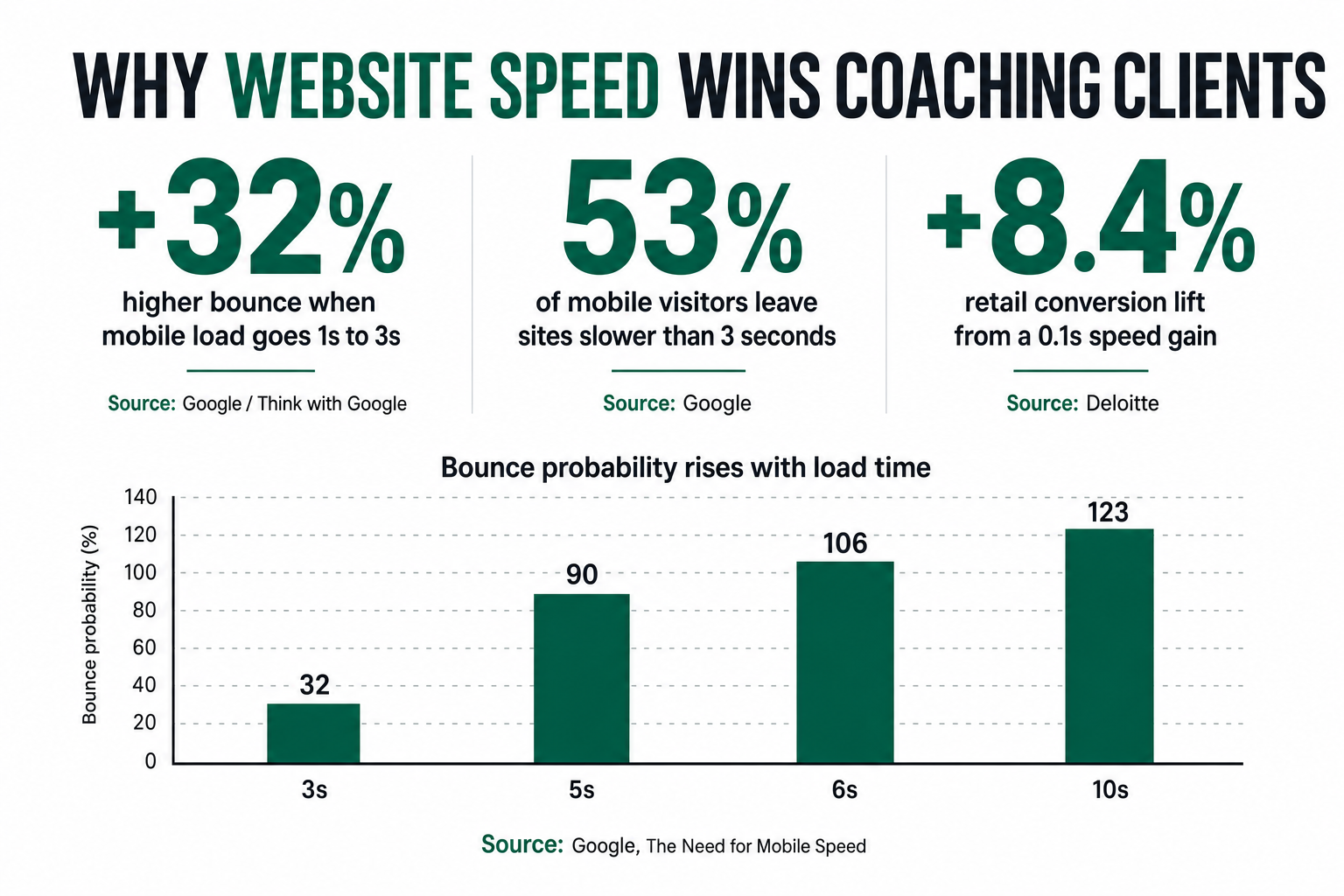
Start with bounce. Google’s research with SOASTA modeled real-world mobile data and found that as a page’s load time grows from 1 second to 3 seconds, the probability of a bounce increases by 32%; from 1 to 5 seconds it’s up 90%, and by 10 seconds, 123% (Think with Google). Separately, Google’s DoubleClick report found 53% of mobile visits are abandoned if a page takes longer than three seconds to load (reported by Marketing Dive).
Increase in the probability a mobile visitor bounces as page load time grows (percent). Source: Think with Google — mobile page speed benchmarks (Google/SOASTA).
Now the money side. Deloitte’s Milliseconds Make Millions study analyzed 30 million user sessions across 37 brands and found that a 0.1-second improvement in mobile load time lifted retail conversions by 8.4% (and average order value by 9.2%), with travel conversions up 10.1% (web.dev case study). Portent’s analysis of over 100 million pageviews across 20 sites found the highest conversion rates cluster in the 0–4 second range, with conversion dropping an average of ~4.42% for each additional second of load time between 0 and 5 seconds (Portent).
Translate that to a coaching practice. If you run ads or content to your site and your page is slow, you’re not just annoying people — you’re paying full price for clicks and converting a fraction of them into booked calls. Speed isn’t a developer’s hobby. It’s the difference between a full discovery-call calendar and a quiet one.
How GoHighLevel builds websites (and why they’re slow)
GoHighLevel’s website and funnel builder is a drag-and-drop, page-builder system. That’s what makes it easy: you move blocks around visually and publish. But under the hood, page builders achieve that flexibility by shipping a lot of generic JavaScript, CSS, and layout scaffolding to every visitor’s browser — the runtime that makes the drag-and-drop output work everywhere. The browser then has to download, parse, and execute all of it before the page is fully usable.
This is not a GoHighLevel-specific flaw; it’s the nature of all-in-one visual builders (the same critique applies to typical WordPress-with-page-builder, Wix, and Squarespace sites). But it has real consequences for Core Web Vitals — Google’s trio of user-experience metrics (Largest Contentful Paint, Interaction to Next Paint, Cumulative Layout Shift). Heavy JavaScript hurts all three, and the numbers show how common the problem is: the median mobile page now ships roughly 570 KB of JavaScript (HTTP Archive Web Almanac 2024), and across the whole web only 48% of mobile sites pass Core Web Vitals (HTTP Archive Web Almanac 2024). Add third-party chat widgets, tracking pixels, and embedded forms — the stuff a coaching site actually needs — and a builder-based page gets heavier still.
To be clear about the trade: GoHighLevel earns its keep the moment the visitor becomes a lead. Its calendars, pipelines, SMS/email automation, and workflows are exactly what a coaching practice needs behind the scenes — it’s why our whole coaching snapshot is built in standard GHL. The weakness is narrow and specific: GHL is not the fastest way to serve your public, indexable marketing pages.
How Astro builds websites (and why they’re fast)
Astro takes the opposite approach. Instead of shipping a big JavaScript runtime and letting it assemble the page in the browser, Astro renders your pages to static HTML at build time and ships almost no JavaScript by default. Interactive pieces — a booking widget, an AI chat bubble, a calculator — are added as isolated “islands” that hydrate independently, so a heavy component can’t block the rest of the page. This is the islands architecture, and it’s why Astro pages tend to load in a blink.
Astro’s own published benchmarks describe sites that are roughly 40% faster to load while shipping about 90% less JavaScript than a typical component-framework build, with perfect Lighthouse scores achievable out of the box (Astro). For a content-and-conversion site — which is exactly what a coaching marketing site is — that’s the ideal profile: near-instant first paint, low bounce, strong Core Web Vitals.
Same coaching offer, two very different front doors
A page-builder runtime and generic JavaScript ship to every visitor, so pages get heavy and struggle to pass Core Web Vitals on mobile. Titles, meta, schema, and llms.txt are limited or manual — convenient to edit inside GHL, but tied to the platform.
Static HTML with near-zero JavaScript by default (interactive islands only where needed), built to hit 90+ PageSpeed and pass Core Web Vitals. You fully control titles, meta, schema, sitemap, robots, and llms.txt — and forms still push leads straight into GoHighLevel, with no lock-in.
The site you’re reading right now is an Astro build, for exactly these reasons. When we build a coaching website for a client, we guarantee a 90+ Google PageSpeed score (often a perfect 100) precisely because the framework does the heavy lifting.
Astro vs GoHighLevel: the head-to-head
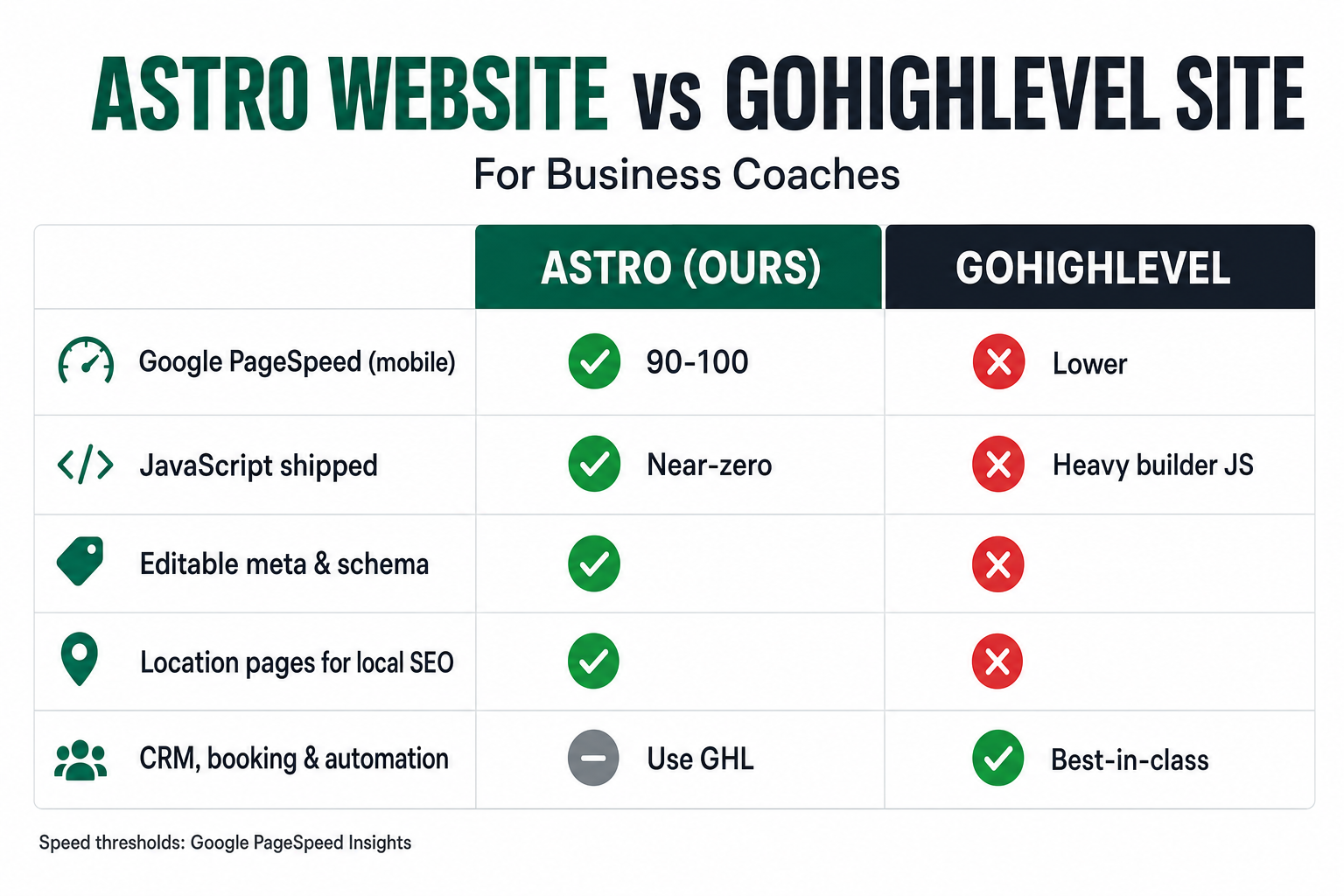
Here’s the honest, side-by-side comparison for the website job specifically. (For the CRM job, GHL wins hands down — that’s not what this table is about.)
| What matters | Astro website (ours) | GoHighLevel website |
|---|---|---|
| Google PageSpeed (mobile) | 90–100 (guaranteed 90+) | Typically lower; builder JS drags it |
| JavaScript shipped | Near-zero by default (islands) | Page-builder runtime on every page |
| Core Web Vitals | Built to pass | Often struggles (heavy JS) |
| Editable title, meta & schema | ✅ Full control | ⚠️ Limited / templated |
| Custom code & advanced schema | ✅ Anything you need | ⚠️ Constrained by the builder |
| Location pages for local SEO | ✅ One per city, optimized | ⚠️ Manual, repetitive to scale |
| llms.txt / AI-crawler files | ✅ Shipped correctly | ⚠️ Manual, if at all |
| CRM, pipelines, automation | ➖ Not its job (use GHL) | ✅ Excellent — GHL’s core strength |
| Booking, SMS, workflows | ➖ Connect to GHL | ✅ Best-in-class |
| Best used as | Your public marketing site | Your back-office CRM engine |
The pattern is clear: the two tools are strongest at opposite ends of the funnel. Astro wins the front door (speed, SEO, editability, AI-readiness). GoHighLevel wins the back office (CRM, booking, follow-up). If you’re comparing GHL to other platforms for running the practice, our GoHighLevel vs Kajabi comparison covers that fight. This one is only about the website.
SEO, AEO & GEO: getting found by Google and AI
Speed is half the SEO story; structure is the other half. Google confirms that page experience — including Core Web Vitals — is used by its ranking systems, and it’s especially decisive as a tiebreaker between pages of similar relevance (Google Search Central). A faster page doesn’t automatically rank #1, but a slow one gives away an edge you didn’t need to lose.
Then there’s everything Google reads besides speed: clean title tags, meta descriptions, valid schema.org structured data, a correct sitemap and robots.txt, and — increasingly — an llms.txt file that tells AI crawlers (ChatGPT, Perplexity, Google’s AI answers) how to read your site. On an Astro build, all of that is fully under your control; you can ship precise, per-page schema and a real llms.txt. Inside a page builder, these are typically templated, limited, or require manual workarounds. For a coach who wants to show up in AI Overviews and answer engines, not just blue links, that control is the whole game. (We go deep on this in our SEO for business coaches playbook.)
The other quiet SEO advantage: location pages. Coaches who serve specific metros — “business coach in Austin,” “executive coach in Chicago” — win by having a genuinely optimized page per location, not one generic page. On Astro that’s straightforward to generate and keep fast; on a builder it’s slow, repetitive, and heavy. Fast, well-structured location pages are one of the highest-leverage things a local or hybrid coaching practice can own.
Editability and cost: the part nobody warns you about
The hidden tax of most coaching websites isn’t the build — it’s the aftermath. On a typical agency-built WordPress or Wix site, every small change becomes a ticket, a quote, or a plugin renewal. On a DIY builder, you technically can edit anything, but you also own every performance regression and broken layout yourself, forever.
Our Get a Website service is priced to remove that tax: $497 one-time + $97/month, and you don’t pay the one-time fee until the site is live and you’re happy. The monthly covers managed Cloudflare hosting, your domain, SSL, and maintenance — plus up to 10 change tickets a month, so updates are handled for you. Need automated content too? Auto blog posting (two posts a week) is $197/month total. Running multiple brands or a small agency? Up to five sites is $1,200 one-time + $297/month.
The setup we actually recommend for coaches
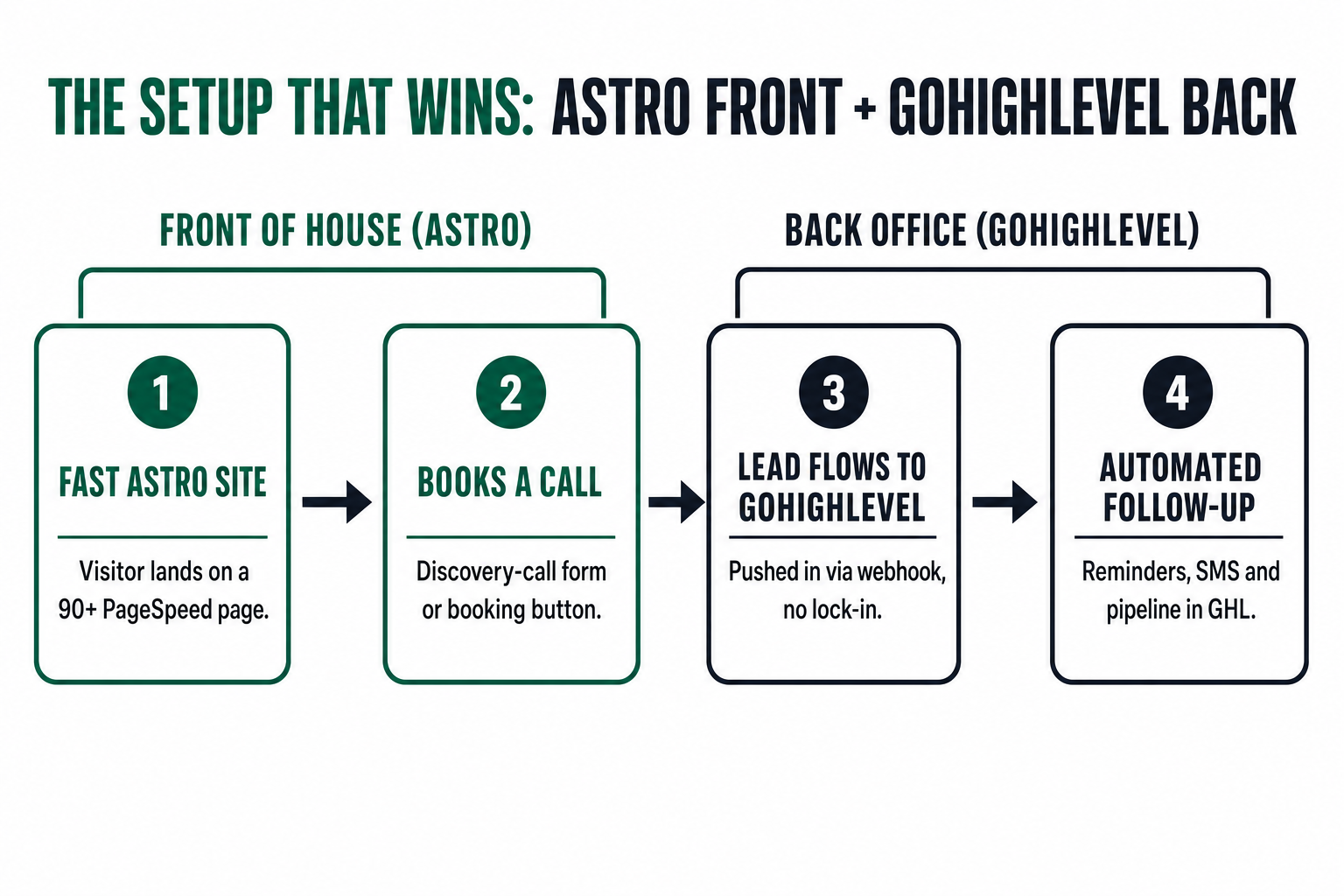
Put it together and the recommendation is simple: Astro front-of-house, GoHighLevel back-office. Your public marketing site — homepage, program pages, location pages, blog — lives on a fast Astro build that ranks and converts. The moment a visitor books or opts in, they flow into GoHighLevel, where your calendars, pipelines, SMS/email cadences, and workflows take over. Each tool does the job it’s best at, and the handoff between them is invisible to your prospect.
The measurable gap between “static-first” and “page-builder” is real. GoHighLevel sites aren’t tracked individually in public datasets, but they’re page-builder output in the same heavy-JavaScript category as WordPress — and in HTTP Archive’s Core Web Vitals Technology Report, Astro origins pass Core Web Vitals at roughly 60% versus about 38% for WordPress, making Astro one of the only frameworks with a majority of sites passing (HTTP Archive / Search Engine Journal).
Share of origins with “good” Core Web Vitals, by technology (percent) — a static framework vs a page-builder platform. Source: HTTP Archive Core Web Vitals Technology Report (2024 snapshot; figures update over time). GoHighLevel sites fall in the same page-builder category as WordPress.
That’s not a knock on GoHighLevel — it’s how we’d architect a serious coaching practice on purpose. Keep the CRM you already trust. Just stop asking it to be the fastest thing your prospects load on their phone.
Frequently asked questions
Astro vs GoHighLevel websites — quick answers
Is GoHighLevel bad for websites?
No — it's just not the fastest option. GoHighLevel's page/funnel builder is convenient and fully functional, and it's superb for the CRM, booking, and automation behind your funnel. The narrow weakness is page speed: like all drag-and-drop builders, it ships heavy JavaScript, which makes it harder to pass Core Web Vitals on mobile. For your public marketing pages, a static Astro site loads dramatically faster.
Do I have to leave GoHighLevel to get a faster website?
Not at all. The recommended setup keeps GoHighLevel as your back office and puts an Astro site out front. Website forms and booking buttons push leads straight into GHL via Zapier, Pabbly, or Make webhooks, so your pipelines and automations don't change. You get speed and SEO up front and keep every GHL workflow you rely on.
Why is Astro faster than a GoHighLevel site?
Astro renders pages to static HTML and ships almost no JavaScript by default, hydrating only small interactive 'islands' where needed. A page builder does the opposite — it ships a runtime to every visitor and assembles the page in the browser. Astro's own benchmarks cite roughly 40% faster loads with about 90% less JavaScript, which is exactly the profile a marketing site wants.
Does page speed really affect how many clients I book?
Yes, measurably. As mobile load time goes from 1s to 3s, bounce probability rises 32% (Think with Google), and Deloitte found a 0.1s speed improvement lifted retail conversions 8.4% (web.dev). For a coach paying for traffic, faster pages mean more of those clicks turn into booked discovery calls.
Will a faster website help me rank on Google and in AI answers?
It helps on both fronts. Google confirms page experience — including Core Web Vitals — is a ranking signal, particularly as a tiebreaker (Google Search Central). Beyond speed, an Astro build gives you full control of schema, sitemap, robots.txt, and an llms.txt file so AI answer engines can read and cite your pages — which page builders limit.
What does a fast coaching website actually cost?
Our Get a Website service is $497 one-time + $97/month, and you only pay the one-time fee after the site is live and you're happy. The monthly covers managed hosting, domain, SSL, maintenance, and up to 10 change tickets. Add auto-blogging for $197/month total, or up to five sites for $1,200 one-time + $297/month.
About the author
Dana Whitfield is a GHL Automation Strategist for Coaches based in Austin, TX. She has spent the last eight years building GoHighLevel systems for 1:1 and group coaching practices, with a focus on discovery-call funnels and high-ticket application screening — and on the line between automation that feels personal and automation that feels like a robot wrote it.