

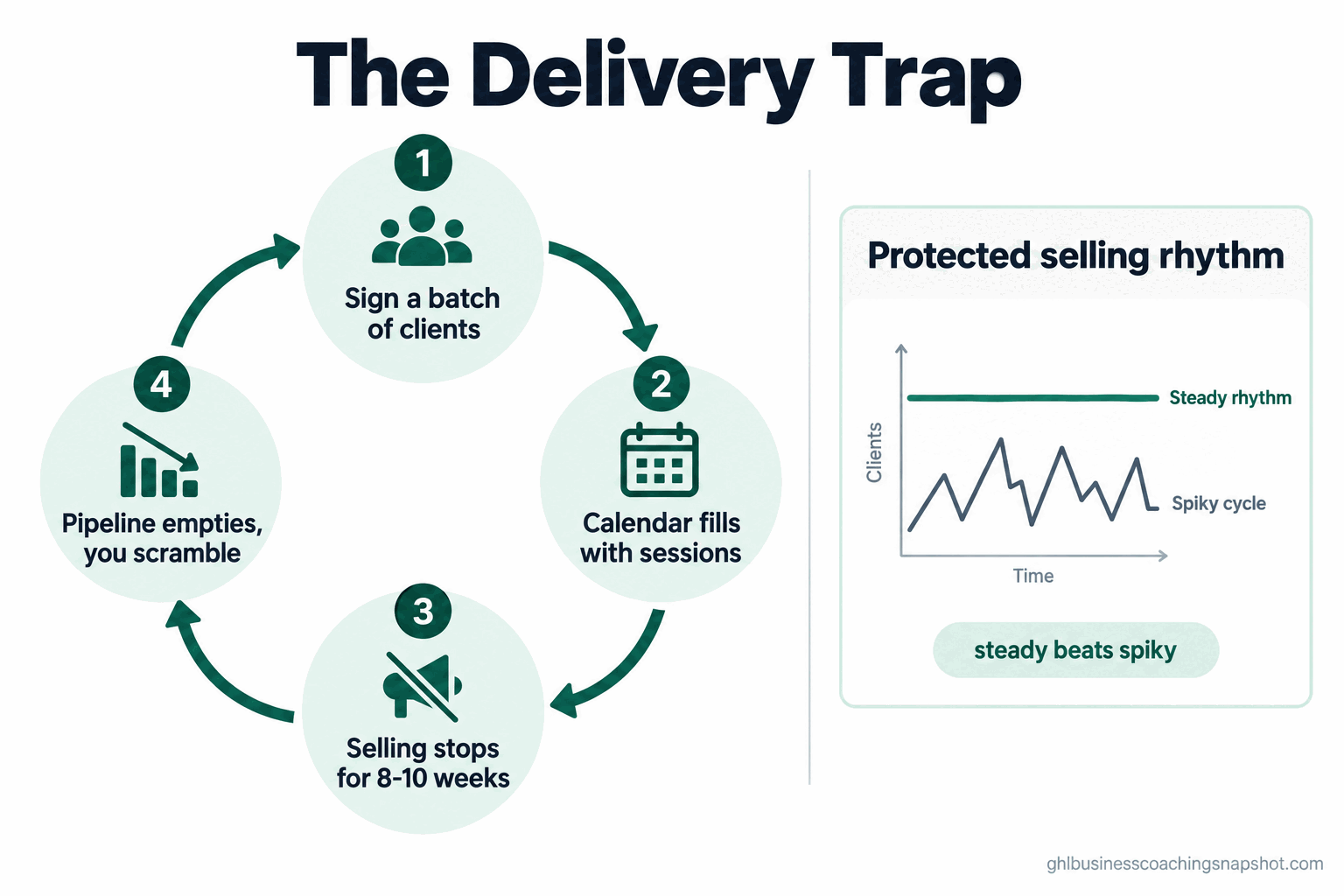
Short answer: coaches stop signing clients the moment they get busy because selling is the one job that still needs their live hours, and delivery eats those hours first. You close three or four clients, your calendar fills with sessions, and the prospecting, the follow-up, and the discovery calls all go quiet for two months. Then those engagements wrap, the pipeline is empty, and you are scrambling. The fix is not grinding harder between clients. It is building a selling system that keeps capturing, booking, and following up while you coach, plus a protected block of your own time that delivery is never allowed to touch. Here is that system, stage by stage, with the real copy and the ways each part breaks.
What the delivery trap actually costs you
It is a Tuesday in a good month. You have five clients mid-engagement, back-to-back calls from ten to four, and prep and notes stacked in the gaps. You tell yourself you will do the marketing on Friday. Friday you are wiped. The next week looks the same, and the one after that. Six weeks later every engagement is wrapping within a fortnight of each other, because you signed them all in the same burst, and your calendar for next month is white space. No discovery calls on the books. No warm leads to ring. Just the cold-start dread you felt last time.
That is the delivery trap, and it bills you three ways.
First, the famine forces discounting. An empty calendar makes you say yes to a bad-fit client at a soft rate because you need the cash this month. Second, the feast forces you to turn good-fit people away or rush the work, because you are full exactly when demand arrives and thin when it does not. Third, the swing caps your growth. You cannot hire, plan, or raise your rate against a revenue number that lurches every quarter. The practice stays small not because the market is small, but because you can only ever push one pedal at a time.
Sources: ICF 2025 Global Coaching Study (Executive Summary); Ueni microbusiness time-use research; Harvard Business Review (audit of 2,241 US firms).
The market is not turning off. The ICF puts global coaching revenue at a record $5.34 billion in its 2025 study, with 122,974 coach practitioners worldwide, up about 15% from 2023 (ICF). More buyers, not fewer. The swing is not the economy. It is you turning the selling engine off whenever delivery gets loud, because there are only so many hours and the client on the call always wins.
Why selling stops the second you get busy
Selling and delivery fight over one resource, and it is not money or leads. It is your attention. Delivery has a hard edge: a client is on the Zoom at 2pm, and if you skip it you lose the client. Selling has no edge. Nobody notices if you do not record a value video today, or send the follow-up text, or open your calendar for next week. So selling is the task that quietly slides, every single time, until the day there is nothing in the pipeline and it becomes an emergency.
This is not a willpower failure. It is baked into how small practices run. Ueni’s research on microbusiness owners found they spend only about 33% of their time actually delivering the service they sell, and put roughly 79% more time into admin, legal, and compliance than into marketing and sales combined (Ueni). Read that again. Even before delivery gets heavy, selling is already the thinnest slice of the week. When client load spikes, the thin slice is the first thing cut to zero.
And the cost compounds, because selling is a lagging system. A lead you fail to answer this week does not hurt today. It hurts in two months, when it would have become a paying client. The follow-up you skip while busy is a deal that quietly dies. Conversica’s 2023 research found about a quarter of companies did not respond to inbound leads at all, up from 5% in 2020, and roughly 35% of those who did respond stopped after one or two attempts, far short of the six to eleven touches most deals need (Conversica via Business Wire). Busy coaches are exactly the people who answer once and give up.
Illustrative: hours per week a solo coach spends selling versus delivering across one feast-and-famine cycle. Selling collapses as delivery peaks, then spikes in a panic once the calendar empties. The goal is to flatten the selling line, not chase it.
The pattern in that chart is the whole problem. Selling and delivery move in opposite directions when they should both be steady. If you want to understand the downstream symptom, we broke it down in the feast-or-famine coaching pipeline. This post is about the upstream cause: the hours themselves, and how to stop delivery from swallowing the ones that sell.
The fix: a selling system that runs without your live hours
You cannot out-discipline this. Telling yourself to “market more” during a busy stretch is like telling yourself to sleep less. The hours are not there. The only durable fix is to make selling need fewer of your live hours, and to wall off the few it still needs so delivery cannot raid them.
That is five parts, and most of it runs without you:
- A protected selling block that is on your calendar like a client is sitting in it.
- An automatic first reply so new leads are answered in seconds, not whenever you surface.
- Async selling so a prospect can learn, qualify, and book without a live call from you.
- A follow-up cadence that keeps touching warm leads on a schedule, through your worst weeks.
- Leaner delivery admin so the service takes fewer hours and gives those hours back to selling.
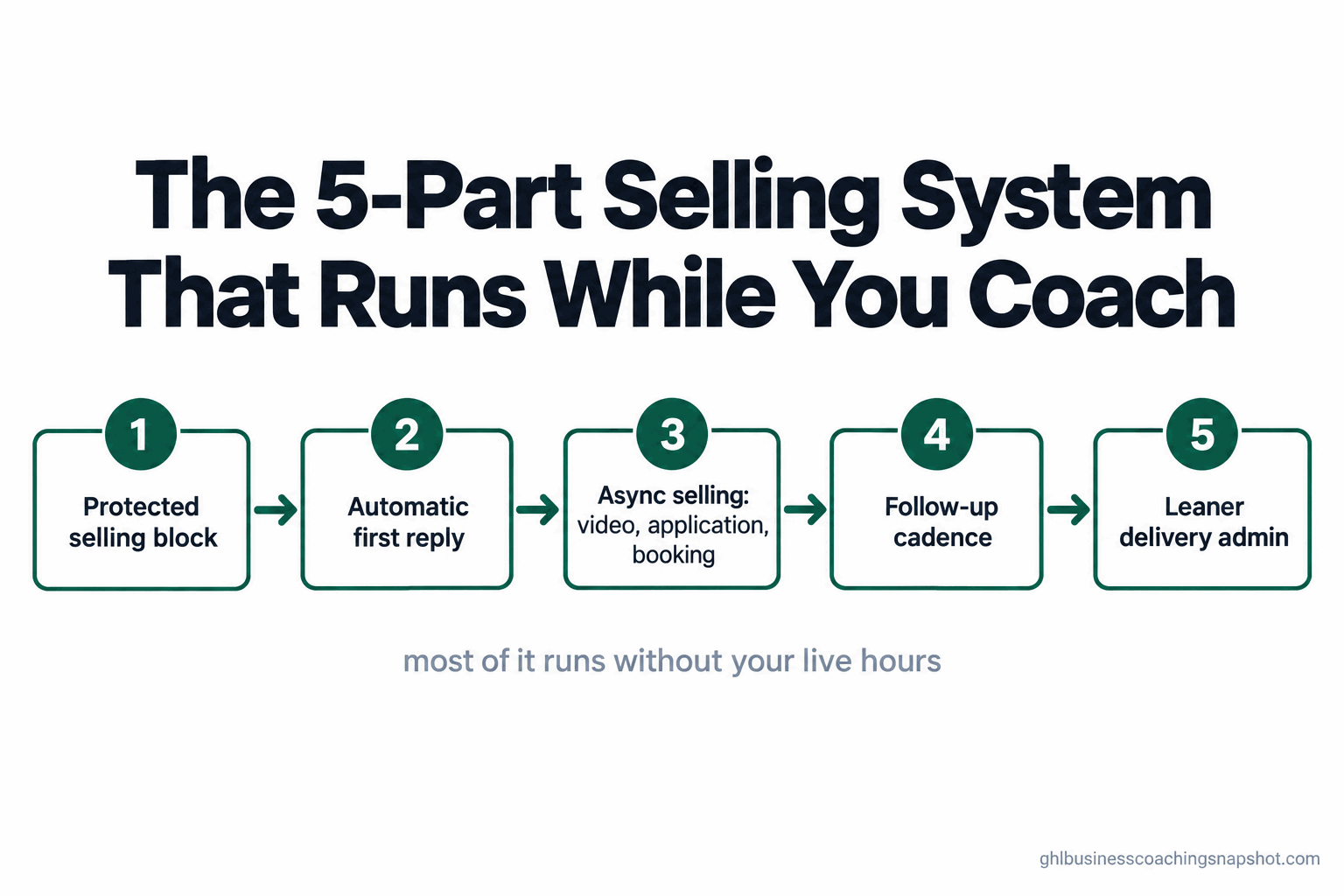
None of this replaces the human parts of selling. You still run the real conversation that enrolls a high-ticket client. The system just makes sure that by the time you are on that call, the lead is captured, qualified, warmed, and booked, so the only thing left is the part only you can do.
Stage 1: Protect one selling block and defend it
Start with time, because no automation fixes a calendar with zero selling hours in it. Pick one block a week, two to three hours, and name it on your calendar as a client appointment. Not “marketing,” which your brain treats as optional. Call it “Pipeline” and give it a fake client name if that is what it takes to stop yourself from booking a session over it.
In that block you do three things, in order: answer every warm lead that came in since last week, record or write one piece of value that feeds the top of the funnel, and look at next month’s calendar to see where the gaps are. That is it. Two hours, once a week, every week, booked or slow.
How it breaks. The block gets eaten by a client who “can only do Thursday at 2.” Defend it the way you would defend a paying client’s slot, because that is what it is: it is the slot that pays for the quiet months. The second failure is using the block to tinker with your website instead of talking to humans. If no part of the block touched a real prospect, it was busywork, not selling. The third is skipping it in a slow week because you feel behind on delivery. Slow weeks are when the block matters most, because that is when the pipeline you build now lands as revenue later.
Stage 2: Make the first reply automatic
The single most valuable thing you can automate is the first response to a new lead, because that is the moment your busy schedule does the most damage. A coach deep in back-to-back sessions might not see a form fill for six hours. By then the prospect has booked a call with someone else. HBR’s audit of 2,241 US firms found that contacting a web lead within an hour made a company roughly 7x more likely to qualify that lead than waiting even one more hour, and more than 60x more likely than waiting a day (HBR).
So the first reply cannot wait on you. When someone fills out your application or inquiry form, an automated text and email should go out inside a minute: acknowledge them by name, answer the obvious next question, and hand them a link to book. This is the same speed-to-lead discipline we cover in speed-to-lead for coaches, and it is the one automation that pays for itself in a single recovered client.
How it breaks. The automated reply reads like a robot wrote it (“Thank you for your submission”). Write it in your own voice, short, like a text you would actually send. The second failure is a reply with no clear next step, so the lead stalls. Always end with one action: book here. The third is firing the auto-reply and then never following up when they do not book, which bleeds straight into Stage 4.
Stage 3: Sell asynchronously, so selling does not need you present
Live discovery calls are expensive. They are a fixed chunk of your scarce hours, and half of them are with people who were never going to buy. The move is to let prospects do as much of the selling journey as possible without you in the room, so your live time is spent only on the ones ready to talk money.
That means a short value video or page that does the teaching you would otherwise do live. An application form that qualifies hard, so unqualified people screen themselves out before they reach your calendar. A booking page that only shows slots inside your selling block and your real availability. And a pre-call sequence that sends the prospect your framework, a case or two, and what to expect, so they arrive warm instead of cold. We go deep on the gate itself in the application form that actually qualifies and on structuring the funnel in the coaching CRM sales pipeline.
Done right, you wake up to three booked calls with people who watched your video, answered your questions honestly, and already know your price. You did not spend an hour of live time on any of that.
How it breaks. The application is too soft, so your calendar fills with tire-kickers and your live hours are wasted anyway. Gate harder. The second failure is making the async path so long that nobody finishes it. Keep it to one video and one form. The third is forgetting that async selling still needs a human close. Do not try to automate the enrollment conversation itself; automate everything up to it.
A busy week, before and after the system
Leads sit unanswered for hours. You squeeze discovery calls between sessions. Follow-up happens when you remember, which is rarely. Marketing stops for weeks. Month two, the calendar is empty.
New leads get a reply in under a minute. Prospects qualify and book themselves into your one selling block. Follow-up runs on a schedule without you. You sell two hours a week, every week, and the pipeline never goes quiet.
Stage 4: A follow-up cadence that survives a brutal week
Most deals are not lost at the pitch. They are lost in the silence afterward, when a prospect says “let me think” and you, buried in delivery, never circle back. The fix is a follow-up cadence that runs on a schedule and does not care how busy you are.
A simple version: after a discovery call with no decision, the system sends a recap and a soft nudge the next day, a piece of proof (a case, a short clip) three days later, a direct “are we doing this?” around day seven, and a final “closing this out, say the word to reopen” around day fourteen. Each touch is pre-written and queued. You approve or personalize where it matters, but the schedule holds even in your worst week. For the detail on what to say on each touch, see discovery-call follow-up for coaches.
And for leads who went cold months ago, a periodic reactivation pass turns your old list back into booked calls without any new ad spend. We walk through that in database reactivation for coaches.
How it breaks. The cadence sounds automated, so prospects tune it out. Write each touch as a real one-to-one message, not a broadcast. The second failure is never stopping the sequence when someone replies or books, which makes you look like you are not paying attention. Build in the stop. The third is a cadence with no end, so you nag. Four or five touches, then stop, then move them to the long-term nurture.
Stage 5: Cut the delivery admin that eats your selling hours
Here is the part most coaches skip. The reason there are no selling hours is not only the sessions. It is everything around the sessions: scheduling, rescheduling, sending notes, chasing payments, onboarding the next client, writing the same welcome email for the fortieth time. Ueni’s data showed owners pour far more time into admin and compliance than into marketing and sales (Ueni). Every hour you claw back from delivery admin is an hour that can go to selling, or to coaching, or to your life.
So automate the admin that does not need your judgment. Onboarding should fire the welcome, the intake form, the contract, and the first booking the moment someone pays, with no action from you. Recurring billing and failed-payment recovery should run themselves, instead of you manually chasing a declined card while a session waits. Session reminders and reschedules should route through the calendar, not your inbox. We lay out the onboarding build in coaching client onboarding and the money side in the proposal, contract, and invoice system.
How it breaks. You automate the admin but keep doing it by hand “just to be safe,” so you get the setup cost and none of the savings. Trust the system and stop shadowing it. The second failure is automating a process that was broken to begin with, which just makes the mess faster. Fix the process, then automate it. The third is over-automating the human touches, like the first welcome, so onboarding feels cold. Automate the plumbing, keep the warmth.
Three versions: solo, cohort, boutique
The five stages hold at every size, but what you protect and what you automate shifts.
Solo coach, 1:1 retainers. Your constraint is raw hours. You cannot add selling time without taking it from somewhere, so Stage 1 and Stage 5 matter most. Protect two hours a week, hard, and be aggressive about cutting delivery admin, because that is your only source of found time. Keep async selling simple: one value video, one tight application, one booking link. If the first 10 clients are the goal, every automated minute is a minute you can spend actually enrolling.
Group or cohort operator. Your constraint is the launch rhythm. Selling clusters around cohort start dates, then goes dark, which is the delivery trap on a bigger timescale. Your protected block is less about weekly prospecting and more about an always-on waitlist that fills between launches, so you never start a cohort from zero. Async selling carries more weight here, since you are selling one offer to many people at once. The retention piece matters too, because a renewing cohort member is a seat you do not have to re-sell. See moving from 1:1 to group coaching for the operating side.
Boutique, 2 to 8 people, fractional retainers. Now selling can be someone else’s protected block, not only yours. The system becomes the handoff: leads get the automatic first reply and qualify async, then route to whoever runs the enrollment call. Your job shifts from doing the selling to making sure the pipeline and follow-up never stall when any one person gets busy. The admin cuts fund a setter or an ops hire, which is how a boutique breaks the trap for good.
Where to focus by stage of practice
| Plan | Solo (1:1) | Cohort / group recommended | Boutique (2-8) |
|---|---|---|---|
| Price | First 10 clients | Scaling past solo | Fractional retainers |
| Feature 1 | Protect 2 hrs/week, hard | Always-on waitlist between launches | Selling becomes a role, not just you |
| Feature 2 | Cut delivery admin first | Async selling does the heavy lifting | Leads route to whoever closes |
| Feature 3 | One video, one form, one link | Retention = seats you don't re-sell | Pipeline never stalls on one person |
| Feature 4 | DIY the build or install a system | Automate cohort onboarding | Admin cuts fund an ops hire |
| See the Snapshot | Book a walkthrough | Compare plans |
The compliance line for automated outreach
The moment selling runs on automated texts and emails, a few rules apply. None of them are hard, but getting them wrong is expensive.
Consent for texts. Automated SMS needs prior express consent, with a clear opt-in at the point someone gives you their number, and every message needs an easy opt-out. This is not optional, and the penalties are per-message. Build the consent checkbox into the same form that triggers your first reply.
Testimonials and results claims. The FTC’s 2023 Endorsement Guides require that testimonials showing standout results carry a clear statement of what clients can generally expect, or that you have substantiation for the claim, and any material connection (an affiliate, a free program in exchange for a review) is disclosed clearly and conspicuously (FTC). If your async video or booking page leans on a client’s six-figure result, it needs that context.
Auto-renewal. If you bill retainers that renew, know that the federal “click-to-cancel” Negative Option Rule was vacated by the 8th Circuit in July 2025 and is not in force, despite a lot of content still saying it is coming. That does not let you off the hook, because more than two dozen states have their own auto-renewal laws, and some are stricter than the vacated federal rule. Make renewal terms clear and cancellation easy regardless. We keep a plain-English rundown in FTC rules for coaches. None of this is legal advice; check your own state.
Common objections
“I don’t have time to build all this. That’s the whole problem.” Fair, and it is the catch-22 of the trap: you need selling time to build the thing that gives you selling time. Two answers. One, you do not build it all at once; Stage 2, the automatic first reply, takes an afternoon and recovers the most leads, so start there. Two, if the build itself is the blocker, that is exactly what a done-for-you system is for. You buy back the 200 hours instead of spending them.
“Won’t automated follow-up feel impersonal and annoy good prospects?” Only if it reads like a machine. A well-written cadence feels like a coach who is genuinely organized and interested, which is attractive, not annoying. The annoying version is the coach who pitches once, disappears for three weeks, then sends a guilt-text out of nowhere. Consistent, warm, and easy to opt out of beats sporadic every time.
“I already pay for Kajabi and Calendly. Isn’t this just more software?” It is often less. A typical stitched stack (a course platform around $249, scheduling, a Zapier plan to glue it together, an email tool) runs past $340 a month across five disconnected tools that do not share data, which is why follow-up falls through the cracks. We added it all up in the true cost of running a coaching business. Consolidating is usually cheaper and, more to the point, it is what makes the first reply and the follow-up actually fire, because the lead data lives in one place.
“My practice is relationship-driven. Automation feels wrong for coaching.” The relationship is the delivery. None of this automates the coaching. It automates the plumbing around it, the reminders and intake and follow-up that you do badly when busy anyway. Protecting the relationship is the point: a lead who gets a fast, warm reply has a better first experience of you than one who waits six hours for a tired coach to surface.
FAQ
How much time a week does selling actually need if I automate it?
For a solo 1:1 coach, two to three protected hours a week is enough once the first reply, async qualification, and follow-up cadence are automated. The automation handles the capture, booking, and nudging; your live hours go only to the enrollment conversations that need a human. The point is to make those two hours happen every week, including busy ones, not to find more hours.
What should I automate first if I can only do one thing?
The automatic first reply to new leads. A busy coach can miss a form fill for hours, and HBR's research found replying within an hour makes you roughly seven times more likely to qualify the lead. An instant text-and-email acknowledgment with a booking link takes an afternoon to set up and recovers the most revenue of any single automation.
Isn't async selling just a sales funnel? Why call it something new?
It uses funnel pieces, but the goal here is specific: remove your live hours from every step except the final enrollment conversation. A value video, a hard-qualifying application, and a self-serve booking page let a prospect do most of the journey while you are coaching, so your scarce time is spent only on people ready to talk money.
Will automated texts get me in trouble with the FTC or TCPA?
Automated SMS needs prior express consent with a clear opt-in and an easy opt-out on every message, so build the consent checkbox into your lead form. Testimonials that show standout results need a generally-expected-results statement or substantiation under the FTC's 2023 Endorsement Guides. Keep renewal terms clear too, since many states have auto-renewal laws. This is general information, not legal advice.
I run cohorts, not 1:1. Does the delivery trap still apply?
Yes, on a bigger timescale. Your selling clusters around launch dates and then goes dark, which is the same on-off pattern. The fix shifts toward an always-on waitlist that fills between launches and heavier async selling, so you never start a cohort from zero. Retention matters more too, because a renewing member is a seat you do not have to re-sell.
Can I build this myself in GoHighLevel, or do I need it done for me?
You can absolutely build it yourself if you have the time and know the platform; the stages in this post are the blueprint. The trade is hours. Wiring the first reply, the qualifying application, the booking funnel, and the follow-up cadence from scratch is a 150-to-200-hour project. A done-for-you snapshot installs the same system in about 24 hours, which is the point if your time is the constraint.
It is a Tuesday in a good month again, a year on. Five clients mid-engagement, the same stacked calendar. But this time the leads that came in overnight already got a reply, three discovery calls are booked into your one protected block on Thursday, and the follow-up cadence is quietly working two prospects you talked to last week. You did not do any of that between sessions. The pipeline is full and you never touched it today. That is the difference between a practice that lurches and one that compounds, and it is the whole reason the system is worth building before the next busy stretch hits.