
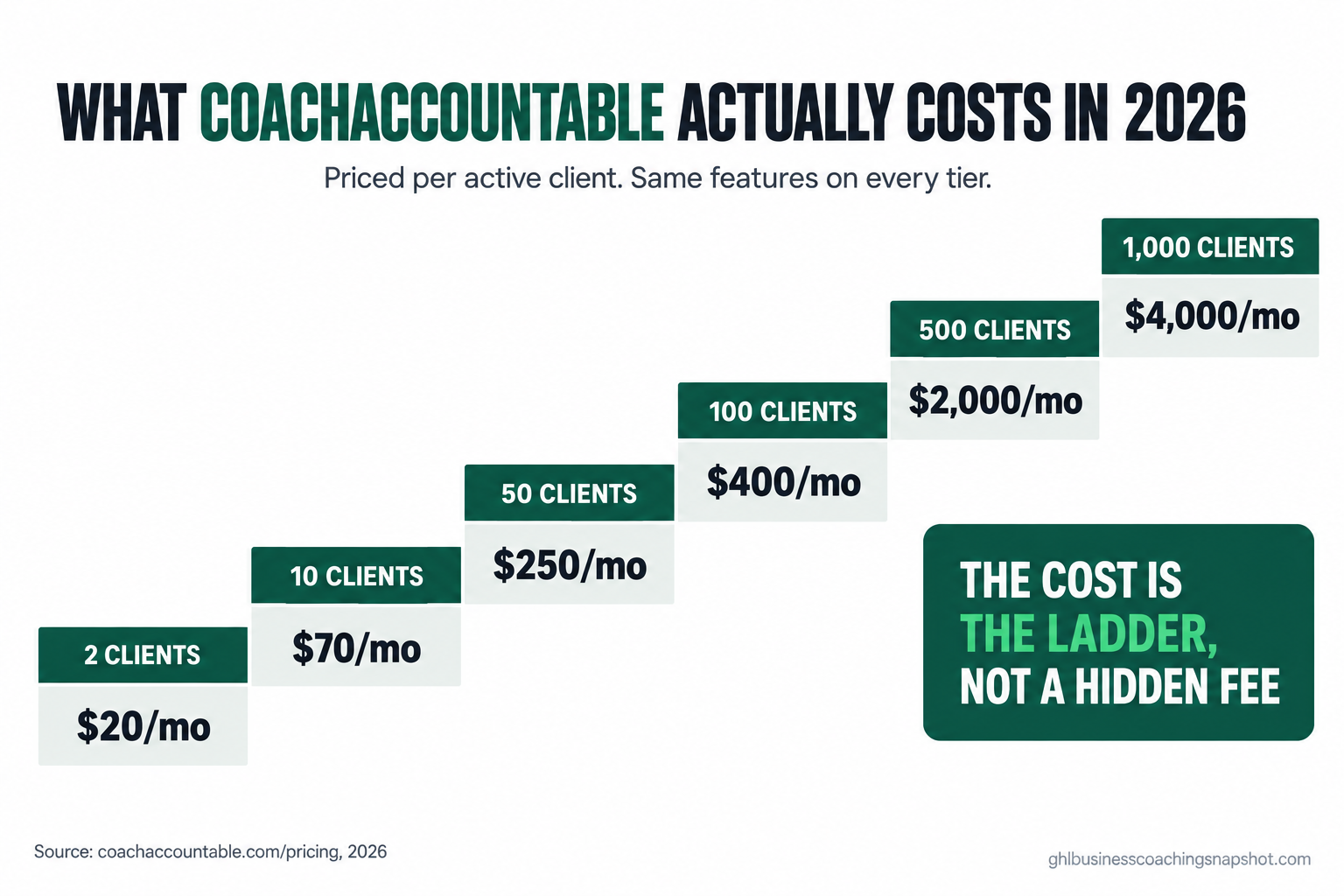
Short answer: in 2026 CoachAccountable prices by how many active clients you have, not by features. It starts at $20 a month for 2 active clients and climbs a long ladder: $40 for 5, $70 for 10, $120 for 20, $250 for 50, $400 for 100, $800 for 200, $2,000 for 500, and $4,000 for 1,000 active clients (CoachAccountable pricing). Here is the part most reviews bury: there are no hidden fees. No setup, no add-ons, no contact caps, unlimited coach and admin seats, and the same full feature set on every tier. So the honest cost question is not “what is Kajabi hiding.” It is two other things: how fast the ladder climbs as you fill your roster, and the front-of-funnel tools CoachAccountable never replaces, which you keep paying for on top. Below is the full ladder, the “active client” rule that moves your bill, and three real monthly budgets you can copy.
What does CoachAccountable actually cost in 2026?
It is renewal week, and a coach I work with forwarded me her CoachAccountable invoice with one line: “This keeps going up and I don’t understand why, the tool hasn’t changed.” It had not changed. She had. She signed up at $70 a month when she had nine clients, and two good cohorts later she was carrying 42 active clients and paying $250. Nothing was hidden. The number simply follows your roster, and nobody had told her that out loud.
So let us say it out loud. CoachAccountable prices by active clients, in flat monthly tiers, and the full ladder straight off its own page looks like this (CoachAccountable pricing):
| Active clients | Monthly price | Yearly if you stay there |
|---|---|---|
| 2 | $20 | $240 |
| 5 | $40 | $480 |
| 10 | $70 | $840 |
| 20 | $120 | $1,440 |
| 35 | $200 | $2,400 |
| 50 | $250 | $3,000 |
| 100 | $400 | $4,800 |
| 200 | $800 | $9,600 |
| 500 | $2,000 | $24,000 |
| 1,000 | $4,000 | $48,000 |
Source: CoachAccountable pricing, 2026. There are steps in between (75 clients at $340, 150 at $600, 250 at $1,000, and so on), and the top of the public ladder is 1,000 active clients at $4,000 a month.
CoachAccountable monthly price against active-client count, 2 to 500 clients. The line is close to straight because the model is close to a flat per-client rate. Source: CoachAccountable pricing, 2026. Confirm live rates before budgeting.
The coaching market paying for tools like this is still growing. The 2025 ICF Global Coaching Study, run by PwC for the International Coaching Federation, counts 122,974 coach practitioners worldwide, a record, up 15% since 2023, and $5.34 billion in annual revenue, with 57% of coaches also offering consulting (ICF). A lot of those coaches are on this exact ladder, climbing a rung every time a launch goes well.
Prices: CoachAccountable, 2026. Industry figures: ICF 2025 Global Coaching Study.
The per-client ladder and the “active client” rule
Most pricing arguments are about features. This one is about one word: active. CoachAccountable only counts clients who are currently active, and you can deactivate and reactivate a client at any time. An inactive client still has access to their records, they just do not count toward your tier (CoachAccountable pricing). That rule is the whole game, and it cuts both ways.
The good side: you are not billed for the client who finished a 12-week program in March and is done. Deactivate them and your count drops. If you run short engagements with clear endings, your active count can stay well below the number of people you have ever coached, and your bill stays low.
The catch: you have to actually do the deactivating, and be honest about who is active. A client on a monthly retainer is active every month. A group cohort of 30 people is 30 active clients for the length of the cohort, even if your attention per person is light. Fill two cohorts that overlap and your active count, and your tier, jumps on the calendar, not on your revenue. The coach from the opening did not have a pricing problem. She had an active-client-count problem she was not managing.
So the cost is partly in your control. The ladder is fixed; where you sit on it depends on how disciplined you are about deactivating finished clients. That is a real operational habit, not a billing trick, and most coaches never set it up.
The fees that are not there (and the one real cost)
This is where CoachAccountable earns genuine credit, and where a teardown has to be fair. When you go hunting for the hidden fees that sink most coaching tools, you come up empty. From its own pricing page: no setup fee, no cancellation fee, no add-ons, no contact caps, unlimited coach and admin logins, and the complete feature set on every plan (CoachAccountable pricing). The 30-day free trial needs no credit card. Payment processing goes through your own Stripe or Square account at their normal rates, so CoachAccountable is not taking a slice of every sale either. Compared with a course platform that meters your contacts and surcharges you for keeping your own Stripe, this is refreshingly plain.
So if the fees are not the hidden cost, what is? Two things.
One: the ladder is the fee. On a tool with hidden charges, the surprise is a line you did not expect. Here the surprise is the tier you climbed into. It is honest and it is predictable, but it is still the thing that makes your bill rise, and it rises with the size of your roster rather than with your revenue. A group program of 40 people paying $200 each is the same active-client count as 40 one-to-one clients paying $2,000 each, and it costs the same on CoachAccountable. The model does not know or care what you charge.
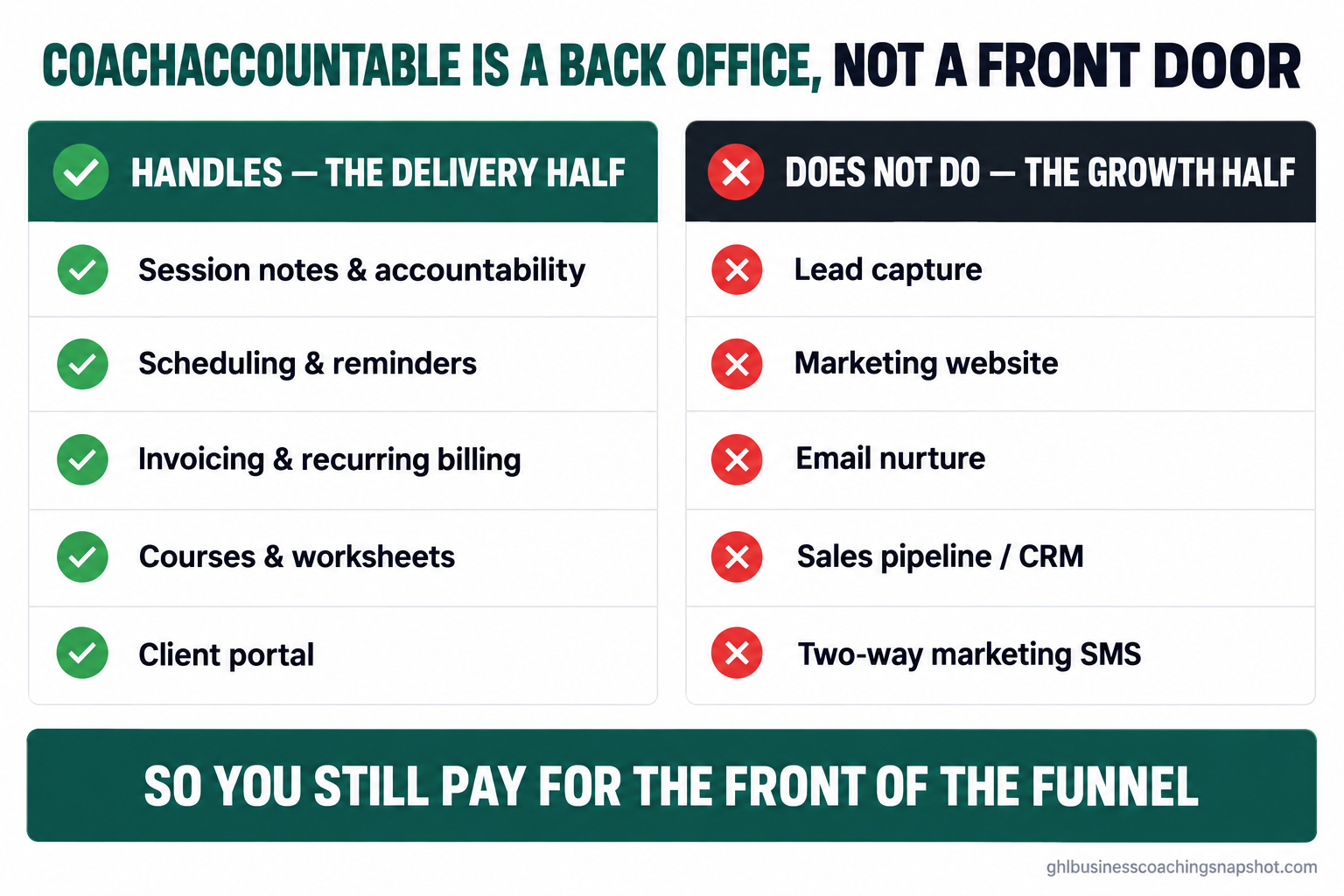
Two: it is a back office, not a front door. This is the cost almost no review states plainly. CoachAccountable is built for the half of the practice that happens after someone becomes a client: session notes, action items, worksheets, metrics, scheduling, contracts, invoicing, courses, and the client portal. It does that very well. What it does not do is the half that happens before: it has no marketing website or storefront, no lead-capture funnels, no email broadcast or nurture tool, no visual sales pipeline, and no two-way marketing SMS. Its own booking widget is designed to embed in a site you build somewhere else. That is a deliberate design choice, and for a coach who already has a steady pipeline it is fine. For a coach whose bottleneck is finding and booking clients, it means CoachAccountable is one line on a longer bill, not the whole answer.
Three real budgets: solo, boutique, scaling practice
The sticker on the ladder is the same for everyone. The real monthly number depends on your roster size and on the front-of-funnel tools you bolt on around it. Here are three budgets with the actual CoachAccountable math plus the stack most coaches run alongside it.
1. Solo coach, a handful of 1:1 clients
You coach 8 to 10 active clients at a time, mostly 1:1, and you already get your clients from referrals and your network.
- CoachAccountable tier: 10 active clients, $70 a month ($840 a year).
- Front of funnel you still pay for: a simple website and an email tool for your list, call it $15 to $30 a month. You probably do not need a CRM or an ad stack yet.
- Real monthly: roughly $85 to $100 all in.
- The verdict: at this size CoachAccountable is a genuinely good deal. It does more of the real job, the delivery, than most tools at the price, and your active count is low. The trap here is not cost, it is buying a bigger platform than you need because it looks more impressive. You do not.
2. Boutique running cohorts and retainers
Two or three coaches, a rolling 50 active clients across 1:1 retainers and a group cohort, and you are starting to run ads or a webinar to fill seats.
- CoachAccountable tier: 50 active clients, $250 a month ($3,000 a year). A full cohort can push you to the next rung for its duration.
- Front of funnel you still pay for: a marketing website, an email and nurture tool (around $39), a scheduler or landing-page tool, and increasingly a real sales pipeline to track discovery calls. Call it $80 to $150 a month, and it is a different login from CoachAccountable.
- Real monthly: roughly $330 to $400 all in, split across tools that do not talk to each other.
- The trap: the active count climbs on the calendar. Overlap two cohorts and you can brush the 75-client rung at $340 for a month, not because revenue rose, but because people are mid-program. Manage your deactivations, or the ladder manages you.
3. Scaling practice, big roster and a growth engine
A signature program, a membership, several coaches, and 200 active clients across everything, with real ad spend and a pipeline you have to track.
- CoachAccountable tier: 200 active clients, $800 a month ($9,600 a year), heading toward $1,000 at 250 and $2,000 at 500.
- Front of funnel you still pay for: a real CRM and pipeline, email, two-way SMS for booking and follow-up, a landing-page builder, and the automation glue between them. Easily $200 to $400 a month on top.
- Real monthly: comfortably $1,000 to $1,200 all in, and the CoachAccountable line alone is climbing every time you grow.
- The trap: paying the per-client ladder for delivery and a second full stack for growth, with an automation tool stitching the two together. At this stage the question stops being “is CoachAccountable cheap” and becomes “why am I paying two systems to run one practice.”
Representative all-in monthly cost by stage: the CoachAccountable tier plus the front-of-funnel tools it does not replace. CoachAccountable rates: CoachAccountable, 2026. Bolt-on ranges are illustrative; your number varies with roster size and which tools you run.
Where the per-client model quietly costs you more
The subscription is the visible cost. For a coaching practice specifically, three quieter costs sit behind it.
Growth is the price event. On a flat-priced tool, growing from 20 to 50 clients costs nothing extra. On CoachAccountable it is the difference between $120 and $250 a month, and 50 to 100 is another $150. That is just how per-client pricing works, but it means your most successful months are also your most expensive ones. If your margins are tight on a group program, model the tool cost per seat before you price the program, not after. A full look at where the whole tool bill lands as you grow is in the true monthly cost of running a coaching business.
The front of funnel is a separate bill, and a separate system. Because CoachAccountable does not capture, nurture, or close leads, the pipeline that actually feeds your practice lives outside it. So you run a marketing tool, maybe a scheduler, maybe an SMS tool, and an automation service to pass data between them. Each one is a login, a bill, and a thing that breaks. The real cost of a delivery-only tool is the stitched stack that grows up around it to do the selling. We tear that stack down in detail in client management software for coaches.
There is no sales pipeline, so your closing is invisible. CoachAccountable shows how your current clients are doing. It does not show how many discovery calls are booked, which proposals are out, or which leads went cold. For a referral-fed solo coach that is fine. For anyone growing deliberately, the missing sales pipeline is the thing you most need to see and the one thing the tool was never built to show.
CoachAccountable plus a stitched front end vs one consolidated system
CoachAccountable for delivery, plus a website, an email tool, a scheduler, and an SMS tool bolted on for the selling. Four to six bills, an automation service holding them together, a client count that climbs with every launch, and no single view of your pipeline.
One system that captures the lead, books the discovery call with reminders, runs the pipeline, sends the follow-up text, onboards the client, delivers the program, and recovers a failed retainer payment. One login, one predictable bill, no per-client meter running against your best months.
None of this makes CoachAccountable a bad product. It is a strong, honestly priced delivery tool, and for a small 1:1 roster it is one of the best-value options in the niche. It means you should price the whole job your practice needs, delivery and growth, before you decide what the per-client ladder is worth to you.
Steal this: the CoachAccountable cost audit and the export message
You cannot judge whether CoachAccountable is priced right for you until you know your real number and whether your tier is honest. Here is the 20-minute audit I run with coaches, and the message to send if you decide to move.
Step 1: Find your true active count. Open CoachAccountable and count clients actually marked active right now. Then count how many of those finished their engagement and should be deactivated. The gap is money you are paying for people you no longer coach.
Step 2: Add the tools CoachAccountable does not replace. List every other tool you pay to run the practice: a website, email, a scheduler, SMS, a CRM or pipeline, an automation service. Add their monthly cost. That total, plus your CoachAccountable tier, is the real cost of your setup, not the one invoice you were looking at.
Step 3: Label each tool with its one job. Delivery, scheduling, billing, courses, website, lead capture, email, pipeline, SMS, automation. Two tools sharing a label is overlap you pay for twice. CoachAccountable overlaps with a course platform, for example, if you run both.
Step 4: Ask the four questions. For every tool, including CoachAccountable:
- What one job does this do, and does anything else I pay for already do it?
- If I cancelled it tomorrow, what would break, and who would notice?
- Is it metered by clients, contacts, or seats, and where is the next tier jump?
- Could one consolidated system absorb this job and two others?
Step 5: Right-size before you switch anything. Deactivate every finished client. If that drops you a tier, you just cut your bill with no migration at all. Many coaches find a rung of savings sitting in stale active clients before they ever consider moving tools.
Step 6: If you are leaving, send this before you cancel. The message that protects your data and your billing:
Subject: Data export and cancellation
Hi, before I close my account I need to export my client data. Please confirm how I export session notes, client records, course content, and billing history, and in what format. Once I have confirmed the export, please cancel my subscription at the end of the current billing period and confirm in writing that no further charges will be made. I am not requesting a refund, only that renewal is stopped and confirmed. Thank you.
Ask for the export first, because client records and course content are the hardest things to rebuild, and ask for written confirmation that billing has stopped, which is your proof if a charge appears next month. Save the reply.
The compliance line on recurring billing
If you bill retainers or memberships on autopay, which most coaching practices do, two rules touch your checkout no matter which tool processes it. None of this is legal advice, so get a real review.
Auto-renewal is more regulated than most content admits. You may have read that a federal “click-to-cancel” rule was coming. The FTC’s Negative Option Rule was vacated by the Eighth Circuit on July 8, 2025 on procedural grounds and is not in force (Reuters). That is not a free pass. More than two dozen states have their own automatic-renewal laws, some stricter than the dead federal rule, so a recurring retainer still needs clear disclosure at signup and an easy way to cancel. Most competing articles still say the federal rule is coming. It is not, and the state laws are what bind you. The recovery side of billing, the charges that fail silently, is its own problem we cover in retainer billing recovery.
Testimonials have rules too. If you show client results anywhere near your offer, the FTC’s 2023 Endorsement Guides require that a testimonial showing an atypical result carry a clear disclosure of the generally expected result, or substantiation, and that any material connection be disclosed clearly and conspicuously (FTC). A “my client tripled her revenue” story needs a real disclosure beside it, whichever tool hosts the page.
Common objections
“CoachAccountable is cheap, why would I change?” At a small roster it is, and you might not. The point of the audit is to know your whole number, not the one invoice. If you run CoachAccountable plus a website, an email tool, a scheduler, and an SMS tool, the real cost is the stack, and a consolidated system can sometimes do more of it for a fixed price. If it is your only tool and your pipeline is referral-fed, the math leans toward keeping it.
“The per-client price feels fair, I only pay for what I use.” It is fair, and that is exactly why it is worth understanding. Your bill rises with roster size rather than revenue, so a well-run group program can push your tool cost up without pushing your margin up. Price the tool cost per seat into the program, and the fairness works for you instead of surprising you.
“I don’t need marketing features, I just need to run my clients.” Then CoachAccountable is a strong fit. The honest caveat is that most coaches who say this get clients from one source, referrals, a podcast, an audience, that could dry up, and the day it does, the missing front of funnel becomes the problem. Keep delivery where it works, but know where the growth engine lives before you need it.
“Isn’t a consolidated system harder to run than one simple tool?” Usually the opposite. The technical work is not the single tool, it is maintaining the stitched stack around it: the automation that breaks, the data that falls out of sync between the delivery tool and the marketing tool. A pre-built system arrives already wired. Setup is a one-time cost you can hand off, not a monthly one you babysit.
FAQ
How much does CoachAccountable cost per month in 2026?
CoachAccountable prices by active clients. It starts at $20 a month for 2 active clients and rises along a ladder: $40 for 5, $70 for 10, $120 for 20, $250 for 50, $400 for 100, $800 for 200, $2,000 for 500, and $4,000 for 1,000 active clients. Every tier includes the full feature set and unlimited coach and admin logins, and there are no separate setup or add-on fees.
Does CoachAccountable have hidden fees?
No. Its pricing page lists no setup fee, no cancellation fee, no add-ons, no contact caps, and unlimited coach and admin seats on every plan, with the complete feature set on every tier. Payment processing runs through your own Stripe or Square account at their normal rates. The cost that surprises coaches is not a hidden fee, it is the per-active-client tier they climb into as their roster grows.
What counts as an active client on CoachAccountable?
An active client is one currently marked active in your account. You can deactivate a client when their engagement ends and reactivate them later, and inactive clients still keep access to their records. Only active clients count toward your pricing tier, so deactivating finished clients is the simplest way to keep your bill in line with who you are actually coaching.
Is CoachAccountable worth it for a coach?
For a solo or small-roster coach who already has a steady source of clients, CoachAccountable is excellent value, because it handles delivery, accountability, scheduling, and billing well at a low tier. It is a weaker fit if your bottleneck is finding and booking clients, because it has no lead capture, no marketing site, no sales pipeline, and no two-way marketing SMS, so you pay for those jobs in other tools on top of it.
Why does my CoachAccountable bill keep going up?
Because it meters active clients, not revenue. Every time your active roster grows past a tier threshold, your price moves up a rung. Full cohorts and overlapping programs can push your active count up for a stretch even when your income has not changed. The fix is to deactivate clients as their engagements end so your tier reflects who you are currently coaching.
Is a consolidated all-in-one cheaper than CoachAccountable?
It depends on your roster and your stack. If CoachAccountable is your only tool and your pipeline is referral-fed, it is hard to beat at a small tier. Once you are paying CoachAccountable plus a website, email, a scheduler, SMS, and an automation service, a flat-priced consolidated system that does capture, booking, pipeline, follow-up, delivery, and billing can cost less than the stack and remove the integration maintenance. Add up your whole bill before you decide.
The invoice that follows your roster
Back to the coach from the start, staring at a bill that kept climbing. Nothing was wrong with CoachAccountable. The tool was honest, the price was predictable, and it did its job well. What she was missing was the whole picture: the number follows your active roster, finished clients left marked active were quietly padding it, and the invoice she was looking at was only the delivery half of what it costs to run a practice. The selling half was spread across three other logins she had stopped counting.
Run the audit this week. Deactivate your finished clients and see if you drop a rung for free. Add up every tool, label each one with its job, and cancel the overlap. Then decide, on purpose, whether a delivery tool priced by headcount plus a separate stack for growth beats one system that does both for a fixed number.
If you want the consolidated version already built, that is what the Coaching Snapshot is: lead capture, booking, pipeline, follow-up, onboarding, and retainer billing recovery in one GoHighLevel account, installed in 24 hours. If you are setting up GoHighLevel to run it, you can start through our GoHighLevel partner link. That is an affiliate link, so we may earn a commission at no extra cost to you.
Pricing on this page reflects CoachAccountable’s published 2026 rates and is linked to its own pricing page; software pricing is set by the vendor and changes often, so confirm the current number on the live page before budgeting. The all-in budgets are illustrative math built from CoachAccountable’s tiers plus representative tool costs, not quotes. Nothing here is legal, tax, or financial advice; consult a qualified professional on auto-renewal, sales-tax, and endorsement compliance. Outcome examples are illustrative, and we do not guarantee revenue, client count, or income gains; actual results depend on your offer, audience, and execution.