

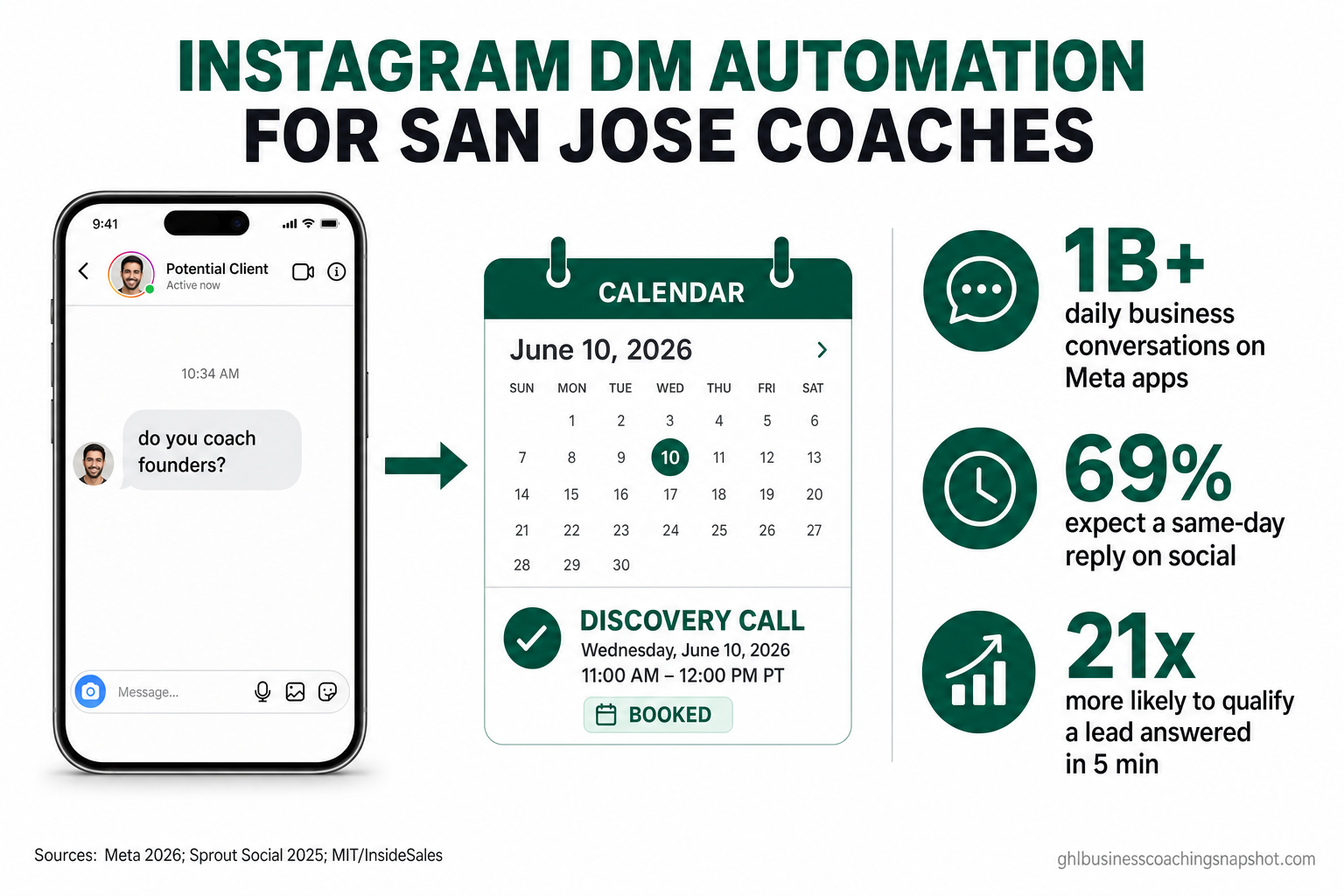
For a San Jose business coach, an Instagram DM is not a social pleasantry — it’s a warm, high-intent inbound lead that expires fast. A founder in Santa Clara watches your reel at 11pm, taps “Message,” and asks “do you work with early-stage SaaS founders?” If that message sits unread until you finish tomorrow’s client block, the moment is gone — and in a market this competitive, the next coach’s auto-reply already booked the call. This is a step-by-step playbook for closing that gap: how to automate your Instagram and Facebook DMs so every inbound message gets an instant, on-brand reply, gets qualified against your real criteria, and gets offered a discovery-call slot — without you living in your inbox.
Why DMs became a coach’s most valuable inbox
A decade ago, “message a business” meant email. Today it means the DM. Messaging between people and businesses has become one of the largest interaction channels on the internet: Meta reports more than 1 billion active conversation threads with businesses every day across WhatsApp, Messenger, and Instagram (Meta, 2026) — up from the roughly 600 million chats a day it cited in 2023 (TechCrunch). People don’t want to fill out a form and wait; they want to ask.
For coaches specifically, that shift is enormous, because the buying decision is relational. A prospect deciding whether to hand you $12,000 wants a human exchange before a form. Instagram is where that exchange starts: around 2 billion people use the app each month (Statista), 83% say they discover new products and services there, and roughly 90% follow at least one business (Instagram, via Hootsuite — platform-reported figures). When a coach’s reel lands, the “Message” tap is the highest-intent action a viewer can take. It’s a raised hand.
And the broader money is following the messages. U.S. social-commerce sales reached roughly $85.6 billion in 2025 and are forecast to top $100 billion in 2026 (EMARKETER). Buyers increasingly expect to transact through conversation: 77% of consumers want conversational messaging to help them choose a product or service, and 58% say they’d buy through a messaging channel if offered (Twilio, 2024). Your DM inbox isn’t a distraction from your funnel — for a modern coaching practice, it is the top of the funnel.
The real cost of a DM that goes cold
Here’s the uncomfortable part: the DM channel rewards speed, and coaches are structurally slow. The core billable activity — coaching — is a phone-off, inbox-closed block. Your highest-ticket prospects (founders, executives) send their “I need help” messages in the evenings and on weekends, exactly when a solo coach is off the clock. So the message that mattered most sits unread the longest.
The research on response speed is blunt. The landmark MIT / InsideSales Lead Response Management study found that contacting a lead within 5 minutes versus 30 minutes made you roughly 21× more likely to qualify them (MIT / InsideSales). That study is old (2007) and used a small sample, so treat the exact multiplier as directional — but the direction is confirmed everywhere. And the field is genuinely slow: Harvard Business Review’s audit of 2,241 U.S. companies clocked the average first response at 42 hours, with 23% never responding at all (HBR, 2011).
Relative odds of qualifying an inbound lead by first-reply speed (30-minute reply = baseline 1×). Source: MIT / InsideSales Lead Response Management study (2007; small sample — directional, not a current national figure).
On social, buyers are even less patient. Sprout Social’s 2025 Index found 69% of consumers expect a same-day response on social and 73% expect a reply within 24 hours — and critically, about 73% say they’ll buy from a competitor when a brand fails to respond (Sprout Social). HubSpot’s research is consistent: 82% of consumers rate an immediate response as important or very important when they have a sales question (HubSpot). A DM that goes cold isn’t neutral — it’s a warm buyer being actively handed to the coach who answered.
Then there’s the replacement cost. Winning a lost prospect back later is the expensive path — acquiring a new customer is widely cited as costing 5–25× more than keeping contact with one you already had (Harvard Business Review — a directional principle whose origin traces to older data). Letting a warm DM decay, then paying to re-acquire that person through ads, is the single most wasteful thing a coaching marketing budget can do.
Why this hits San Jose coaches especially hard
San Jose is one of the most demanding coaching markets in the country, and both sides of that — the opportunity and the pressure — argue for automating your DMs.
On the opportunity side, this is a deep pool of buyers who can afford a five-figure engagement. The San Jose–Sunnyvale–Santa Clara metro is home to roughly 1.97 million people, its largest employment sector is Professional, Scientific & Technical Services, and the metro’s median household income is about $162,576 (U.S. Census / Data USA); San Jose city’s own median household income sits near $141,565 (U.S. Census QuickFacts). Founders, engineers-turned-managers, and operators here are exactly the audience for executive, startup, and leadership coaching — and they’re comfortable buying through a screen.
On the pressure side, two Silicon Valley realities make a cold DM more expensive:
- An always-on, mobile-first culture. Your buyers here run on Slack and iMessage; they expect a business to reply the way a colleague would — in minutes, at any hour. A DM you answer “after my 4 o’clock” reads, to a Valley founder, as no answer at all.
- A crowded, fragmented field. Business coaching is a big, fragmented industry — roughly a $20.0 billion U.S. market spread across about 76,014 businesses with no dominant player (IBISWorld), and the global profession is still growing fast (ICF counts 122,974 coach practitioners generating $5.34B in 2025, up from 109,200 in 2023 — ICF 2025 Global Coaching Study). In San Jose specifically, a high-intent prospect has a long shortlist. Answering first is often how you get on it.
Automating your DM inbox neutralizes both. It answers on the first “ding,” at any hour, in your voice — so you stop feeding your reach and ad spend to the competitor down the 101 who happened to be at their phone.
What Instagram DM automation actually is (and isn’t)
Let’s be precise, because “DM automation” gets used for two very different things.
It is not blasting cold, unsolicited pitches into strangers’ inboxes. That’s spam, it violates Meta’s platform policies, and it torches your brand. This playbook is entirely about inbound messages — people who messaged you first, replied to your story, or commented on a post asking for more.
It is a conversational agent that treats every inbound DM like a trained front-desk person would: it replies instantly, asks the same intake questions you’d ask, checks your real calendar, and books the discovery call — then logs the whole thread in your CRM and escalates to you when a human is genuinely needed. It’s the DM-inbox sibling of an AI web-chat widget: same job, different doorway.
It also pairs naturally with comment-to-DM automation, where a public comment (“drop me the details”) triggers a private DM. Comment-to-DM starts the conversation; DM automation carries it to a booked call. Together they turn a viral reel into a full calendar instead of a full inbox you can’t clear.
Why does the message channel convert so well? Reach. A message lands and gets read: DMs and SMS carry a widely-cited ~98% open rate with most read within minutes, versus roughly 20% for email (Infobip — long-standing industry benchmark). When your qualification and booking happen inside the channel the prospect already opened, you remove every click that used to leak leads.
The playbook: 6 steps to DM-to-booked-call
Here’s the exact flow to build. Each step is a job the automation does so you don’t have to.
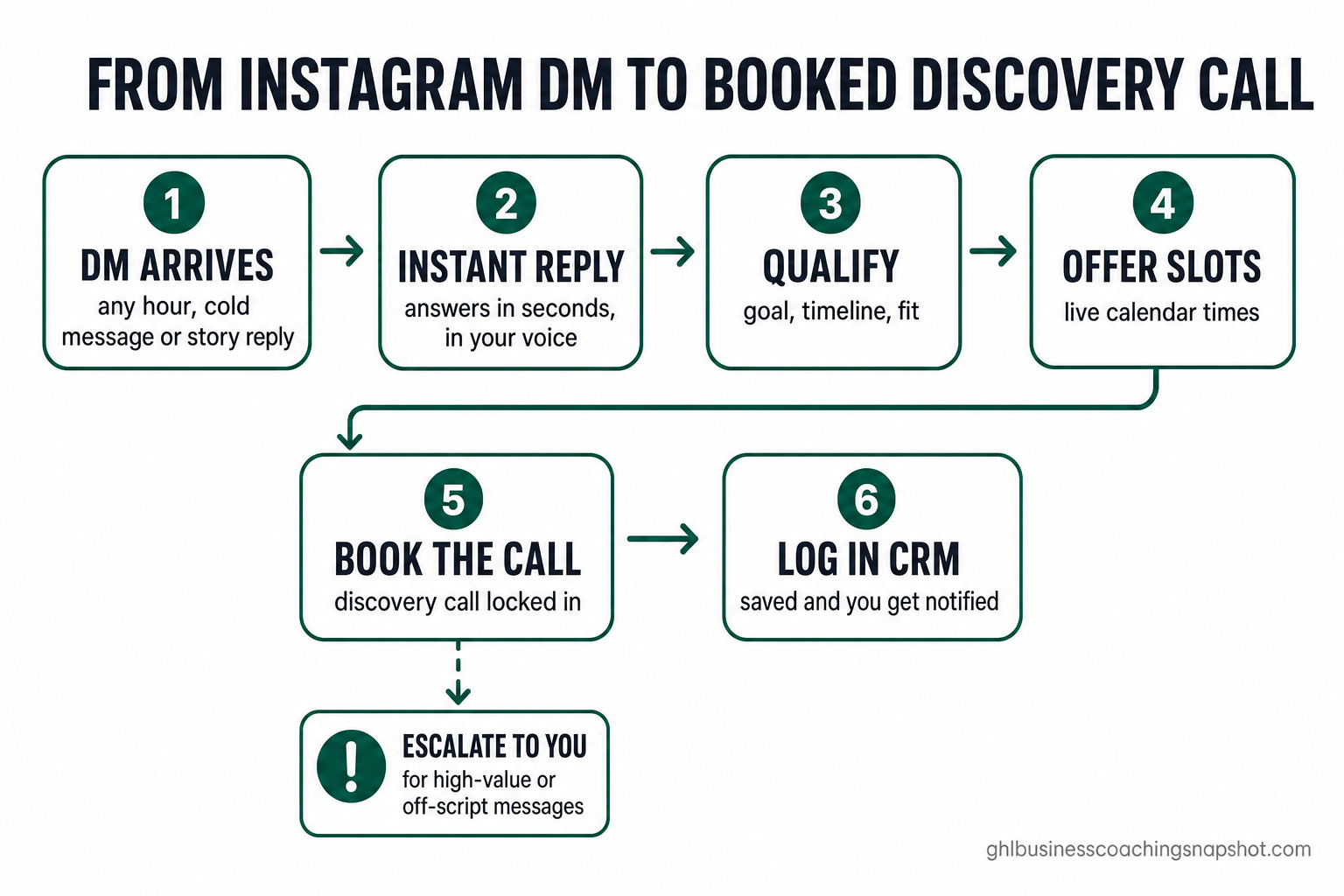
- Reply instantly, in your voice. The moment a DM arrives — a cold message, a story reply, or a “link please” — the agent responds within seconds with a warm, on-brand opener that acknowledges what they said. No “thanks for reaching out, we’ll get back to you.” An actual answer to their actual question.
- Qualify against real criteria. Conversationally, the agent asks what most coaches ask on the call: what they’re working on, their timeline, and whether they’re a fit for your program. This is the DM version of a coaching application form that actually qualifies — it screens for fit, not just volume, so your calendar fills with the right people.
- Offer real calendar slots. For a qualified prospect, the agent pulls live availability and offers specific times (“Thursday 10am or Friday 2pm PT?”). Booking inside the DM, while intent is peak, is the single most valuable action in a high-ticket funnel.
- Confirm and reduce no-shows. Once booked, it fires your confirmation and reminder sequence so the call doesn’t evaporate — the same discipline that drives fewer discovery-call no-shows.
- Log everything in the CRM. Name, the full conversation, qualification notes, and the booked appointment all flow into your GoHighLevel contact record and calendar — one place to see every lead and every booking, not a DM thread you’ll lose.
- Escalate to you when it matters. If a message is high-value, sensitive, or off-script, the agent flags it and pings you to step in — so a human enters exactly when a human is needed.
A Tuesday, 11:14pm, mid-scroll
A SaaS founder in Sunnyvale DMs 'do you coach early-stage founders?' after your reel. It sits unread until you're between sessions at 2pm the next day. By then she's messaged two other coaches — one replied in four minutes and booked her. You never even saw a lead.
The same DM arrives. The agent replies in seconds, asks about her stage and timeline, confirms she's a fit, and offers Thursday 10am. She books before she puts her phone down. You wake up to a qualified discovery call with notes attached.
How to build it in GoHighLevel
The good news for coaches already running GoHighLevel: the DM agent doesn’t live in a separate silo. It plugs into the CRM, calendar, and workflows you already use. At a high level:
- Connect your channels. Link your Instagram and Facebook accounts to the messaging platform — through the official connection flow, so no passwords ever change hands and you keep full control of your accounts.
- Give the agent your voice and rules. Feed it your intake questions, your qualification criteria, your program details, and a few example replies so it sounds like you — candid and warm, not a chatbot reading a script.
- Wire it to your calendar. The agent reads real availability from your GHL calendar and books directly, then triggers your existing appointment and reminder automation so booked calls stay booked.
- Bridge every conversation into the CRM. Each DM thread, with tags and qualification notes, lands on the contact record and pipeline — with escalation rules that text or notify you when a high-value prospect needs a human.
- Add the safety nets. Set fallbacks for questions the agent shouldn’t answer, an easy “talk to a human” path, and a follow-up nudge if a qualified prospect doesn’t book on the first pass.
You can wire these pieces yourself if you enjoy the build — or have the whole thing delivered done-for-you. Our done-for-you social media service includes an AI DM agent that answers your Facebook and Instagram messages, qualifies the prospect, collects their info, and books the discovery call straight onto your calendar, 24/7, in your coaching voice — alongside a comment agent and a website chat agent, and the content engine that generates the DMs in the first place.
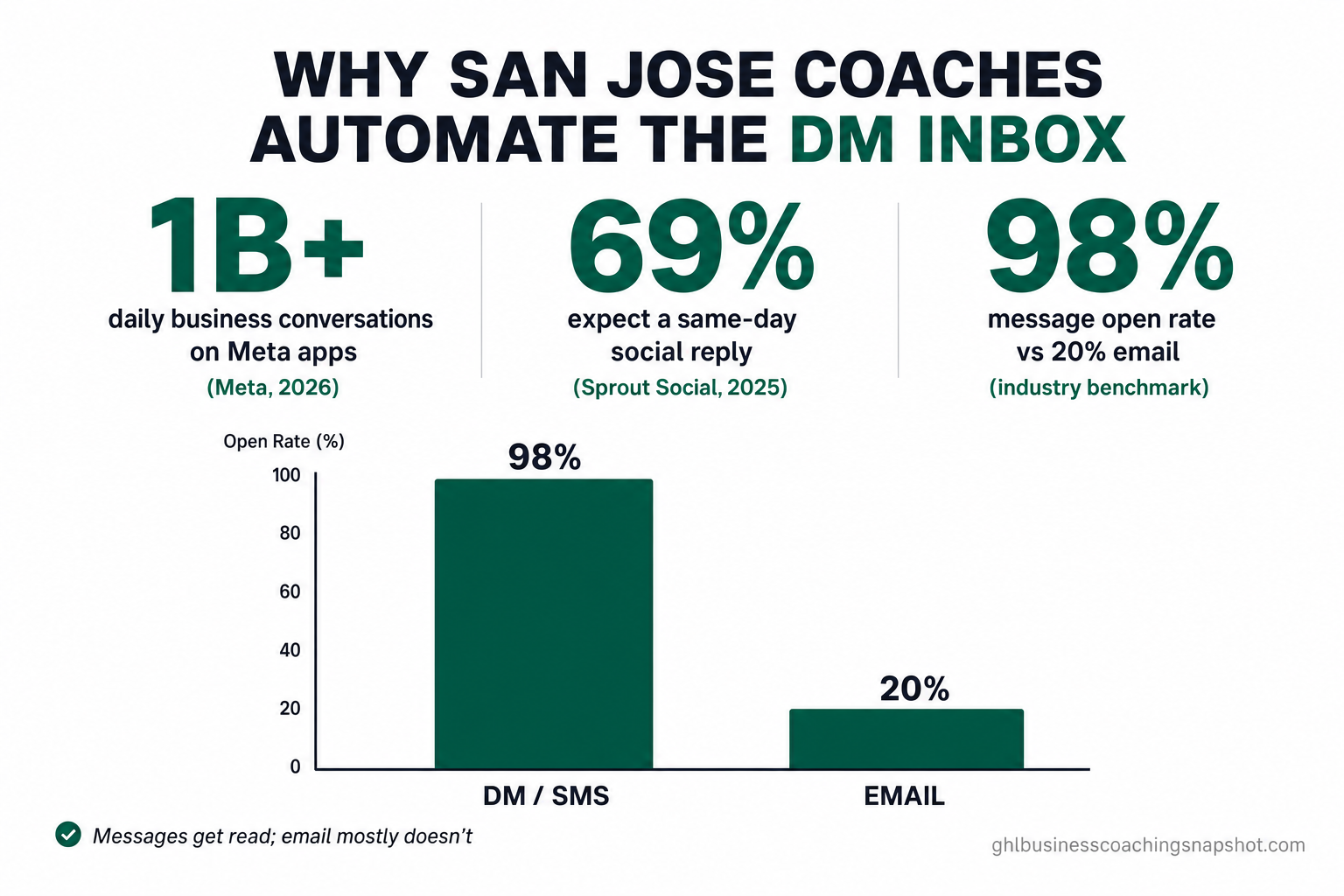
Approximate open rates by channel (percent). Message channels are read; email mostly isn’t. Source: Infobip (widely-cited industry benchmark, not a single fresh study).
Keeping it personal, not robotic
The obvious objection: isn’t answering a coaching inquiry with a bot cold? It would be — if the agent tried to be the coach. It doesn’t. The agent handles the part of the interaction that was never relational: the logistics of getting a qualified human onto your calendar. The real conversation — the discovery call and the coaching itself — is still you, fully present, with the context already gathered.
Think about what the alternative actually communicates. A prospect who DMs at 11pm and hears nothing for 18 hours doesn’t experience “warmth” — they experience being ignored. An agent that answers, engages with their specific question, and books them a slot feels like attentiveness: someone took them seriously the instant they reached out. Done well, automation at the front door doesn’t cheapen the relationship — it makes sure the relationship gets to start at all.
Three guardrails keep it human:
- Answer their question first, pitch second. The opener must respond to what they actually said, not deflect into a canned funnel.
- Qualify like a coach, not an interrogation. Two or three natural questions, not a form read aloud.
- Escalate fast. The instant a conversation has real nuance — a sensitive situation, a big-fish prospect, an off-script question — it goes to you.
For a San Jose coach competing in a fast, crowded, high-income market, the math is simple. Your prospects are in your DMs. Slow is the default. The coach who answers first — every time, at every hour, in a real voice — is usually the coach who gets the call. DM automation is how a one-person practice finally answers its inbox like a ten-person firm. It’s the same principle that runs through every system we build, from speed-to-lead for coaches to turning reels into discovery calls: protect the human moments by automating everything that isn’t one.
FAQ
What is Instagram DM automation for a coaching business?
It's a conversational agent connected to your Instagram (and Facebook) inbox that handles inbound messages 24/7 — people who messaged you first, replied to a story, or commented asking for details. It replies instantly in your coaching voice, asks your qualification questions, checks your real calendar and books the discovery call, and logs the whole conversation in your GoHighLevel CRM. It escalates to you when a message is high-value or needs a human. It is strictly for inbound conversations, not cold outreach.
Is automating my DMs against Instagram's rules?
Automating replies to inbound messages — people who contacted you first — is a supported, mainstream use of Meta's business messaging tools, and it's what this playbook covers. What violates Meta's policies (and torches your brand) is unsolicited cold DMing of strangers. Connect your accounts through the official platform flow so nothing about your login changes hands, keep the automation to inbound conversations, and always give people an easy path to reach a human.
Why is speed so important for coaching DMs specifically?
Because a DM is a high-intent, perishable lead. Buyers on social expect fast replies — about 69% expect a same-day response and roughly 73% will buy from a competitor if a brand doesn't respond (Sprout Social 2025). A landmark lead-response study found leads contacted within 5 minutes were about 21x more likely to qualify than at 30 minutes (MIT/InsideSales; older, small sample, so directional). For a solo coach who is in session all day, the only way to hit a minutes-not-hours reply standard around the clock is to automate the first touch.
Will a DM agent make my coaching practice feel impersonal?
Only if it tries to be the coach — which it shouldn't. A well-built agent handles the logistics of getting a qualified human onto your calendar: the instant reply, the intake questions, and the booking. The real conversation — the discovery call and the coaching — is still you, with the context already gathered. In practice, a prospect who DMs at 11pm and hears nothing for a day feels ignored, while one the agent answers and books feels taken seriously immediately. Answer their question first, qualify like a coach, and escalate anything with nuance.
Is DM automation worth it for a San Jose coaching practice specifically?
San Jose is a dense, competitive, high-income market — the metro's median household income is about $162,576 (U.S. Census / Data USA) and its biggest sector is professional and technical services, so there's a deep pool of five-figure coaching buyers who are comfortable buying through a screen and expect Slack-speed replies. In a fragmented field with a long shortlist of coaches, answering first is often how you get the call. A DM agent lets a one-person practice answer every inbound message instantly, at any hour, in your voice.
Can I build DM automation inside GoHighLevel?
Yes. You connect your Instagram and Facebook accounts to the messaging platform, give the agent your voice, qualification criteria, and program details, then wire it to your GHL calendar so it books directly and triggers your existing appointment reminders. Every conversation — with tags and notes — flows into your CRM contact record and pipeline, with escalation rules that notify you for high-value prospects. You can build it yourself, or have it delivered done-for-you as part of our social media service, which includes the DM, comment, and web-chat agents plus the content that generates the DMs.
Related reading
- Comment-to-DM Automation for Coaches — turn public comments on your posts into private DM conversations that book calls.
- AI Web Chat Widget for Coaches — the same instant-reply logic, on your website instead of your DMs.
- Speed to Lead for Coaches — the instant-response system every inbound inquiry should hit, on every channel.
- How to Reduce Discovery-Call No-Shows — once the DM books the call, keep it from evaporating.
- The Coaching Application Form That Actually Qualifies — the qualification logic your DM agent should ask.
- How to Get Coaching Clients on Instagram — the organic content strategy that fills your DMs in the first place.
About the author. Dana Whitfield is a GHL Automation Strategist for Coaches based in Austin, TX, who has spent the last eight years building GoHighLevel systems for 1:1 and group coaching practices — with a focus on discovery-call funnels, lead-magnet nurture, and high-ticket application screening. She is fascinated by the line between automation that feels personal and automation that feels like a robot wrote it.
Outcomes described on this site are illustrative, not guaranteed. The statistics cited are drawn from third-party research linked inline; some figures (notably the MIT/InsideSales 2007 study, the 2011 HBR audit, the 5–25× acquisition-cost principle, and platform-reported Instagram figures) are older, from limited samples, or self-reported, and are noted as such. Your results depend on your offer, audience, and execution.