

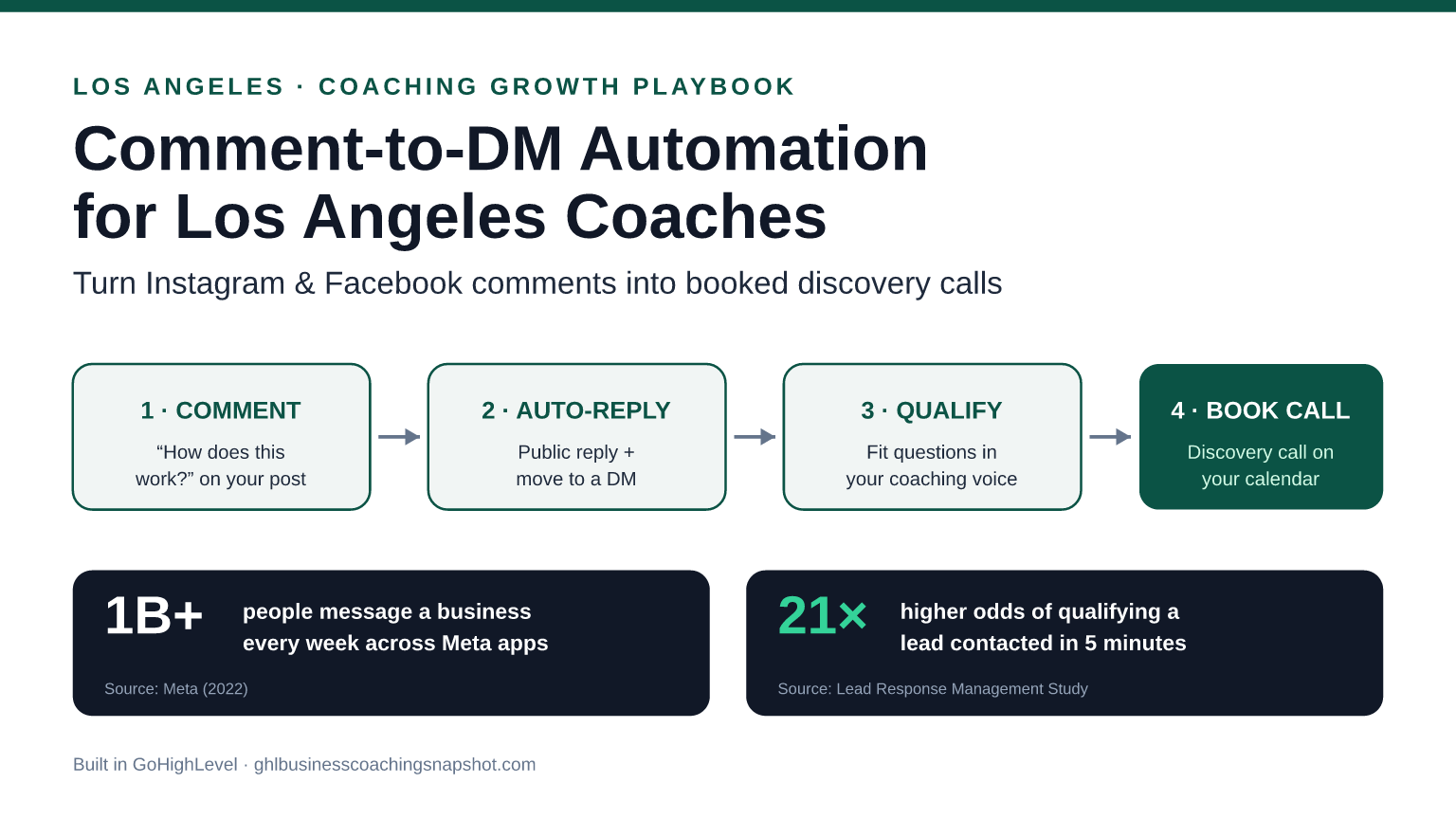
For a Los Angeles business coach, the most expensive words on your social media are “how does your program work?” left sitting in the comments for six hours. Someone in-market — a founder in Santa Monica, a sales leader in DTLA, an agency owner in Pasadena — watched your reel, felt the pull, and raised their hand in public. Then your day happened: back-to-back sessions, school pickup, the 405. By the time you see the comment, they’ve scrolled on, and the coach who replied in ninety seconds is the one now on their calendar. This is a how-to guide for building a comment-to-DM automation inside GoHighLevel (GHL) that catches that raised hand instantly — replies to the comment, moves the conversation into a direct message, qualifies the prospect in your voice, and books the discovery call — without you touching your phone.
Why LA coaches leak clients in the comments
Coaching has a demand problem most coaches don’t recognize as one: your best prospects rarely fill out a form. They engage. They comment “price?” under a carousel, they DM “is this for someone at my stage?”, they reply to a Story with a single flame emoji. Each of those is a warm, high-intent signal — and each one has a shelf life measured in minutes, not days.
The leak isn’t a lack of leads. It’s the gap between the moment someone raises their hand and the moment you respond. And that gap, for a solo or boutique coach, is structurally wide:
- You’re coaching when the comments come in. The whole point of your practice is being fully present with a client for 60 minutes at a stretch. That’s exactly when a reel is peaking and the comments are landing — and you can’t (and shouldn’t) break a session to answer them.
- The interesting conversations hide in three inboxes. Instagram comments, Instagram DMs, and Facebook Messenger are three separate streams, and the good stuff — “how do we start?” — is buried between spam, bots, and “love this 🙌”.
- Manual replying doesn’t scale past a good week. The better your content performs, the more comments you get, and the further behind you fall. A reel that finally breaks out becomes a pile of unanswered raised hands.
- “I’ll DM them later” almost never happens. By the time your day clears, the prospect’s moment of intent has cooled — and someone louder or faster has already replied.
None of this is a discipline failure. It’s a timing and consistency problem, and timing-and-consistency problems are precisely what automation is for. The same logic drives speed-to-lead for coaches: the fix isn’t to try harder to be fast, it’s to build a system that’s fast for you.
This matters because Los Angeles is not a thin market. California is home to roughly 4.2 million small businesses (U.S. SBA Office of Advocacy, 2024), and the U.S. business-coaching market alone runs about $19.9 billion across ~80,490 businesses (IBISWorld). In a metro as dense and competitive as LA, that means abundant prospects — and abundant coaches competing for the same raised hand. The tiebreaker is who answers first.
The data: speed and messaging decide who books
If “reply faster” sounds like soft advice, the research says otherwise. Response speed is one of the most rigorously studied variables in all of sales, and the findings are blunt.
The window is tiny, and it closes fast. The foundational Lead Response Management Study — 15,000+ leads analyzed by Dr. James Oldroyd — found that contacting a lead within 5 minutes rather than 30 made you about 21x more likely to qualify it, and 100x more likely to even reach the person (Lead Response Management Study). It’s older research, but it remains the primary source everyone cites, and the follow-up work in Harvard Business Review confirmed the shape: firms that responded within an hour were 7x more likely to qualify a lead than those who waited even sixty minutes longer (HBR, “The Short Life of Online Sales Leads”).
And almost no business actually moves that fast. The same HBR audit of 2,241 U.S. companies found that only 37% responded within an hour, 16% took one to twenty-four hours, 24% took more than a day, and 23% never responded at all. That’s the real competitive landscape — and it’s your opportunity. A coach who genuinely answers in seconds isn’t competing against a high bar; they’re competing against silence.
How fast businesses actually respond to an inbound lead (share of companies, percent). Most are slow or silent. Source: Harvard Business Review, “The Short Life of Online Sales Leads” (audit of 2,241 companies, 2011; directional).
Meanwhile, the conversation moved into the DM. Buyers don’t want a phone tree anymore — they want to message. More than 1 billion people now message a business account across Messenger, Instagram, and WhatsApp every week (Meta, via Adweek), and Meta reports roughly 600 million chats a day between people and businesses (TechCrunch). Meta is leaning into it hard: click-to-message ads are a multibillion-dollar business used by roughly 40% of its advertisers (AdExchanger). Consumers have said for years they prefer it, too — a Facebook/Nielsen survey found 53% are more likely to buy from a business they can message directly (Campaign; ~2016, directional).
Put the two facts together and the strategy writes itself. Buyers are raising their hands in comments and DMs, they reward speed, and they punish silence — 73% will take their business to a competitor if you ignore them on social (2025 Sprout Social Index). The odds multiplier below is what you’re leaving on the table every time a comment sits unanswered.
How much more likely you are to reach and qualify a lead when you respond in 5 minutes vs 30 minutes (multiplier, ×). Source: Lead Response Management Study (Oldroyd) (2007; foundational/directional).
What “comment-to-DM automation” actually is
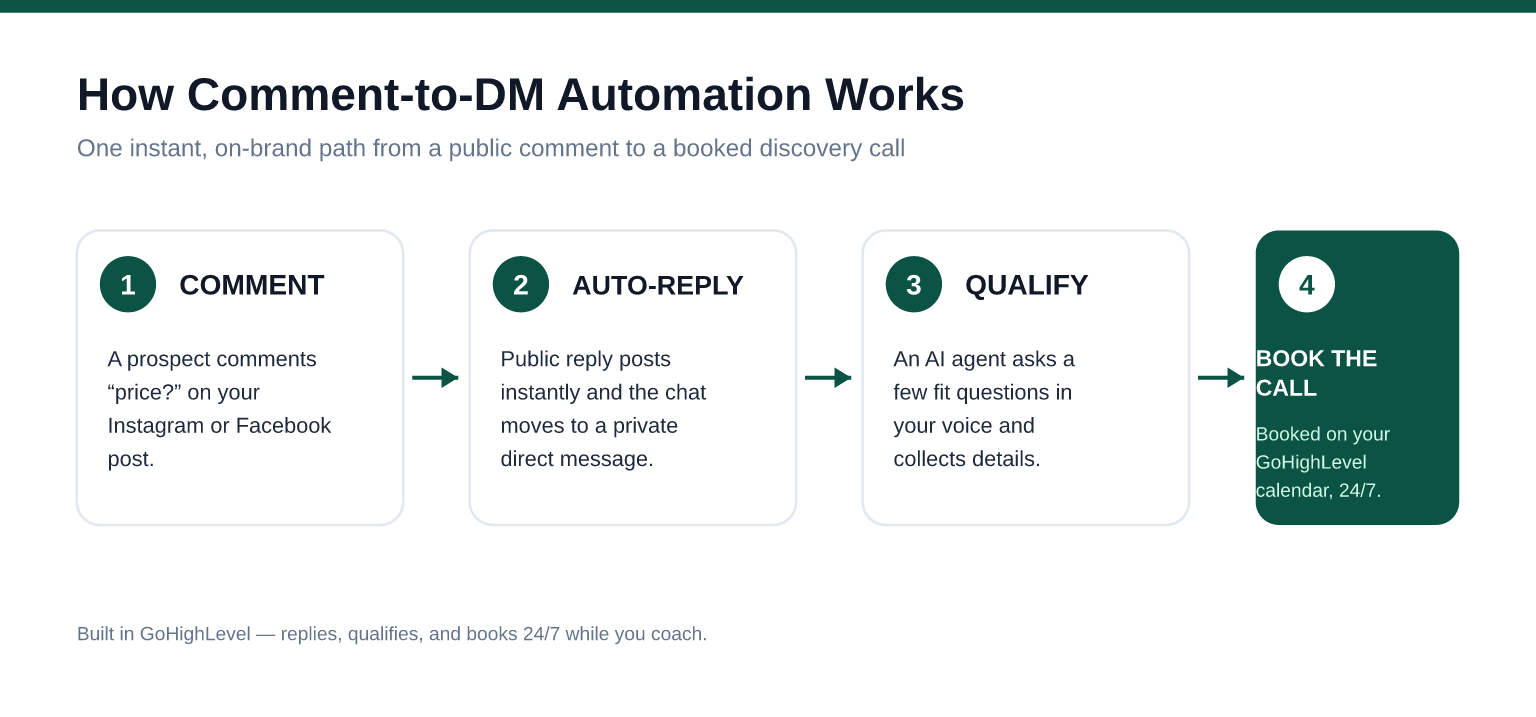
Comment-to-DM automation is not a spam bot that carpet-blasts “check your DMs 🔥” under every comment. Done right, it’s a triggered, well-timed conversation that treats a comment or a DM as the start of a real relationship — answering instantly, in your coaching voice, and moving a genuinely interested person one gentle step closer to a booked call. A coaching-tuned system does five jobs:
- Watches every comment and DM across Instagram and Facebook — one place, 24/7, so nothing sits unseen while you’re in session.
- Replies instantly and publicly to the comment — a short, human, on-brand acknowledgment (answering the question or inviting them to continue in DM), which also signals to the algorithm that your post drives engagement.
- Moves the conversation to a DM — where a real, private, qualifying exchange can happen without your pricing and process living in a public comment thread.
- Qualifies in your voice — asks the two or three questions that matter (stage, goal, fit) and collects contact details, so you only spend live time on people who are actually a match.
- Books the discovery call and hands off — drops the qualified prospect straight onto your calendar with a confirmation and reminders, and logs the whole thread in your CRM.
That combination — a Comment agent that replies under your posts and a DM agent that qualifies and books — is exactly what our done-for-you social media system runs across Instagram, Facebook, and TikTok, and it plugs directly into the GoHighLevel calendar, pipelines, and contact records you already use. It’s the social-media sibling of the website chat widget that books discovery calls — same job, different front door.
How to build it in GoHighLevel (step by step)
Here’s the actual build. If you’re comfortable in GHL you can wire most of this yourself; if you’d rather have it delivered and tuned to your voice, that’s what our team installs. Seven steps:
Step 1 — Connect Instagram and Facebook to GoHighLevel. In GHL, connect your Facebook Page and Instagram professional account so comments and DMs flow into the conversations inbox. This is the foundation: it turns three scattered social inboxes into one CRM-connected stream you can automate against. (Instagram DM automation requires an Instagram professional account linked to a Facebook Page — set that up first.)
Step 2 — Trigger on the comment. Build a workflow that starts when someone comments on a post or ad — ideally scoped to a keyword or intent (“price,” “info,” “start,” “how,” or a specific call-to-action word you use in captions like “GUIDE”). Keyword-scoping keeps you from auto-replying to “🙌” and focuses the automation on real raised hands. This is the Instagram DM and Facebook Messenger automation working together.
Step 3 — Reply to the comment publicly, then invite to DM. The workflow posts a short, warm public reply (“Just sent you a DM with the details 👇” or a one-line answer plus “happy to walk you through it — check your messages”). Keep it human and specific to the post; a canned reply under every comment reads as a bot and gets ignored. The public reply does double duty: it answers the watching audience and signals engagement to the algorithm.
Step 4 — Open the DM and start qualifying. The moment they’ve engaged, the DM agent opens a private message in your voice and asks the two or three questions that actually determine fit — where they are now, what they’re trying to change, and what kind of support they’re looking for. This is qualification, not interrogation: warm, brief, and clearly written by someone who coaches. The goal is to separate “ready to talk” from “just browsing” before you ever spend live time.
Step 5 — Route by intent. Qualified, in-market prospects get moved toward a booked call. People who aren’t ready get a helpful resource (a guide, a masterclass replay, a link to a relevant post) and a tag that drops them into a longer nurture — so a “not now” becomes a “later” instead of a dead end. This is the same intent-routing discipline behind good discovery-call follow-up.
Step 6 — Book the discovery call inside the DM. For qualified prospects, the agent shares your GHL calendar link (or books directly) and confirms the slot without ever leaving the conversation. Then appointment automation takes over: confirmation, calendar invite, and a reminder sequence by SMS and email — which is how you keep the no-show rate down on the calls you just worked so hard to book.
Step 7 — Log everything and loop in a human when it matters. Every comment, DM, qualification answer, and booking is tagged on the contact record in your CRM, and the workflow pings you (or your VA) the instant a conversation needs a real person — a nuanced question, a high-value prospect, an objection worth handling live. Automation carries the first 80%; you show up for the moment that closes.
A breakout reel drops on a Tuesday
Your reel takes off during a full client day. Forty-one comments pile up — nine of them ask about your program. You see them at 9pm, exhausted, and reply to the top three. The other six have moved on. Two already booked calls with coaches who answered while you were teaching.
The reel takes off. Each 'how does this work?' comment gets a warm public reply within seconds and a DM that answers, qualifies, and offers a time. By the time you check your phone between sessions, four discovery calls are on Thursday's calendar — booked in your voice, while you were fully present with the client in front of you.
The rules: staying compliant with Meta (and not sounding like a bot)
Automating conversations on Instagram and Facebook comes with real guardrails, and ignoring them is how accounts get restricted. Two principles keep you safe and effective:
The honest version isn’t a limitation — it’s what makes this work. Prospects can tell the difference between a bot that dumps a link and a system that actually reads their comment, answers it, and offers a real next step. Build it to be fast and helpful, keep a human in the loop for the conversations that deserve one, and you get the speed advantage without the spam risk. If you’d rather not manage the policy details yourself, keeping the automation compliant and on-voice is part of what our social media management team handles.
Why this matters more in Los Angeles
Los Angeles concentrates two things at once: an enormous pool of high-intent buyers, and an equally enormous pool of coaches competing for them. Across Greater LA — from tech and media founders on the Westside to real-estate and sales teams across the Valley and DTLA — there’s a deep bench of people who can afford a five-figure coaching engagement and are actively scrolling for one. That’s the good news. The hard news is choice: an LA prospect who comments on your reel has probably engaged with three other coaches’ content this week, too.
Two local pressures raise the stakes:
- Your audience is mobile, distracted, and fast-moving. LA prospects are watching Reels between meetings, on the treadmill, stuck on the 10. The window in which their intent is live is short, and a reply that lands now — while they’re still in the app — is worth far more than a thoughtful DM eight hours later.
- Speed is your cheapest competitive edge. You may not out-spend the coach with a bigger ad budget, but you can absolutely out-respond them. When only 37% of businesses answer within an hour (HBR), instant, qualified, on-brand replies are a moat you can build this week — and it compounds with every reel, because organic reach on Instagram rewards the engagement your fast replies generate.
The math for an LA coach is simple. Your prospects are raising their hands in your comments and DMs every time your content works. Most will book with whoever answers first — and most businesses answer slowly, or not at all. A comment-to-DM automation is how a busy solo or boutique practice finally answers every raised hand, instantly, in your voice, and turns the engagement you already earn into calls on your calendar.
FAQ
What is comment-to-DM automation for a coaching business?
It's an automated system that watches your Instagram and Facebook posts, replies instantly to comments (especially ones showing buying intent like 'price?' or 'how does this work?'), moves the conversation into a private direct message, qualifies the prospect with a few questions in your coaching voice, and books a discovery call onto your calendar — all without you touching your phone. Built in GoHighLevel, it turns the engagement your content already earns into booked calls, and logs every conversation in your CRM.
Why does response speed matter so much for booking coaching clients?
Because intent is perishable. The Lead Response Management Study found that contacting a lead within 5 minutes rather than 30 makes you roughly 21x more likely to qualify it, and Harvard Business Review found firms that respond within an hour are about 7x more likely to qualify a lead than those who wait even an hour longer. Yet only 37% of businesses respond within an hour and 23% never respond at all (HBR). For a coach, answering a comment or DM in seconds instead of hours is often the entire difference between booking the call and losing the prospect to a faster competitor.
Isn't automating Instagram and Facebook messages against the rules?
Not when it's done correctly. Meta allows businesses to respond to people who have engaged with them (commented or messaged), and provides official tools and messaging windows for it. What's prohibited is cold-blasting strangers or deceptive impersonation. A compliant build responds to genuine engagement, stays inside Meta's messaging windows, uses approved message tags, sounds clearly like your practice, and hands off to a human for anything nuanced. Keeping it compliant and on-voice is exactly what our done-for-you social media service manages.
Will automated replies make my coaching brand sound like a bot?
Only if they're built lazily. A good comment-to-DM system replies specifically to the actual comment, uses your coaching voice and phrasing, asks real qualifying questions, offers a genuinely useful next step, and loops in you or your VA the moment a conversation needs a human. The goal isn't to fake a live person — it's to be fast and helpful, so a prospect gets a real answer now instead of silence for eight hours. Prospects reward that; they don't punish it.
Do I need to be on GoHighLevel to run comment-to-DM automation?
It's built to run natively inside GoHighLevel, using its social connections, conversations inbox, calendar, forms, and workflows so your comment and DM automation shares data with your pipeline, appointment reminders, and client records. If you're not on GHL yet, that's the foundation we set up first. You can build the workflow yourself if you enjoy the work, or have the full coaching-tuned system installed and managed done-for-you as part of our social media service.
What happens to prospects who comment but aren't ready to book?
They don't get dropped — they get routed. The automation tags anyone who isn't ready for a call and sends them a helpful resource (a guide, a masterclass replay, a relevant post) instead of a hard booking push, then drops them into a longer nurture sequence. That turns a 'not right now' into a 'later' rather than a dead end, so the content that earned the comment keeps working for you over the following weeks.
Related reading
- Done-For-You Social Media for Coaches — the service that runs the comment, DM, and web-chat AI agents described in this post.
- Speed-to-Lead for Coaches — why the first responder usually wins, and how to be one without living on your phone.
- How to Get Coaching Clients on Instagram — the organic reach that fills your comments in the first place.
- The 24/7 Website Chat Widget That Books Discovery Calls — the same instant-answer idea, applied to your website’s front door.
- Reduce Discovery-Call No-Shows — keep the calls you just booked from evaporating before they happen.
About the author. Tara Iyengar is a Funnel & Client-Experience Designer based in Raleigh, NC, who builds the client-facing surface of coaching practices — application forms, masterclass funnels, accountability check-ins, and the SMS and DM cadences clients actually thank you for. She came up writing copy for course launches before specializing in the GoHighLevel build that sits underneath them, and she is opinionated about message timing and allergic to “just checking in” texts.
Outcomes described on this site are illustrative, not guaranteed. The statistics cited are drawn from third-party research linked inline; some figures (notably the 2007 Lead Response Management Study and the ~2016 Facebook/Nielsen survey) are older or vary by year and are framed as directional. Always follow Meta’s current platform and messaging policies. Your results depend on your offer, audience, content, and how you deliver.