

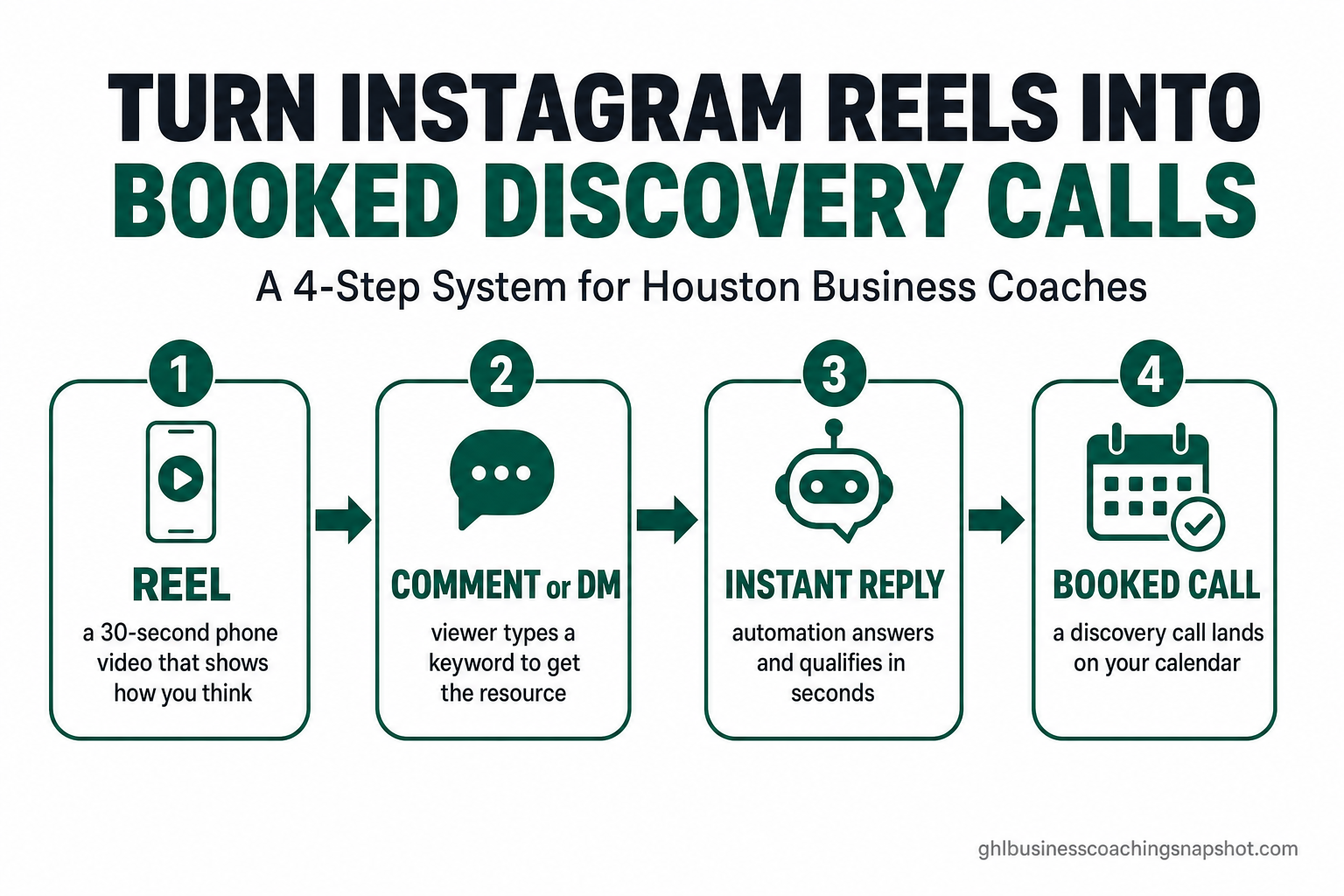
For a Houston business coach, a Reel that gets 40,000 views and zero booked calls isn’t marketing — it’s a hobby. The coaches winning right now aren’t the ones chasing virality. They’ve built a quiet machine: a short video engineered to be shared, a comment or DM that turns a viewer into a conversation, a reply that lands in seconds not hours, and a calendar link at the end of it. This is the build guide for that machine — the exact reel structure, the automation that catches the reply, and a 30-day plan you can run yourself or hand off.
The system, in one picture
Here’s the mistake almost every coach makes: they judge a Reel by its view count. But views don’t book calls — conversations do. A Reel’s only job is to start enough of the right conversations that some of them become discovery calls. Everything downstream of the video is what actually converts, and it’s the part coaches ignore.
Think of it as a four-stage relay, and a dropped baton at any stage kills the whole thing:
- The Reel earns a save, a share, or a comment.
- A trigger — a comment keyword or a DM — turns that spark into a one-to-one thread.
- An instant reply answers, qualifies for fit, and offers the calendar before the person’s attention moves on.
- The booking puts a real discovery call on your schedule.
The coaches who “can’t make content work” almost always have a stage-2 or stage-3 problem, not a video problem. They make decent Reels, then let the comments and DMs pile up for two days. By the time they reply, the buyer has scrolled past 300 other videos. The fix isn’t a better hook — it’s closing the gap between interest and response.
Why Reels are the highest-leverage channel for Houston coaches right now
Houston is one of the densest small-business markets in the country — Texas is home to roughly 3.5 million small businesses employing about 4.9 million people, ~44.9% of the state’s private-sector workforce (SBA Office of Advocacy, Texas 2025 Profile). That’s an enormous pool of founders, operators, and executives — exactly the people who hire business coaches. The US business coaching market itself is about $20 billion across ~76,000 businesses, and it’s highly fragmented, with no single firm holding more than 5% (IBISWorld). Fragmented means winnable: attention, not brand size, decides who gets the call.
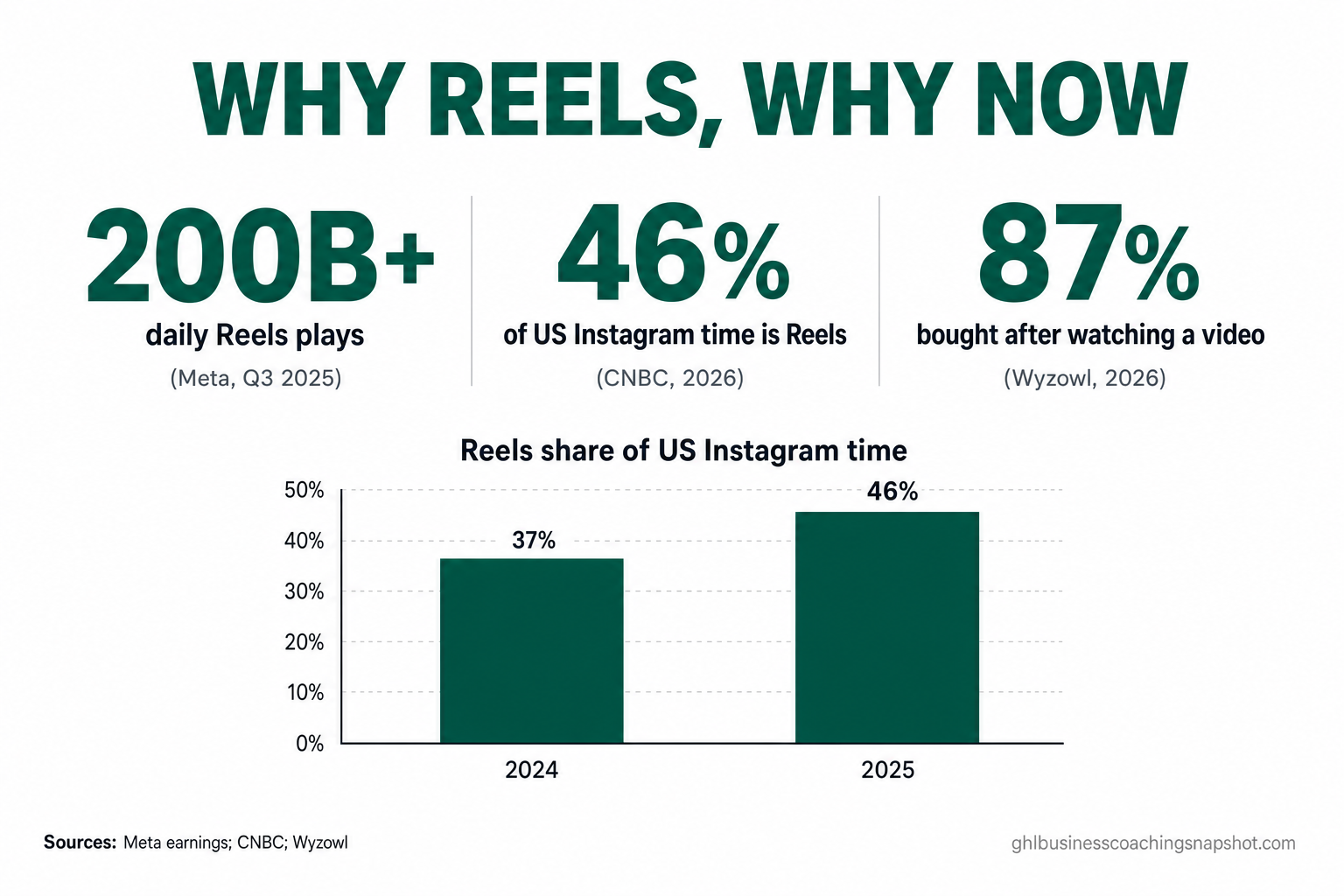
And attention has moved decisively to short-form video. Reels crossed 200 billion daily plays in late 2025 — roughly double the ~100 billion a year earlier (Meta, Q3 2025 earnings) — and now accounts for 46% of the time US users spend on Instagram, up from 37% the year before (CNBC).
Reels’ share of total US time spent on Instagram, percent. Source: CNBC, citing platform data (Jan 2026).
That matters because the format also sells. Short-form video is the highest-ROI content format marketers use, for the fourth straight year (HubSpot), and consumers say so themselves: 87% report being convinced to buy something after watching a video, 63% would rather learn about a product or service from a short video than any other format, and 84% want to see more brand video in 2026 (Wyzowl).
For a Houston coach, the takeaway is simple: your future clients are already spending nearly half their Instagram time watching Reels, and they’re primed to act on video. The only question is whether your Reel starts a conversation or just adds to the count.
Step 1 — Build the Reel to earn the share
You don’t need a studio. You need a phone, decent light, and a video built around one idea. The winning coaching Reel isn’t a produced brand film — it’s a talking-head clip with a strong first line, one point demonstrated, and a clear next step. Here’s the anatomy.
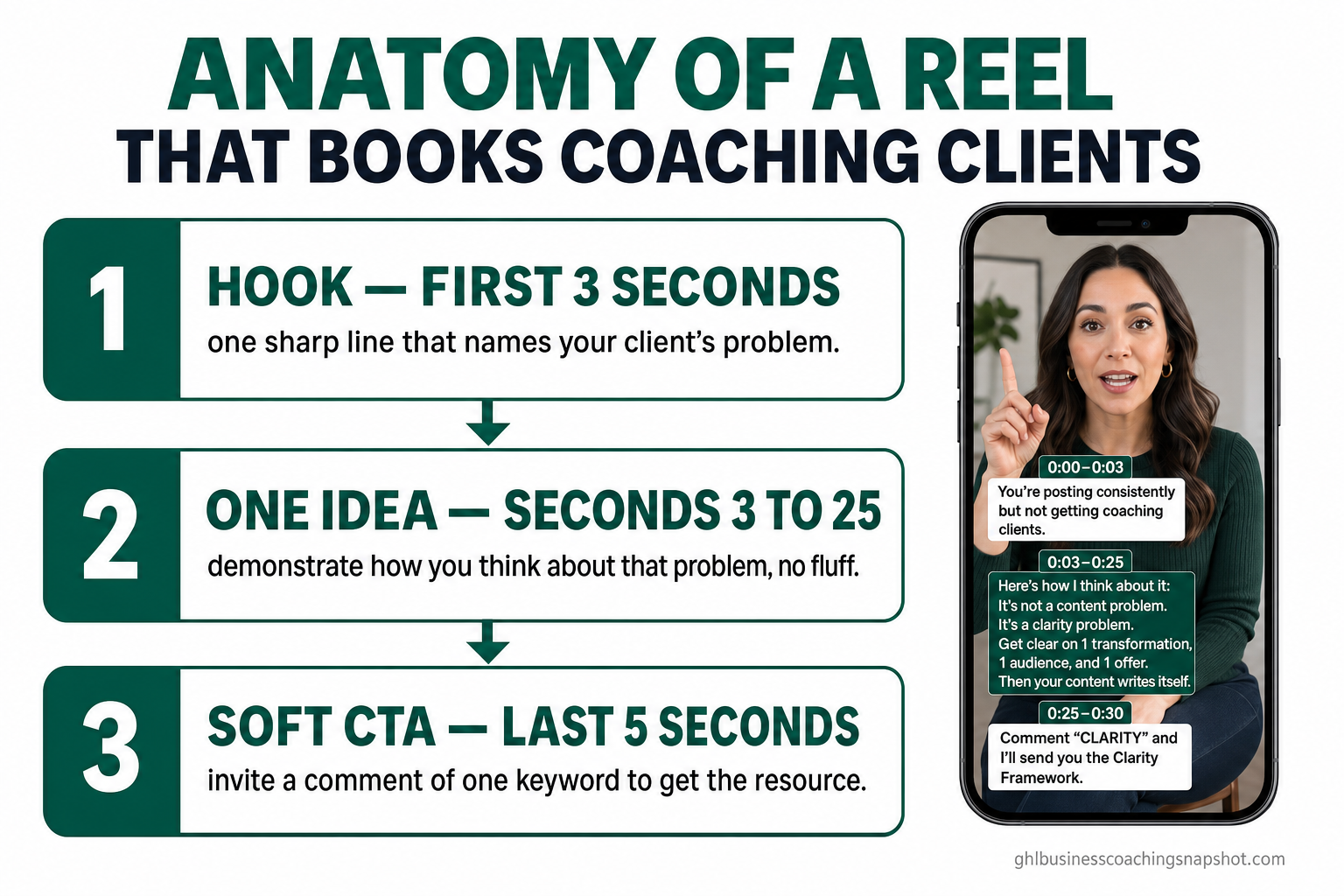
The hook (first 3 seconds). This is the whole ballgame. Name your buyer’s exact problem in one line, before you introduce yourself, before any logo animation. “The reason your discovery calls don’t close isn’t your pitch” beats “Hi, I’m a business coach” every time. If the first three seconds don’t stop a thumb, nothing after them matters.
One idea (seconds 3–25). Pick a single, specific point and demonstrate how you think about it. Not a list of ten tips — one idea, shown with enough substance that a founder thinks, “this person actually knows my problem.” Depth on a narrow point builds more authority than breadth. This is also what earns the save and the share, which is how the algorithm decides to show your Reel to non-followers.
The soft CTA (last 5 seconds). End with a low-friction invitation, not a hard sell. The highest-converting version for coaches is a keyword prompt: “Comment the word PLAYBOOK and I’ll send you the exact framework.” That single instruction does two things — it boosts the comment count (a ranking signal) and, crucially, it creates the trigger that Step 2 runs on.
Five hook formulas that work for coaches:
- The wrong assumption: “You don’t have a lead problem. You have a follow-up problem.”
- The cost of inaction: “Every discovery call you don’t book this week is roughly $X you’ll never see.”
- The contrarian take: “Stop niching down. Here’s what actually gets high-ticket clients.”
- The mistake callout: “Three things coaches say on a discovery call that kill the sale.”
- The mini case: “How one client went from chasing leads to a full calendar without more ads.”
Write for captions-on: most Reels are watched on mute, so burn your captions into the video and make the first line legible on screen.
Step 2 — Turn watchers into conversations
A Reel that ends without a way to raise your hand is a dead end. Step 2 is the bridge: the keyword comment or the DM that moves someone from passive viewer to one-to-one thread — where the actual selling happens.
The mechanic is the comment-to-DM trigger. When someone comments your keyword (“PLAYBOOK”), an automation instantly DMs them the promised resource and opens a private conversation. Done manually, this is impossible at scale — you can’t watch every comment thread across nine platforms while you’re mid-session. Done with automation, every single commenter gets an instant, personal-feeling DM and a path toward a call.
This is exactly the pattern in our comment-to-DM automation for coaches: a public comment becomes a private DM becomes a qualified conversation. In GoHighLevel, it runs on the built-in Instagram DM and Facebook Messenger responders, so the reply fires whether the person comments, DMs, or messages your page — no coach sitting there refreshing the app.
The design rule: the CTA in the Reel and the trigger in the automation must be the same word. If the video says “comment PLAYBOOK,” the automation listens for PLAYBOOK. Mismatched keywords are the single most common reason a comment-to-DM setup quietly does nothing.
Step 3 — Reply in seconds, qualify, and book
This is the step that separates coaches who book calls from coaches who collect views. Interest on social is perishable, and the data is blunt about it. Contacting a lead within 5 minutes instead of 30 makes you roughly 21× more likely to qualify them (MIT/InsideSales research), and 73% of consumers now expect a response within 24 hours or sooner on social, with DMs and comments among their most-preferred channels (2025 Sprout Social Index).
Sources: MIT/InsideSales Lead Response Management study; 2025 Sprout Social Index; Wyzowl Video Marketing Statistics 2026.
A good instant reply does three jobs in one short exchange:
- Deliver what you promised (the framework, the guide) so trust is earned, not asked for.
- Qualify with one or two light questions — “what are you coaching around right now?” — so you’re not booking calls with people who’ll never buy a $10K program.
- Offer the calendar with a direct booking link, so a warm person can pick a time in ten seconds instead of playing scheduling tag.
This is the same principle behind our speed-to-lead system for coaches, applied to social: the fastest credible response usually wins the client. The reason it has to be automated is arithmetic — a Reel that pops can generate hundreds of comments overnight, and no coach is answering all of them at 11pm. An automation replies to every one in seconds, qualifies, and hands you only the conversations worth your time. When there’s a real human moment, it pings you to jump in.
What happens after a Reel pops
A Reel gets 400 comments and you don't see them until tomorrow. You DM the first 30, give up on the rest, and your replies land hours or days later — cold. The warm buyers have already booked with a faster competitor, and you're left blaming 'the algorithm.'
Every commenter gets an instant, personal-feeling DM that qualifies them for fit and offers the booking link while attention is still hot. Only real, qualified calls hit your calendar — and you spend your hours coaching instead of chasing threads across nine apps.
Step 4 — Post enough to get a winner
No single Reel is guaranteed to hit. This is a volume-and-consistency game, and the numbers reward showing up. Analysis of millions of Instagram posts finds that accounts posting 3–5 times per week roughly double their follower-growth rate compared with those posting 1–2 times (Buffer / Metricool). More at-bats means more chances at the Reel that breaks out — and because the system captures every commenter, even your mid-performing videos book calls.
Sources: Buffer / Metricool cadence analysis; Meta Q3 2025 earnings; CNBC (Jan 2026).
The catch: consistent output is precisely the part busy coaches can’t sustain. You’ll ship Reels for three weeks, land a client, get busy delivering, and go dark for a month — right when the momentum was building. Consistency is a systems problem, not a willpower problem, which is why most coaches eventually put it on rails (more on that below).
The 30-day Houston launch plan
Here’s how to stand the whole system up in four weeks. It’s the same sequence we run for coaching clients — compressed so you can start solo.
- Week 1 — Foundation. Pick two or three themes you want to be known for (e.g., “scaling past founder-led sales,” “closing high-ticket without discounting”). Write 10 hooks. Set up the comment-to-DM automation with one keyword and connect your calendar booking link. Draft the qualifying questions.
- Week 2 — First reps. Film and post 4–5 Reels, one idea each, captions burned in, same keyword CTA. Confirm the automation fires: comment the keyword yourself and watch the DM + booking link arrive in seconds. Fix any keyword mismatch now.
- Week 3 — Volume + local angle. Post 5 more. Add a Houston-specific hook or two (“What I see coaching Houston founders get wrong about hiring”) — local specificity earns local trust and comments. Repurpose your best clip to TikTok, Shorts, LinkedIn, and Facebook.
- Week 4 — Read the data and double down. Look at which Reels drove the most saves, shares, and keyword comments — not just views. Make two more in the style of your top performer. Review every booked call: were they qualified? Tighten the qualifying questions if the calendar is filling with tire-kickers.
By day 30 you’ll know two things most coaches never measure: which topics start conversations, and how many conversations it takes to book a call. That ratio is your growth dial.
The metrics that tell you it’s working
Ignore vanity views. Track the chain that actually leads to revenue:
- Keyword comments / DMs per Reel — did the video start conversations?
- Reply-to-book rate — of the people your automation engaged, how many booked?
- Show rate — how many booked calls actually happen (this is where reminders earn their keep; see reducing discovery-call no-shows).
- Cost per booked call — even organic content has a time cost; know it.
- Saves and shares — the leading indicator that the algorithm will keep distributing a Reel to new Houston prospects.
If conversations are high but bookings are low, your reply/qualify step needs work. If bookings are high but shows are low, fix reminders. The system makes each leak visible instead of blaming “content.”
Run it yourself vs. hand it off
You can absolutely run this solo — the plan above is designed for exactly that, and plenty of coaches do it well. Be honest about the failure mode, though: the system only works if the Reels keep coming and the automation keeps firing. The week you get busy with clients is the week the content stops, and a month later you’re starting the momentum over from zero.
That’s the whole reason done-for-you exists. Instead of you filming, editing, captioning, posting across nine channels, and babysitting the comment-to-DM automation, a service runs the machine: content in your voice, 5 days a week across 9 channels, plus the AI agents that reply to comments and DMs and offer the booking link — so the conversations start and get answered whether or not you’re in session. That’s the difference between a Reel strategy you have and one that actually runs.
None of this replaces the thing that actually closes a high-ticket client: you, on the discovery call, being genuinely useful. The Reels system’s only job is to make sure enough of the right Houston buyers arrive at that call already trusting you. Build the video for the share, wire it to a conversation, answer in seconds, and post enough to get a winner — the calendar takes care of itself. For where social sits in the wider stack, see AI for business coaches; if you’re weighing in-house against outsourcing, we ran the DFY vs in-house numbers for Orlando coaches, and the Atlanta social media playbook covers the strategy layer above these mechanics.
FAQ
Do I need a lot of followers for this to work for my Houston coaching practice?
No. Reels are distributed largely to non-followers based on watch-through, saves, and shares, so a strong hook on a small account can still reach new Houston prospects. And because the system captures every keyword comment and DM, you book calls from the people who engage — not from a big follower count.
How many Reels do I have to post to book discovery calls?
Cadence matters more than any single video: accounts posting 3–5 times a week roughly double their growth rate versus 1–2 times (Buffer / Metricool). Plan on 3–5 Reels a week for at least 30 days before judging results — the volume is what surfaces the winners, and the automation books calls even from mid-performing videos.
What is a comment-to-DM automation, exactly?
When a viewer comments a keyword you name in the Reel (say, 'PLAYBOOK'), an automation instantly sends them a DM with the promised resource and opens a private conversation that qualifies them and offers your booking link. In GoHighLevel it runs on the built-in Instagram DM and Facebook Messenger responders, so it fires in seconds without you watching the app.
Why does the reply have to be instant?
Because interest on social is perishable. Research on lead response found that contacting someone within 5 minutes instead of 30 makes you about 21× more likely to qualify them (MIT/InsideSales), and 73% of consumers expect a social response within 24 hours or sooner (2025 Sprout Social Index). A DM that waits until tonight is usually a lost call.
Can I run this myself, or do I need a service?
You can run it yourself — the 30-day plan in this post is built for a solo coach. The realistic risk is consistency: most coaches go dark the moment client work gets busy. A done-for-you service exists to keep the content and the automation running 5 days a week across 9 channels so the pipeline doesn't stall when you get busy.
Related reading
- Comment-to-DM Automation for Coaches (Los Angeles) — the trigger that turns a public comment into a private, booked conversation.
- Speed to Lead for Coaches — why the fastest credible reply usually wins the client, on every channel.
- Done-For-You vs In-House Social Media for Coaches (Orlando) — the real monthly cost of each model, compared.
- Social Media Marketing for Coaches (Atlanta) — the strategy layer above these Reel mechanics.
- Reduce Discovery-Call No-Shows — protect the calls this system books with the right reminder sequence.