

You’ve outgrown stock GoHighLevel when the workarounds cost more than a build would. Concretely: your automations live in a stack of Zapier zaps that break without telling you, you’re paying someone to copy data between GHL and the tools around it, the feature you need simply isn’t in the platform, your reporting lives in three spreadsheets, generic AI bots can’t qualify a high-ticket lead, or a platform you depend on doesn’t talk to GHL at all. This is a pain-points post for business, executive, and startup coaches in San Francisco who already run GoHighLevel (GHL) and keep hitting the same walls. Below are the six signs — with the real, sourced cost of ignoring each one — and an honest read on when a custom GHL development build is cheaper than the duct tape.
What “outgrowing GoHighLevel” actually means
GoHighLevel is genuinely good at what it ships: CRM, pipelines, calendars, forms, email and SMS, courses and memberships, payment recovery — the whole back office of a coaching practice in one login. For most coaches, stock GHL plus a well-built snapshot covers 90% of the job on day one. Outgrowing it isn’t a knock on the platform; it’s what happens when your practice gets specific enough that the last 10% — the part that’s your offer, your cohort model, your reporting — stops fitting inside the defaults.
The tell is not “GHL can’t do this.” It’s “GHL can almost do this, so I bridged the gap with a zap / a spreadsheet / a VA / a manual export I run every Monday.” Each of those bridges felt free the week you built it. Together they become a second operating system — undocumented, fragile, and running on your attention. The average company already juggles 93 different applications (Okta, Businesses at Work 2024), and every seam between two of them is a place data can go missing.
That sprawl has a name and a number. Research from Harvard Business Review found that knowledge workers toggle between applications around 1,200 times a day, and reorienting after each switch adds up to just under four hours a week — about 9% of working time (HBR, 2022; the sample skews large-company, so read it as directional for a solo practice). Over a year, that’s the better part of five working weeks lost to tab-hopping — before you count the cognitive tax, which the American Psychological Association’s task-switching research puts as high as 40% of productive time (APA, summarizing foundational 2001 work — directional, but the direction is familiar to anyone who reconciles a failed payment, then a no-show, then a course-access ticket in three separate tabs).
Why San Francisco coaches hit this wall sooner
Two things about operating in San Francisco push coaches into custom-development territory faster than the national average.
First, the market is deep and crowded. California is home to 4.34 million small businesses — more than any other state (SBA Office of Advocacy, 2025 California profile), and more than 12% of them sit in the San Francisco metro, where small businesses account for 46.7% of area employment (SBA Office of Advocacy, 2024 metro profiles). That’s an enormous pool of founders, operators, and executives — exactly the buyers an executive or startup coach wants — and a correspondingly large pool of other coaches chasing them. Nationally, business coaching is already a $20.0 billion industry made up of about 76,000 mostly small firms with no single player holding more than a sliver of the market (IBISWorld, 2025). In a market that fragmented and that active, the coach who books the fast-moving Bay Area founder is usually the one whose intake, follow-up, and onboarding feel effortless — which only happens when the system behind them is coherent.
Second, manual work is simply more expensive here. The mean hourly wage across the San Francisco-Oakland-Fremont area is $48.19, versus $33.54 nationally (U.S. Bureau of Labor Statistics, May 2025) — roughly 44% above the national average. Whether the person copying leads from Calendly into GHL is you (at your billable rate) or an assistant (at a Bay Area wage), the hour costs more in San Francisco than almost anywhere else. That changes the math on automation: a workaround that’s tolerable at a Midwest labor rate can quietly become the most expensive line in a San Francisco practice.
Mean hourly wage, all occupations (USD). Manual admin time costs about 44% more in the SF metro than the national average. Source: U.S. Bureau of Labor Statistics, “Occupational Employment and Wages in San Francisco-Oakland-Fremont,” May 2025.
The 6 signs you’ve outgrown the defaults
None of these mean GHL is failing you. They mean your practice has gotten specific enough that the defaults need a custom layer on top. If two or more sound like your Monday, it’s worth pricing a build against the workaround.
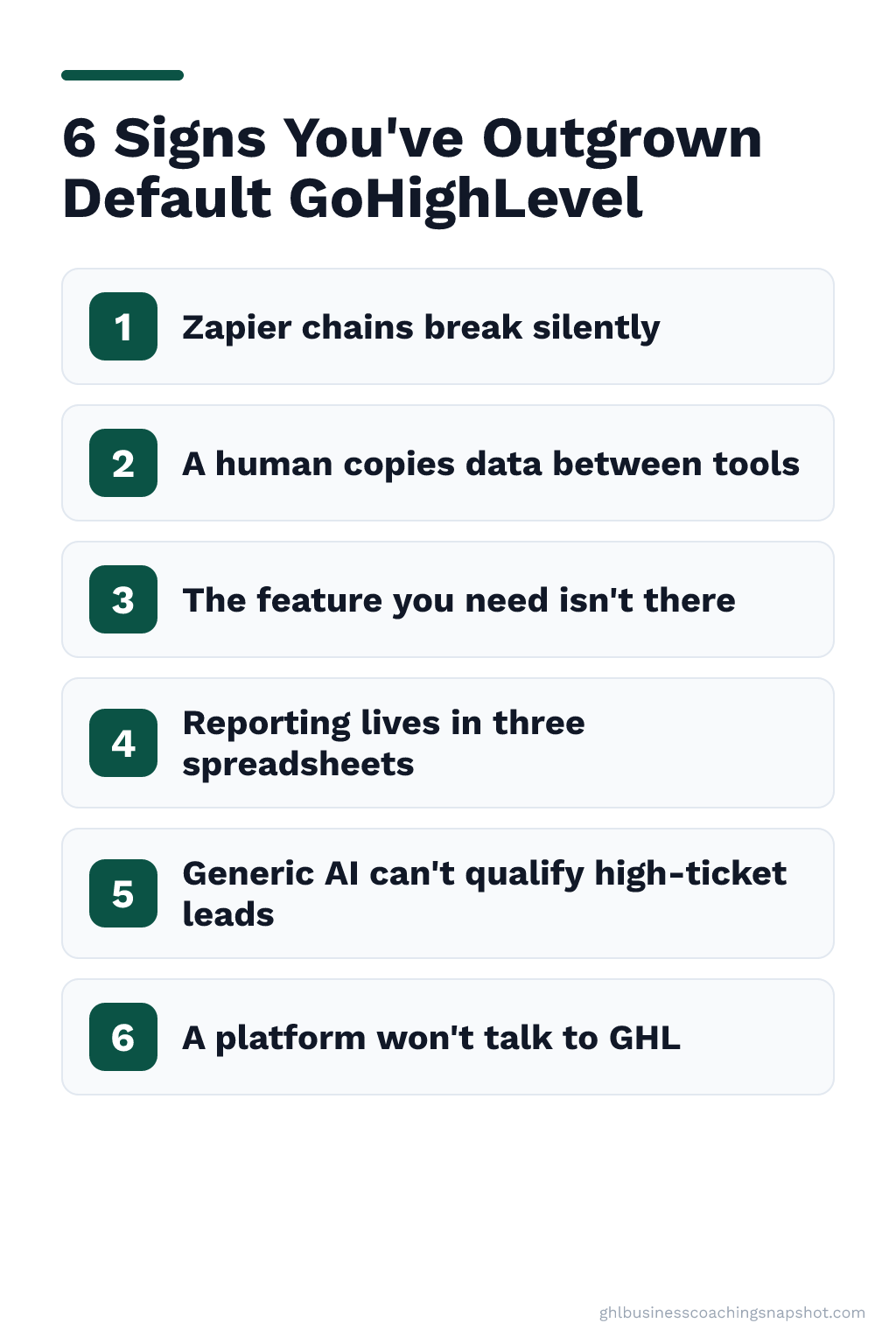
Sign 1 — Your Zapier or Make chains break silently
No-code glue is where most practices start, and there’s nothing wrong with that. The problem is that a chain of zaps has no error handling and no one watching it. A field renames upstream, an API quietly rate-limits, a trigger misfires — and the zap doesn’t tell you. It just stops. You find out three weeks later when a client says, “I never got the onboarding email,” and you realize a whole cohort slipped through a broken link in the chain. Multiply the ~1,200 daily context switches (HBR, 2022) by the mental load of also being the monitoring system for a dozen silent automations, and you’re running your practice on vigilance. Custom webhooks and GHL-native workflows with real logging and retry logic replace “hope the zap fired” with “the system tells me if anything fails.”
Sign 2 — You’re paying a human to copy data between GHL and other tools
If a VA’s weekly checklist includes “export bookings from Calendly, tag them in GHL,” or “reconcile Stripe against the pipeline,” you’ve found a seam GHL’s defaults don’t close. That’s a two-way sync problem, and it’s the single most common thing our team builds: a connector so a Calendly booking, a Circle community join, or a Teachable enrollment automatically tags the GHL contact, moves the deal stage, and fires the right sequence — no human in the middle (GHL development). The cost of not building it is paid every week at San Francisco wages of $48.19/hr (BLS, May 2025). Five hours a week of copy-paste is roughly $12,500 a year in labor — and that’s before the client who churns because a mis-keyed row dropped them from a renewal sequence. (If the answer is “I just need reliable hands on the system,” a dedicated GHL VA may be the right call instead — more on that split below.)
Sign 3 — The feature you need simply isn’t there
A branded client portal. A cohort dashboard your group program logs into. A program-specific calculator. A custom object GHL doesn’t model. Sometimes the gap isn’t an integration — it’s a feature the platform doesn’t ship and no marketplace plugin fits. This is the line between configuring GHL and extending it. A custom-built portal or dashboard that reads from the GHL API and adds exactly the layer your program needs is a defined, fixed-scope build — the same category as the custom client portal an NYC coach commissioned when Kajabi, spreadsheets, Stripe, and email stopped adding up to a client experience.
Sign 4 — Your reporting lives in three spreadsheets, not one dashboard
You want to see MRR by program tier, applications by source, and retainer churn in one place. Instead you export from GHL, export from Stripe, paste both into a Google Sheet, and rebuild the same view every month. That monthly ritual is “work about work” — the coordination and busywork that already eats 58% of the average knowledge worker’s day, versus the skilled, strategic work they were hired for, according to Asana’s survey of 9,615 knowledge workers (Asana, Anatomy of Work Global Index 2023). A custom reporting dashboard that pulls live from GHL plus your other tools turns a monthly export ritual into a URL you open.
Share of the average knowledge worker’s day (percent). Rebuilding reports by hand is “work about work.” Source: Asana, Anatomy of Work Global Index 2023 (survey of 9,615 knowledge workers).
Sign 5 — Generic AI chatbots don’t understand your high-ticket offer
Off-the-shelf bots are trained to answer FAQs, not to qualify a $25,000 engagement. When a prospective client asks whether your mastermind fits a Series-A founder, a generic bot either hallucinates or punts — and a mis-qualified lead is worse than no bot at all. A custom AI agent trained on your programs, offer, and qualifying criteria, wired into your GHL pipeline, can screen an applicant with branching logic, book the discovery call, and tag the contact correctly — the difference between a chatbot and an actual intake screener. This is standard custom GHL development work, and it’s where a coaching-specific build beats a bolt-on widget.
Sign 6 — A platform you depend on won’t talk to GHL
Your course lives in Kajabi. Your community is in Circle or Mighty Networks. Your calls book through Calendly. Your finance team wants QuickBooks. None of them natively syncs with GHL, so you live with islands of data that never reconcile — and course access, the thing clients actually pay for, is the riskiest island of all. A purpose-built connector (or, for agencies, a published GHL Marketplace app) makes those platforms two-way with GHL: an enrollment grants access and tags the contact; a cancellation in GHL revokes access automatically. If you’re weighing a full move instead of a bridge, our GoHighLevel migration playbook for coaches walks the consolidation route.
No-code duct tape vs. custom GHL development
The honest comparison isn’t “no-code is bad, custom is good.” No-code glue is the right first move, and plenty of practices never need to graduate from it. The comparison that matters is ongoing cost and risk versus one-time build cost — because the workaround keeps charging you every month, and the build charges you once.
Stock GHL + no-code duct tape vs. a custom GHL development layer
| Plan | Stock GHL + duct tape | Custom GHL development layer recommended |
|---|---|---|
| Price | $0 up front · pays every month | From $3K fixed · built once |
| Feature 1 | Zaps break silently — no logging, no retries | Webhooks with real error handling, logging & retries |
| Feature 2 | A VA copies data by hand (billed weekly at $48.19/hr in SF) | Two-way sync — no human in the middle |
| Feature 3 | Reports rebuilt from three spreadsheets each month | One live dashboard: MRR by tier, churn, source |
| Feature 4 | Generic bot mis-qualifies high-ticket leads | AI agent trained on your actual programs & offer |
| Feature 5 | Platforms don't reconcile — course access at risk | Course access grants & revokes automatically |
| Feature 6 | Fragile, undocumented, runs on your attention | Documented, owned, and yours to run |
| Price a build → |
Published pricing for these builds is transparent: fixed-scope quotes start around $3K for a simple GHL integration or platform connector, $5–15K for custom AI chatbots and course migrations, and $15–40K for full cohort dashboards and client portals, with an hourly retainer option at $75/hr for evolving work (GHL development). The point of listing them isn’t the numbers — it’s that you can set a build cost against a year of the workaround and get a real answer.
When a custom build is actually worth it (and when it isn’t)
Here’s the candid version, because over-building is as expensive as under-building.
A custom build usually isn’t worth it yet if you’re a solo coach with one program, a few hundred contacts, and no live subscriptions. Stock GHL plus a good snapshot and a couple of well-maintained zaps will carry you a long way, and you shouldn’t spend $5K to save two hours a month. Start there. If you just need reliable hands to run the system you already have rather than extend it, a dedicated GHL VA (from $997/mo) is the cheaper, faster fix — and we’re honest about that split.
A custom build starts paying for itself when the workaround’s annual cost — labor, churned clients, your own attention — clears the one-time build cost. Five hours a week of copy-paste at San Francisco wages is ~$12,500/year; a single lost high-ticket client can be $10–50K. Against a $3–15K integration, the math often flips fast. The other trigger is risk: if a broken automation or a mis-mapped course access can lose a paying client, the fragile version isn’t cheaper — it’s a liability you haven’t been billed for yet. We break down the broader build-vs-buy decision in the coaching snapshot vs. DIY, and where the two paths differ from a pure course move in the migration playbook.
A San Francisco coach's operations
Your assistant spends Monday morning exporting Calendly bookings and reconciling Stripe against the pipeline. Two zaps quietly broke last month, so a cohort missed its onboarding. You rebuild the same MRR report from three spreadsheets, and a generic chatbot keeps booking calls with unqualified leads. Every fix is manual, and the whole thing runs on you remembering to check it.
A booking, a payment, and a course enrollment each tag the GHL contact and move the deal stage automatically — no human in the middle. Webhooks log every run and retry on failure, so a break pages you instead of a client. One dashboard shows MRR by tier, source, and churn in real time. A custom AI agent screens applicants against your actual criteria before it ever books a call. You spend Monday coaching.
The build itself is a one-time event; the system it leaves behind runs your practice for years. That asymmetry — pay once, benefit for years, versus pay a little every week forever — is the whole argument for custom development, once you’re genuinely past the defaults.
FAQ
How do I know if I've outgrown default GoHighLevel?
Look for the workarounds, not the platform. You've outgrown the defaults when your automations live in brittle Zapier or Make chains that break without warning, you're paying a person to copy data between GHL and other tools, the feature you need simply isn't in GHL, your reporting is rebuilt from multiple spreadsheets each month, generic AI bots can't qualify your high-ticket leads, or a platform you depend on (Kajabi, Circle, Calendly) doesn't sync with GHL. One of these is normal; two or more that recur every week means the workaround now costs more than a build would.
How much does custom GoHighLevel development cost for a coaching practice?
Fixed-scope quotes typically start around $3K for a simple GHL integration or platform connector, $5–15K for custom AI chatbots and course migrations, and $15–40K for full cohort management dashboards and client portals, with an hourly retainer option around $75/hr for evolving or exploratory work. The right way to decide is to set the one-time build cost against a year of the current workaround — labor, churned clients, and your own time. In a high-wage market like San Francisco, the math flips toward building sooner.
Is custom development different from just hiring a GHL VA?
Yes, and they solve different problems. A GHL VA (from about $997/mo) reliably runs the system you already have — building workflows, managing contacts, handling day-to-day operations. Custom development extends what GHL can do: two-way integrations, custom dashboards and portals, webhooks with error handling, and AI agents trained on your programs. If you need hands on an existing setup, hire a VA; if you need capability GHL doesn't ship, you need development. Some practices use both — a developer builds the custom layer, and a VA runs it.
Why do San Francisco coaches need this more than coaches elsewhere?
Two reasons. First, the SF metro is one of the deepest and most competitive small-business markets in the country — California has 4.34 million small businesses, over 12% of them in the San Francisco area (SBA Office of Advocacy) — so a frictionless client experience is a real differentiator. Second, manual work is more expensive here: the SF-Oakland-Fremont mean wage is $48.19/hr versus $33.54 nationally (BLS, May 2025), about 44% higher, so every hour spent stitching tools together by hand costs more in San Francisco than almost anywhere else. That changes the automation math in favor of building.
Can you connect Kajabi, Teachable, Circle, or Calendly to GoHighLevel?
Yes — cross-platform integration is one of the most common custom builds. We build two-way syncs and webhook connectors between GHL and Kajabi, Teachable, Thinkific, Circle, Mighty Networks, Calendly, HubSpot, QuickBooks, Stripe, or anything with an API. A booked call, a community join, or a course enrollment can automatically tag the GHL contact, move the deal stage, and fire the right sequence, and a cancellation in GHL can revoke access on the other platform. Getting course access and active billing to reconcile cleanly is the technical heart of the job.
Will a custom build lock me into a proprietary system?
It shouldn't. Good GHL development keeps your business logic inside standard GoHighLevel workflows, forms, calendars, and webhooks wherever possible, and any custom software (a portal, a dashboard, a connector) is documented and owned by you. The goal is to extend GHL for how you actually coach, not to trap you in something only one vendor can maintain. Every fixed-price build should come with documentation and a bug-fix warranty so you're never stranded.
Related reading
- Custom Client Portals for NYC Business Coaches — when Kajabi, spreadsheets, Stripe and email stop adding up to a client experience.
- The GoHighLevel Migration Playbook for Coaches — the six-step way to consolidate a duct-taped stack into one clean GHL account.
- Build a Coaching CRM Sales Pipeline That Closes — the pipeline your integrations should feed.
- GoHighLevel vs. Kajabi for Coaches — decide which platform should own your practice before you build on top of it.
- The Coaching Snapshot vs. DIY — the honest build-vs-buy math on doing it yourself.
- Hire a GHL VA for Coaches — when you need reliable hands on the system rather than a custom build.
About the author. Dana Whitfield is a GHL Automation Strategist for Coaches based in Austin, TX, who has spent the last eight years building GoHighLevel systems for 1:1 and group coaching practices — with a focus on discovery-call funnels, high-ticket application screening, custom integrations, and clean workflow architecture. She is fascinated by the line between automation that feels personal and automation that feels like a robot wrote it.
Outcomes described on this site are illustrative, not guaranteed. Statistics are drawn from third-party research linked inline; some figures (notably the Harvard Business Review toggling data and the APA task-switching estimate) are enterprise-weighted or foundational/older, and are noted as such. Pricing and platform features vary. Your results depend on your offer, stack, and execution.