
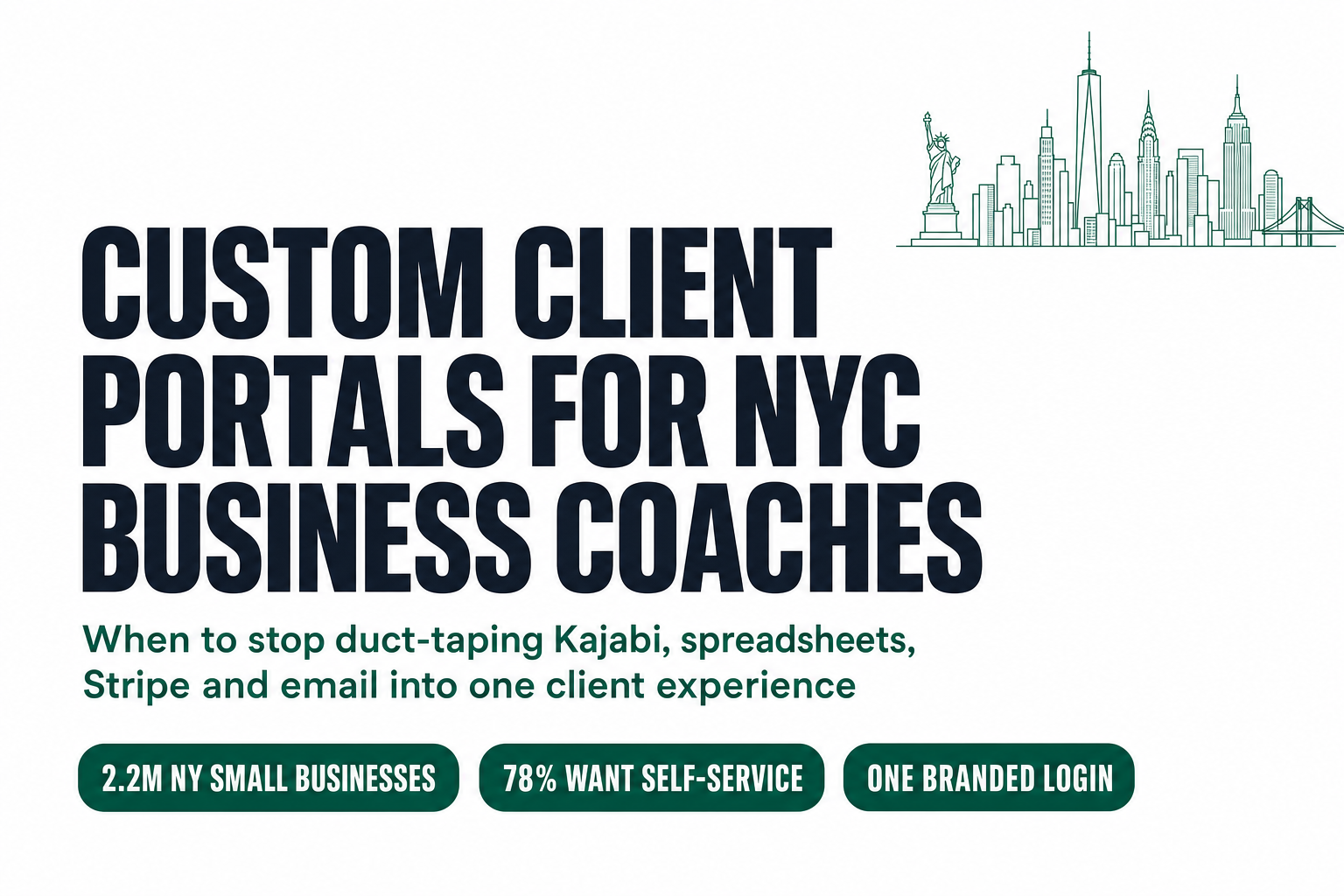
A New York City business coach usually doesn’t decide to buy custom software — they hit a wall. The wall is a Tuesday night spent copying a client’s email out of Kajabi into a spreadsheet, reconciling a failed Stripe charge, and answering the same “where do I find last week’s worksheet?” message for the third time. The duct-taped stack — a course platform, a scheduler, an email tool, Stripe, a spreadsheet, and a community app — made sense one purchase at a time. Together it became a second job, and none of it feels like the premium experience a $5K–$50K client is paying for. This is a pain-points post: what the patchwork actually costs a high-ticket NYC coaching practice in hours, churn, and risk — and the specific moment a custom client portal (one branded login where clients see their program, homework, billing, and progress in a single place) stops being a luxury and starts paying for itself.
The patchwork that runs most NYC coaching practices
No coach sets out to build a Frankenstein stack. You start with a scheduler because phone tag was killing you. You add an email tool for the newsletter. You launch a program on Kajabi or Teachable, run the community in Circle or Slack, take payments through Stripe, collect applications on a form builder, and track who’s paid, who’s behind, and who’s up for renewal in a spreadsheet you keep meaning to clean up. Each tool was the right call the week you bought it. Stacked together, they turn into an operations job you never applied for.
The tax isn’t only the pile of monthly invoices — it’s the switching between them. Harvard Business Review’s study of real work patterns found people toggle between applications and websites around 1,200 times a day, and that reorienting after each switch adds up to just under four hours a week — about 9% of their working time (HBR, 2022). For a coach whose calendar is already full of sessions, that’s the better part of a coaching day every week spent moving a name from one tab to another.
The hidden admin tax of a multi-tool stack. Source: Harvard Business Review, “How Much Time and Energy Do We Waste Toggling Between Applications?” (2022).
The deeper cost is that no single tool holds the truth. Kajabi knows what a client watched. Stripe knows whether they paid. Your spreadsheet knows they’re a Cohort 3 client on a payment plan who missed the last two check-ins. Nobody — not you, and definitely not the client — can see all of that in one place. That’s the gap a custom client portal is built to close, and it’s the same gap that makes a clean coaching CRM sales pipeline so valuable on the sales side.
Your clients already expect a portal — your tools don’t give them one
Here’s the uncomfortable part: your high-ticket clients are not grading your operation against other coaches. They’re grading it against every polished software experience they use all day — their bank, their payroll app, their kid’s school portal. And what those experiences trained them to expect is self-service: log in, see everything, do the thing, without emailing anyone.
The data backs up the expectation. 78% of CRM leaders report that customers want to solve their issues on their own before reaching out to a person (HubSpot, 2024). But the supply hasn’t caught up with the demand — Gartner found that only 14% of customer-service issues are fully resolved in self-service today (Gartner, 2024). That gap between what clients want and what scattered tools deliver is exactly where a coaching practice feels high-touch or feels chaotic.
The self-service gap, in percent. Sources: HubSpot (2024) for demand; Gartner (2024) for what’s actually resolved.
And when the software experience is bad, people don’t complain — they leave. Wyzowl’s research found 80% of users have deleted an app because they couldn’t figure out how to use it or didn’t see its value (Wyzowl). A client who can’t find last week’s worksheet, who gets a “your card was declined” email with no way to fix it, or who has to keep a folder of six different logins, is a client forming a quiet opinion about whether the renewal is worth it. Good client onboarding and low client churn both start with a client who can actually see what they bought.
What the duct-taped stack actually costs a high-ticket coach
Add it up and the patchwork bills you three ways: your time, your retention, and your risk.
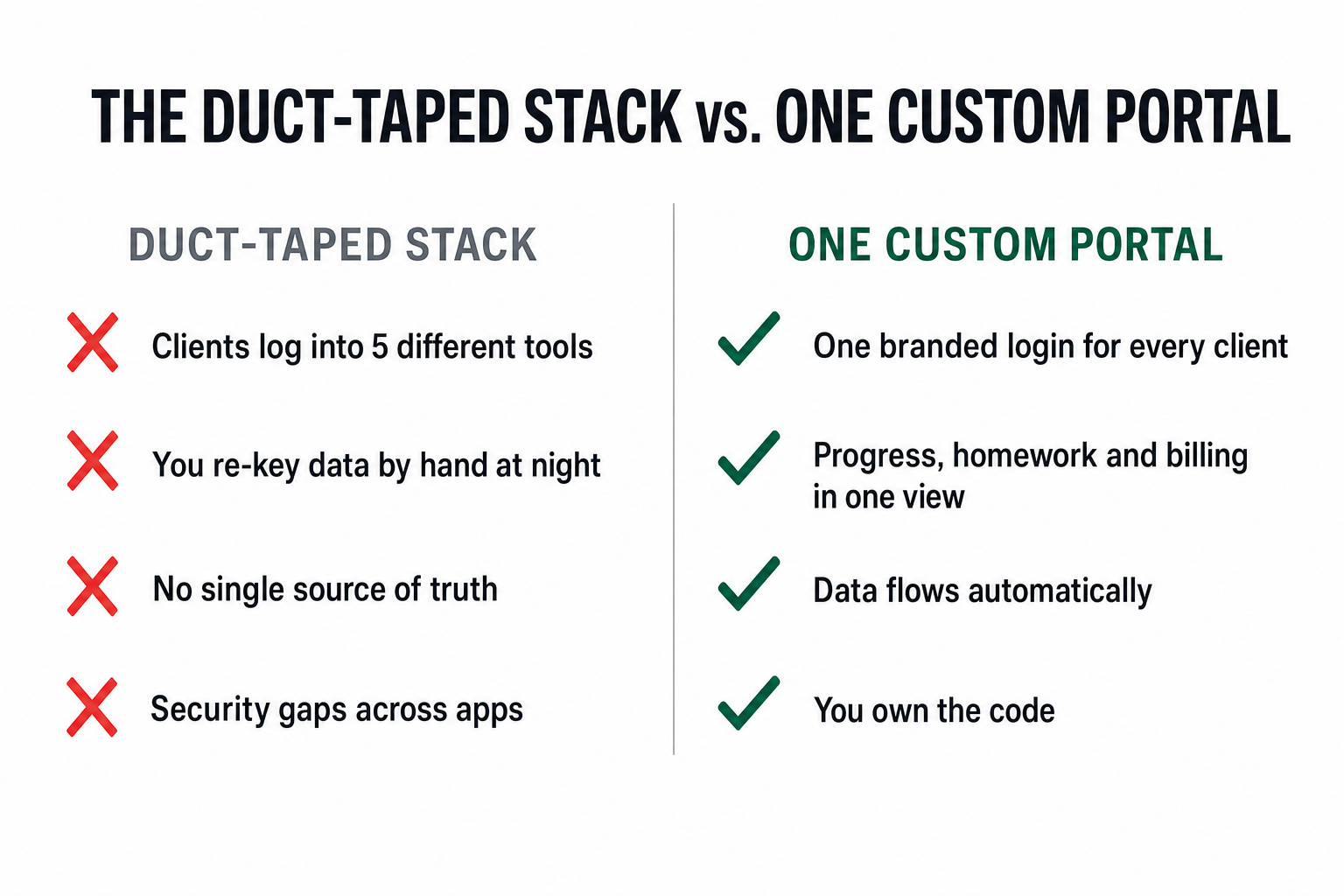
Duct-taped stack vs. one custom portal
Client logs into 5 tools · you re-key data at night · no single source of truth · PII scattered across spreadsheets · 'where's my worksheet?' emails
One branded login · homework, billing and progress in one view · data flows automatically · access controlled and logged · clients self-serve
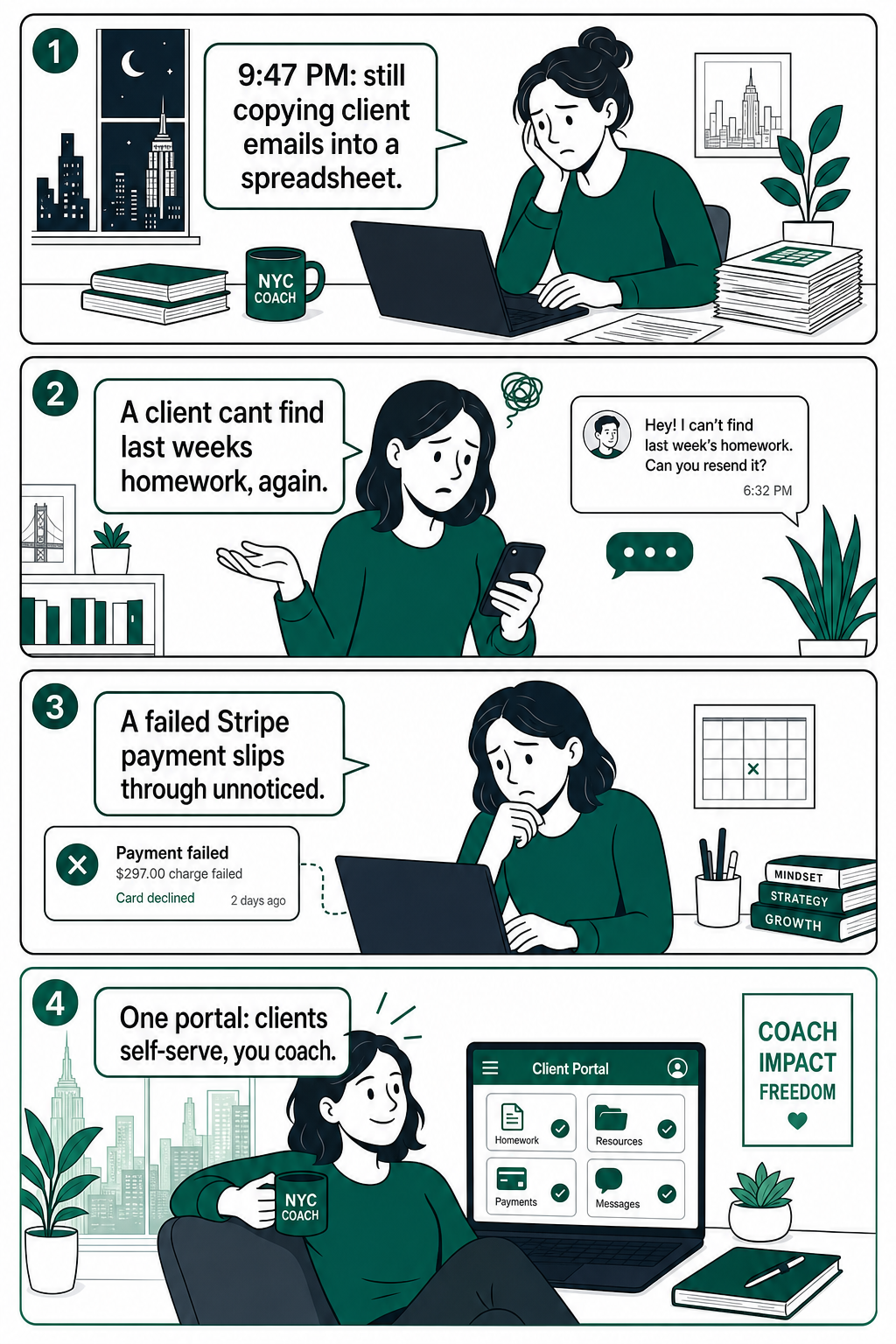
Time is the most obvious line item. The four hours a week HBR measured is conservative for a coach who is also the ops team; reconciling billing, chasing homework, and re-keying intake data between tools can eat a full day. That’s a day you can’t bill and can’t coach.
Retention is the quiet one. High-ticket clients renew on how the whole relationship feels, and the between-session surface — the portal, the reminders, the “here’s your next step” — is most of that feeling. When 80% of people will abandon software they find confusing (Wyzowl), a clunky, six-login experience is a renewal risk you’re not pricing in.
Risk is the one coaches ignore until it bites. A spreadsheet of client names, emails, payment details, and private intake notes is exactly the kind of soft, unencrypted target that gets breached — and in 2025 the average U.S. data breach reached a record $10.22 million (IBM Cost of a Data Breach Report, 2025). No solo coach absorbs a number like that, but even a small exposure — a shared Google Sheet, a departed VA who still has access — is a client-trust event you can’t undo. A purpose-built portal with real authentication and access control isn’t paranoia; it’s table stakes for holding other people’s data.
Why New York City raises the stakes
New York is one of the deepest, most competitive coaching markets in the country — which cuts both ways. The upside: the pool of prospective clients is enormous. New York State’s small businesses employ 3.7 million people and generate nearly $1 trillion in annual sales (NYS Comptroller, 2026), and the greater New York metro area is home to roughly 2.5 million small businesses (U.S. SBA Office of Advocacy, 2024). That’s a lot of founders, executives, and operators who could use a coach.
The downside: they can all find the next coach in about four seconds. The U.S. business-coaching market is roughly $20 billion across some 72,000 firms (IBISWorld, 2025), and coaching worldwide has grown fast — the ICF’s 2025 Global Coaching Study put global coaching revenue at about $5.34 billion, up from $4.564 billion in its 2023 study (International Coaching Federation, 2025). A growing market means more competitors, which means the experience around your coaching is what separates a $2,000/month retainer from a commodity.
Global coaching industry revenue, USD billions. Source: International Coaching Federation, 2025 Global Coaching Study.
A Manhattan coaching client paying premium rates has premium expectations. When your operation feels like one calm, branded system instead of a tour through six apps, you’re not just saving yourself time — you’re signaling that you run a real practice worth staying in.
Five signs you’ve outgrown the duct tape
You don’t need custom software the day you start coaching. Most practices should run on off-the-shelf tools — or a well-built GoHighLevel setup — for as long as those tools fit. You’ve outgrown the patchwork when:
- You have a “system of spreadsheets.” The truth about who’s paid, who’s active, and who’s up for renewal lives in a sheet only you can read, and it’s wrong by Friday.
- Clients ask you for things a portal should answer. “Where’s the replay?” “Can you resend the invoice?” “What module am I on?” — every one of those is a self-service question your tools force into your inbox.
- Onboarding a client takes you, not a workflow. Every new client means you manually granting access across three or four platforms.
- Two tools disagree and you’re the reconciliation engine. Stripe says paid, Kajabi says locked out, and you’re the one fixing it at night.
- You want to offer something the tools can’t do. A cohort leaderboard, a homework-submission flow, a progress dashboard, a members’ resource hub tied to their tier — the feature you can picture but can’t buy off the shelf.
Hit three or more and you’re paying for custom software already; you’re just paying in your own hours instead of building the asset.
What a custom client portal actually is (and isn’t)
A custom client portal is a single, branded, secure place your clients log into to see and do everything about their program — modules and replays, homework and check-in submissions, their cohort timeline, their invoices and payment method, and a direct line to you — with progress tracking built in. Under the hood it’s usually a modern web app (think Next.js with a database and real authentication like Supabase), pulling together the data that’s currently scattered across Kajabi, Stripe, your scheduler, and that spreadsheet.
Here’s what it isn’t: it isn’t a rip-and-replace of everything you use, and it isn’t a six-figure enterprise build. A branded client/member portal is a scoped project — often on the order of a few weeks — not a year-long IT program. And critically, you own the code. Unlike a rented platform, a custom portal can’t sunset a feature you depend on or hike its price because you grew.
The modern reason this is even feasible for a solo coach: AI-assisted development. Building with tools like Claude Code lets a small team ship the same coaching software far faster than a traditional hourly dev shop — a working portal in weeks instead of a multi-month engagement — which is what drags a custom build from “someday” into this quarter’s budget. That’s the model behind our custom software and AI builds.
Build vs. buy vs. duct tape: the honest math
There are three real options, and the right one depends on where your pain actually is.
- Keep duct-taping. Free in dollars, expensive in hours and risk. Fine while you’re small and the spreadsheet still fits in your head. It stops being fine the moment the admin eats a coaching day or a client churns over a clunky experience.
- Buy a done-for-you system. If your bottleneck is lead capture, booking, follow-up, and billing, a GoHighLevel snapshot or a professional GHL build and migration gives you a proven operating system in days, not a custom project. This is the right answer for most coaches, most of the time.
- Build custom. When the differentiator is the client-facing experience — a portal, dashboards, tier logic, or an AI agent no off-the-shelf tool offers — a custom build turns your hours into an owned asset. Pair it with a dedicated GHL VA + developer to run it, or with a fast Astro website as the public front door, and the whole practice runs as one system instead of a browser full of tabs.
The test is simple: if you can buy your way out of the pain for a few hundred dollars a month, buy. If the thing you need can’t be bought — and you’re in a market like New York where experience is the edge — build it once, own it, and stop paying the tax in your own evenings.
FAQ
What is a custom client portal for a coaching business?
It's a single, branded, secure web app your clients log into to see and do everything about their program — course modules and replays, homework and check-in submissions, their cohort timeline, invoices and payment method, progress tracking, and messaging with you. Instead of logging into Kajabi for content, Stripe for billing, and email for everything else, the client has one login, and you have one source of truth. It's typically built as a modern web app (for example Next.js with Supabase authentication) that pulls together the data currently scattered across your tools.
When does a New York City coach actually need custom software instead of off-the-shelf tools?
When the client-facing experience is your bottleneck and no product sells what you need. Most coaches should run on off-the-shelf tools or a done-for-you GoHighLevel setup for as long as those fit. You've outgrown them when your 'system' is a spreadsheet only you can read, clients keep emailing self-service questions, onboarding requires you to manually grant access across several platforms, or you want a feature — a cohort leaderboard, a homework flow, tier-specific dashboards — that you can picture but can't buy. In a competitive market like NYC, a premium experience is often the differentiator that justifies the build.
How much does a custom coaching client portal cost, and how long does it take?
It's a scoped project, not an open-ended IT program. A branded client/member portal is typically on the order of a few weeks of build time rather than months, because AI-assisted development (we build with Claude Code) lets a small team ship the same software far faster than a traditional hourly dev shop. The exact scope and quote depend on which integrations and features you need — the fastest way to a number is to book a build consult and spec it out. Every project includes a 30-day bug-fix warranty, and the code is 100% yours.
Isn't a duct-taped stack of Kajabi, Stripe, and spreadsheets good enough?
It's good enough until it isn't. The hidden costs are time (knowledge workers lose about 9% of the workweek just switching between apps, per HBR 2022), retention (80% of users have abandoned software they found confusing, per Wyzowl), and security (client PII in spreadsheets is a soft breach target, and the average U.S. breach hit a record $10.22 million in 2025 per IBM). If the admin is eating a coaching day, or a clunky experience is costing you renewals, the stack is no longer free — you're just paying in hours and risk instead of dollars.
Do I need to rip out GoHighLevel or my course platform to add a portal?
No. A custom portal usually sits on top of what you already run, pulling data from GoHighLevel, Kajabi, Stripe, or your scheduler rather than replacing them. If most of your pain is booking, follow-up, and billing, you may not need custom software at all — a GoHighLevel snapshot or a migration into GHL solves that more cheaply. Custom software is the right tool specifically when the client experience itself is what you can't buy off the shelf. We'll tell you honestly which path fits before you spend anything.
Who maintains a custom portal after it's built?
You have options. Every build ships with a 30-day bug-fix warranty. After that, you can hire a dedicated GHL VA plus developer to run and extend it month to month, stay on an hourly retainer for feature additions as your programs grow, or maintain it in-house since you own the code. The goal is that your software keeps pace with your practice instead of freezing the day it launches.
Related reading
- Build a Coaching CRM Sales Pipeline That Closes — the sales-side system that feeds the clients your portal serves.
- Coaching Client Onboarding That Clients Actually Finish — the first experience your portal should nail.
- Reduce Coaching Client Churn — why the between-session surface drives renewals.
- How to Migrate Your Coaching Business to GoHighLevel (Phoenix Playbook) — the cheaper path when booking and billing are the real bottleneck.
- The Coaching Snapshot vs. DIY — the honest build-vs-buy math before you commission anything custom.
- Astro vs. GoHighLevel Websites for Coaches — where your public front door should live.
About the author. Marcus Okafor is a Coaching Operations & Retention Consultant based in Denver, CO, who advises business and executive coaches on the unglamorous half of the practice — onboarding, retainer billing, and the between-session contact that drives renewals. A recovering spreadsheet operator, he now insists every recurring task earn its place inside a real system, and his writing leans on numbers from cohort launches and failed-payment recovery work.
Outcomes described on this site are illustrative, not guaranteed. Statistics are drawn from third-party research linked inline; figures are current as of publication (the HBR toggling study dates to 2022 and is noted as such). Software scope, timelines, and costs vary by project. Your results depend on your offer, audience, and execution.