

If you coach for a living in Charlotte, you already know the problem this post is about: the hours you’re most valuable — mid-session, on a call, deep in a strategy block — are exactly the hours you can’t pick up the phone. A founder from the Uptown finance world dials your number between meetings, gets four rings and a voicemail greeting, and hangs up. That inquiry doesn’t wait. It calls the next coach on the shortlist.
For years there was one answer to this: hire a human answering service to catch the calls you miss. Now there’s a second: a 24/7 AI receptionist — a conversational voice agent built into GoHighLevel (GHL) that answers, qualifies, and books the discovery call itself. This is an honest, coach-specific head-to-head. Not “AI wins because AI” — a real look at cost, coverage, qualification, and the one metric that actually pays your bills: which option books more discovery calls.
The real question isn’t “who answers” — it’s “who books”
Most comparisons of this kind stop at coverage: does someone (or something) pick up the phone? That’s the wrong finish line. Picking up is table stakes. For a coach selling a $5K–$50K engagement, the job isn’t to take a message — it’s to move a warm, qualified prospect onto your calendar before they cool off or call a competitor.
So the honest question is: between a human answering service and an AI receptionist, which one actually gets a qualified discovery call onto your calendar? That reframes everything. A service that answers politely and emails you a message has not booked a client — it has added a task to your to-do list and reintroduced the delay you were paying to remove.
Sources: MIT / LeadResponseManagement; Invoca; Grand View Research.
Why Charlotte coaches miss the calls that matter most
Charlotte is a business town. It’s the second-largest banking center in the United States, home to major financial and corporate headquarters, and one of the fastest-growing metros in the Southeast. That’s a dense pool of exactly the buyers a high-ticket coach wants: founders, executives, sales leaders, and operators with the budget and the urgency to hire help. It also means your competition is thick — U.S. business coaching is roughly a $20 billion industry (IBISWorld) — and your prospects have a long shortlist.
Here’s the structural bind. The people most likely to hire you are the busiest people in the city, and they call when they have a gap — early morning before the market opens, between back-to-back meetings, in the evening after a hard board session. Those are precisely the windows a solo coach is mid-session, off the clock, or asleep. When researchers placed calls to a sample of small businesses, only 37.8% reached a live person — the rest hit voicemail or dead air (411 Locals study of 85 U.S. small businesses, a small, older sample that’s illustrative of the pattern, not a current national law). Every coach who has let a call ring out while finishing a session knows the direction is right.
And slow is the industry norm, which is the opportunity. In an audit of 2,241 U.S. companies, the average first response took 42 hours, and 23% never responded at all (Harvard Business Review). In a market as competitive as Charlotte, simply answering first — every time, at every hour — is often how you win the call.
Option 1: The traditional human answering service
A human answering service is the incumbent solution, and for good reason: it’s a real person, warm and off a script, who picks up when you can’t. For a coach, that usually means an operator in a call center answers “Thanks for calling [Your Practice],” takes the caller’s name and number, maybe a sentence about what they want, and relays it to you by email or text. Some services offer light appointment-setting into a shared calendar.
What it does well:
- A human voice. Callers who dislike automation get a person, immediately.
- Overflow coverage. It catches calls during sessions, after hours, and on weekends.
- Simple to start. Most services onboard you in a day with a basic script.
Where it strains for a high-ticket coaching practice:
- It takes messages; it doesn’t close. The operator doesn’t know your programs, your price points, or the difference between a founder ready to invest and a tire-kicker. It can’t run your real qualification logic, so it hands you back a callback task — and the callback delay is the exact leak you were trying to seal.
- Per-minute billing punishes good conversations. Most services bill by the minute or by the call. A caller who wants to actually talk about your program costs you more, and a long qualifying conversation is billed against you rather than treated as the win it is.
- Booking is shallow or absent. Few general answering services integrate deeply with GoHighLevel, so booked times, tags, recordings, and pipeline stages rarely flow into your CRM automatically. You re-key everything.
- Consistency drifts. Different operators, different shifts, variable adherence to your script. A prospect’s first impression of a five-figure engagement is left to whoever happens to answer.
None of this makes an answering service bad. It makes it a message-taker — and a message is not a booked client.
Option 2: The 24/7 AI receptionist
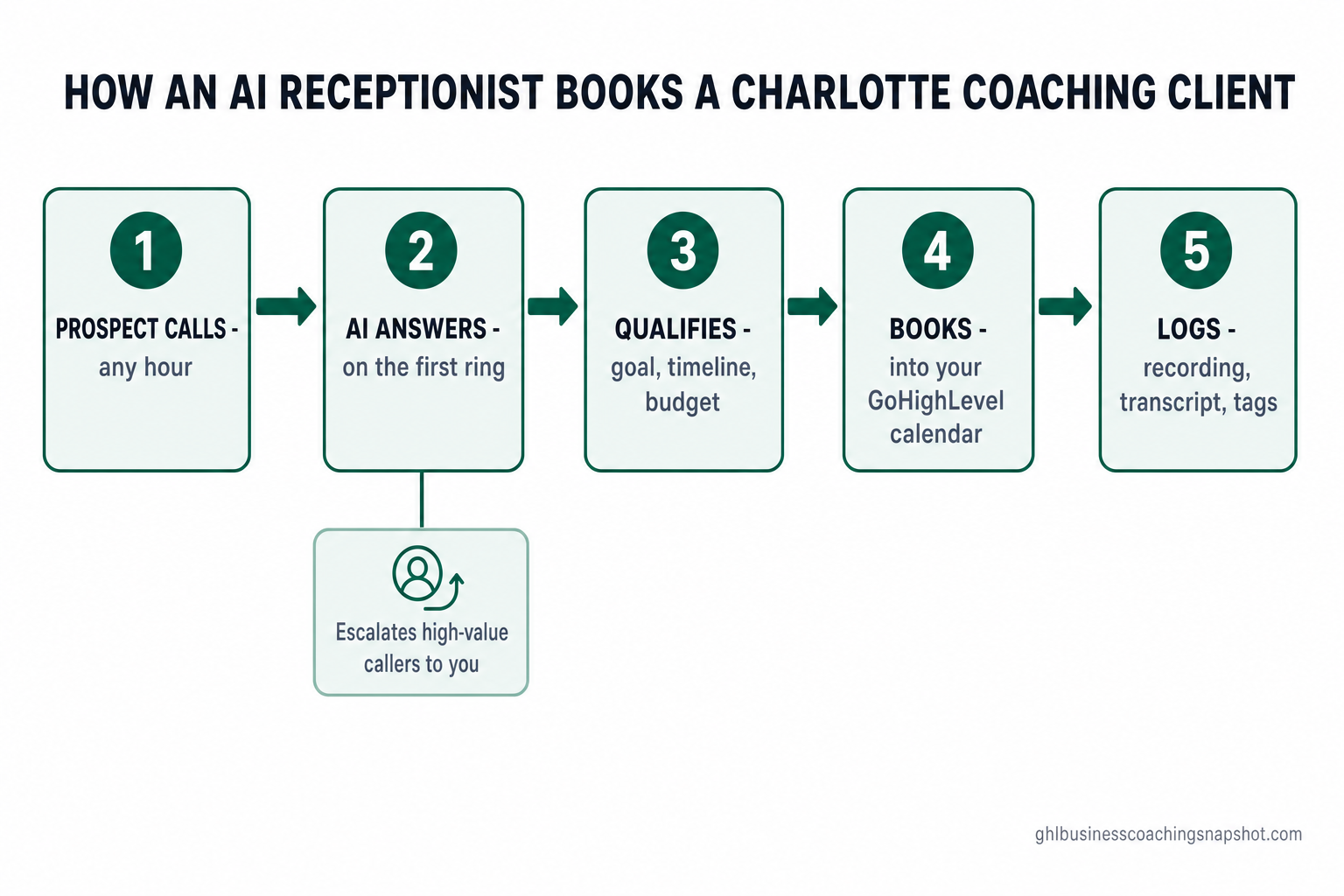
An AI receptionist is a conversational voice agent that answers your business line like a trained front-desk person — one that never sleeps, never double-books, and knows your practice cold. Built on a production voice-AI layer and wired into GoHighLevel, it does the full job, not just the pickup:
- Answers on the first ring, 24/7, in a warm, on-brand voice you script.
- Qualifies conversationally using the same criteria as your discovery-call funnel — goal, timeline, budget, fit — so it screens for the right client, not just any caller.
- Books directly into your live GHL calendar, then fires your existing appointment and reminder automation so the call doesn’t become a no-show.
- Logs everything to the CRM: recording, transcript, tags, and pipeline stage land on the contact record automatically, with live-transfer or instant SMS follow-up when a caller is high-value.
The trade-off is honest, too: it’s software, so a caller who insists on a human wants an escalation path (a good build gives them one), and it needs a thoughtful setup to sound like your practice rather than a generic bot. But on the metric that matters — getting a qualified discovery call onto your calendar the instant a prospect reaches out — it’s doing the whole job the answering service only starts.
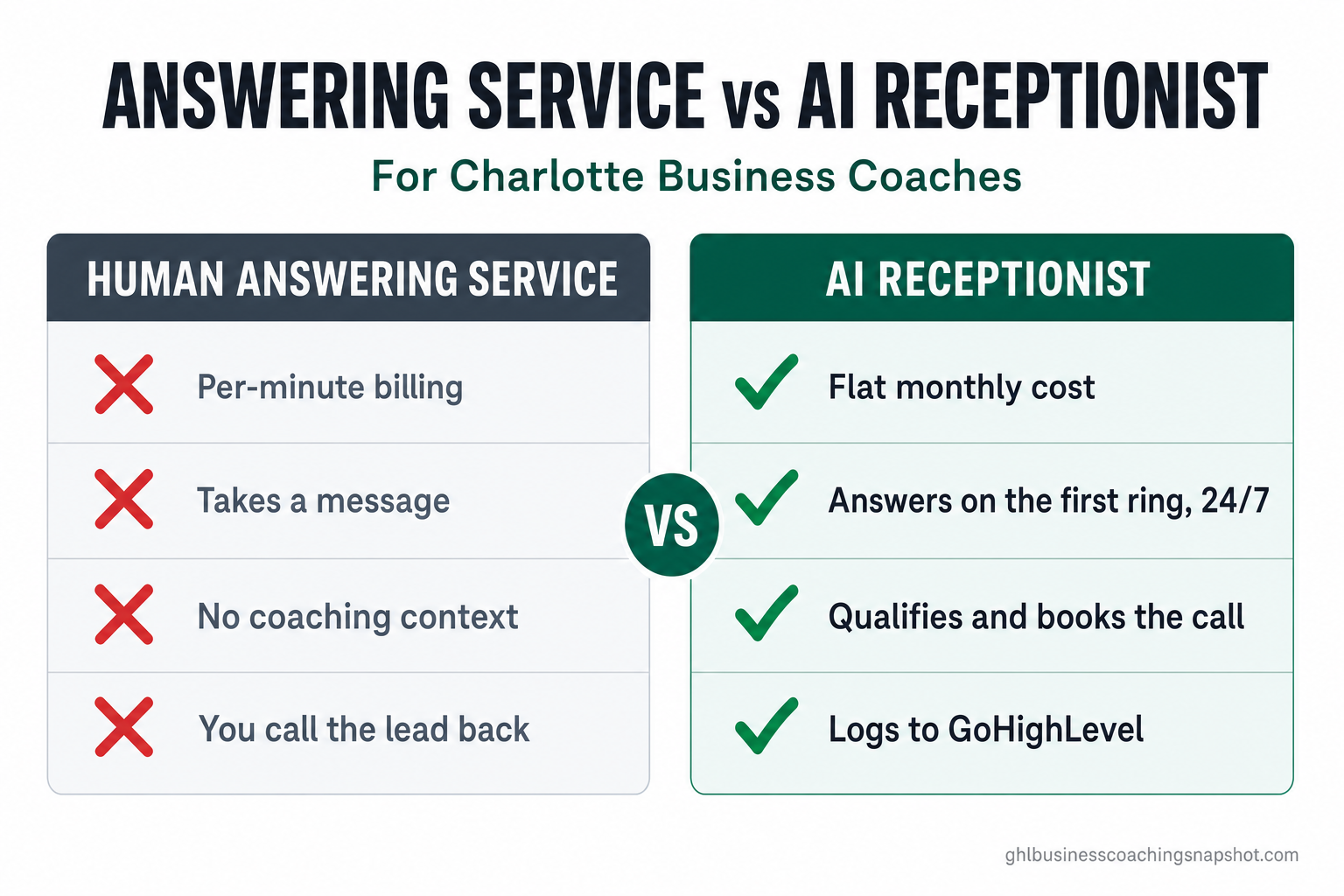
Head-to-head: the comparison that matters
Line them up on the dimensions that decide whether an inquiry becomes a booked call — coverage, speed, qualification, booking, CRM integration, and cost structure.
Human answering service vs AI receptionist — for a coaching practice
| Plan | Human answering service | AI receptionist (GHL) recommended |
|---|---|---|
| Price | Per-minute / per-call | Flat monthly |
| Feature 1 | Business hours + after-hours (tiered plans) | 24/7/365, no shifts or overflow gaps |
| Feature 2 | Answers, but hold/queue times vary | Answers on the first ring, every time |
| Feature 3 | Takes a message; can't run your qualification logic | Qualifies on goal, timeline, budget and fit |
| Feature 4 | Rarely books; shallow or no calendar integration | Books directly into your live GHL calendar |
| Feature 5 | Message emailed/texted; you re-key into the CRM | Recording, transcript, tags auto-logged to CRM |
| Feature 6 | You still have to call the lead back | Call is booked — no callback task for you |
The pattern is consistent. A human answering service is built to capture a call so a human can handle it later. An AI receptionist is built to complete the call — to do the thing you would have done if you’d been free to pick up. For a solo or small coaching practice, that difference is the difference between a longer to-do list and a fuller calendar.
The cost math for a high-ticket practice
Cost is where coaches usually anchor first, so let’s be concrete — and then reframe it around what a single booked client is worth.
Traditional answering services typically bill per minute or per call — commonly $0.75–$2.00 a minute, with small-business plans often landing in the $135–$400/month range once you cover meaningful volume and after-hours coverage (Housecall Pro; Callin pricing data). An in-house part-time receptionist is a different order of magnitude entirely once you add wages, payroll taxes, and benefits. AI phone-answering, by contrast, is usually a flat monthly cost that doesn’t spike when a caller wants a real conversation — the long qualifying call that a per-minute service bills against you is exactly the call the AI is designed to have.
Illustrative typical monthly cost for a small U.S. coaching practice (USD). Answering-service and receptionist figures vary widely by call volume, hours, and market; AI phone-answering is typically a flat monthly fee. Source ranges: Housecall Pro and Callin (2025) provider pricing. A fully custom, done-for-you GHL build is priced separately. Shown for comparison, not a quote.
But the sticker price is the wrong denominator. Here’s the reframe. Phone leads convert to revenue at roughly 10–15× the rate of web-form leads (Invoca), and winning back a prospect you’ve lost costs far more than keeping contact in the first place. Coaching sessions in North America average around $272 an hour (ICF Global Coaching Study), and a high-ticket package runs well into five figures. So a system that books one additional discovery call — the founder who called at 8:40pm and would otherwise have hit voicemail — has paid for a year of itself. The question isn’t “what does it cost per month.” It’s “how many otherwise-missed calls does it need to convert to be worth it?” For a high-ticket coach, the answer is usually a fraction of one.
A Thursday, 8:40pm, mid-strategy block
A Charlotte founder calls after a brutal board meeting. The service answers, takes his name and number, and emails you a message: 'Wants to know about coaching.' You see it at 9:15am. You call back at 11. He booked with someone else at 9:40pm the night before.
The same founder calls. The agent answers on the first ring, asks what he's working on and his timeline, offers Tuesday at 10am, and books it into your calendar. By morning there's a qualified discovery call waiting for you — recording and notes attached.
When a human answering service is still the right call
To keep this honest: the AI receptionist is not the answer for everyone. Choose a human answering service if:
- Your callers strongly prefer a person and your brand is built on white-glove human touch at every contact point.
- Your call reasons are messy and non-standard — lots of one-off situations that don’t fit a repeatable qualification script.
- You want zero build. A basic answering service turns on in a day; an AI receptionist that sounds like your practice takes a thoughtful setup.
And you don’t have to treat it as either/or. The strongest setup for many practices is an AI receptionist as the default 24/7 first responder, with a clean escalation to a human — you, or a service — for the callers who ask for one. You get instant answer-and-book on every call, and a human safety net for the exceptions. That hybrid is exactly the kind of routing our team wires up inside GoHighLevel.
How to build the AI receptionist in GoHighLevel
If you’re already on GHL, the receptionist doesn’t live in a separate silo — it plugs into the CRM, calendar, and workflows you use every day. At a high level, the build is:
- Provision the voice agent. A production voice-AI layer answers your business number with a script tuned to your practice and offer — not a generic “how can I help you.”
- Give it your qualification logic. Feed it the same criteria as your discovery-call application so it screens for fit, not just volume.
- Connect your calendar. The agent reads real availability from your GHL calendar and books directly, then triggers your existing reminders so the call doesn’t no-show.
- Bridge every call into GHL. Recording, transcript, tags, and pipeline stage flow into the contact record automatically, with live-transfer rules for high-value callers.
- Add the SMS safety net. If a call drops or lands mid-conversation, an instant SMS follow-up keeps the thread warm — text lands at roughly a 98% open rate versus about 20% for email (Gartner).
You can wire the pieces yourself if you enjoy the build, or have it delivered done-for-you. Either way, the goal is the same thing an answering service never quite reaches: not a message on your desk in the morning, but a qualified discovery call already on your calendar.
FAQ
What's the difference between an answering service and an AI receptionist?
A human answering service picks up when you can't and takes a message — name, number, a sentence about what the caller wants — then relays it to you to follow up. An AI receptionist is a conversational voice agent that completes the interaction: it answers on the first ring, runs your qualification questions, checks your live GoHighLevel calendar, books the discovery call, and logs the recording, transcript, and tags to the CRM. The short version: an answering service captures the call so a human can handle it later; an AI receptionist handles it now.
Which one books more discovery calls for a coaching practice?
For most high-ticket coaching practices, the AI receptionist — because it removes the callback delay. A human answering service hands you a message, so you still have to call the lead back, reintroducing the very delay that loses the client (contacting a lead within 5 minutes instead of 30 makes you roughly 21× more likely to qualify them, per MIT/LeadResponseManagement). The AI receptionist books the call in the moment, while the prospect is still on the phone and still warm. A message is not a booked client.
How much does an AI receptionist cost compared to an answering service?
Traditional answering services usually bill per minute or per call, so costs rise with volume and with the long, valuable qualifying conversations you actually want. An AI receptionist is typically a flat monthly cost that doesn't spike when a caller wants a real conversation. But the more useful math for a coach is ROI: because phone leads convert to revenue at roughly 10–15× the rate of web-form leads (Invoca) and coaching engagements often run five figures, a system that books one otherwise-missed call can pay for a year of itself. For a high-ticket practice, it usually needs to convert a fraction of one extra call to be worth it.
Will an AI receptionist sound like a robot to my Charlotte clients?
Only if it's built lazily. A well-configured voice agent uses a natural voice and a script written in your practice's tone, handles interruptions, and escalates to a human the moment a caller asks. Its job isn't to be the coach — it's to handle the logistics of getting a qualified prospect onto your calendar. In practice, a prospect who reaches voicemail at 9pm feels ignored, while one the agent answers and books feels taken seriously the instant they reached out.
Can I use both an AI receptionist and a human answering service?
Yes, and for many practices that's the strongest setup. Run the AI receptionist as the default 24/7 first responder so every call is answered and booked instantly, with a clean escalation path to a human — you or a service — for the callers who prefer one or hit a non-standard situation. You get instant answer-and-book on the common cases and a human safety net for the exceptions. That routing is straightforward to build inside GoHighLevel.
Do I need to leave GoHighLevel to add an AI receptionist?
No. The AI receptionist is built to plug into the GoHighLevel you already run. The voice agent answers your number, reads availability from your GHL calendar to book, and writes the recording, transcript, tags, and pipeline stage back to the contact record — then connects to your existing appointment reminders and SMS follow-up. It's a custom GHL development project, not a platform migration, so nothing about your current CRM, forms, or workflows has to change.
Related reading
- Why Business Coaches in Miami Are Losing Clients to Missed Calls — the pain-points case for a 24/7 AI receptionist, with the full cost-of-a-missed-call breakdown.
- Speed to Lead for Coaches — the instant-response system every inbound inquiry should hit, on every channel.
- How to Reduce Discovery-Call No-Shows — once the call is booked, keep it from evaporating.
- The Coaching Application Form That Actually Qualifies — the qualification logic your AI receptionist should ask on the phone.
- AI for Business Coaches — where an AI receptionist fits in the wider stack of coaching automation.
About the author. Marcus Okafor is a Coaching Operations & Retention Consultant based in Denver, CO, who advises business and executive coaches on the unglamorous half of the practice — onboarding, retainer billing, and the between-session systems that decide whether a calendar stays full. He is a recovering spreadsheet operator who now insists every recurring task earns its place inside a CRM.
Outcomes described on this site are illustrative, not guaranteed. The statistics cited are drawn from third-party research linked inline; some figures (notably the 411 Locals call-answer sample) are older or from limited samples and are noted as such. Cost ranges are illustrative, not quotes. Your results depend on your offer, lead sources, and market.